US Visa Rules Explained: What You Need in 2026
Wondering about US visa rules in 2026? Learn key changes, application tips, and what to expect. Contact Vasquez Law for a free consultation today.
Published on July 17, 2026· Updated July 17, 2026
Talk to an immigration attorney
Free call. A clear plan for your case.
Free & confidential · Se habla espanol · Mon-Fri 8am-7pm, Sat 9am-2pm (ET)
Have questions? Talk to an attorney - free evaluation.
Call 1-844-967-3536Worried how the latest immigration news affects you?
Schedule a confidential case review with an immigration attorney - know exactly where you stand.
USCIS Case Status
Check your USCIS case status
Enter your receipt number and get the official status. Free, no registration.
US Visa Rules Explained: What You Need in 2026
Understanding US visa rules is crucial for foreigners planning to visit, study, or work in the United States. In 2026, new updates affect visa types like the B2 tourist visa, visitor visas, and student policies. This guide covers key rules, application steps, costs, and common mistakes to help applicants from North Carolina, Florida, and nationwide. If you're pursuing immigration benefits or want to stay compliant with the latest requirements, read on for actionable insights from Vasquez Law Firm's immigration attorneys based in Raleigh and Orlando.
Need help with your case? Our experienced attorneys are ready to fight for you. Se Habla Español.
Or call us now: 1-844-967-3536
Quick Answer
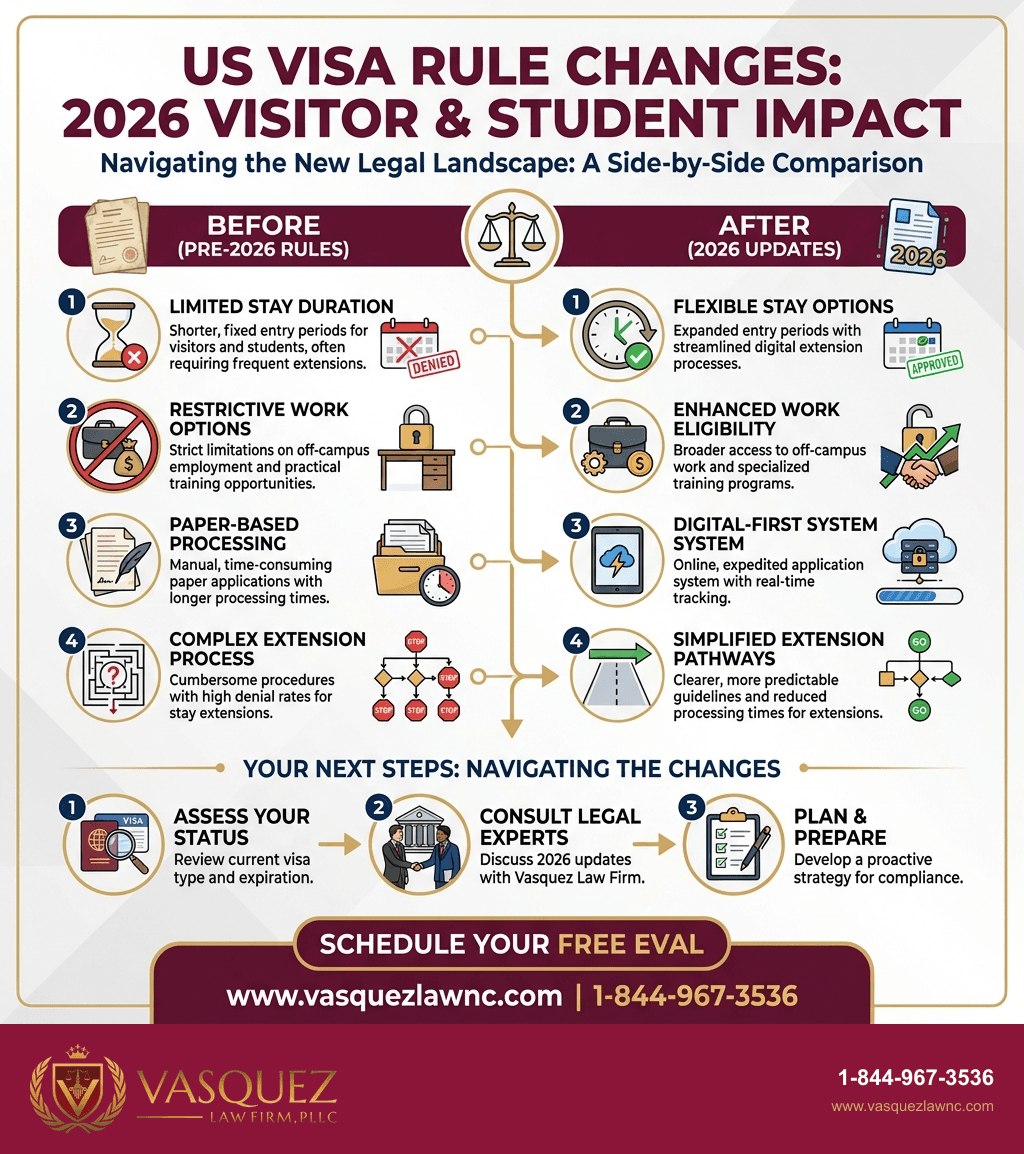
US visa rules define eligibility, application steps, and duration for various visa types like the B2 tourist visa and visitor visas. Updates in 2026 include stricter requirements for students and journalists, processing delays, and changes to allowed stay periods.
- Visitor visas (B2) allow stays up to 6 months generally
- New policies limit durations for some student and journalist visas
- Applications require Form DS-160 and consulate appointments
- Supporting evidence and interview preparedness are vital
- Consult immigration attorneys in Raleigh NC or Orlando FL for local guidance
Understanding US Visa Rules
Each year, the United States modifies visa rules to address national security and immigration enforcement goals. In 2026, visa policies underwent notable changes under federal immigration law (8 U.S.C. §§ 1101–1525) and regulations (8 CFR Parts 100–299). For example, the B2 visa category, used by tourists and short-term visitors, typically allows stays up to six months per visit. However, Customs and Border Protection officers at ports of entry retain discretion to grant shorter periods based on individual case details.
Recent changes also affect foreign students and journalists, many of whom face reduced authorized stay durations or more frequent status checks. These updates respond to security priorities outlined in INA § 214(b) and related directives. It's essential to keep up with both federal guidelines and specific rules from USCIS and the Department of State.
For individuals in North Carolina and Florida, local consulate and USCIS office policies may influence processing times and procedural details. The nearest US embassy or consulate typically handles visa interviews after an electronic application submission process. See U.S. Citizenship and Immigration Services for official updates.
Key Visa Types Under Updated Rules
- B2 Visitor Visa: Most common nonimmigrant visa for tourism or family visits
- F1 Student Visa: Subject to new duration limits and reporting requirements
- J1 Exchange Visitor Visa: Includes journalists with recent policy restrictions
Impact of Trump's Visa Rule Changes
Policies from the Trump administration that remain in effect include stricter requirements for maintaining visa status and limits on Optional Practical Training (OPT) periods for students. These changes affect visa renewals and employment eligibility. Applicants in Raleigh, NC or Orlando, FL should consult a knowledgeable immigration lawyer to track current trends.
Step-by-Step US Visa Application Process
- Complete Form DS-160: Online nonimmigrant visa application form required for most visa types. Accurate responses reduce denial risks.
- Pay Visa Application Fee: Non-refundable fee varies by visa type. Keep receipts for proof.
- Schedule a U.S. Visa Appointment: Book online at the nearest U.S. embassy or consulate, such as Raleigh or Orlando locations.
- Prepare Required Documents: Includes passport, visa fee receipt, appointment confirmation, and supporting evidence of travel intent and ties abroad.
- Attend Visa Interview: Interview is generally mandatory, where biometric data is taken and officers assess eligibility.
- Wait for Processing: Processing times vary, with some applications taking several weeks. Check current USCIS processing times at USCIS Processing Times.
- Receive Visa Decision: Approved visas are typically stamped in the passport and returned by courier or pickup.
Virtual Consultations Available
For business immigration visas like H-1B or L-1, Vasquez Law Firm offers virtual consultations through Zoom to review applications and answer questions remotely, serving clients nationwide.
Documents and Evidence Checklist
- Valid Passport with at least 6 months validity beyond your intended stay
- Confirmation page of Form DS-160 submission
- Receipt of visa application fee payment
- Appointment confirmation for U.S. visa interview
- Proof of financial means to cover your stay (bank statements, employment letters)
- Travel itinerary and accommodation details
- Letters of invitation or sponsorship if applicable
- Evidence of ties to your home country (job, property, family)
- Academic documents if applying for student visas
- Previous U.S. visas and travel history documents
Timeline: What to Expect in 2026
- Weeks 1-2: Submit DS-160 form and visa fee payment
- Weeks 3-4: Schedule and attend visa appointment
- Weeks 4-8: Background checks and visa processing (can extend if administrative processing is needed)
- Week 8+ Receive visa approval or denial notification
Note: Timing depends on visa type, country of origin, and consulate workload. Processing times can be checked at USCIS Processing Times.
Common Mistakes to Avoid
- Submitting incomplete or incorrect DS-160 forms – double-check all answers before submission.
- Missing visa appointments or arriving unprepared for interview questions.
- Failing to provide strong evidence of ties to your home country, risking a denial under INA § 214(b).
- Ignoring new policy updates that affect visa validity period or status maintenance.
- Not paying close attention to expiration dates, leading to overstays.
- Providing inconsistent or false information during interviews, which can lead to permanent denial.
- Applying too late and missing planned travel dates or deadlines.
- Neglecting to seek legal advice for complex cases, such as visa waivers or previous denials.
If you only remember one thing: Accurate, honest, and complete visa applications, combined with preparedness for your interview, significantly improve your chances of success.
Jurisdiction Notes for NC and FL
North Carolina Notes
NC residents applying for nonimmigrant visas typically use the U.S. Consulate General in Atlanta for in-person interviews, although USCIS services are available locally in Raleigh for extension and change of status filings. Regional security procedures may affect interview wait times and document requests.
Florida Notes
Applicants in Orlando and wider Florida have access to the U.S. Consulate/Embassy in Miami or other regional facilities for visa interviews. USCIS offices in Orlando handle local immigration benefit filings. Vasquez Law Firm's Orlando office offers direct support for visa applicants.
Nationwide Notes
US visa law is federally regulated by USCIS and the Department of State. Although procedures vary somewhat by location, national rules such as INA § 101(a)(15)(B) define visa types. Stay updated through official sources and legal counsel.
When to Call a Lawyer
- If your visa application was denied under INA § 214(b) or 221(g).
- If you received a request for additional evidence or administrative processing delays.
- If you have criminal history or previous immigration violations.
- If you need help gathering evidence for your visa interview.
- If you are unsure about eligibility under new visa rules or Trump's policy changes.
- If you require assistance with changing or extending your visa status in the U.S.
- If your travel involves complex business or student visa categories.
- If you face possible deportation or removal proceedings.
About Vasquez Law Firm
At Vasquez Law Firm, we combine compassion with aggressive representation. Our motto "Yo Peleo®" (I Fight) reflects our commitment to standing up for your rights.
- Bilingual Support: Se Habla Español — Spanish-speaking attorneys and staff available
- Service Areas: North Carolina, plus Florida and nationwide for immigration
- Experience: Over 30 years helping clients navigate complex legal matters
- Results: Thousands of successful cases across multiple practice areas
Attorney Trust and Experience
William J. Vásquez is admitted to the North Carolina State Bar (2011) and to the U.S. Courts of Appeals for the 4th, 5th, 6th, and 11th Circuits. The firm has provided dedicated legal representation since 2011, with personalized attention to each client's case.
Don't wait to get the help you deserve. Call us now for immediate assistance. Se Habla Español.
Frequently Asked Questions
What are the new rules for U.S. visas in 2026?
In 2026, US visa rules emphasize stricter eligibility verification, especially for visitor and student visas. New policies limit the maximum allowed stay for certain visa classes, and require additional documentation during visa appointments. These reforms are aimed at enhanced security and compliance with immigration laws under INA § 214(b) and are enforced nationally, with local implications in Raleigh and Orlando.
How long can you stay in the U.S. with a tourist visa?
A B2 tourist visa generally allows a stay up to six months per trip. However, the actual permitted time is decided by Customs and Border Protection officers at the port of entry. Extensions require applying to USCIS before expiration. Overstaying can lead to penalties, visa revocation, or future bans.
What is required for a U.S. visa appointment?
Applicants must complete Form DS-160 online, pay the visa application fee, and schedule their appointment at a U.S. embassy or consulate. At the appointment, biometric data is collected and visa officers ask about travel purpose and ties to home country. Supporting documents vary by visa type but generally include proof of finances, travel plans, and ID.
Can new U.S. visa rules affect Indian applicants?
Yes. Indian applicants face stricter interview scrutiny and document requirements due to high visa demand and federal updates. Processing may take longer at Indian consulates. Early application and expert legal advice improve chances of approval.
What does Trump's new visa policy mean for foreign students?
Foreign students must comply with shorter Optional Practical Training periods and stricter status maintenance rules imposed by policies continuing post-Trump administration. This affects those studying in North Carolina or Florida and may require careful planning to avoid violations.
How can I apply for a U.S. visitor visa from North Carolina?
Start by filling out DS-160 and paying the fee. Schedule an interview at the nearest consulate, prepare your documents (passport, financial proof, ties to your home), and attend the appointment. Legal assistance from Vasquez Law Firm in Raleigh is available to guide you.
What are common mistakes in U.S. visa applications?
Common mistakes include errors in DS-160, missing deadlines, weak evidence of home ties, failing to prepare for interviews, and providing false information. Avoid these to reduce delays and denials.
What happens if my visa application is denied?
Denials usually cite INA § 214(b) or 221(g). You may reapply fixing issues or appeal if eligible. A lawyer can evaluate your case and recommend the best course.
Sources and References
- U.S. Citizenship and Immigration Services
- Executive Office for Immigration Review
- Legal Information Institute
Take the first step toward justice today. Our team is standing by to help. Se Habla Español.
Start Your Free Evaluation Now
Call us: 1-844-967-3536
Se Habla Español - Estamos aquí para ayudarle.
If you need legal assistance, learn more about speak with an immigration lawyer, or call us at 1-844-967-3536 for a free evaluation.

William Vasquez
Founder & CEO, Vasquez Law Firm, PLLC
William Vasquez is the founder and CEO of Vasquez Law Firm, PLLC, a results-driven firm specializing in immigration, criminal defense, personal injury, and workers' compensation. A U.S. Air Force veteran and recipient of the Joint Service Achievement Medal, William is dedicated to fiercely fighting for his clients' rights.
Related Legal Services
Need legal help? Learn more about speak with an immigration lawyer, or contact us for a free evaluation.
You can also visit North Carolina immigration law firm for more information.