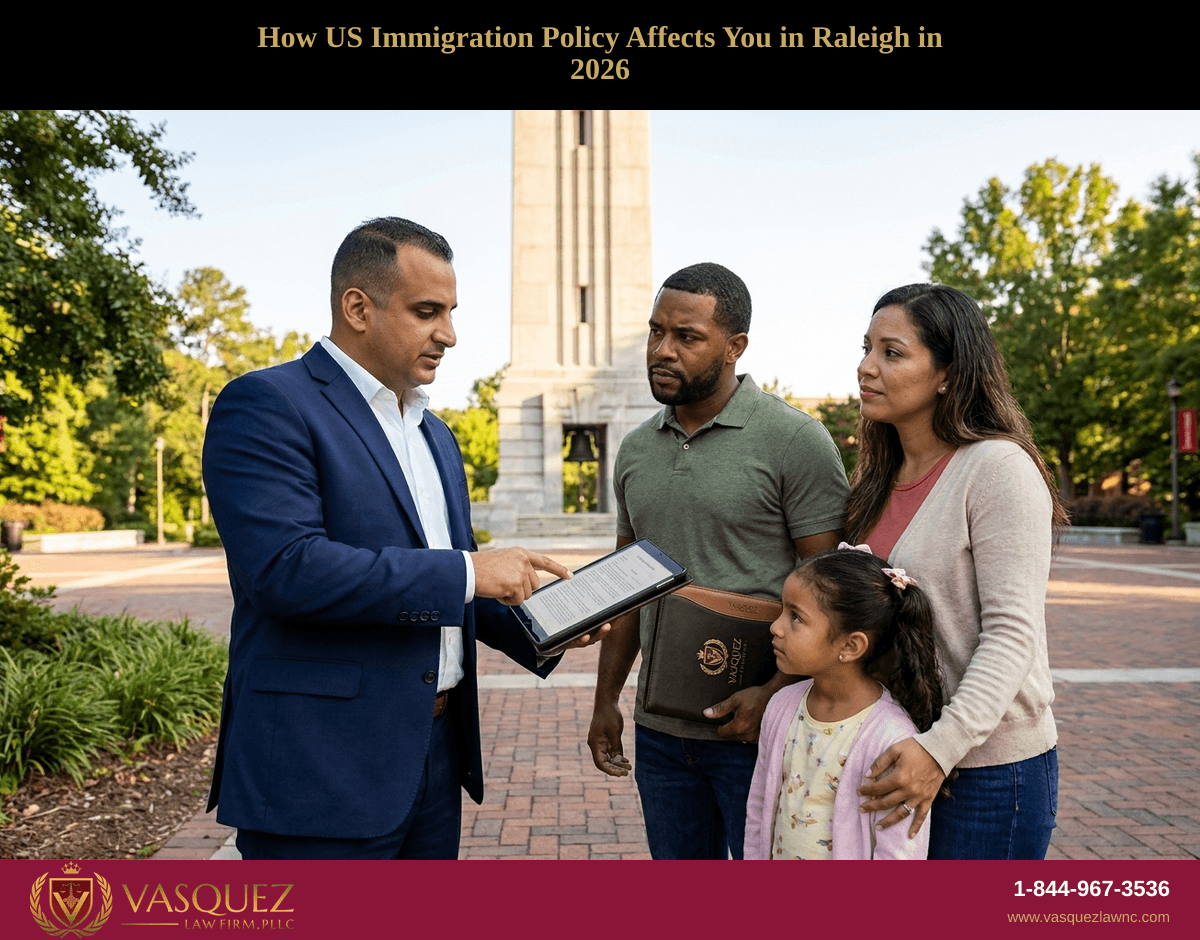
How US Immigration Policy Affects You in Raleigh in 2026
Understand US immigration policy updates in 2026. Learn how changes affect green cards, visas, and enforcement. Contact Vasquez Law for a free consultation.
Published on May 26, 2026
Talk to an immigration attorney
Free call. A clear plan for your case.
Free & confidential · Se habla espanol · 24/7
Have questions? Talk to an attorney - free evaluation.
Call 1-844-967-3536Worried how the latest immigration news affects you?
Schedule a confidential case review with an immigration attorney - know exactly where you stand.
How US Immigration Policy Affects You in Raleigh in 2026
US immigration policy continues to evolve in 2026, impacting visa applicants, green card seekers, and Dreamers nationwide, including those in Raleigh, NC, and Orlando, FL. This article explains the latest updates, key immigration rules, and practical steps you can take to protect your status in the US. Understanding the current policies helps you avoid mistakes and prepares you for any changes that could affect your immigration journey.
Need help with your case? Our experienced attorneys are ready to fight for you. Se Habla Español.
Or call us now: 1-844-967-3536
Quick Answer
US immigration policy in 2026 focuses on streamlining visa and green card processes, with updates to employment-based categories and renewed protections for Dreamers. Processing times remain dynamic but have improved for many applicants. Knowing your rights and recent policy changes helps you avoid delays and maintain legal status.
- USCIS processing times updated monthly
- Policy changes impact visa caps and renewals
- DACA renewal times average 14–22 months
- Employment-based green cards see retrogression
- Local offices in Raleigh and Orlando assist applicants
Understanding US Immigration Policy in 2026
Immigration policy in the United States is governed by a complex system of laws, regulations, and executive actions that shape who can enter, stay, and work in the country. In 2026, federal agencies like U.S. Citizenship and Immigration Services (USCIS) and the Executive Office for Immigration Review (EOIR) continue to update policies to reflect political priorities and economic needs.
For example, family reunification and humanitarian programs remain high priorities, while enforcement targets specific unauthorized entries and certain criminal offenses. Applicants in Raleigh, North Carolina, and Orlando, Florida, find that local USCIS offices follow national policy closely but also adapt to regional processing demands.
Understanding these policies requires awareness of key government actions, such as visa allocation ceilings, processing backlogs, and administrative procedures. Immigration laws including 8 U.S.C. § 1151 (visa allocations) and INA § 240A (cancellation of removal) define the framework.
Our immigration services team in Raleigh and Orlando helps clients grasp these changes to make informed decisions.
Major US Immigration Policy Changes in 2026
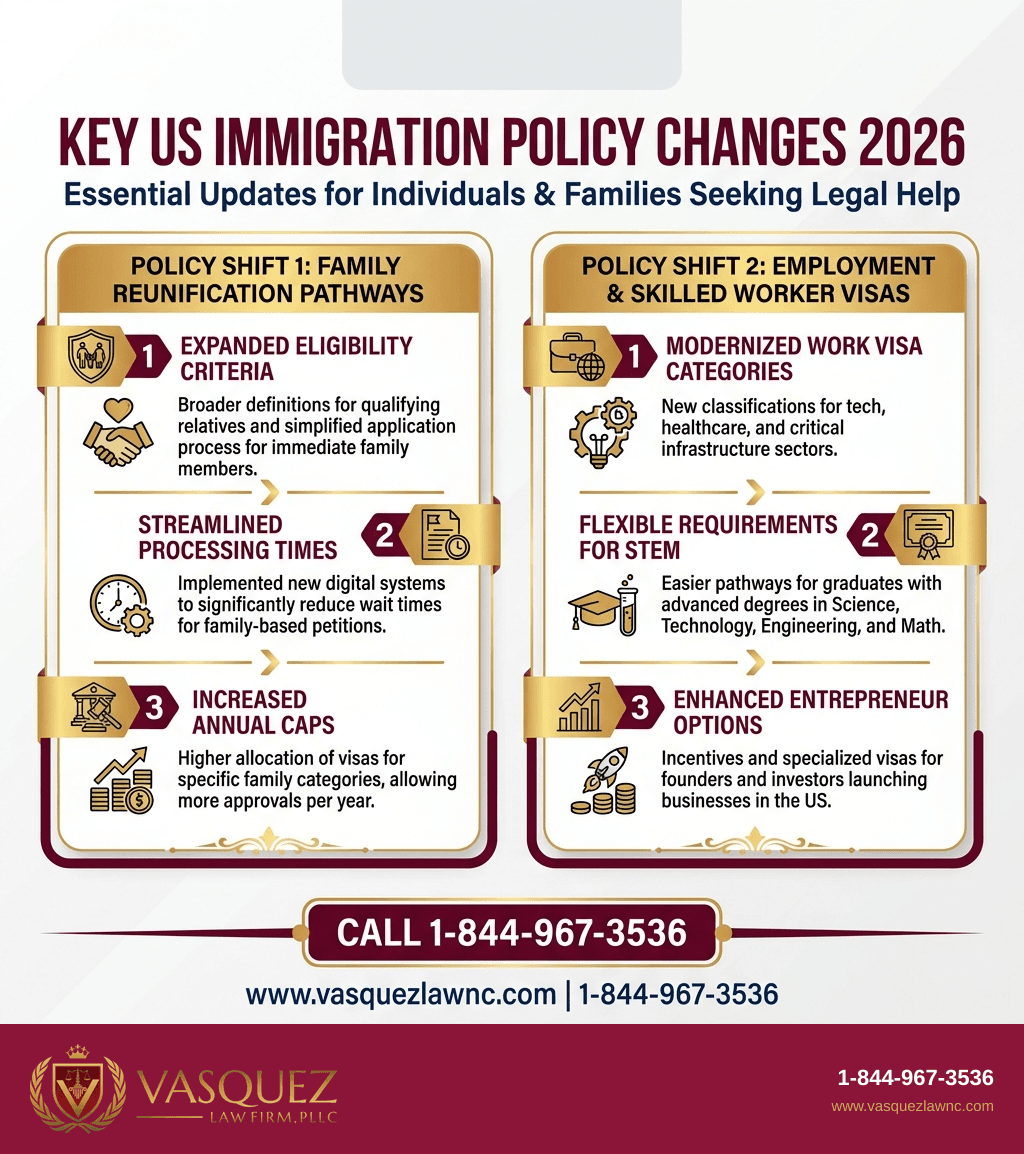
Recent US immigration policy news highlights several notable changes affecting applicants nationwide. First, employment-based green card categories, especially for India and South Asia, face continued retrogression leading to longer wait times. This impacts highly skilled workers and their families, necessitating alternative legal strategies.
Second, the use of electronic filing and improved case management systems speeds up processing for many visa petitions, including family-based applications. USCIS's published processing times show improvements, but delays still exist due to high demand.
Third, the Deferred Action for Childhood Arrivals (DACA) program renewal process now takes approximately 14 to 22 months (Form I-821D), according to USCIS data, which is critical for Dreamers in Raleigh and Orlando. Policy changes also include clarifications on ICE enforcement protocols and protections for certain visa holders.
For the latest immigration policy updates, consult Vasquez Law Firm’s detailed briefings.
Step-by-step Guide to Navigate Immigration Rules
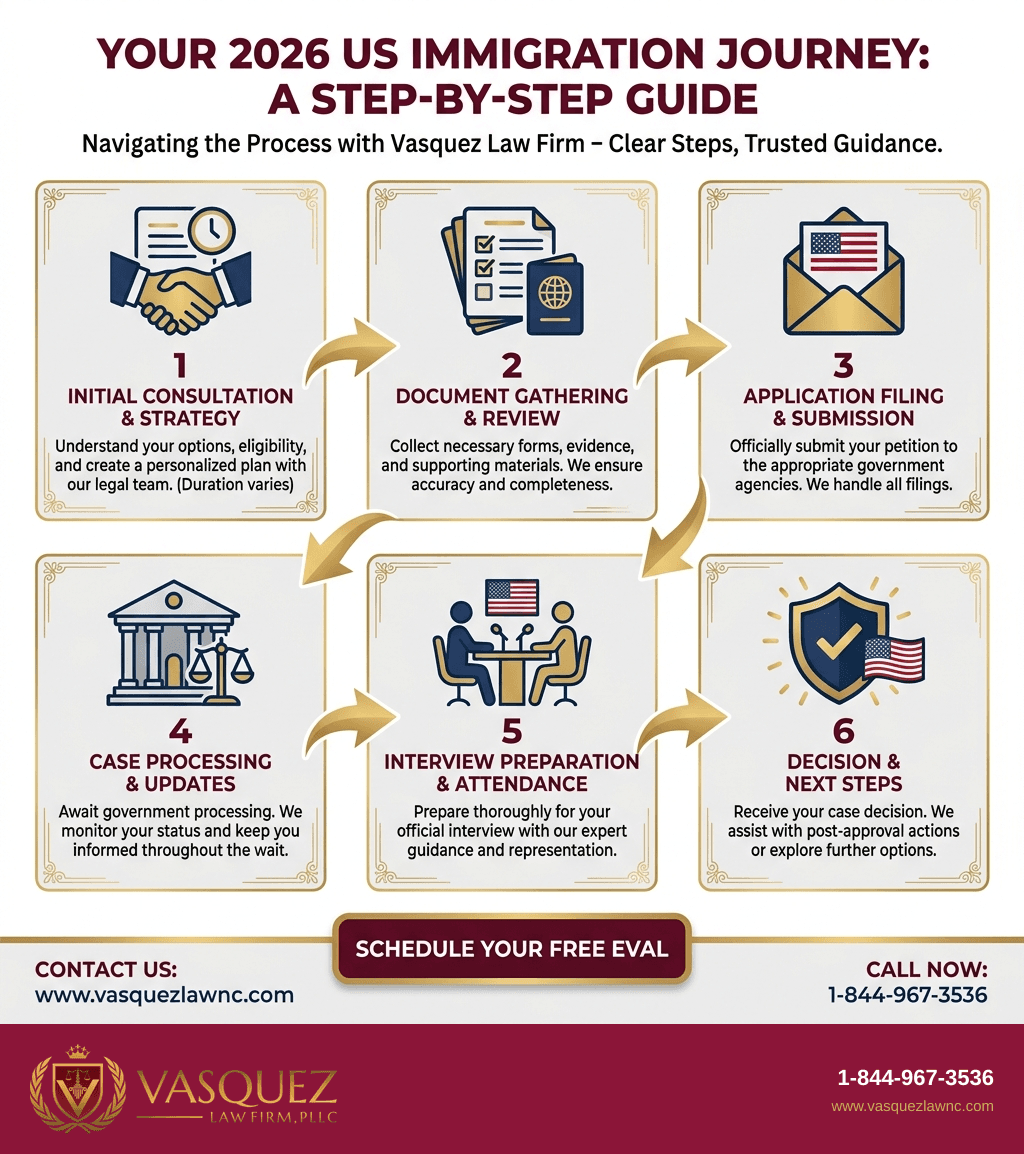
- Understand your immigration category. Knowing if you are applying for a family-based visa, work visa, or humanitarian relief shapes your strategy.
- Gather required documentation. Complete forms and supporting documents carefully; missing evidence causes delays.
- File your petition early. USCIS processing times vary; filing early helps avoid backlogs.
- Attend biometrics and interviews as scheduled. Prompt attendance ensures your case progresses smoothly.
- Respond timely to any Requests for Evidence (RFEs). Ignoring RFEs risks denial or abandonment of applications.
- Maintain status while your case is pending. Work with an immigration attorney to understand how to stay compliant.
- Track USCIS case status online. Use the USCIS website for the most current updates.
- Contact an immigration lawyer for complex or denied cases. Professional help increases chances of success.
Common Mistakes Made in Immigration Cases
- Filing incomplete or incorrect forms. Double-check all entries and use up-to-date versions.
- Missing deadlines. Late filings or responses lead to rejection or delays.
- Providing inconsistent or conflicting information. Ensure your documents and statements match perfectly.
- Not submitting sufficient supporting evidence. Proof of eligibility is key.
- Ignoring USCIS communications. Always respond promptly.
- Failing to inform USCIS of address changes. Missing mail can result in missed deadlines.
- Attempting self-representation without legal knowledge. Immigration law is complex; mistakes are costly.
If you only remember one thing: Seek experienced legal advice early to prevent these errors.
Timeline for Immigration Processes in 2026
- DACA renewal: 14 to 22 months from filing to decision (Form I-821D).
- Family-based green cards: 10 to 24 months depending on category and country of origin.
- Employment-based green cards: Variable, with retrogression causing delays especially for certain nationalities.
- Naturalization (citizenship): 8 to 12 months after filing Form N-400.
- Asylum applications: Scheduling hearings can take 6 months to several years depending on EOIR docket.
Monitoring USCIS processing times regularly is recommended.
Costs and Fees Associated with Immigration
- USCIS filing fees vary from $50 (affidavits) to more than $1,200 for adjustment of status (Form I-485).
- Biometrics fee usually $85, mandatory for most applications.
- Legal fees for representation depend on case complexity but typically range from $1,500 to $5,000 or more.
- Additional costs include translations, medical exams, and travel for interviews or biometrics appointments.
Vasquez Law Firm provides transparent pricing and helps clients in Raleigh and Orlando budget accordingly.
Jurisdiction Notes for NC, FL, and Nationwide
NC notes
Clients in Raleigh and throughout North Carolina benefit from local USCIS offices handling biometrics and interviews. The North Carolina immigration community is diverse, meaning our attorneys have extensive experience with regional trends and challenges affecting visas and green cards.
FL notes
In Orlando, Florida, USCIS regional services center supports the Hispanic and immigrant population. Our firm provides bilingual representation ensuring that language or cultural barriers do not impede your case progress under current policies.
Nationwide concepts (general only, rules vary)
Federal immigration statutes and regulations apply nationwide, but processing times and enforcement priorities can differ by region. Staying informed through USCIS updates and legal counsel ensures you adapt correctly wherever you reside in the United States.
When to Call an Immigration Lawyer
- If you receive a Notice to Appear or removal proceedings.
- If your visa or status renewal is nearing expiration.
- If you face denial or delays without clear explanation.
- If you identify errors on official USCIS documents.
- If you are concerned about ICE enforcement or detentions.
- If your employment-based application is subject to retrogression.
- If you need help responding to Requests for Evidence.
- If you want to explore alternatives after a denial.
- If you are a Dreamer seeking DACA application or renewal.
About Vasquez Law Firm
At Vasquez Law Firm, we combine compassion with aggressive representation. Our motto "Yo Peleo®" (I Fight) reflects our commitment to standing up for your rights.
- Bilingual Support: Se Habla Español — Spanish-speaking attorneys and staff available
- Service Areas: North Carolina, Florida, and nationwide immigration services
- Experience: Over 30 years helping clients navigate complex legal matters
- Results: Thousands of successful cases across multiple practice areas
Attorney Trust and Experience
William J. Vásquez is admitted to the North Carolina State Bar (2011) and to the U.S. Courts of Appeals for the 4th, 5th, and 11th Circuits. Florida-jurisdiction matters at the firm are handled by Florida Bar attorney Harold Estrada-Rodriguez (FL Bar No. 1041171). The firm has provided dedicated legal representation since 2011, with personalized attention to each client's case.
Don't wait to get the help you deserve. Call us now for immediate assistance.
Se Habla Español
Frequently Asked Questions
What is the current U.S. policy on immigration?
The current U.S. immigration policy in 2026 emphasizes processing efficiency and prioritizes family reunification, humanitarian relief, and enforcement against certain unauthorized entries. Recent changes focus on streamlining visa application backlogs and revising employment-based green card allocations. USCIS continues to update forms and procedures, affecting many applicants nationwide, including Raleigh and Orlando.
What are the new immigration rules for 2026?
New immigration rules in 2026 include updates to employment-based visa caps, increased use of electronic filings, and clearer procedures for certain asylum seekers. Changes also affect DACA renewal timelines, which currently take 14 to 22 months per USCIS's latest processing times. These rules aim to reduce backlog and prevent fraud.
Can ICE legally ask for ID in public?
ICE officers may ask individuals for identification if they have a reasonable suspicion that a person is present unlawfully. However, individuals are not required to carry ID at all times under federal law. Knowing your rights during encounters with ICE is essential. Legal counsel from Raleigh or Orlando immigration attorneys can provide guidance.
What is the new rule for green card holders in 2026?
In 2026, new policies streamline green card renewals, emphasizing electronic submissions and reducing processing times to approximately 8 to 12 months. Certain employment-based green card applicants face retrogression, especially individuals from India and South Asia, which may delay final approval. Staying updated on USCIS regulations helps avoid surprises.
How long does USCIS take to process visa applications in 2026?
USCIS processing times vary by visa type. For example, DACA renewals take about 14 to 22 months (I-821D form), while family-based petitions often range from 10 to 24 months. Processing times are updated monthly on the USCIS website. Consulting with a Raleigh immigration lawyer can help estimate wait times for your specific case.
What are common mistakes in immigration applications?
Common mistakes include submitting incomplete forms, missing deadlines, providing inconsistent information, neglecting supporting evidence, and failing to update USCIS with changes. These errors can lead to delays or denials. Working with experienced attorneys in Raleigh or Orlando reduces risk and increases chances of a smooth process.
How do recent policy changes impact South Asian employment green card seekers?
Recent changes have introduced retrogression affecting Indian and South Asian applicants in employment-based green card categories. This means longer waiting times, with some cases delayed several years. Applicants should stay informed on visa bulletin updates and may need legal advice to explore alternative options or maintain status during the wait.
Can Dreamers in Raleigh and Orlando benefit from new policies?
Yes. New 2026 policies aim to improve DACA renewals and administrative protections for Dreamers nationwide. While the federal framework remains, local offices in Raleigh and Orlando can assist with applications and renewals. Timely filings and legal guidance from Vasquez Law Firm improve chances of success under current USCIS guidelines.
Sources and References
- U.S. Citizenship and Immigration Services
- Executive Office for Immigration Review
- Legal Information Institute
Take the first step toward justice today. Our team is standing by to help.
Start Your Free Evaluation Now
Call us: 1-844-967-3536
Se Habla Español - Estamos aquí para ayudarle.
William Vasquez
Founder & CEO, Vasquez Law Firm, PLLC
William Vasquez is the founder and CEO of Vasquez Law Firm, PLLC, a results-driven firm specializing in immigration, criminal defense, personal injury, and workers' compensation. A U.S. Air Force veteran and recipient of the Joint Service Achievement Medal, William is dedicated to fiercely fighting for his clients' rights.
Related Legal Services
Need legal help? Learn more about get immigration legal help today, or contact us for a free evaluation.
You can also visit North Carolina immigration lawyers for more information.