What Is Immigration Law and How Does It Affect You in 2026?
What is immigration law? Learn how current immigration laws affect your rights and options in 2026. Get help from our Raleigh and Orlando immigration lawyer.
Published on May 22, 2026
Talk to an immigration attorney
Free call. A clear plan for your case.
Free & confidential · Se habla espanol · 24/7
Have questions? Talk to an attorney - free evaluation.
Call 1-844-967-3536Worried how the latest immigration news affects you?
Get a free, confidential case review with an immigration attorney - know exactly where you stand.
What Is Immigration Law and How Does It Affect You in 2026?
Immigration law governs who can enter, stay, and work in the United States. In 2026, understanding these laws is critical for residents, workers, and families in Raleigh, NC and Orlando, FL. This guide explains key immigration laws, consequences of violating them, and local resources. Whether you are applying for visas, seeking to adjust status, or facing deportation, knowing how immigration law works helps protect your rights.
Need help with your case? Our experienced attorneys are ready to fight for you. Se Habla Español.
Or call us now: 1-844-967-3536
Quick Answer
Immigration law defines who may enter and remain in the U.S. in 2026. Violating these laws can lead to serious penalties, including deportation. Knowing your rights and options protects you.
- Fed. law regulates visas, residency, deportation
- Consequences for violations include removal and bans
- Local USCIS offices in Raleigh and Orlando enforce laws
- Seek legal help early to avoid common mistakes
- Documentation and deadlines are critical for success
Understanding Immigration Law in the USA
Imagine arriving at a U.S. airport and presenting your passport only to be denied entry because you do not meet immigration laws requirements. Immigration law governs who is allowed to enter, stay, and work in the United States legally. It includes categories such as visas, permanent residency, naturalization, asylum, and deportation rules.
The core legislation is the Immigration and Nationality Act (INA), enacted in 1952. This federal law has been amended many times to address new challenges. It creates visa categories like family-sponsored, employment-based, and humanitarian relief. It also outlines grounds for inadmissibility and deportability found in 8 U.S.C. §§ 1182 and 1227.
The INA is enforced nationwide, including in Raleigh, NC and Orlando, FL, by agencies such as U.S. Citizenship and Immigration Services (USCIS), Immigration and Customs Enforcement (ICE), and the Department of Homeland Security (DHS). USCIS handles applications and petitions, while ICE manages enforcement and removal proceedings.
The immigration law code includes detailed regulations under Title 8 of the Code of Federal Regulations (8 C.F.R.). For example, 8 C.F.R. § 245.1 defines eligibility for adjustment of status to permanent resident, a critical benefit for many immigrants.
For immigrants in Raleigh and Orlando, understanding local USCIS office procedures is crucial. While federal law is uniform, processing times and procedures can vary by office. You can check current USCIS processing times for forms like I-485 and I-821D on the official USCIS website (https://egov.uscis.gov/processing-times/).
Key Steps to Take for Immigration Cases
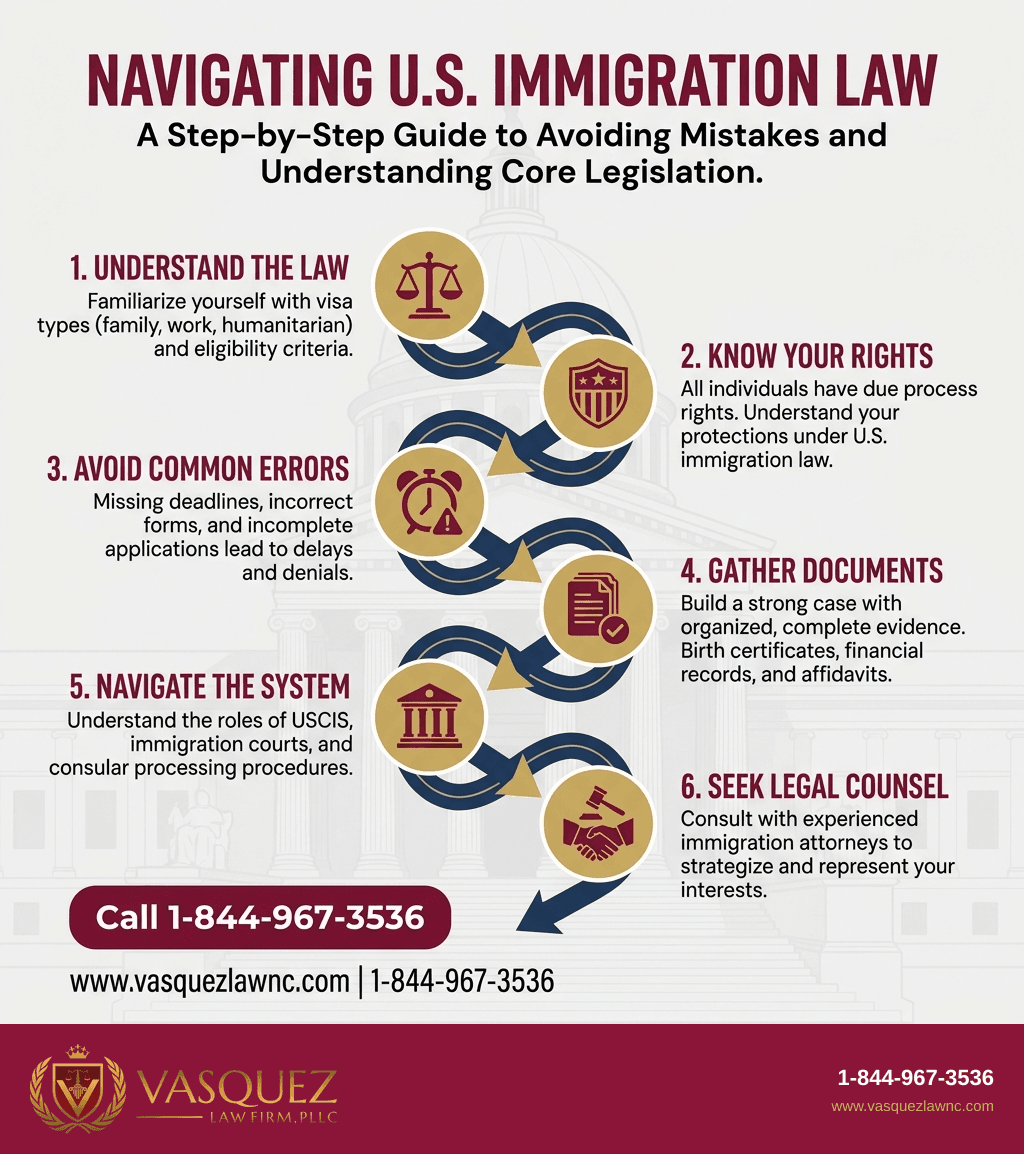
Facing an immigration matter can be overwhelming. Here are step-by-step actions that you or a family member may need to take:
- Assess eligibility: Determine which immigration benefits or status fits your situation, such as family sponsorship or asylum.
- Gather documents: Collect passports, birth certificates, proof of residence, employment letters, and any other evidence required by USCIS.
- File application: Complete the proper USCIS forms carefully, such as I-130 (family petition) or I-485 (green card adjustment).
- Attend biometrics and interviews: USCIS schedules fingerprinting and interviews to verify your identity and eligibility.
- Monitor case status: Keep track of USCIS updates online and meet any additional requests promptly.
- Respond to legal challenges: Some cases face Requests for Evidence (RFE) or Notices to Appear (NTA) for deportation. Legal help is critical here.
- Finalize status: If approved, receive immigration documents confirming your new legal status.
Vasquez Law Firm helps clients navigate every step with personalized guidance tailored to Raleigh and Orlando residents. Learn more about our immigration legal services.
Common Mistakes to Avoid in Immigration Cases
Immigration law is complex, and mistakes can cause delays or denials. Some common errors include:
- Incomplete forms: Missing answers or signatures lead to rejections.
- Missing documentation: Failing to submit required proof can delay or deny cases.
- Inaccurate information: Providing false or inconsistent data raises red flags and can cause removal proceedings.
- Missing deadlines: USCIS and courts have strict time limits for filing and responding.
- Not disclosing prior violations: Concealing past deportations or visa overstays can cause severe consequences.
- Ignoring legal changes: Laws and policies evolve, so staying informed is essential.
- Not seeking legal aid: Without expert advice, you risk avoidable errors.
If you only remember one thing: Early consultation with an immigration lawyer can prevent costly mistakes and improve success chances.
Timeline and What to Expect in Immigration Processes
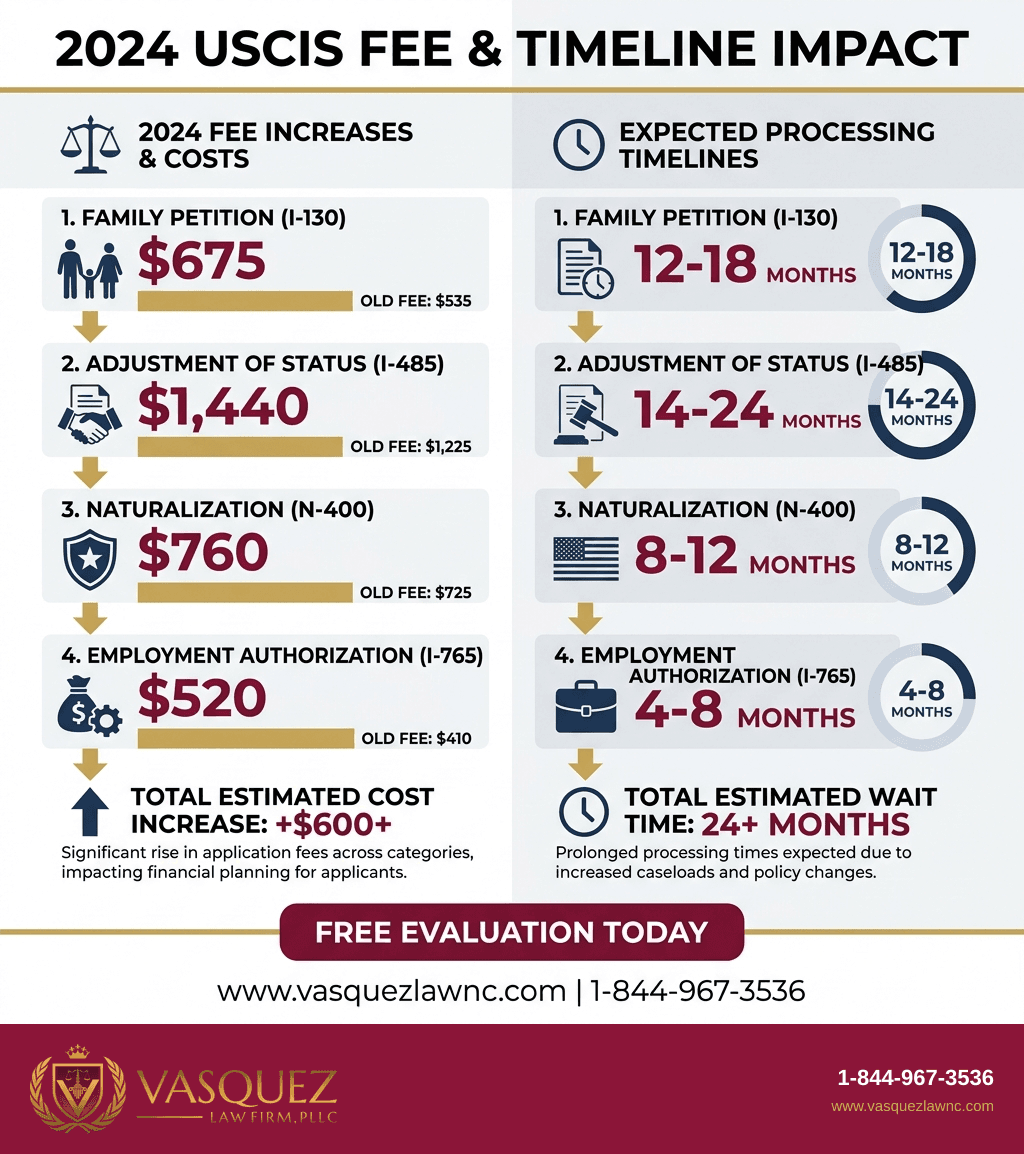
Timelines vary by application type, complexity, and USCIS workload. For 2026, average processing times include:
- Adjustment of Status (I-485): 8 to 14 months
- DACA Renewal (I-821D): 14 to 22 months
- Family-sponsored petitions (I-130): 7 to 14 months depending on visa category
- Work visas (H-1B, TN): 1 to 6 months based on premium processing availability
After submission, USCIS sends receipt notices, schedules biometrics, and may request additional evidence. Interviews follow before final approval. Delays can occur due to background checks or Requests for Evidence.
At any point, denial or a Notice to Appear may initiate removal proceedings overseen by the Executive Office for Immigration Review (EOIR).
For RCC and Orlando-based applicants, processing times may differ slightly due to local USCIS office volume. Always check the latest processing times on the USCIS site for your specific form.
Costs and Fees: What Impacts the Price of Immigration Cases
USCIS charges filing fees varying by form, ranging from $265 for naturalization applications (Form N-400) to over $1,200 for some green card applications. Legal fees depend on case complexity, documentation needed, and representation level.
- Simple visa or residency petitions cost less than complex deportation defense.
- Delays or Requests for Evidence can increase total expenses.
- Hiring a qualified immigration lawyer can save time and avoid costly mistakes.
At Vasquez Law Firm, transparent fee structures and free initial consultations help you plan your case effectively. Contact our office for pricing details specific to your needs.
Jurisdictional Notes for NC and Orlando, FL
North Carolina Notes
N.C. residents benefit from local USCIS offices and access to immigration courts within the Fourth Circuit jurisdiction. While immigration law is federal, North Carolina cases may be affected by local enforcement policies and state social service resources. Vasquez Law Firm’s Raleigh office specializes in handling immigration matters for NC clients, including adjustment of status, asylum claims, and deportation defense.
Orlando, Florida Notes
Orlando-based immigrants access USCIS and ICE services in Florida. Florida enforcement can differ in intensity based on federal priorities. Business immigration consultations by Vasquez Law’s immigration lawyers are conducted virtually via Zoom, providing convenience for visa applicants. The firm also supports family-based immigration and deportation defense locally.
Nationwide Concepts (General Only)
US immigration law applies uniformly across states but regional differences exist in processing times and court assignments. Agencies involved include USCIS, ICE, DHS, and EOIR. Immigration law is complex and changes frequently, so nationwide updates from official government sites are essential to monitor.
When to Call an Immigration Lawyer Now
- You receive an immigration court Notice to Appear (NTA).
- You face deportation or removal proceedings.
- You want to apply for adjustment of status or a visa.
- You have been detained by ICE or CBP officers.
- You must respond to a USCIS Request for Evidence.
- You are concerned about overstaying your visa or unlawful presence.
- You need help applying for DACA or a work permit.
- You have questions about waivers or relief from inadmissibility.
- You want to apply for naturalization or citizenship.
- You want to understand your rights related to immigration enforcement.
About Vasquez Law Firm
At Vasquez Law Firm, we combine compassion with aggressive representation. Our motto "Yo Peleo®" (I Fight) reflects our commitment to standing up for your rights.
- Bilingual Support: Se Habla Español — Spanish-speaking attorneys and staff available
- Service Areas: North Carolina, Florida, and nationwide immigration services
- Experience: Over 30 years helping clients navigate complex legal matters
- Results: Thousands of successful cases across multiple practice areas
Attorney Trust and Experience
William J. Vásquez is admitted to the North Carolina State Bar (2011) and to the U.S. Courts of Appeals for the 4th, 5th, and 11th Circuits. Florida-jurisdiction matters at the firm are handled by Florida Bar attorney Harold Estrada-Rodriguez (FL Bar No. 1041171). The firm has provided dedicated legal representation since 2011, with personalized attention to each client's case.
Don't wait to get the help you deserve. Call us now for immediate assistance.
Se Habla Español
Frequently Asked Questions
What are the current immigration laws in the United States?
Current immigration laws are embodied in the Immigration and Nationality Act, which regulates visas, green cards, and deportation. In 2026, these laws emphasize security while providing legal paths for immigration. They apply throughout Raleigh, NC and Orlando, FL. Staying informed helps protect your rights.
What is the Immigration and Nationality Act (INA)?
The INA is the main federal law governing immigration. Enacted in 1952, it outlines visa categories, grounds for removal, naturalization requirements, and enforcement procedures. It forms the legal foundation USCIS and immigration courts use nationwide.
What are the consequences of violating immigration laws?
Violations like unauthorized work or overstaying a visa can lead to deportation, detention, denial of benefits, and re-entry bans. These consequences are strictly enforced across the U.S., including Raleigh and Orlando. It is essential to consult a lawyer to mitigate risks.
Can ICE deport permanent residents?
Yes, permanent residents may face deportation for certain offenses or fraud. However, relief options like cancellation of removal exist under INA § 240A(b). Legal counsel can help navigate such cases and protect your status.
How long does it take to process immigration applications?
Processing times vary. Adjustment of Status takes about 8-14 months, DACA renewals up to 22 months in 2026. Local USCIS offices, such as in Raleigh and Orlando, may have specific timelines. Check USCIS website for updates.
What documents are needed for immigration applications?
Documents often include photo ID, birth certificates, employment letters, and filing forms. Requirements differ by case type. Our firm can prepare a checklist helping you provide accurate documentation.
What are common mistakes in immigration filings?
Common mistakes include incomplete forms, missed deadlines, inaccurate info, and failing to disclose prior immigration violations. These can cause denials or delays. Professional legal review is recommended.
How can I stay informed about changes in immigration law?
Use official sources like USCIS, EOIR websites, legal updates, and consult qualified attorneys regularly. Staying informed allows you to respond proactively as rules evolve in 2026 and beyond.
Sources and References
- U.S. Citizenship and Immigration Services
- Executive Office for Immigration Review
- Legal Information Institute
Take the first step toward justice today. Our team is standing by to help.
Start Your Free Evaluation Now
Call us: 1-844-967-3536
Se Habla Español - Estamos aquí para ayudarle.

William Vasquez
Founder & CEO, Vasquez Law Firm, PLLC
William Vasquez is the founder and CEO of Vasquez Law Firm, PLLC, a results-driven firm specializing in immigration, criminal defense, personal injury, and workers' compensation. A U.S. Air Force veteran and recipient of the Joint Service Achievement Medal, William is dedicated to fiercely fighting for his clients' rights.
Related Legal Services
Need legal help? Learn more about immigration case consultation, or contact us for a free evaluation.
You can also visit NC immigration legal help for more information.