How Trump Green Card Policy Affects Applicants in 2026
Learn how the Trump green card policy impacts applicants in 2026. Discover new rules, what applicants must do, and contact Vasquez Law for help.
Published on May 24, 2026
Talk to an immigration attorney
Free call. A clear plan for your case.
Free & confidential · Se habla espanol · 24/7
Have questions? Talk to an attorney - free evaluation.
Call 1-844-967-3536Free Tool
Check Your USCIS Case Status Now
Enter your receipt number - get the official USCIS status in English or Spanish. No registration.
How Trump Green Card Policy Affects Applicants in 2026
The Trump green card policy has introduced significant changes in how applicants nationwide—including those in Raleigh, NC, and Orlando, FL—must proceed with their applications in 2026. This guide details new USCIS green card news, explains the rules applicants need to follow, and provides actionable steps to protect your immigration status and rights.
Need help with your case? Our experienced attorneys are ready to fight for you. Se Habla Español.
Or call us now: 1-844-967-3536
Quick Answer
Trump's green card policy in 2026 means most applicants must leave the U.S. to complete processing at a consulate unless exempted. The government if not careful could deny green cards more often under these stricter rules. Applicants in Raleigh, NC, and Orlando, FL, should prepare documents carefully and consult an experienced immigration attorney to protect their status.
- Consular processing required for most green card applicants
- New grounds for inadmissibility and denials introduced
- Applicants must follow updated USCIS application steps
- Denials can lead to removal proceedings
- Legal guidance is critical to protect your case
- Processing times updated at USCIS.gov
Understanding Trump Green Card Policy Changes
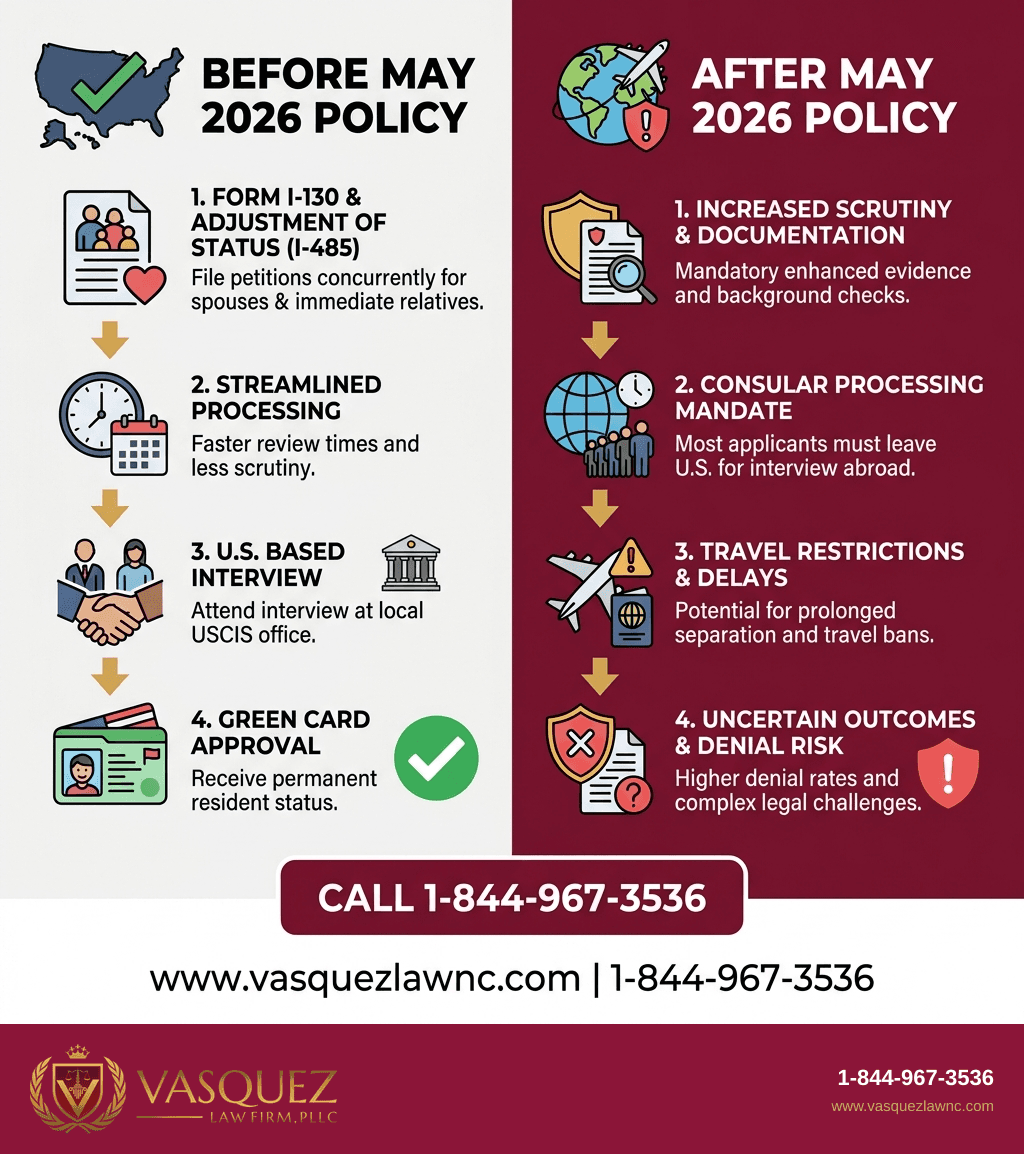
In 2026, the Trump green card policy significantly reshapes how green card applications are processed. A key change is mandatory consular processing for most applicants, meaning applicants must leave the United States and complete their application at a U.S. consulate abroad. This contrasts with previous options to adjust status within the U.S. under 8 U.S.C. § 1255.
These new rules, detailed by USCIS, introduce stricter grounds for inadmissibility. Applicants with prior unauthorized presence or criminal records may face higher denial risks. According to 8 C.F.R. § 245.1, eligibility requirements are now more rigorous, affecting many applicants in Raleigh, NC, and Orlando, FL.
The policy also impacts H1B holders applying for green cards. The Trump green card policy narrows eligibility and adds procedural hurdles for those with temporary work visas. Keeping up with USCIS green card news is essential to understand deadlines and requirements.
Failure to comply with these new rules can lead to green card denial and potential removal proceedings administered by the Executive Office for Immigration Review. Applicants should be aware that the U.S. government has increased scrutiny and enforcement regarding these cases.
Learn more about how these changes affect you by exploring our immigration services and consulting with Attorney Vasquez, who has extensive experience navigating complex USCIS procedures.
Step-by-Step: What Applicants Need to Do
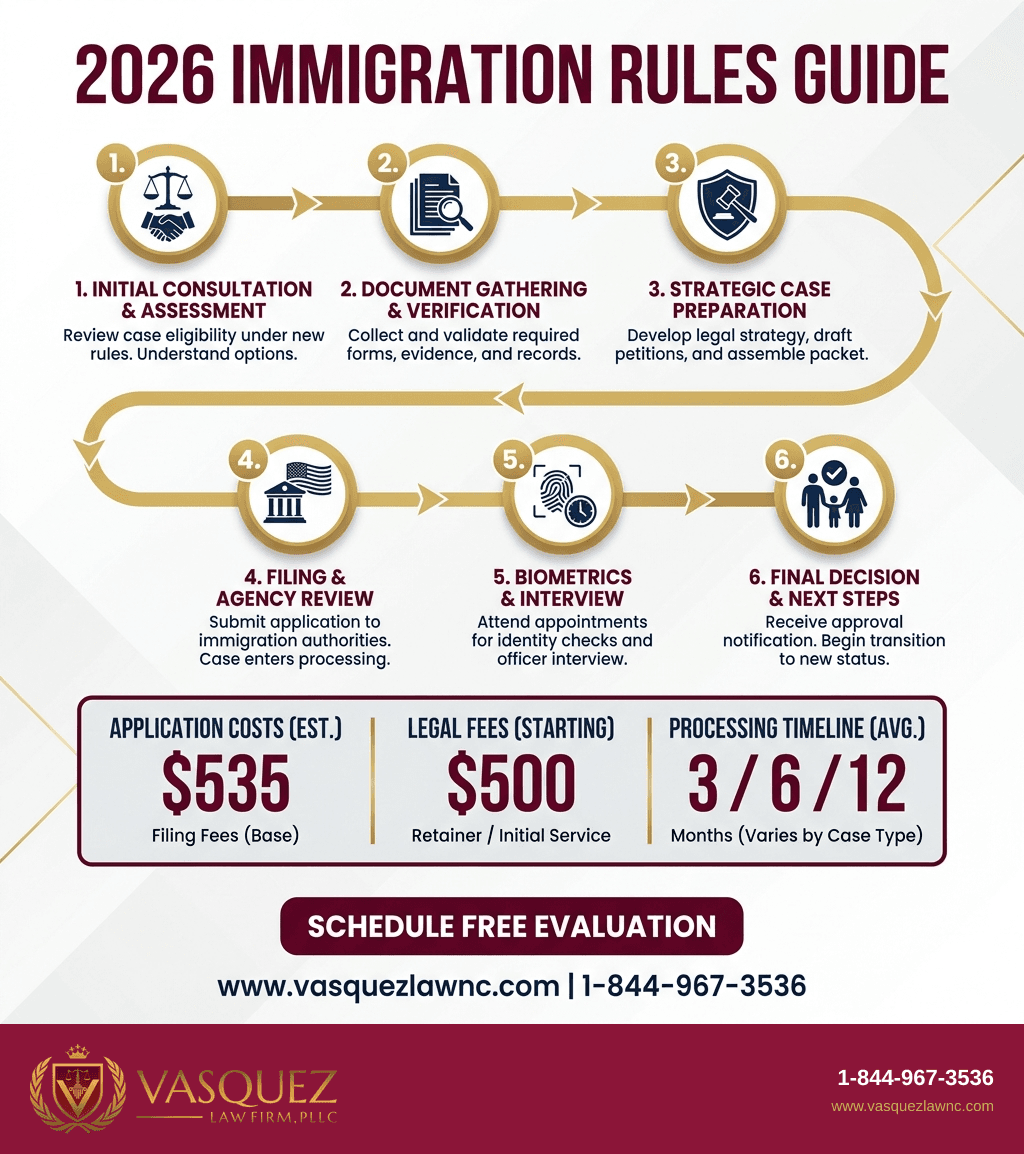
- Review Eligibility: Determine if you qualify under the revised criteria, considering the new grounds for inadmissibility and mandatory consular processing.
- Prepare Documents: Collect all necessary evidence, including birth certificates, employment records, and proof of legal entry.
- File Form I-130 or I-485 as Applicable: Understand whether you must file for consular processing or adjustment of status.
- Attend Consular Interview: Plan for travel outside the U.S. for your interview unless exempt.
- Monitor Case Status: Use USCIS resources such as processing times to track your case progress.
- Prepare for Possible Challenges: Be ready for increased USCIS scrutiny, including additional documentation requests or denials.
- Consult an Attorney: Contact Vasquez Law Firm early to get help navigating these complicated changes.
Documents and Evidence Checklist
- Valid passport(s) and visa(s)
- Birth certificates and marriage certificates
- Employment authorization documents and pay stubs (especially for H-1B holders)
- Proof of continuous residence
- Criminal background clearances, if applicable
- Medical examination results from approved physicians
- Evidence supporting eligibility under the new rules
- Copies of all previous applications and USCIS correspondence
Timeline: What to Expect in 2026
- Initial Petition Filing: 0-3 months to USCIS receipt and acceptance.
- USCIS Processing: 6-12 months depending on case and category. Check current times at USCIS.gov.
- Consular Processing Delay: 2-6 months wait for consular interview appointment once approved.
- Interview and Adjudication: May take 1-2 hours on interview date, followed by 1-4 weeks for results.
- Green Card Issuance: Once approved, receive green card within 1-2 months via mail.
- Additional Delays: Possible Requests for Evidence (RFE) or delays due to new grounds of inadmissibility.
Costs and Fees: What Impacts the Price
- USCIS filing fees vary based on form type; Form I-130 costs $535, Form I-485 costs $1,140 in most cases.
- Medical exam fees average $200-$500 depending on provider.
- Attorney fees depend on case complexity; consult Vasquez Law Firm for a personalized quote.
- Travel costs for consular appointments outside the U.S.
- Possible additional costs for responses to RFEs or appeals.
- Delays in processing can increase total costs due to extended legal support and travel needs.
Common Mistakes and How to Avoid Them
- Missing Documentation: Always check your paperwork thoroughly to avoid delays—use a checklist.
- Ignoring Consular Processing Requirement: Understand that most applicants must leave the U.S., so plan accordingly.
- Failing to Disclose Prior Violations: Honest answers prevent denial due to misrepresentation.
- Late Filing: Submit forms on time to preserve eligibility.
- Inadequate Legal Representation: Seek experienced counsel to navigate new rules.
- Overlooking Updates: USCIS rules change; stay informed with official sources like USCIS.gov.
- Not Preparing for Interview: Practice responses and bring all requested documents.
- Traveling Without Permission: Know when Advance Parole is required to avoid abandoning your application.
If you only remember one thing: early consultation with an immigration attorney can prevent costly mistakes under the Trump green card policy.
North Carolina and Florida-Specific Notes
North Carolina (Raleigh Area) Notes
Applicants in Raleigh, NC, must work closely with immigration attorneys familiar with both federal procedures and local USCIS field office practices. While USCIS policies are federal, local offices in NC may have specific appointment availability and processing timelines. Vasquez Law Firm’s Raleigh office provides in-person support to guide you through the Trump green card policy changes.
Florida (Orlando Area) Notes
In Orlando, FL, consular processing remains a significant factor for green card applicants due to proximity to international consulates. The firm offers virtual consultations for business immigration topics including H-1B visas impacted by Trump’s policy updates. Orlando clients benefit from bilingual support tailored to recent USCIS rule adjustments.
Nationwide Concepts
Throughout the U.S., the Trump green card policy mandates consular processing for the majority of applicants under INA § 212(a) grounds unless exempted. Applicants nationwide face stricter admissibility checks and tighter interview scrutiny. Following federal statutes 8 U.S.C. § 1255 and associated regulations 8 C.F.R. § 245.1 is essential for application success.
When to Call a Lawyer Now
- If you received a Request for Evidence under the new green card rules.
- If USCIS scheduled you for consular processing unexpectedly.
- If there is a criminal record or prior immigration violations in your history.
- If you are a temporary visa holder (H1B) facing application delays or denials.
- If your green card application was denied under the new rules.
- If you fear deportation or removal proceedings.
- If you are unsure about eligibility under the changed policy.
- If you need help preparing for a consular interview abroad.
About Vasquez Law Firm
At Vasquez Law Firm, we combine compassion with aggressive representation. Our motto "Yo Peleo®" (I Fight) reflects our commitment to standing up for your rights.
- Bilingual Support: Se Habla Español — Spanish-speaking attorneys and staff available
- Service Areas: North Carolina, Florida, and nationwide immigration services
- Experience: Over 30 years helping clients navigate complex legal matters
- Results: Thousands of successful cases across multiple practice areas
Attorney Trust and Experience
William J. Vásquez is admitted to the North Carolina State Bar (2011) and to the U.S. Courts of Appeals for the 4th, 5th, and 11th Circuits. Florida-jurisdiction matters at the firm are handled by Florida Bar attorney Harold Estrada-Rodriguez (FL Bar No. 1041171). The firm has provided dedicated legal representation since 2011, with personalized attention to each client's case.
Don't wait to get the help you deserve. Call us now for immediate assistance.
Se Habla Español
Frequently Asked Questions
What is the new rule for green card holders in 2026?
The Trump green card policy in 2026 requires most applicants to complete their application process outside the U.S., through consular processing. This means applicants cannot typically adjust status within the country and must attend interviews abroad, increasing travel and timing considerations.
Is the U.S. government deporting green card holders under this policy?
No, the new policy does not direct deportation of existing green card holders. However, stricter admissibility criteria could lead to removal proceedings against applicants denied under new rules if they remain in the U.S. unlawfully.
Can I still get my green card with Trump policy changes?
Yes, but the process may require you to leave the U.S. for consular interviews, and be prepared for more stringent document requirements and background checks. Legal help is recommended to successfully navigate these changes.
What are the new green card rules for H1B visa holders?
The policy adds hurdles for H1B holders, such as stricter income and admissibility checks. Green card processing may take longer and require consular interviews outside the U.S. Careful preparation is essential.
Does this policy affect DACA recipients?
DACA recipients seeking green cards must also comply with the consular processing requirement unless exempt. This can complicate their process, so expert advice is important to evaluate legal options.
How long does green card processing take under the new rules?
Processing times vary but generally may take 8 to 18 months including consular processing. Check current USCIS published times at USCIS.gov for specifics on your form type.
What happens if my green card application is denied?
If denied, you may face removal proceedings or need to appeal the decision. Consulting an attorney quickly can help explore options such as reopening or filing motions to reconsider under immigration law.
Where can I get assistance for my green card application?
For applicants in Raleigh, NC, and Orlando, FL, Vasquez Law Firm offers bilingual legal support to guide you through the new Trump green card policy requirements, ensuring you understand your rights and options clearly.
Sources and References
- U.S. Citizenship and Immigration Services
- Executive Office for Immigration Review
- Legal Information Institute
Take the first step toward justice today. Our team is standing by to help.
Start Your Free Evaluation Now
Call us: 1-844-967-3536
Se Habla Español - Estamos aquí para ayudarle.

William Vasquez
Founder & CEO, Vasquez Law Firm, PLLC
William Vasquez is the founder and CEO of Vasquez Law Firm, PLLC, a results-driven firm specializing in immigration, criminal defense, personal injury, and workers' compensation. A U.S. Air Force veteran and recipient of the Joint Service Achievement Medal, William is dedicated to fiercely fighting for his clients' rights.
Related Legal Services
Need legal help? Learn more about how our immigration attorneys can help, or contact us for a free evaluation.
You can also visit North Carolina immigration law firm for more information.