What Trump Travel Restrictions Mean for Visa Holders in 2026
Trump travel restrictions affect visa and green card holders in 2026. Learn how these rules impact your status. Call Vasquez Law for a free evaluation.
Published on June 5, 2026
Talk to an immigration attorney
Free call. A clear plan for your case.
Free & confidential · Se habla espanol · 24/7
Have questions? Talk to an attorney - free evaluation.
Call 1-844-967-3536Worried how the latest immigration news affects you?
Schedule a confidential case review with an immigration attorney - know exactly where you stand.
What Trump Travel Restrictions Mean for Visa Holders in 2026
Trump travel restrictions have renewed implications for visa and green card holders in 2026. These rules, often called travel bans, affect travelers on passports from specific designated countries. If you live in Raleigh, NC or Orlando, FL, understanding these restrictions can protect you from unexpected deportation or denied entry. This guide explains what you need to know about the travel ban’s effect January 2026, how lawful permanent residents and dual nationals may be impacted, and what steps to take to safeguard your immigration status.
Visa holders facing new restrictions should review their options with a work visa attorney.
Need help with your case? Our experienced attorneys are ready to fight for you. Se Habla Español.
Or call us now: 1-844-967-3536
Quick Answer
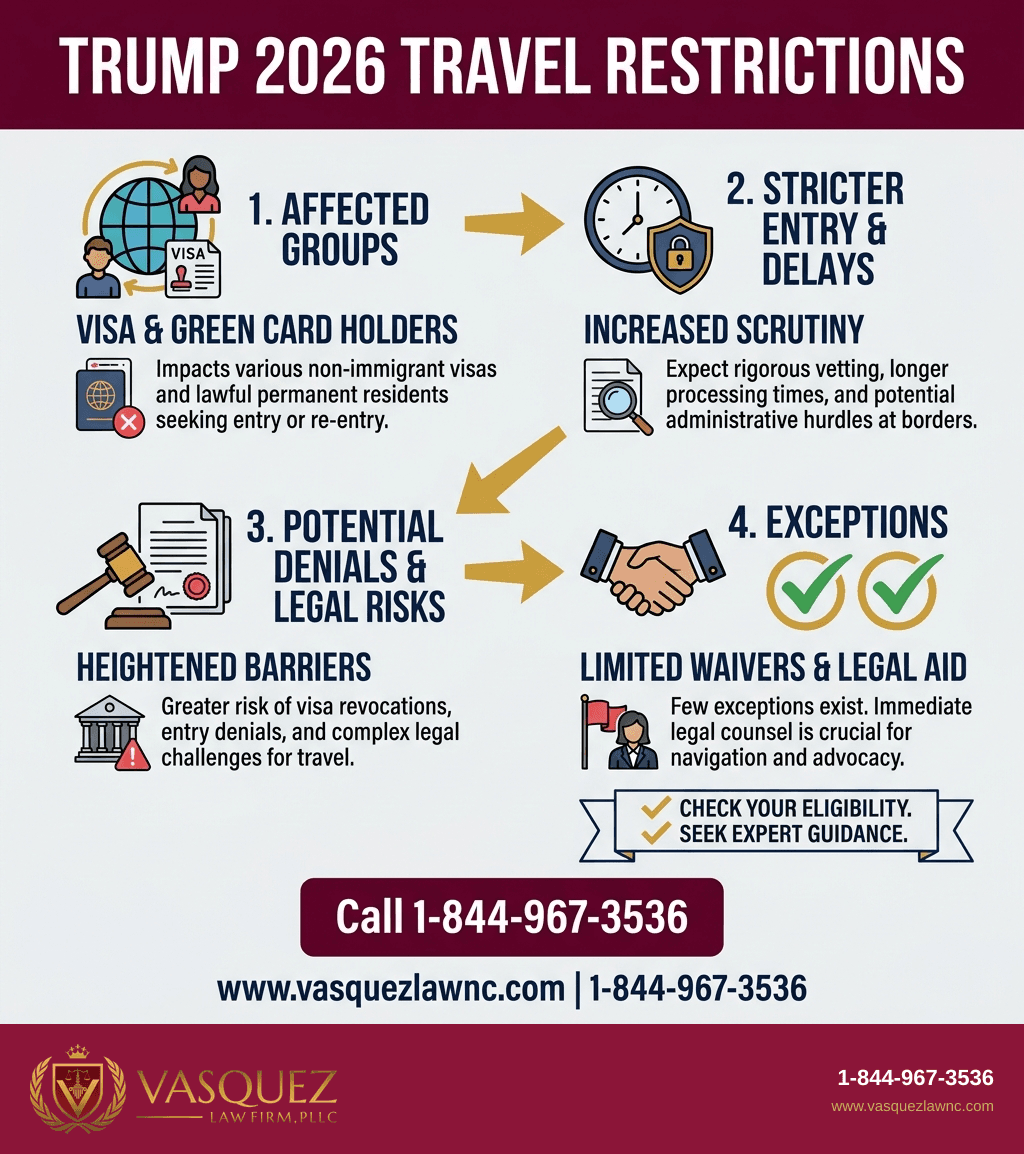
Trump travel restrictions in 2026 affect individuals from designated countries, impacting visa holders, green card holders, and some dual nationals. The travel ban resumed effect January 2026, causing barriers for travelers using passports from specific countries. Lawful permanent residents have some protections but must understand complex rules before traveling.
- Restrictions apply to passports of designated countries
- Lawful permanent residents face fewer entry denials but must be cautious
- Dual nationals traveling on banned country passports may be stopped
- Processing times for travel authorizations can take several months
- Legal advice is essential to avoid costly mistakes
Understanding Trump Travel Restrictions
On January 1, 2026, several Trump-era travel restrictions officially took effect again. These restrictions generally bar or limit the entry of foreign nationals from a specific list of designated countries. The Department of Homeland Security and USCIS have publicly outlined that these travel bans are designed to mitigate national security and public safety risks, though the list of countries has been modified over time.
For example, travelers on passports from countries such as Iran, Syria, and others face significant hurdles in obtaining visas or entering the United States. These restrictions impact visa applicants, temporary protected status (TPS) holders, and lawful permanent residents returning from abroad. Dual nationals are considered under special rules depending on which passport they use for travel. Understanding who is affected requires knowing the details of the travel ban and recent changes made in 2026.
In Raleigh, NC and Orlando, FL, residents who hold visas or green cards issued in these jurisdictions should be aware that while USCIS governs immigration nationally, local immigration attorneys can provide guidance specific to how these rules affect residents in these areas. If you are traveling from or through these regions, knowing the travel ban's impact can help you avoid denied entry or secondary inspection at ports of entry.
This update reinstates several provisions that had been suspended during prior administrations, affecting how lawful permanent residents and other travelers cope with re-entry. Resources like the USCIS Policy Manual and Executive Office for Immigration Review guidelines provide further insights into implementing these restrictions legally and fairly.
For detailed official updates, visit the U.S. Citizenship and Immigration Services site and consult legal assistance for any planned international travel.
What Is the Travel Ban?
The travel ban, formally known as Presidential Proclamation 9645 and subsequent related proclamations, restricts entry of aliens from designated countries for certain periods or indefinitely. The list of affected countries and the types of visas impacted are subject to change. The focus is mainly on countries perceived to pose terrorism-related risks or security threats based on government assessments.
Who Enforces These Restrictions?
The Department of Homeland Security, USCIS, and Customs and Border Protection enforce travel bans at ports of entry and during visa adjudications. Immigration courts, under the Executive Office for Immigration Review, determine admissibility in cases of dispute. These agencies coordinate to apply the restrictions as mandated by law and executive orders.
Legal Framework Behind Travel Bans
Travel restrictions rely heavily on 8 U.S.C. § 1182, which lists inadmissibility grounds for aliens, including suspensions or restrictions based on nationality or other security concerns. The waivers under 8 C.F.R. § 217.2 offer limited exceptions, but these are discretionary and often require detailed legal applications.
Step-by-Step: What to Do If Affected
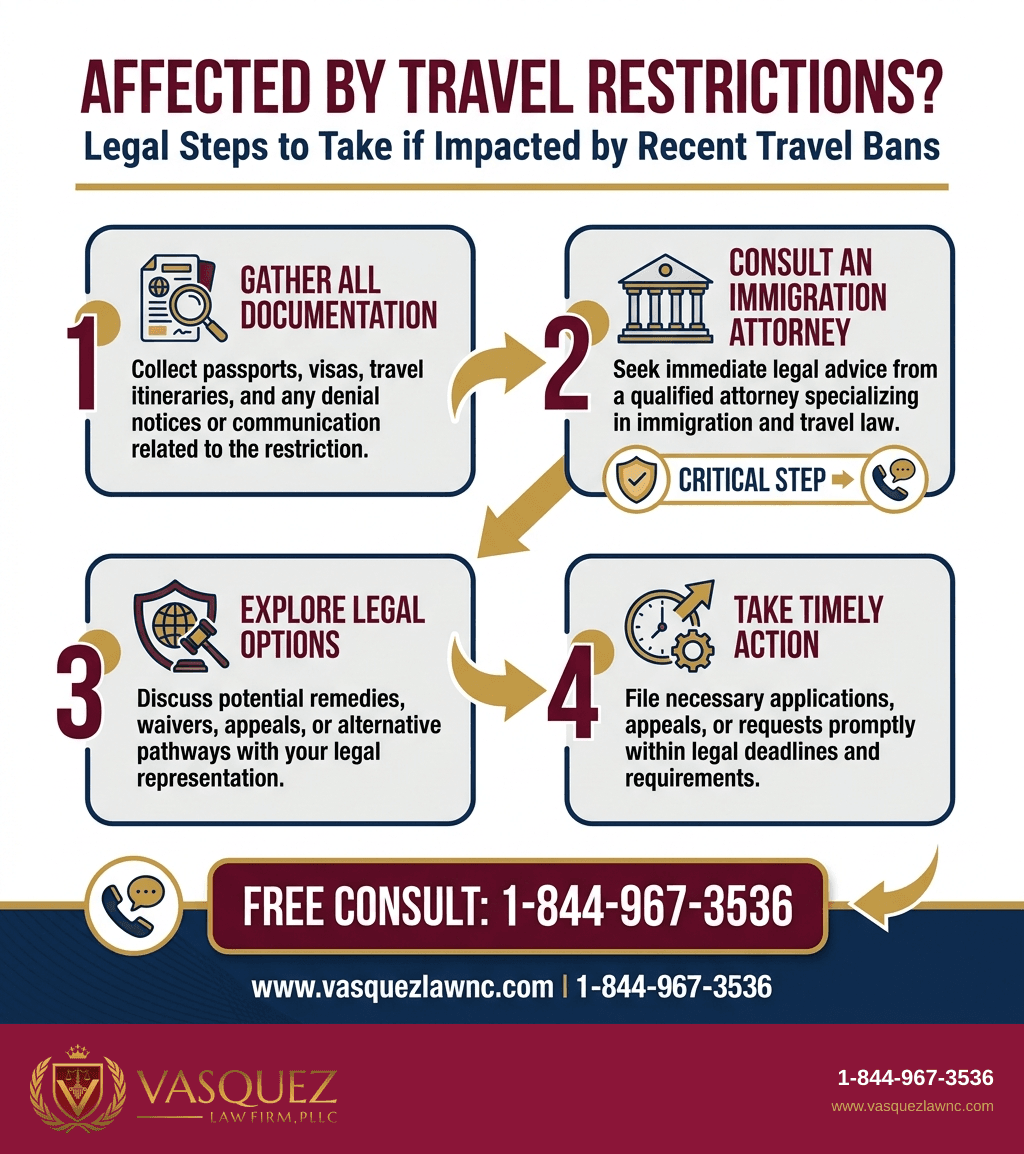
If you or a loved one fall under the scope of Trump travel restrictions, there are several crucial steps to follow to protect your immigration status and travel plans:
- Check the Designated Countries List: Confirm if your passport country is included in the current travel ban list by checking official DHS and USCIS announcements.
- Consult an Immigration Lawyer: Speaking with a qualified immigration attorney in Raleigh, NC or Orlando, FL helps clarify how the restrictions apply to your case and possible waivers available.
- Gather Your Documents: Prepare your visa, green card, passport, travel history, and any evidence of ties to the United States.
- Apply for Advance Parole if Needed: For green card holders planning travel, filing Form I-131 to request advance parole can prevent inadmissibility issues upon return.
- Prepare for Secondary Inspection: At ports of entry, you may be subject to additional questioning or document review. Have your attorney’s contact information handy.
- Monitor Travel Ban Updates: Since policies change, stay informed of any new amendments or rescissions that may affect your eligibility.
Why Legal Advice Matters
Each traveler's situation is unique. For instance, dual nationals need tailored strategies depending on which passport is used. Lawful permanent residents must understand the risks of traveling without advance parole. Mistakes can lead to denial of entry or removal proceedings, so legal counsel can mitigate these risks.
Documents and Evidence Checklist
Before international travel, especially if you are under a travel ban’s potential scope, gather and review the following documents carefully:
- Valid U.S. visa or green card documents
- Current and valid passports, including all held nationalities
- Form I-131 (Application for Travel Document) receipt or approval
- Proof of residence and employment in Raleigh, NC or Orlando, FL
- Evidence of family ties in the United States (birth certificates, marriage licenses)
- Documentation supporting humanitarian reasons or waivers if applicable
- Copies of any prior immigration filings and decisions
Having these readily available decreases delays and supports your case during inspection or when applying for waivers.
Timeline: What to Expect for Processing
Processing under travel restriction rules varies but typically involves these phases:
- Verification: Confirming your country’s status on the travel ban list — immediate.
- Form I-131 Processing: Advance parole forms related to travel bans currently average 3-6 months per USCIS Processing Times (https://egov.uscis.gov/processing-times/).
- Port of Entry Screening: Can cause delays from hours to days if secondary inspection is required.
- Legal Waiver Filing: If inadmissible, waiver petitions can take 6 months or longer.
Planning international travel well in advance is essential to avoid last-minute complications based on these timelines.
Common Mistakes to Avoid
- Traveling without checking the travel ban list: Before any trip, verify if your nationality is listed as designated to avoid surprises.
- Failing to apply for advance parole: Green card holders leaving without advance parole risk losing their permanent residency.
- Ignoring dual nationality complications: Traveling on a banned country’s passport may trigger restrictions even if you hold another citizenship.
- Not consulting a lawyer: Self-representation or outdated information can lead to denied entry or lost immigration benefits.
- Delaying document renewals or filings: Expired visas, green cards, or travel permits increase the risk of denial.
- Misunderstanding waiver availability: Not all inadmissible travelers qualify for waivers; legal guidance is essential.
- Assuming no impact on lawful permanent residents: Legal nuances make some residents vulnerable if traveling without proper permissions.
If you only remember one thing: Always check current travel restrictions and consult an immigration attorney before international travel in 2026.
NC and FL Notes on Travel Restrictions
North Carolina Notes
In Raleigh, NC and across the state, immigration enforcement follows federal policies, including travel bans. Local USCIS offices handle applications like I-131 for advance parole. Community resources and advocacy in NC stress awareness of these restrictions to protect residents, especially immigrants from designated countries. Vasquez Law Firm’s Raleigh office provides tailored guidance to help understand these federal rules and their local practical impacts.
Florida Notes
In Orlando, FL, the immigration system also administers Trump travel restrictions under the same federal guidelines. Given Florida’s diverse immigrant population from designated countries, understanding travel bans is critical. Local immigration courts may hear challenges regarding admissibility linked to these bans. Residents in Orlando can benefit from Vasquez Law Firm’s bilingual legal services to navigate restrictions in 2026.
Nationwide Concepts
Travel bans are federally enforced and apply nationwide. However, implementation varies based on local USCIS offices and international ports of entry. Further, policies can change due to litigation or executive action. Travellers across the U.S. must keep updated via official sources, like USCIS or the Executive Office for Immigration Review. This ensures compliance with 8 U.S.C. § 1182 and related regulations.
When to Call a Lawyer Now
- You plan international travel from Raleigh, NC or Orlando, FL and hold a visa or green card
- Your country is newly added to the designated countries list under Trump travel restrictions
- You are a dual national unsure which passport to use for re-entry
- You face secondary inspection or detention at a port of entry
- Your visa or green card renewal is pending and travel is urgent
- You received a notice of inadmissibility due to the travel ban
- You want to apply for waivers related to the travel ban
- You are undocumented and fear deportation linked to travel restrictions
- You need help understanding procedural updates from USCIS
About Vasquez Law Firm
At Vasquez Law Firm, we combine compassion with aggressive representation. Our motto "Yo Peleo®" (I Fight) reflects our commitment to standing up for your rights.
- Bilingual Support: Se Habla Español — Spanish-speaking attorneys and staff available
- Service Areas: North Carolina, Florida, and nationwide immigration services
- Experience: Over 30 years helping clients navigate complex legal matters
- Results: Thousands of successful cases across multiple practice areas
Attorney Trust and Experience
William J. Vásquez is admitted to the North Carolina State Bar (2011) and to the U.S. Courts of Appeals for the 4th, 5th, and 11th Circuits. Florida-jurisdiction matters at the firm are handled by Florida Bar attorney Harold Estrada-Rodriguez (FL Bar No. 1041171). The firm has provided dedicated legal representation since 2011, with personalized attention to each client's case.
Don't wait to get the help you deserve. Call us now for immediate assistance.
Se Habla Español
Frequently Asked Questions
What are Trump travel restrictions in 2026?
Trump travel restrictions in 2026 refer to rules limiting entry of certain foreign nationals from designated countries. These travel bans affect visa holders, lawful permanent residents, and travelers on specific passports. The restrictions resumed effect January 2026 after earlier pauses. They aim to restrict entry based on national security concerns and have specific application details determined by U.S. immigration authorities.
Who is affected by the travel ban in 2026?
Individuals with visas or green cards from designated countries face the greatest impact. Dual nationals traveling on passports of banned countries may also be affected. Lawful permanent residents generally have protections but must be cautious when traveling abroad. Travelers on passports from countries removed from the banned list typically do not face restrictions under the 2026 update.
Can lawful permanent residents be denied entry under these restrictions?
Generally, lawful permanent residents (green card holders) are protected from entry denial under travel bans. However, complex legal factors apply, such as length of absence and criminal records. The Executive Office for Immigration Review clarifies that certain grounds of inadmissibility may still apply, so legal advice is crucial before traveling.
What steps should NC or FL residents take to comply with Trump travel restrictions?
Residents in Raleigh, NC, or Orlando, FL should first verify if their country is on the travel ban list. Next, consult with immigration attorneys to review visas, green cards, and travel history. Collect all relevant documents before travel. Filing advance parole or travel authorization can help avoid denied entry. Vasquez Law Firm offers free evaluations for residents needing guidance on these steps.
How long do travel restriction cases or changes take to process?
Processing times vary but generally take 3 to 6 months for travel authorization or green card-related cases affected by travel bans. USCIS updates processing times regularly; checking the latest for forms like I-131 (advance parole) is advised. Delays may occur due to additional background checks or administrative processing.
What common mistakes should visa holders avoid regarding travel bans?
Common mistakes include traveling without confirming your country’s status, failing to secure advance parole, ignoring changes in travel ban lists, and missing deadlines for document renewals. Some travelers also underestimate the impact of dual nationality and assume green card holders face no restrictions. Consulting a lawyer can help avoid costly errors.
Can dual nationals traveling on non-banned passports face restrictions under the travel ban?
Dual nationals generally face fewer restrictions when traveling on passports not listed as designated countries. However, if immigration officials determine the individual's nationality based on origin or other factors, restrictions could still apply. The law is nuanced; an immigration attorney can clarify risks based on individual circumstances.
Where can I find official updates on Trump travel restrictions and processing times?
Official updates are posted on the USCIS website and the Executive Office for Immigration Review site. USCIS processing times for relevant forms like I-131 are updated regularly at https://egov.uscis.gov/processing-times/. Checking these sites helps stay informed of any changes that might affect travel or immigration status.
Sources and References
- U.S. Citizenship and Immigration Services
- Executive Office for Immigration Review
- Legal Information Institute
Take the first step toward justice today. Our team is standing by to help.
Start Your Free Evaluation Now
Call us: 1-844-967-3536
Se Habla Español - Estamos aquí para ayudarle.
If you need legal assistance, learn more about speak with an immigration lawyer, or call us at 1-844-967-3536 for a free evaluation.

William Vasquez
Founder & CEO, Vasquez Law Firm, PLLC
William Vasquez is the founder and CEO of Vasquez Law Firm, PLLC, a results-driven firm specializing in immigration, criminal defense, personal injury, and workers' compensation. A U.S. Air Force veteran and recipient of the Joint Service Achievement Medal, William is dedicated to fiercely fighting for his clients' rights.
Related Legal Services
Need legal help? Learn more about speak with an immigration lawyer, or contact us for a free evaluation.
You can also visit North Carolina immigration law firm for more information.
![Report: DHS Finds Criminal Histories in SIJ Benefits [2026]](/_next/image?url=https%3A%2F%2Fvuuyorlsmhunqektprqy.supabase.co%2Fstorage%2Fv1%2Fobject%2Fpublic%2Fblogs%2Fimmigration-header-1782500860607.png&w=1920&q=75)