Trump Refugee Cap Explained: What It Means in 2026
Wondering how the Trump refugee cap affects resettlement in 2026? Learn about refugee ceiling limits, policies, and what NC and FL immigrants should know. Contact us today.
Published on May 27, 2026
Talk to an immigration attorney
Free call. A clear plan for your case.
Free & confidential · Se habla espanol · 24/7
Have questions? Talk to an attorney - free evaluation.
Call 1-844-967-3536Worried how the latest immigration news affects you?
Schedule a confidential case review with an immigration attorney - know exactly where you stand.
Trump Refugee Cap Explained: What It Means in 2026
The Trump refugee cap continues to influence U.S. refugee policy in 2026 with limits set on refugee admissions. This article explains the refugee ceiling, the historical context of Trump-era policies, and what these changes mean for immigrants in Raleigh, NC, and Orlando, FL. We detail how refugee resettlement works today, what to expect in the U.S. refugee admissions program for 2026, and key legal insights every prospective refugee should understand.
Need help with your case? Our experienced attorneys are ready to fight for you. Se Habla Español.
Or call us now: 1-844-967-3536
Quick Answer
The Trump refugee cap is a federally set limit on the number of refugees admitted each fiscal year. In 2026, this cap remains historically low at 7,500 refugees nationwide, shaping how many individuals can resettle in the U.S. including Raleigh, NC and Orlando, FL.
- Refugee caps are set annually by presidential determination.
- Trump policies lowered refugee admissions significantly.
- The 2026 cap affects processing times and eligibility.
- Consult immigration attorneys to navigate refugee law.
- Local offices like Vasquez Law Firm help with refugee cases.
Understanding the Trump Refugee Cap
In fiscal year 2026, the United States refugee cap is set at 7,500 individuals, continuing the restrictions first enacted during the Trump administration. This number marks one of the lowest refugee ceilings in decades. The refugee cap is an annual limit on how many refugees the U.S. government will admit during that fiscal year. It is determined by the President after consulting with the Department of State and other agencies overseeing the refugee admissions program.
President Trump's policies, implemented from 2017 through 2020, drastically reduced the refugee ceiling from previous years' levels, which had been as high as 110,000 in 2016. His administration's priority was to impose additional security screenings and restrict admissions. The refugee cap controls the flow of refugees resettled across the country, including North Carolina and Florida regions served by our Raleigh and Orlando offices.
The refugee resettlement program known as the U.S. Refugee Admissions Program (USRAP) is a multi-agency effort involving U.S. Citizenship and Immigration Services (USCIS), the Department of State, and refugee resettlement agencies. The cap limits how many people USRAP can screen and admit during one fiscal year.
With the cap low, many refugee applicants face longer processing times and increased uncertainty. This impacts families, vulnerable populations, and community organizations. Immigrants and refugees in Raleigh, NC, and Orlando, FL need to stay informed on these developments to understand their rights and options.
For those seeking legal guidance, our immigration services team at Vasquez Law Firm provides support navigating refugee law and the admissions process.
Step-by-Step: Navigating Refugee Resettlement in 2026
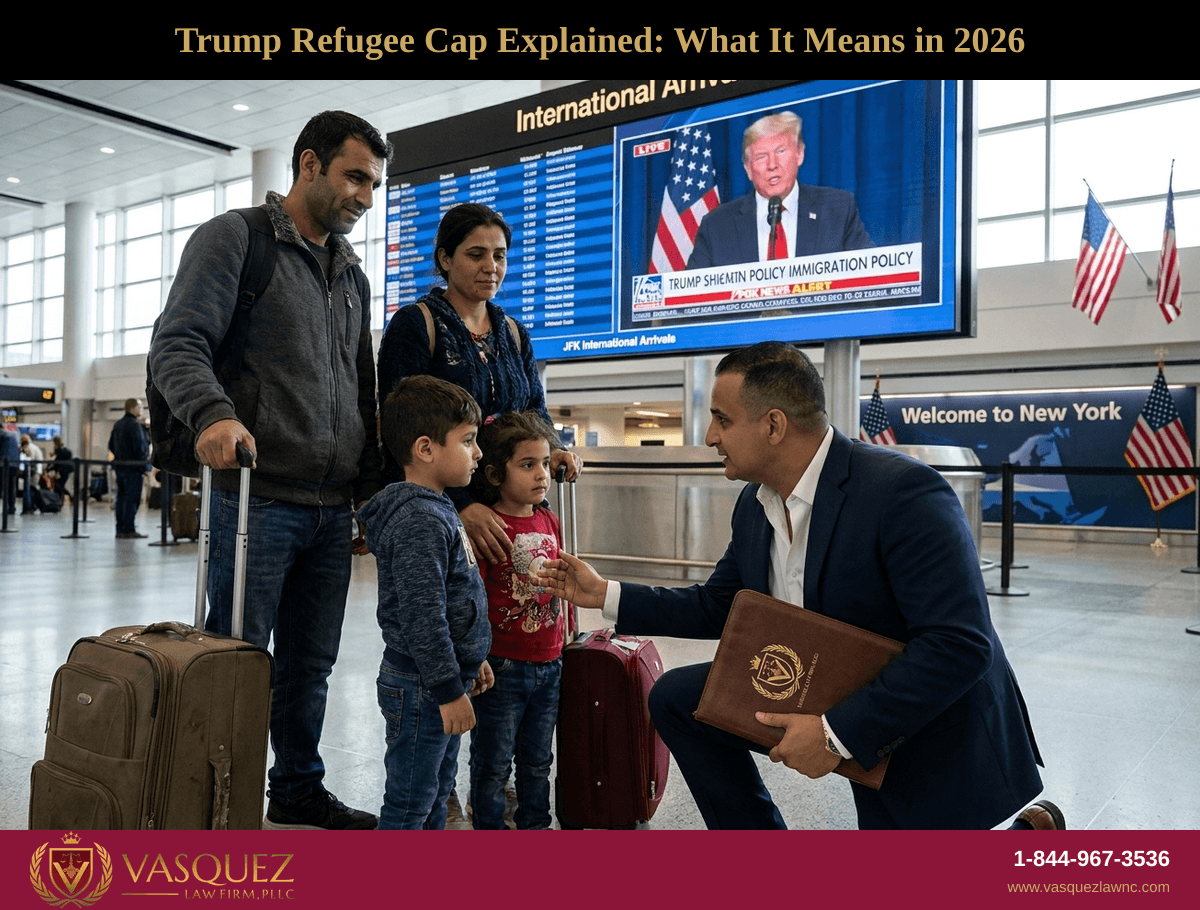
Refugee resettlement is a complex process involving multiple steps and agencies, especially under current caps and screening procedures. Here is an overview of the typical steps for refugee applicants in 2026:
- Referral: Refugees are referred to USRAP by the United Nations High Commissioner for Refugees (UNHCR), family members, or U.S. embassies.
- Pre-screening: The Department of State and USCIS conduct in-depth background checks, security screening, and medical exams.
- Interview: USCIS officers interview the refugee to verify eligibility as outlined in 8 C.F.R. § 207 and 8 U.S.C. § 1157.
- Approval or Denial: USCIS determines eligibility and approves or denies the case. Denied applicants may request reconsideration or appeal if grounds exist.
- Placement: Approved refugees are placed with resettlement agencies in states such as North Carolina and Florida and provided assistance.
- Travel: Refugees receive travel arrangements and orientation before arriving in the U.S.
Throughout these steps, the low refugee ceiling limits how many cases can be started and completed.
Our Attorney Vasquez and the team guide clients through this multi-step process, ensuring documentation and deadlines are met to improve chances of success.
Common Mistakes to Avoid in Refugee Applications
- Incomplete documentation: Failing to submit all required evidence delays cases. Fix: Double-check USCIS checklist and submit complete forms.
- Missing interviews: Not attending scheduled USCIS interviews can result in denial. Fix: Keep track of appointments and contact USCIS if rescheduling is needed.
- Incorrect information: Providing inconsistent or inaccurate answers affects credibility. Fix: Prepare carefully for interviews and review applications thoroughly.
- Ignoring updates: Not responding timely to Requests for Evidence (RFEs) leads to dismissal. Fix: Respond within USCIS deadlines.
- Assuming automatic approval: Refugee caps create competition; not all applicants are accepted. Fix: Work with an attorney for realistic expectations.
- Missing deadlines: Late filings or appeals can prevent reconsideration. Fix: Note deadlines immediately and track them systematically.
- Failing to consult legal advice: Attempting to navigate complex immigration laws alone often leads to mistakes. Fix: Contact experienced immigration attorneys.
If you only remember one thing: Timeliness, accuracy, and legal guidance are key to a successful refugee resettlement application in 2026.
Timeline and What to Expect from Refugee Resettlement
- Referral to USCIS processing: 6-9 months under current workloads.
- Security clearance and medical exam: 3-6 months, often concurrent with interviews.
- USCIS interview to approval: Several months depending on caseload.
- Total duration: 18-24 months or longer due to cap-induced backlogs.
- Travel arrangement and resettlement services: Scheduled after approval, could take additional weeks.
Processing times vary. Check USCIS processing times page for updates on Form I-590, which applies to refugee registration and processing.
Costs and Fees Affecting Refugee Cases
- Application fees: Refugee applicants generally do not pay USCIS fees, but pay for medical examinations.
- Medical exams: Costs vary but typically range from several hundred dollars depending on required vaccinations and tests.
- Legal fees: Hiring an immigration attorney can vary by case complexity. Consultation and representation fees differ accordingly.
- Travel costs: The U.S. government covers refugee travel expenses once approved, including airfare.
- Resettlement support: Local agencies provide aid but personal expenses post-arrival may vary.
Understanding these cost factors helps applicants plan. Vasquez Law Firm offers transparent pricing and explains costs upfront.
Jurisdiction Notes for NC and FL Refugees
North Carolina Notes
North Carolina hosts many refugees due to established community support networks. Refugees admitted in Raleigh and other parts of NC receive help through local resettlement agencies. Vasquez Law Firm’s Raleigh office provides representation and legal advice tailored to NC refugee status adjustments and family reunification processes.
Florida Notes
Orlando, FL is a hub for refugee resettlement in central Florida. Refugees here face similar challenges with the low refugee cap affecting intake numbers. Our Orlando office is equipped to assist with immigration filings, adjustment of status applications, and naturalization post-resettlement.
Nationwide Concepts (General Only, Rules Vary)
Refugee policies operate under federal jurisdiction but have localized implementation differences. State cooperation and available services vary. Refugees nationwide must navigate USCIS, Department of State processes, and local resettlement agency requirements specific to their region.
When to Call a Lawyer Now
- If you have received a Notice to Appear or immigration court summons.
- If your refugee application has been denied or delayed excessively.
- When you receive Requests for Evidence or Notices of Intent to Deny.
- If you are unsure how the refugee cap affects your case timeline.
- If you need help preparing for USCIS interviews or biometrics.
- When family reunification or derivative refugee status questions arise.
- If you want legal assistance filing adjustment of status or asylum applications post-arrival.
- If you experience discrimination or rights violations during resettlement.
- When you need bilingual support or interpretation for immigration proceedings.
- If you want to know about alternative immigration options if refugee status is unavailable.
About Vasquez Law Firm
At Vasquez Law Firm, we combine compassion with aggressive representation. Our motto "Yo Peleo®" (I Fight) reflects our commitment to standing up for your rights.
- Bilingual Support: Se Habla Español — Spanish-speaking attorneys and staff available
- Service Areas: North Carolina, Florida, and nationwide immigration services
- Experience: Over 30 years helping clients navigate complex legal matters
- Results: Thousands of successful cases across multiple practice areas
Attorney Trust and Experience
William J. Vásquez is admitted to the North Carolina State Bar (2011) and to the U.S. Courts of Appeals for the 4th, 5th, and 11th Circuits. Florida-jurisdiction matters at the firm are handled by Florida Bar attorney Harold Estrada-Rodriguez (FL Bar No. 1041171). The firm has provided dedicated legal representation since 2011, with personalized attention to each client's case.
Don't wait to get the help you deserve. Call us now for immediate assistance.
Se Habla Español
Frequently Asked Questions
What is the refugee cap for 2026?
The refugee cap for 2026 is set at 7,500, which is a historically low limit established by recent presidential determinations. This cap governs the maximum number of refugees admitted to the United States in the fiscal year. USCIS administers refugee admissions under this limit as part of the U.S. Refugee Admissions Program.
How did Trump's policies affect refugee resettlement?
During the Trump administration, refugee admissions were drastically reduced, with caps lowered to historic lows. Policies introduced added restrictions and extensive vetting procedures that slowed refugee resettlement. This shift remains influential in 2026, as the current refugee ceiling reflects many Trump-era policy impacts.
Has Trump reduced overall immigration?
Trump’s policies focused on tightening immigration enforcement and reducing legal immigration numbers, including refugee admissions. While certain immigration pathways saw reductions, policies have evolved post-Trump, but his administration's restrictions continue to influence immigration trends in 2026.
What is the United States Refugee Admissions Program?
The U.S. Refugee Admissions Program (USRAP) manages refugee resettlement by screening and admitting refugees to the United States. The program involves various federal agencies, including USCIS and the State Department, following the refugee cap set annually by presidential determination.
What should refugees in Raleigh and Orlando know about the Trump refugee cap?
Refugees in Raleigh and Orlando should understand that the Trump-era reduced refugee cap limits the number of admitted refugees nationwide, affecting wait times and processing delays. Staying informed about these limits helps manage expectations during resettlement processes.
How long does refugee processing take under the current cap?
Refugee processing times vary but can range from 18 to 24 months or longer due to increased vetting and volume limits imposed by caps like the Trump refugee cap. USCIS regularly updates processing times, which applicants can check online.
Can refugees appeal denials or delays related to the refugee cap?
Generally, refugees cannot appeal the presidential refugee cap because it is a policy limit. However, legal challenges may be available for individual application denials or procedural errors. Consulting an attorney familiar with refugee law is advised.
How can an attorney assist with refugee cases under the 2026 cap?
An attorney can help prepare refugee applications properly, ensure necessary documentation, and guide applicants through complex USCIS procedures affected by current caps. Legal counsel also helps manage case expectations based on changing policies and provides help with appeals or motions if needed.
Sources and References
- U.S. Citizenship and Immigration Services
- Executive Office for Immigration Review
- Legal Information Institute
Take the first step toward justice today. Our team is standing by to help. Se Habla Español.
Start Your Free Evaluation Now
Call us: 1-844-967-3536
Se Habla Español - Estamos aquí para ayudarle.


William Vasquez
Founder & CEO, Vasquez Law Firm, PLLC
William Vasquez is the founder and CEO of Vasquez Law Firm, PLLC, a results-driven firm specializing in immigration, criminal defense, personal injury, and workers' compensation. A U.S. Air Force veteran and recipient of the Joint Service Achievement Medal, William is dedicated to fiercely fighting for his clients' rights.
Related Legal Services
Need legal help? Learn more about NC immigration legal team, or contact us for a free evaluation.
You can also visit statewide immigration legal services for more information.