How USCIS Video and Image Gallery Works in 2026
The USCIS Video and Image Gallery offers a visual and interactive way to access immigration data in 2026. This resource helps applicants and attorneys understand processing trends, case statuses, and petition volumes. For residents of Raleigh, NC and Orlando, FL, the gallery complements official reports by providing accessible insights into USCIS operations.
Published on August 26, 2026
Talk to an immigration attorney
Free call. A clear plan for your case.
Free & confidential · Se habla espanol · 24/7

Have questions? Talk to an attorney - free evaluation.
Call 1-844-967-3536Free Tool
Check Your USCIS Case Status Now
Enter your receipt number - get the official USCIS status in English or Spanish. No registration.
This article gives general legal information. It is not legal advice for your specific case. Reading this does not create a lawyer-client relationship. For advice about your situation, contact Vasquez Law Firm.
What is the USCIS Video and Image Gallery and how does it work?
Need legal help?
Immigration in NC and FL. Personal injury and workers compensation across NC. Criminal defense in Johnston and Harnett counties, and traffic tickets in 10 NC counties. Tell us your county and we will tell you exactly what we can do.
The USCIS Video and Image Gallery is an online tool that shows immigration data collected by the United States Citizenship and Immigration Services (USCIS). It has videos, charts, and pictures that explain important statistics about immigration applications, petitions, and processing times. This gallery helps the public, applicants, and lawyers understand complex data about different immigration benefits.
USCIS runs the gallery. It collects data from reports made every three months and every year. The data includes information on forms like I-485 (adjustment of status), I-130 (family petitions), I-765 (work permits), and others. The gallery uses videos and charts so users can explore data in an easy and interactive way. This makes the information clear and easy to access.
The gallery updates regularly when USCIS releases new reports and data. Users can browse by categories such as employment-based petitions, family-based petitions, humanitarian programs, and naturalization statistics. For example, the Fiscal Year 2026 Quarter 2 report shows detailed visual data on pending applications, approvals, denials, and processing times.
By showing USCIS data visually, the gallery helps people understand immigration trends and how USCIS is performing. It is especially helpful for applicants in Raleigh, NC and Orlando, FL, where our offices help clients understand this data based on local USCIS field office processing.
Who benefits from the USCIS Video and Image Gallery and who is affected?
The USCIS Video and Image Gallery helps many groups. These include immigration applicants, lawyers, researchers, policymakers, and the general public. It gives real-time information about USCIS operations. These operations affect millions of immigrants across the country, including people living in Raleigh, NC and Orlando, FL.
Applicants for adjustment of status, work permits, family-based petitions, and humanitarian relief can use the gallery to see processing trends that relate to their cases. For example, the gallery’s visual data on Form I-485 pending applications helps applicants guess wait times based on preference categories and country of chargeability (the country linked to their application).
Immigration lawyers use the gallery to give accurate advice about expected processing times and approval rates. Our Raleigh, NC office uses this data to help clients prepare for realistic timelines and to spot possible delays or backlogs for their petition types.
Policymakers and advocacy groups use the gallery to check USCIS workload and how resources are used. The data helps find system-wide problems, like backlogs in employment-based petitions or increases in naturalization applications. For people in Orlando, FL, where our Florida office is located, the gallery offers local information about USCIS field office activity.
Overall, the gallery affects anyone working with USCIS by giving clear, easy-to-access data that helps with decision-making and setting expectations.
What does the law say about USCIS data transparency and reporting?
USCIS must provide clear immigration data under federal law and agency rules. The Immigration and Nationality Act (INA) and related laws allow USCIS to collect, keep, and publish data on immigration benefit decisions.
The law requires USCIS to report on application and petition processing to Congress and the public. This includes data on forms like the Application to Register Permanent Residence or Adjust Status (Form I-485). This form is governed by 8 U.S.C. A7 1255 (INA A7 245(a)). This law lets certain aliens (non-citizens) change their status to lawful permanent resident (green card holder).
USCIS must also provide data on work permits under rules like 8 CFR A7 274a.12. This rule defines which aliens can get work permits. Transparency in processing these applications is very important for applicants and employers.
USCIS says it is committed to transparency in its reports and data tools. The main source document says:
"These reports provide data on various aspects of USCIS operations. In addition, certain tables list the USCIS office responsible for the adjudication." (Source: USCIS, https://www.uscis.gov/tools/reports-and-studies/immigration-and-citizenship-data)
This legal framework supports making and keeping the Video and Image Gallery as a tool for public access to immigration data.
What should you do if you want to use the USCIS Video and Image Gallery for your immigration case?
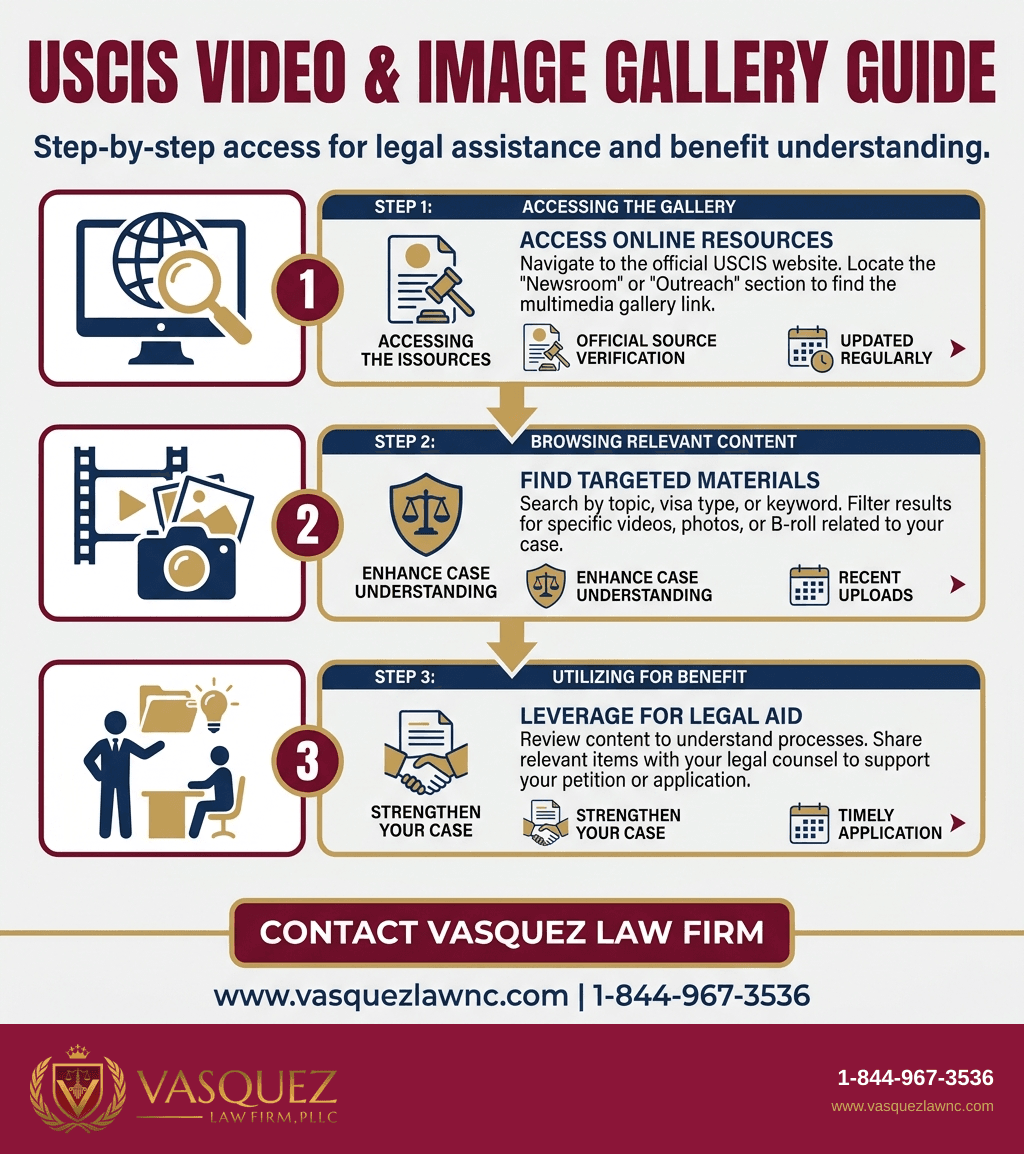
If you are an immigration applicant or lawyer, the USCIS Video and Image Gallery can help you understand processing times, approval rates, and case backlogs. Here are steps to use it well:
- Go to the official USCIS website section for reports and studies, especially the Immigration and Citizenship Data page.
- Find the Video and Image Gallery to see the latest visual data on your form type or immigration benefit category.
- Look for data that matters to your case, like pending application numbers, processing times by USCIS field office, or approval rates.
- Compare data by quarter and fiscal year to find trends or improvements in processing.
- Talk with an immigration lawyer to understand the data for your situation and to plan your next steps.
At our Raleigh, NC and Orlando, FL offices, we see many clients benefit from reviewing this data before filing or while their case is processing. Many applicants do not realize how USCIS backlogs affect their timelines. The gallery helps set realistic expectations and avoid unnecessary delays.
Below is a simple table showing example processing times and pending application counts for Form I-485 from recent USCIS quarterly reports. It shows how gallery data can be summarized for practical use:
| Form | Pending Applications | Median Processing Time | Field Office |
|---|---|---|---|
| I-485 (Adjustment of Status) | 150,000 | 8 months | Raleigh, NC |
| I-485 (Adjustment of Status) | 200,000 | 10 months | Orlando, FL |
| I-765 (Employment Authorization) | 75,000 | 4 months | National Average |
Using this data, applicants can plan their filings and follow up with USCIS as needed. Always check for the latest updates because processing times can change.
What happens next with the USCIS Video and Image Gallery and immigration data reporting?
USCIS keeps improving and updating its data reporting tools, including the Video and Image Gallery. This is to increase transparency and public access. Future updates will likely add more interactive features and local data for field offices like those in Raleigh, NC and Orlando, FL.
The agency’s focus on data-driven insights shows in its quarterly and yearly reports. The main source document says:
"This report is produced in response to the direction set forth in the Consolidated Appropriations Act, 2022, Joint Explanatory Statement... It contains the number of forms received, processed, approved, denied, and pending by month, along with the average processing time and the number of forms pending for more than six months." (Source: USCIS, https://www.uscis.gov/tools/reports-and-studies/immigration-and-citizenship-data)
As immigration policies and demand change, USCIS data reporting will stay an important tool for applicants and lawyers. Staying informed through the Video and Image Gallery helps manage expectations and supports good legal planning.
For people in Raleigh, NC and Orlando, FL, watching USCIS data can show when local offices have backlogs or improvements. This helps clients act at the right time.
What's Your Immigration Situation?
Answer 3 questions - we'll tell you your options
Question 1 / 3
What best describes your situation?
Keep Reading
Frequently Asked Questions about the USCIS Video and Image Gallery
1. What types of immigration data are available in the USCIS Video and Image Gallery?
The gallery includes data on application and petition numbers, approval and denial rates, processing times, and pending case counts. It covers forms like I-485, I-130, I-765, and humanitarian petitions. The data is shown visually with charts, videos, and dashboards.
2. How often is the USCIS Video and Image Gallery updated?
USCIS updates the gallery every three months, matching its official data reports. The Fiscal Year 2026 Quarter 2 data was released in August 2026. Updates show recent processing trends and case statuses.
3. Can I use the gallery data to predict my case processing time?
The gallery gives median processing times and pending case counts that help estimate wait times. But each case is different. Factors like category, country of chargeability, and USCIS office workload affect processing times.
4. Is the Video and Image Gallery accessible to the public?
Yes, the gallery is free and open on the USCIS website. It is made for applicants, lawyers, researchers, and the public to improve transparency.
5. How can I get help interpreting the data from the USCIS Video and Image Gallery?
It is best to talk with an experienced immigration lawyer. Our Raleigh, NC and Orlando, FL offices help clients understand USCIS data and use it for their cases.
This article gives general legal information. It is not legal advice for your specific case. Reading this does not create a lawyer-client relationship. For advice about your situation, contact Vasquez Law Firm.
Reviewed by William Vasquez, Founder & CEO, Vasquez Law Firm, PLLC.
If you need legal help, learn more about our immigration legal services, or call us at 1-844-967-3536 for a free evaluation.
Related Topics

William Vasquez
Founder & CEO, Vasquez Law Firm, PLLC
William Vasquez is the founder and CEO of Vasquez Law Firm, PLLC, a results-driven firm specializing in immigration, criminal defense, personal injury, and workers' compensation. A U.S. Air Force veteran and recipient of the Joint Service Achievement Medal, William is dedicated to fiercely fighting for his clients' rights.
Related Legal Services
Need legal help? Learn more about our immigration legal services, or contact us for a free evaluation.
You can also visit immigration lawyers serving all of North Carolina for more information.