How H-1B Visa Works: Key Facts for 2026 Applicants
Discover how the H-1B visa works in 2026, including application steps, fees, and lottery details. Contact Vasquez Law for a free consultation.
Published on June 21, 2026
Talk to an immigration attorney
Free call. A clear plan for your case.
Free & confidential · Se habla espanol · 24/7
Have questions? Talk to an attorney - free evaluation.
Call 1-844-967-3536Worried how the latest immigration news affects you?
Schedule a confidential case review with an immigration attorney - know exactly where you stand.
USCIS Case Status
Check your USCIS case status
Enter your receipt number and get the official status. Free, no registration.
How H-1B Visa Works: Key Facts for 2026 Applicants
The H-1B visa is a sought-after nonimmigrant work visa allowing U.S. employers to hire foreign professionals in specialty occupations. In 2026, applicants face updated fees and processing steps. This guide covers eligibility, the lottery system, fees including the controversial $100,000 additional fee, salary requirements, and green card pathways relevant for applicants in Orlando, FL and Raleigh, NC. Understanding these aspects helps applicants navigate the complex immigration process more confidently. Vasquez Law Firm offers virtual consultations to assist with H-1B visas and related immigration services.
Need help with your case? Our experienced attorneys are ready to fight for you. Se Habla Español.
Or call us now: 1-844-967-3536
Quick Answer
The H-1B visa allows U.S. companies to employ foreign workers in specialty jobs requiring high education. Applicants face a lottery due to high demand and must meet salary and fee regulations, including a disputed $100,000 fee. It can lead to a green card with employer sponsorship. Processing usually takes 3 to 6 months.
- Requires specialty occupation and bachelor's degree
- Lottery limits approvals each year
- Includes base and potential $100,000 fees
- Employer must pay prevailing wage
- Can lead to permanent residency
What Is the H-1B Visa and Who Qualifies?
Imagine a U.S. tech company needing a software engineer with a specialized degree but failing to find a qualified local candidate. They may sponsor an H-1B visa holder who has the necessary education and skills. The H-1B visa is a nonimmigrant classification allowing employers to temporarily hire foreign workers in specialty occupations. Specialty occupations generally require a bachelor's degree or higher in a specialty field such as IT, engineering, mathematics, health, or finance.
To qualify for an H-1B visa, the applicant must have at least a bachelor’s degree or equivalent in a relevant specialty. The employing company must prove the position requires such qualifications and that the foreign worker meets them. Common qualifying positions include software developers, financial analysts, and engineers.
Applications must be submitted by U.S.-based companies, not by individuals themselves. The H-1B visa allows the worker to stay and work up to initially three years, extendable to six years in most cases.
If you want detailed guidance for your H-1B visa case, our immigration services include virtual consultations from our offices in Orlando, FL, and Raleigh, NC.
How the H-1B Visa Lottery Works
Each fiscal year, the U.S. government places an annual numerical limit (cap) on the number of new H-1B visas: 65,000 general visas plus 20,000 for advanced degree holders from U.S. institutions. Demand often exceeds these caps. For example, in the 2025 fiscal year, USCIS received over 300,000 H-1B petitions.
When petitions exceed the cap, USCIS conducts a computerized lottery that randomly selects petitions to process. The lottery first selects advanced degree holders, then uses leftover visas for the general pool.
Applicants and employers must file together electronically during a short filing window beginning April 1 each year for the fiscal year starting October 1. Being selected in this lottery does not guarantee visa approval, but it allows the petition to be processed.
Lottery Implications
- Not all applications are processed due to the cap
- Applicants not selected may reapply next year
- Premium processing can speed decision after selection
Lottery For Applicants in Orlando and Raleigh
Employers in Orlando, FL and Raleigh, NC participate in this nationwide lottery system. Vasquez Law Firm provides guidance for virtual H-1B consultations, helping employers and applicants comply fully with lottery requirements.
Updated H-1B Visa Fees and $100,000 Fee Controversy
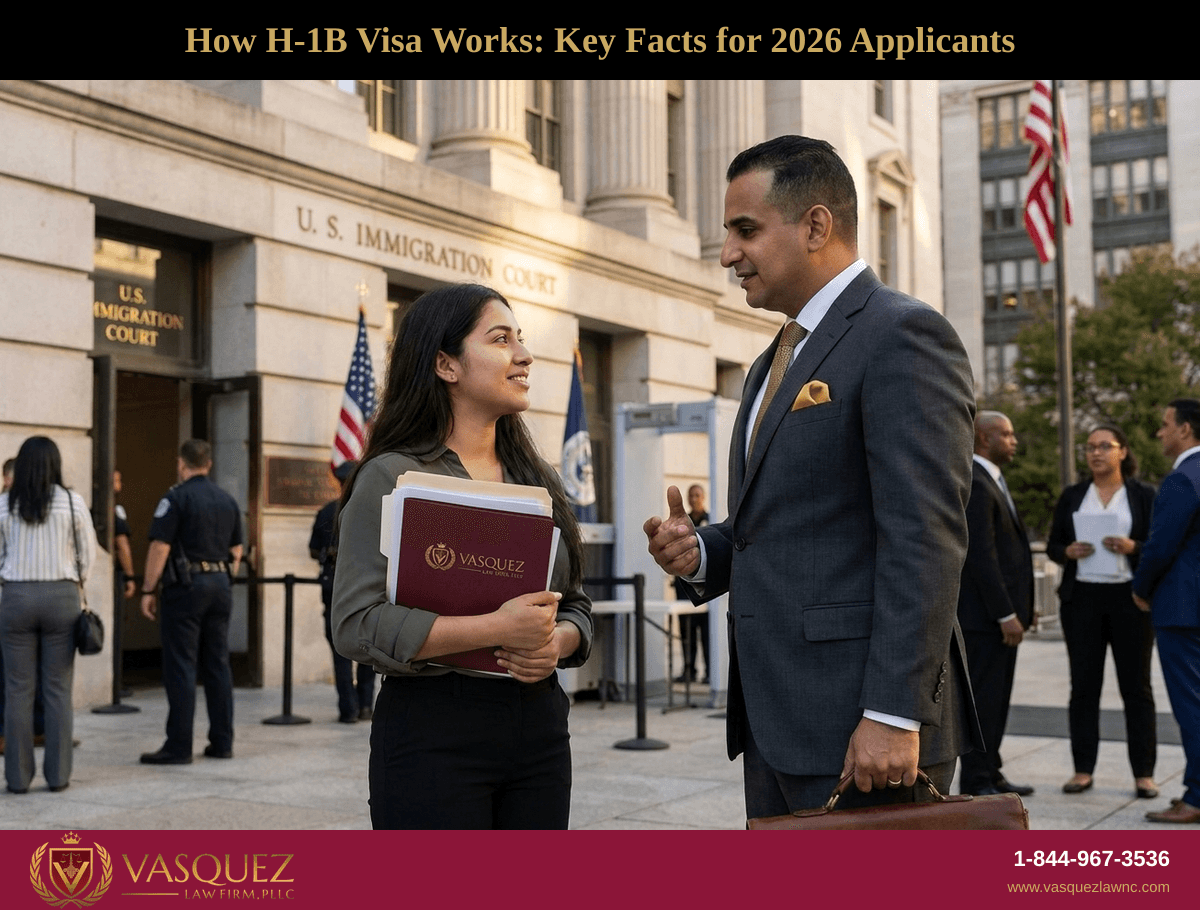
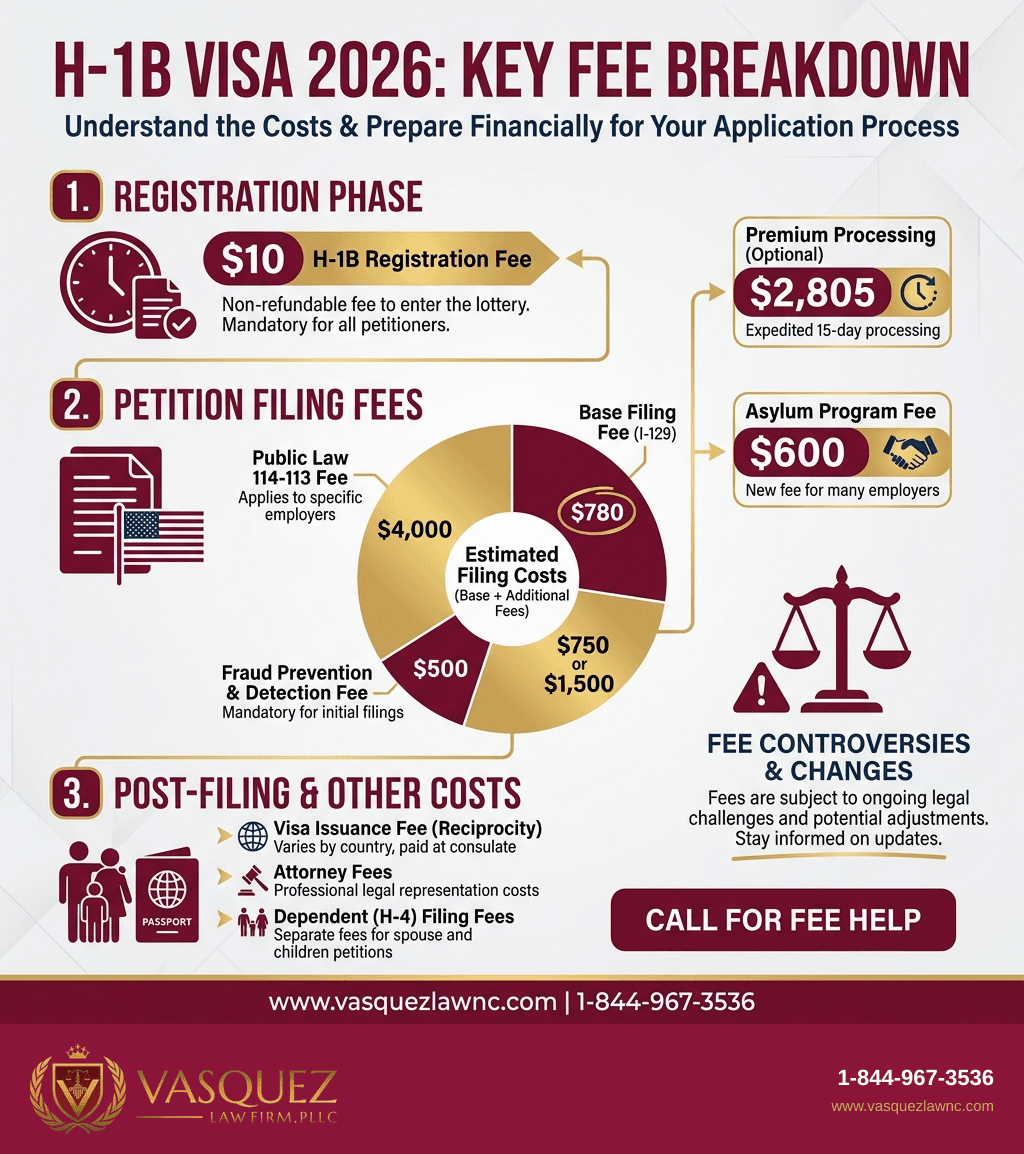
Employers sponsoring H-1B visa holders must pay several mandatory fees to USCIS and the Department of Labor. These include the base filing fee of $460 (Form I-129), an American Competitiveness and Workforce Improvement Act (ACWIA) fee ($750 or $1,500 depending on the size of the employer), an anti-fraud fee of $500, and a Public Law 114-113 fee of $4,000 for certain larger employers.
In 2026, the Department of Homeland Security proposed a new $100,000 fee applied to some large companies employing many H-1B workers. This fee targets employers with more than 50 employees, where over 50% hold H-1B or L-1 visas, aiming to slow what DHS views as exploitation of the program.
A federal judge blocked the fee in early 2026, citing concerns the administration exceeded its authority. DHS responded with an appeal, prolonging legal uncertainty. Applicants seeking H-1B visas with larger employers should carefully monitor this evolving situation.
How Fees Affect Applicants
- Smaller employers typically pay base and ACWIA fees only
- Large employers may face additional $4,000 and (potentially) $100,000 fees
- Applicants do not pay fees directly; employers cover costs
- Fee litigation may impact which employers file petitions
Resources to Monitor Fees
For the latest fee details, applicants and employers should consult the U.S. Citizenship and Immigration Services website and legal counsel specializing in business immigration.
Salary Requirements and Differences from Other Visas
One key H-1B visa requirement is that employers pay the foreign worker the higher of the actual wage paid to similar employees or the prevailing wage for the occupation and location. This protects both U.S. and foreign workers from wage undercutting.
The prevailing wage depends on the job’s geographic location and is published by the Department of Labor. For example, a software engineer in Orlando, FL will have a different prevailing wage than in New York City due to cost-of-living differences.
Comparing H-1B with the J-1 exchange visitor visa shows clear differences. The J-1 visa primarily supports cultural and educational exchange programs and has various subcategories such as students and trainees. In contrast, H-1B holders work for employers in specialty jobs. J-1 holders often face home residency requirements not applicable to H-1B visa holders.
Salary Example
A typical H-1B software developer in Raleigh, NC might have a prevailing wage around $90,000 annually, which the employer must meet or exceed to maintain compliance.
Differences Summary
- H-1B requires specialty occupation and prevailing wage
- J-1 is for cultural/educational exchange with distinct restrictions
- H-1B often allows longer-term work and dual intent
- J-1 may require returning to home country for two years
Pathways from H-1B Visa to Green Card
Many H-1B holders aspire to obtain lawful permanent residency (green card) in the U.S. This transition requires an employer to sponsor the foreign worker for an employment-based immigrant visa.
There are several categories, but most H-1B applicants seek an EB-2 (advanced degree) or EB-3 (skilled worker) green card. The process involves labor certification from the Department of Labor, employer filing an immigrant petition (Form I-140), and the applicant filing adjustment of status (Form I-485) if visa numbers are available.
This process can take several years depending on the country of origin and visa bulletin availability. H-1B status allows applicants to stay legally in the U.S. during the green card process.
Vasquez Law Firm provides legal help on these complex steps to facilitate smooth transitions from temporary H-1B status to permanent residency.
Application Process: Step-by-Step for 2026
- Employer Prepares Forms: Employer completes the Labor Condition Application (LCA) with the Department of Labor to attest wages and working conditions.
- USCIS Petition Submission: Employer submits Form I-129 petition to USCIS during the April filing window.
- Lottery Selection: If USCIS receives more petitions than the cap, it conducts a lottery to select petitions for processing.
- Petition Processing: USCIS reviews petitions, issues Requests for Evidence (RFEs) if needed, and approves or denies cases.
- Visa Application: Upon USCIS approval, the worker applies for an H-1B visa stamp at a U.S. consulate if outside the country or requests status change if inside the U.S.
- Work Authorization Begins: Upon visa issuance or status approval, the worker may start employment on or after the designated start date for that fiscal year, usually October 1.
Employers and applicants in Orlando and Raleigh should plan early and consider all supporting evidence and timelines. Consulting experienced immigration attorneys, such as Attorney Vasquez, can prevent costly delays and denials.
Common Mistakes to Avoid When Applying
- Incomplete documentation: Failing to provide enough proof of specialty occupation or educational qualifications can cause denials.
- Late petition submissions: Missing the April filing deadline disqualifies applicants for that fiscal year lottery.
- Incorrect employer attestations: Errors in the Labor Condition Application or I-129 forms create issues.
- Ignoring USCIS requests: Failing to respond timely to RFEs can lead to denial.
- Not meeting salary requirements: Underpaying workers violates regulations and can result in penalties.
- Overlooking lottery rules: Attempting multiple petitions improperly or petitioning from multiple employers without compliance risks fraud allegations.
- Lack of legal counsel: Trying to navigate complex rules without expert guidance increases risk of error.
If you only remember one thing: Thorough preparation and expert legal help improve your chances to secure H-1B status successfully in 2026.
NC, FL, and Nationwide Notes
North Carolina Notes
Applicants in Raleigh, NC benefit from access to Vasquez Law Firm’s local immigration team. While H-1B visas are federal, local employers and employees often need guidance on state labor laws, wage rules, and compliance. Virtual consultations make it convenient for North Carolina clients to get expert advice quickly.
Florida Notes
Orlando-based employers and workers can likewise access Vasquez Law Firm’s expert services virtually. Florida's tight labor market means demand for skilled H-1B employees is high. Understanding the DHS fee updates and lottery rules is crucial for local businesses sponsoring workers.
Nationwide Concepts
H-1B visas operate under federal statutes like INA § 214(b) and regulations at 8 C.F.R. § 214.2(h). All employers nationwide must comply with DOL wage rules and USCIS procedures. Costs and processing times are similar across states, though job market conditions may vary.
When to Call a Lawyer Now
- If you received a Request for Evidence (RFE) from USCIS about your H-1B petition
- If your application was denied or rejected during the lottery process
- If your employer faces the new $100,000 fee and you want clarity on costs
- If you want to start the green card process while on H-1B status
- If you are unsure whether your job qualifies as a specialty occupation
- If you are filing from Orlando or Raleigh and want virtual legal support
- If USCIS processing times are delaying your work authorization
- If you face wage compliance questions or labor condition application issues
- If you are considering changing employers while on H-1B status
- If you need help understanding differences between H-1B and other visas
About Vasquez Law Firm
At Vasquez Law Firm, we combine compassion with aggressive representation. Our motto "Yo Peleo®" (I Fight) reflects our commitment to standing up for your rights.
- Bilingual Support: Se Habla Español — Spanish-speaking attorneys and staff available
- Service Areas: North Carolina, Florida, and nationwide immigration services
- Experience: Over 30 years helping clients navigate complex legal matters
- Results: Thousands of successful cases across multiple practice areas
Attorney Trust and Experience
William J. Vásquez is admitted to the North Carolina State Bar (2011) and to the U.S. Courts of Appeals for the 4th, 5th, 6th, and 11th Circuits. Florida-jurisdiction matters at the firm are handled by Florida Bar attorney Alekssandra Lopez. The firm has provided dedicated legal representation since 2011, with personalized attention to each client's case.
Don't wait to get the help you deserve. Call us now for immediate assistance.
Se Habla Español
Frequently Asked Questions
What does H-1B mean in visa?
The H-1B visa is a nonimmigrant visa that allows U.S. employers to hire foreign workers in specialty occupations requiring at least a bachelor's degree. It is specifically designed for skilled professionals in specialized fields under U.S. immigration law.
Can an H-1B visa lead to a green card?
Yes, many H-1B visa holders apply for employment-based green cards through employer sponsorship while maintaining their status. The process involves labor certification and can take several years depending on visa category and country of origin.
Who qualifies for an H-1B visa?
Applicants with a job offer in a specialty occupation requiring a bachelor’s or higher degree qualify. The employer must prove the role requires such qualifications and that the applicant meets educational and experience criteria.
What is the H-1B visa salary requirement?
Employers must pay the prevailing wage for the position based on Department of Labor standards to ensure fairness compared to U.S. workers. This protects workers from wage undercutting by foreign employees.
How does the H-1B visa lottery work?
Due to demand exceeding the annual cap, USCIS holds a randomized lottery for petitions filed during the April window to select which petitions will be processed for that year, prioritizing advanced degree holders first.
What is the $100,000 H-1B visa fee dispute about?
The DHS proposed a $100,000 fee on some large employers with many H-1B workers. A federal judge blocked it pending appeal, creating uncertainty. This fee would add substantial costs for certain employers sponsoring H-1B workers.
What are the differences between H-1B and J-1 visas?
H-1B is for specialty occupation workers with an option to pursue permanent residency. J-1 is for exchange visitors with various limits, including home residency requirements and work restrictions.
How long does it take to process an H-1B visa application?
Typical processing times range from 3 to 6 months. USCIS offers premium processing for faster redress. Times vary by caseload, petition type, and requests for further evidence.
Sources and References
- U.S. Citizenship and Immigration Services (USCIS)
- Executive Office for Immigration Review
- Legal Information Institute
Take the first step toward justice today. Our team is standing by to help.
Start Your Free Evaluation Now
Call us: 1-844-967-3536
Se Habla Español - Estamos aquí para ayudarle.

William Vasquez
Founder & CEO, Vasquez Law Firm, PLLC
William Vasquez is the founder and CEO of Vasquez Law Firm, PLLC, a results-driven firm specializing in immigration, criminal defense, personal injury, and workers' compensation. A U.S. Air Force veteran and recipient of the Joint Service Achievement Medal, William is dedicated to fiercely fighting for his clients' rights.
Related Legal Services
Need legal help? Learn more about our immigration legal services, or contact us for a free evaluation.
You can also visit North Carolina immigration lawyers for more information.