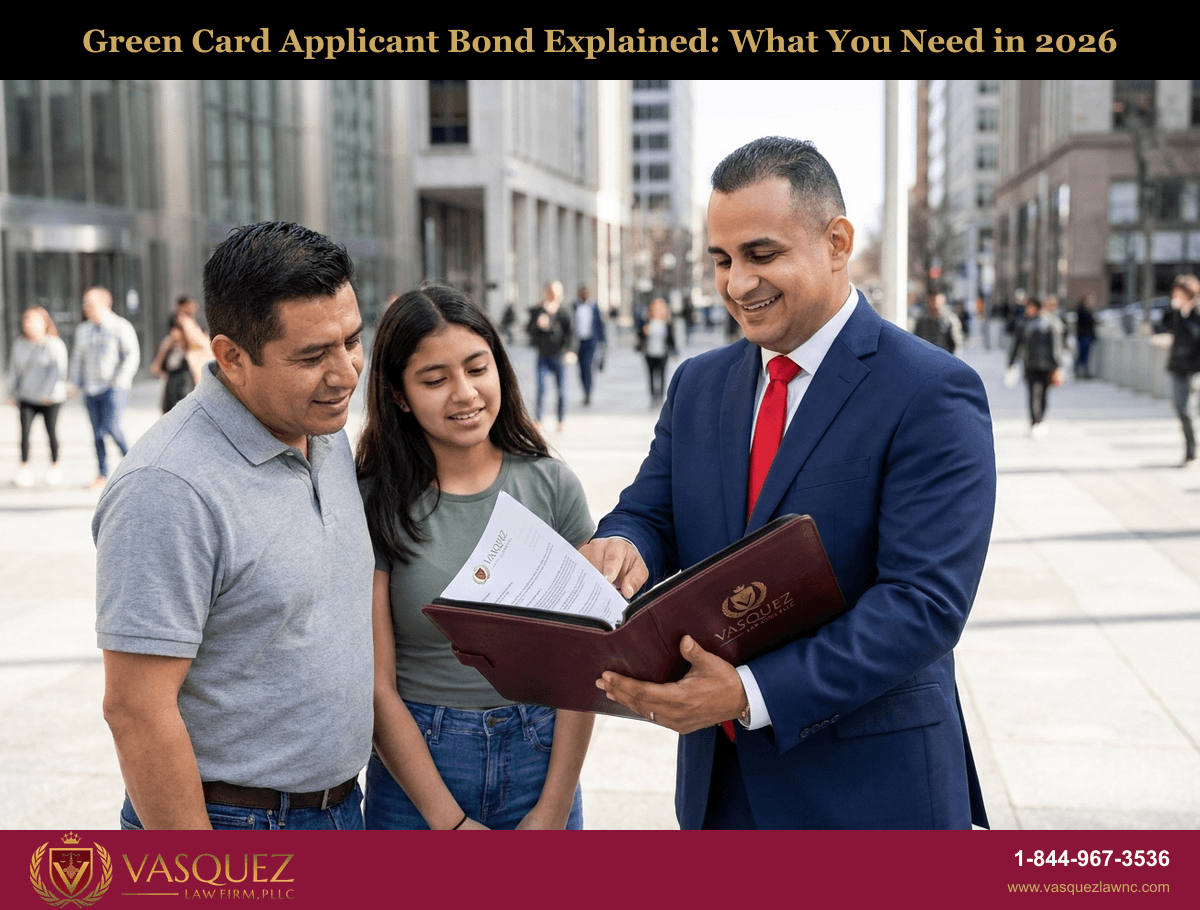
Green Card Applicant Bond Explained: What You Need in 2026
Wondering about a green card applicant bond? Learn the costs, process, and rules in 2026. Get expert help from Vasquez Law Firm. Call for a free consultation.
Published on July 20, 2026· Updated July 20, 2026
Talk to an immigration attorney
Free call. A clear plan for your case.
Free & confidential · Se habla espanol · 24/7
Have questions? Talk to an attorney - free evaluation.
Call 1-844-967-3536Free Tool
Check Your USCIS Case Status Now
Enter your receipt number - get the official USCIS status in English or Spanish. No registration.
Green Card Applicant Bond Explained: What You Need in 2026
A green card applicant bond is a financial promise that U.S. immigration authorities require. It makes sure that people follow immigration rules during their case. In 2026, immigration law has clear rules about bonds. These include how much money is needed and how to get refunds. These rules affect applicants in Raleigh, NC, and Orlando, FL. Knowing how these bonds work is very important for immigrants applying for a green card or those held by ICE. This guide explains the main steps, costs, timelines, and legal points. It also shows common mistakes to avoid. This helps immigrants protect their rights at every stage.
Need help with your case? Our experienced attorneys are ready to fight for you. Se Habla Español.
Or call us now: 1-844-967-3536
Quick Answer
A green card applicant bond is money paid to make sure an immigrant follows immigration rules during their case. The bond amount can be from $1,500 to $100,000 depending on the case. People in Raleigh and Orlando often have bonds near $15,000. Bonds may be paid back after the case ends if all rules are followed.
- Needed for some detained green card applicants
- Makes sure the person goes to future immigration hearings
- Bond amounts change based on case details and risk
- Family, friends, or a bondsman can pay the bond
- Refunds given after following bond rules
Understanding Green Card Applicant Bonds
Imagine Juan, who is applying for a green card in Raleigh, NC. He is held in custody during his process. To get out of custody, USCIS or ICE may ask for a bond. This bond is a financial promise that Juan will go to all required hearings and follow immigration laws. If Juan does not go, the bond money can be lost.
Green card applicant bonds are part of the federal immigration system. They help manage immigration enforcement in a fair way. These bonds are different from bonds in criminal cases. They are set by federal law, especially 8 U.S.C. a7 1231, which controls detention and removal of immigrants.
What Is a Bond for USCIS?
A bond for USCIS, also called an immigration bond, is money paid to get a detained immigrant released while waiting for their immigration court hearing or green card process. The bond makes sure the immigrant will go to hearings and follow immigration rules. If the person follows the rules, the bond money is returned. If not, the government may keep the bond and detain the person again.
Why Some Applicants Must Post Bonds
Not every green card applicant must pay a bond. Bonds are usually needed when a person is held by U.S. Immigration and Customs Enforcement (ICE) while waiting for removal or green card decisions. This happens if there is a risk the person might run away. For example, applicants with past removals, criminal records, or missing documents often face bond requirements.
The $15,000 Visa Bond Rule
Currently, including in North Carolina and Florida, bonds around $15,000 are common for green card applicants. This amount covers possible removal costs if the immigrant does not follow the rules. Bigger bonds, like $100,000 mentioned in news, may happen in high-risk cases but are rare. These bond amounts can affect immigrantsu2019 families and sponsors a lot.
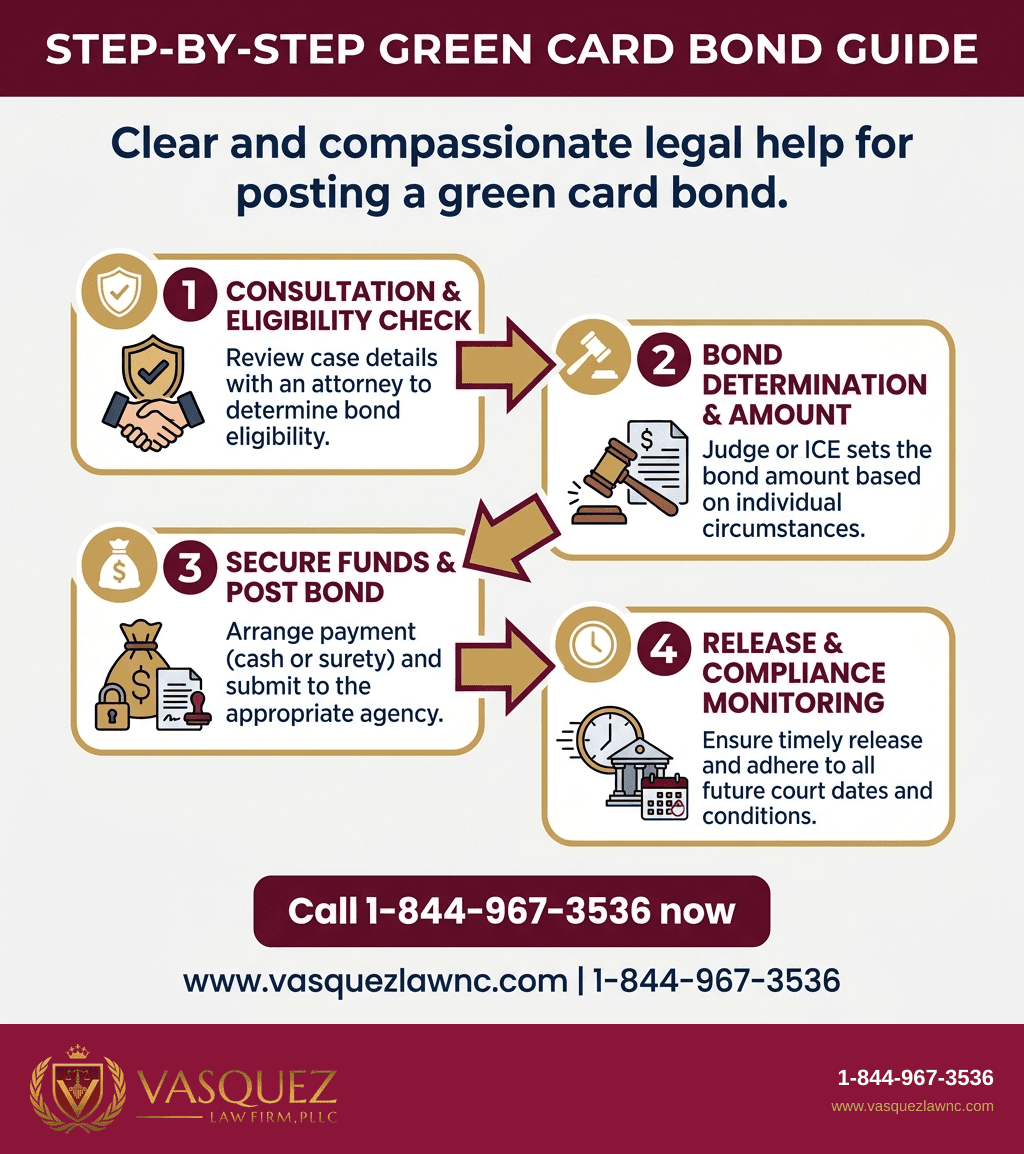
Step-by-Step Process for Posting a Bond
Think about Maria in Orlando, FL. After she learns her bond amount, her family wants to know how to post the bond. Below is a step-by-step guide for most green card applicants facing bonds in 2026:
1. Receive Bond Determination
An immigration judge or ICE officer decides the bond amount during a hearing or review. You must pay this full amount to get release.
2. Find a Bondsman or Pay Directly
Applicants or their families can pay the bond directly to ICE or use a licensed immigration bondsman. Bondsmen may charge a non-refundable fee, usually 10-15% of the bond.
3. Submit Required Paperwork and Payment
The bondsman or applicant sends the bond payment and needed forms to ICE or immigration court. They may also provide proof of relationship or financial papers if required.
4. Await Release on Bond
After paying the bond, the detained person is usually released within a few days. ICE gives conditions for release and requires the immigrant to attend future hearings.
5. Comply with Hearing Dates and Terms
The immigrant must go to all court or USCIS appointments. Missing a hearing can cause bond loss and re-detention.
6. Apply for USCIS Bond Refund
If the case ends with all rules followed, the petitioner can ask USCIS for a refund of the bond. USCIS may keep some fees. This usually happens within 90 days after the case closes.
Common Mistakes with Bonds and How to Avoid Them
- Using unlicensed bond agents: Only use licensed immigration bondsmen to avoid scams and illegal actions.
- Failing to understand income requirements: Sponsors in green card cases must meet minimum income rules, often 125% of the federal poverty level, to pay bonds.
- Ignoring the 90-day immigration rule: USCIS may refuse bond refunds if the immigrant leaves or breaks rules within 90 days of release (see USCIS 90-day rule).
- Believing bonds cover all costs: Bonds only guarantee attendance; they do not pay for legal fees or other costs.
- Not acting quickly: Waiting too long to pay bond keeps detention longer and can hurt the case.
- Providing false information: Lying on visa or citizenship forms, including about bond status, can cause serious penalties and bond loss.
- Not notifying attorneys: Keep your immigration lawyer in Raleigh or Orlando informed to handle bond and case properly.
If you only remember one thing: Always post bond with help from an experienced immigration attorney to avoid costly mistakes and delays.
Timeline and What to Expect During Bond Proceedings
- Day 1-3: Judge or ICE sets bond amount; you get notified.
- Day 4-10: Pay bond and process paperwork.
- Day 11-15: Bond paid; detainee usually released.
- Next months until case ends: Attend hearings and follow release rules.
- Within 90 days of closing: Ask USCIS for bond refund if you qualify.
This timeline can change based on case difficulty and local processing in Raleigh, NC, and Orlando, FL. Check USCIS Processing Times for updates.
Frequently Asked Questions
Is ICE releasing people on bond in 2026?
ICE still releases detained immigrants on bond when it is right. They decide based on risk of running away or danger. Bonds let eligible detainees wait for court outside detention after paying bond. This process is the same in Raleigh, NC, and Orlando, FL.
What is the $15,000 visa bond rule?
The $15,000 visa bond is a common amount needed to release many detained immigrants applying for green cards. This rule is not a law but shows ICE's usual bond to cover removal costs if the immigrant does not follow rules.
What is the minimum income to sponsor an immigrant in 2026?
Sponsors usually must show income 125% above the federal poverty level. This shows they can support the immigrant and pay bonds if needed. This amount changes every year; check the latest USCIS rules for Raleigh and Orlando cases.
Can an immigrant get out on bond if denied a visa?
Visa denial does not automatically allow bond release. If detained, bonds may still be paid to get release while waiting for removal or other cases. Legal help is very important in these complex situations.
How does the USCIS bond refund work?
After following all immigration rules and no violations, USCIS gives back the bond money minus some fees. The refund can take up to 90 days after the case ends.
What is the penalty for lying on visa or citizenship applications?
Lying on visa or citizenship forms is a serious crime. It can cause bond loss, denial of benefits, fines, and even criminal charges. Being honest is very important during bond and immigration processes.
What is the 90-day immigration rule?
The USCIS 90-day rule is the time when certain actions must happen after release on bond. This includes going to hearings or asking for bond refund. Breaking this rule can cause bond loss.
Who can post a bond for a green card applicant?
Family, friends, or licensed immigration bondsmen can pay a bond. Applicants should make sure bondsmen are licensed and talk to an immigration lawyer to avoid problems.
Jurisdiction Notes
North Carolina Notes
USCIS and Immigration Court in Raleigh, NC follow federal bond rules. But local processing times and bondsman availability can change how posting works. Vasquez Law Firm helps local immigrants with bonds and immigration cases.
Florida Notes
Orlando, FL immigration cases also follow federal rules. Local ICE offices and courts handle bond hearings the same way. Check local rules and resources to speed up release and refunds.
Nationwide Immigration Bond Framework
Federal laws 8 U.S.C. a7 1231 and rules 8 C.F.R. a7 103.6 control immigration bonds in all states. They focus on making sure people follow rules using financial promises. Practices may be a little different by region.
When to Call a Lawyer Now
- If ICE detains you and asks for a bond.
- If the bond amount seems very high or unclear.
- If you donu2019t know how to pay the bond or about legal fees.
- After getting a bond denial from immigration court.
- If you face bond loss threats for missed hearings.
- If you think a bondsman is unlicensed or charges too much.
- To follow the USCIS 90-day rule correctly.
- If you need help asking for a bond refund.
About Vasquez Law Firm
At Vasquez Law Firm, we mix care with strong representation. Our motto "Yo Peleoae" (I Fight) shows our promise to protect your rights.
- Bilingual Support: Se Habla Espaf1ol u2014 Spanish-speaking lawyers and staff ready to help
- Service Areas: North Carolina, plus Florida and nationwide for immigration
- Experience: Over 30 years helping clients with tough legal issues
- Results: Thousands of successful cases in many practice areas
Attorney Trust and Experience
William J. Ve1squez joined the North Carolina State Bar in 2011. He is also admitted to the U.S. Courts of Appeals for the 4th, 5th, and 11th Circuits. The firm has offered focused legal help since 2011, giving personal attention to each clientu2019s case.
Donu2019t wait to get the help you need. Call us now for fast assistance.
Se Habla Espaf1ol
Sources and References
- U.S. Citizenship and Immigration Services
- Executive Office for Immigration Review
- Legal Information Institute
Take the first step toward justice today. Our team is ready to help.
Start Your Free Evaluation Now
Call us: 1-844-967-3536
Se Habla Espaf1ol - Estamos aqued para ayudarle.
If you need legal assistance, learn more about NC immigration legal team, or call us at 1-844-967-3536 for a free evaluation.


William Vasquez
Founder & CEO, Vasquez Law Firm, PLLC
William Vasquez is the founder and CEO of Vasquez Law Firm, PLLC, a results-driven firm specializing in immigration, criminal defense, personal injury, and workers' compensation. A U.S. Air Force veteran and recipient of the Joint Service Achievement Medal, William is dedicated to fiercely fighting for his clients' rights.
Related Legal Services
Need legal help? Learn more about NC immigration legal team, or contact us for a free evaluation.
You can also visit immigration attorneys across North Carolina for more information.