How Family-Based Green Cards Work in Raleigh in 2026
Wondering how family-based green cards work in 2026? Learn processing times, rules, and steps. Contact Vasquez Law Firm for a free consultation today.
Published on June 15, 2026
Talk to an immigration attorney
Free call. A clear plan for your case.
Free & confidential · Se habla espanol · 24/7
Have questions? Talk to an attorney - free evaluation.
Call 1-844-967-3536Free Tool
Check Your USCIS Case Status Now
Enter your receipt number - get the official USCIS status in English or Spanish. No registration.
How Family-Based Green Cards Work in Raleigh in 2026
Family-based Green Cards remain a key pathway for immigrants seeking permanent residency in the U.S. as of 2026. The process involves multiple categories, priority dates, and wait times that can differ by family relationship and country of origin. For residents and families in Raleigh, NC, and Orlando, FL, understanding how to navigate these rules matters for reunification and legal compliance. This article breaks down what qualifies you, the timelines to expect, steps to apply, and common pitfalls to avoid. Vasquez Law Firm offers bilingual legal support to guide families through this often complex immigration process.
Need help with your case? Our experienced attorneys are ready to fight for you. Se Habla Español.
Or call us now: 1-844-967-3536
Quick Answer
Family-based Green Cards allow U.S. citizens and permanent residents to sponsor certain relatives for permanent residency. The process varies by family category and country, with wait times from months to years depending on preference. Immediate relatives typically wait less than 18 months. Application steps include petition filing, visa availability, and adjustment or consular processing.
- Categories include spouses, children, parents, siblings
- Priority dates determine visa availability
- Processing times vary by category and nationality
- Evidence of relationship and legal eligibility needed
- Legal help can improve success and shorten delays
Understanding Family-Based Green Cards
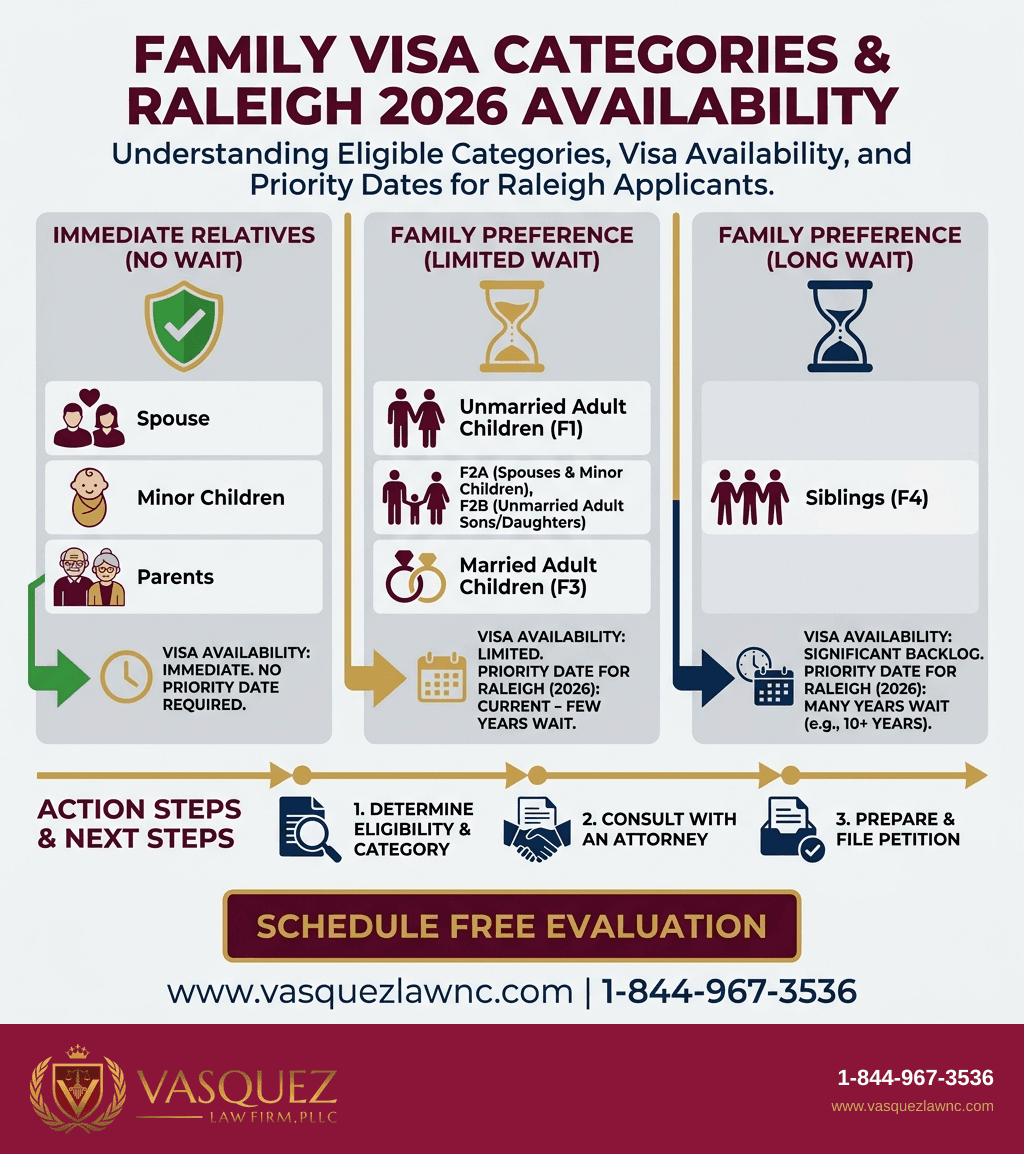
Imagine a Raleigh family where a U.S. citizen wants to bring their sibling from abroad. They must navigate through family-based green card categories, which can affect how long the process takes. Immediate relatives, like spouses or parents, are not subject to annual visa limits and get priority. However, siblings and adult children fall into preference categories with annual caps and longer waits.
Family-based green cards are governed by Immigration and Nationality Act (INA) § 201 and § 203, which define the classes of relatives eligible for sponsorship and their priority. The categories are:
- Immediate Relatives (no numerically limited visas): spouses, unmarried children under 21, parents of U.S. citizens
- Family Preference Categories: siblings, married children, adult children of citizens and LPRs
Understanding these categories helps applicants in Raleigh and Orlando set realistic expectations. For example, a sibling from India may wait over 10 years due to the visa backlog.
Learn more about our immigration services to help you navigate these categories effectively.
Family-Based Green Card Priority Dates
USCIS assigns a priority date when your petition (Form I-130) is received. It is your “place in line.” The Department of State publishes the Visa Bulletin monthly, showing which priority dates are current and when you can proceed to the next step.
Backlogs vary dramatically by country and category. Immediate relatives do not wait for visa numbers but must still process their applications.
Who Qualifies?
A U.S. citizen can petition for a spouse, parent, child, or sibling. A lawful permanent resident (LPR) can petition for a spouse or unmarried children. The qualifying relationship must be proven with official documents, and the petitioner must meet income requirements.
Legal Framework
The petition process is codified under 8 U.S.C. § 1154, which details the responsibilities of petitioners and USCIS oversight. Regulations at 8 C.F.R. § 204 implement these rules. Knowing them helps prevent common mistakes.
Step-by-step Process to Get a Family-Based Green Card
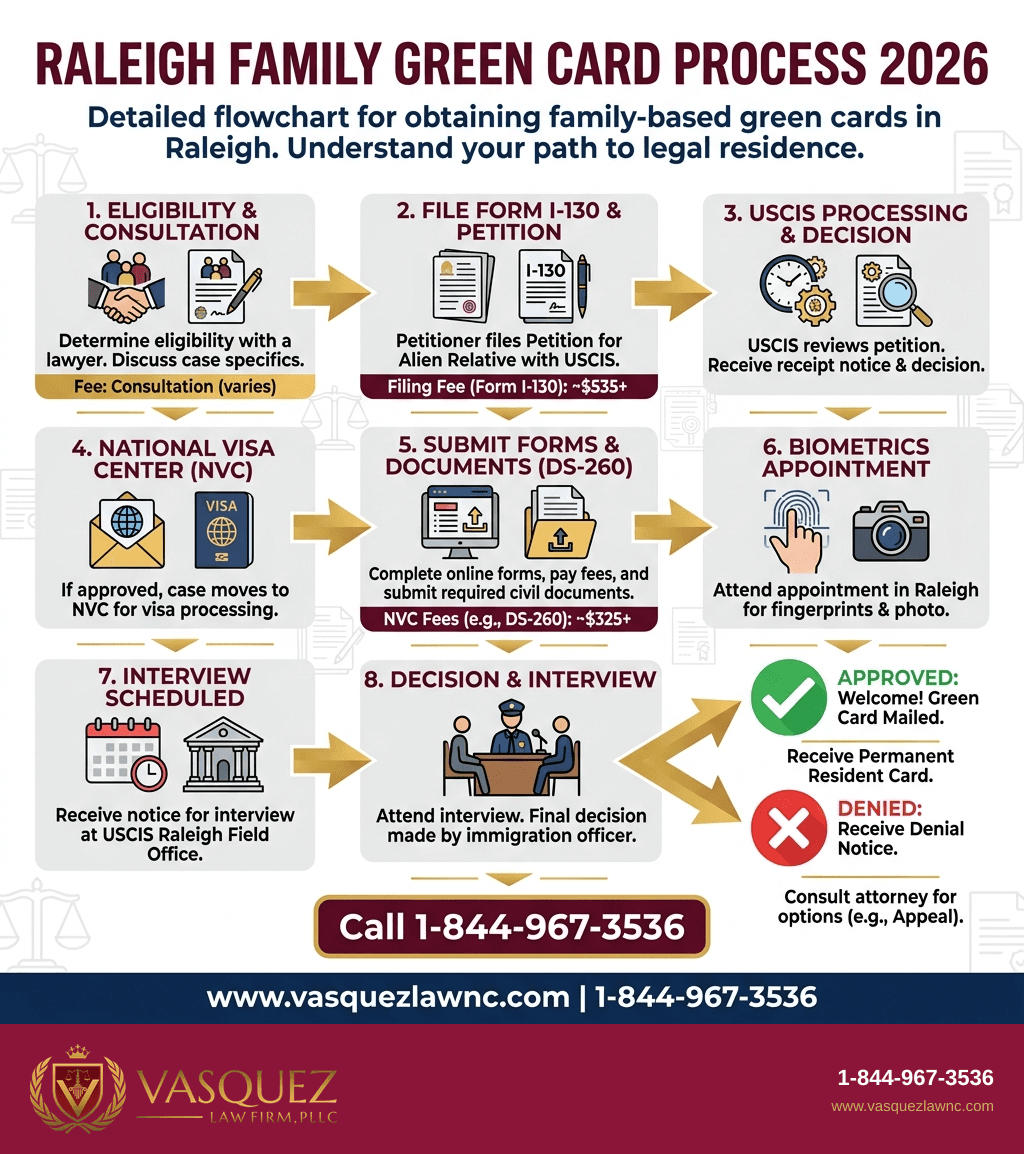
Planning your family-based green card petition in Raleigh begins with a clear sequence of steps. While timelines vary, the main stages include:
- Filing the Petition (Form I-130): The U.S. citizen or LPR files a petition for their relative with USCIS.
- USCIS Processing: USCIS reviews the petition and issues a Notice of Action. Current processing times for Form I-130 at USCIS are approximately 7-12 months as of 2026 (USCIS Processing Times).
- Visa Availability: Once approved, the petition waits for a visa number unless you are an immediate relative.
- Adjustment of Status or Consular Processing: If the applicant is in the U.S., they can apply for adjustment of status using Form I-485. Otherwise, they undergo consular processing at a U.S. embassy or consulate.
- Interview and Final Decision: The applicant will attend a USCIS interview or consular interview where eligibility is verified.
- Receive Green Card: Upon approval, the applicant receives their permanent resident card.
During any phase, legal advice from experts, such as Attorney Vasquez, can improve the chances of success and help prepare for interviews.
USCIS Form Needs
- I-130 Petition for Alien Relative
- I-485 Application to Adjust Status (if in U.S.)
- I-864 Affidavit of Support (financial sponsor form)
- I-765 Work Permit (optional)
- Form DS-260 for Consular Processing applicants
Documents Checklist for Family-Based Green Card Applications
Appropriate documentation is crucial. Below is a checklist commonly required for family-based green cards:
- Proof of U.S. citizenship or permanent resident status of petitioner (birth certificate, passport, green card)
- Proof of family relationship: marriage certificate, birth certificates, adoption records
- Valid passport pages of the beneficiary
- Photographs meeting USCIS guidelines
- Form I-864 Affidavit of Support with petitioner’s financial records (tax returns, pay stubs)
- Medical examination report (Form I-693)
- Police clearance certificates and other country-specific documents (for consular cases)
Missing or incomplete documentation is a leading cause of delays or denials.
Tips on Document Preparation
- Use certified translations for any documents not in English
- Organize originals and copies neatly
- Pay attention to expiration dates (e.g., medical exams)
Timeline and What to Expect during Processing
Processing times differ greatly depending on the family category and country of origin. For example, immediate relative petitions typically take 12-18 months from filing to green card receipt.
Preference categories may wait years, especially for countries with high demand like India or Mexico. For siblings of U.S. citizens, wait times can exceed 12 years.
The following is a typical timeline overview:
- Petition approval: 7-12 months
- Visa availability wait: 0-144+ months depending on category and country
- Adjustment or Consular processing: 6-12 months
Priority dates must be current to proceed with the final steps. This information is updated monthly by the State Department's Visa Bulletin.
Keeping track of your priority date and the Visa Bulletin at travel.state.gov is critical.
Typical Wait Times by Relationship
- Immediate Relatives: less than 18 months
- Spouses and Minor Children of LPRs: 2-4 years
- Unmarried Adult Children: 5-8 years
- Married Adult Children: 10-14 years
- Siblings: 14+ years
Costs and Fees: What Affects the Price
USCIS filing fees are set by regulation, but total costs for family-based green cards also include legal fees, medical exams, travel, and document procurement. In 2026, typical USCIS fees include:
- Form I-130: $535
- Form I-485: $1,140 + $85 biometrics
- Form I-864 Affidavit of Support: no fee
- Medical exam costs: typically $100-$500 depending on provider
Legal fees vary widely based on case complexity. Vasquez Law Firm offers clear fee structures and free case evaluations to estimate total costs upfront.
Additional Expense Factors
- Attorney consultation and representation fees
- Travel costs for consular interviews
- Document translation or certification fees
Common Mistakes When Applying and How to Avoid Them
- Filing incomplete petitions: Missing forms or signatures delay processing. Double-check every document.
- Not proving family relationship adequately: Use certified birth and marriage certificates or notarized affidavits.
- Failing to update USCIS with address changes: This can cause missed notices and delays.
- Ignoring Visa Bulletin priority dates: Trying to file adjustment too early causes denials.
- Applying without financial support proof: The I-864 Affidavit is mandatory; without it the petition fails.
- Missing interview appointments: Rescheduling is difficult and costly.
- Not consulting legal help when complications arise: Issues like prior removal orders or inadmissibility must be addressed professionally.
If you only remember one thing: Carefully prepare your paperwork and stay informed on priority dates to avoid costly delays.
NC and FL Family-Based Immigration Notes
North Carolina Notes
Raleigh residents enjoy access to local USCIS offices for biometrics and sometimes interviews. Vasquez Law Firm is based in Raleigh and specializes in family immigration matters here. Local processing centers’ workload can affect timing.
Some North Carolina courts assist families with immigration-related family law issues such as custody or guardianship.
Florida Notes
For families in Orlando, FL, consular processing at nearby U.S. embassies is common for those outside the U.S. The monthly visa bulletin applies equally. Vasquez Law Firm provides bilingual support to Floridian clients facing these processes as well.
Florida offices have seen increased backlogs in family visa handling during 2026, making timely legal counsel important.
Nationwide Concepts
Family-based green card petitions fall under federal jurisdiction. USCIS and Department of State manage the nationwide visa allocation and adjudication. Waiting periods and visa quotas apply uniformly but vary by country of origin. Understanding this federal structure is key for applicants across all states.
When to Call a Lawyer for Your Family-Based Green Card
- Petition denied or delayed beyond USCIS normal processing times
- Requests for evidence (RFE) you do not understand or cannot fulfill alone
- Complicated family relationships or mixed immigration statuses
- Prior immigration violations or criminal history
- Need guidance on visa backlog and priority date management
- Preparing for USCIS or consular interviews
- Applying for waivers of inadmissibility
- Receiving a notice to appear in immigration court
About Vasquez Law Firm
At Vasquez Law Firm, we combine compassion with aggressive representation. Our motto "Yo Peleo®" (I Fight) reflects our commitment to standing up for your rights.
- Bilingual Support: Se Habla Español — Spanish-speaking attorneys and staff available
- Service Areas: North Carolina, Florida, and nationwide immigration services
- Experience: Over 30 years helping clients navigate complex legal matters
- Results: Thousands of successful cases across multiple practice areas
Attorney Trust and Experience
William J. Vasquez is admitted to the North Carolina State Bar (2011) and to the U.S. Courts of Appeals for the 4th, 5th, and 11th Circuits. Florida-jurisdiction matters at the firm are handled by Florida Bar attorney Harold Estrada-Rodriguez. The firm has provided dedicated legal representation since 2011, with personalized attention to each client's case.
Don't wait to get the help you deserve. Call us now for immediate assistance.
Se Habla Español
Frequently Asked Questions
How long does it take to get a family-based green card?
Family-based green card processing times vary by category and country. For immediate relatives of U.S. citizens in 2026, processing is about 12-18 months. Others may wait much longer, especially with high-demand countries. Checking USCIS Form I-130 processing times offers current estimates.
What are the new green card rules for 2026?
USCIS updated document requirements in 2026, emphasizing stronger evidence of family ties and speeding processing with electronic applications. However, eligibility criteria remain based on Immigration and Nationality Act sections 201 and 203.
Who qualifies for a family-based green card?
Immediate relatives (spouses, parents, children) of U.S. citizens and certain family preference categories qualify. Eligibility depends on petitioner’s status and documented family relationship under U.S. law.
Can a family-based green card application be denied?
Applications may be denied for insufficient evidence, inadmissibility, fraud, or background issues. Legal advice after denial helps explore appeals or motions to reopen.
What documents are needed for a family-based green card?
Essential documents include proofs of citizenship or residency status, family relationship certificates, financial support forms, and a medical exam report. Translations are required for non-English documents.
How does the priority date affect family-based visas?
The priority date is your petition filing date and governs your queue position for visa allocation. Waiting varies by category and country. The Visa Bulletin publicly tracks this info monthly.
Can I work while waiting for my family-based green card?
If filing adjustment of status, you may apply for a work permit using Form I-765. Eligibility depends on your current status. Work authorization shortens waiting impacts.
What happens after my family-based green card is approved?
Once approved, you receive permanent residency and can work and travel within USCIS guidelines. After meeting residency requirements, naturalization may be available.
Sources and References
- U.S. Citizenship and Immigration Services
- Executive Office for Immigration Review
- Legal Information Institute
Take the first step toward justice today. Our team is standing by to help.
Start Your Free Evaluation Now
Call us: 1-844-967-3536
Se Habla Español - Estamos aquí para ayudarle.


William Vasquez
Founder & CEO, Vasquez Law Firm, PLLC
William Vasquez is the founder and CEO of Vasquez Law Firm, PLLC, a results-driven firm specializing in immigration, criminal defense, personal injury, and workers' compensation. A U.S. Air Force veteran and recipient of the Joint Service Achievement Medal, William is dedicated to fiercely fighting for his clients' rights.
Related Legal Services
Need legal help? Learn more about our immigration legal services, or contact us for a free evaluation.
You can also visit North Carolina immigration lawyers for more information.