How DHS Impacts Immigration Cases in Raleigh and Orlando in 2026
Learn how DHS impacts immigration in Raleigh and Orlando. Know your rights, processes, and next steps. Contact Vasquez Law for a free evaluation today.
Published on June 8, 2026
Talk to an immigration attorney
Free call. A clear plan for your case.
Free & confidential · Se habla espanol · 24/7
Have questions? Talk to an attorney - free evaluation.
Call 1-844-967-3536Worried how the latest immigration news affects you?
Schedule a confidential case review with an immigration attorney - know exactly where you stand.
How DHS Impacts Immigration Cases in Raleigh and Orlando in 2026
The Department of Homeland Security (DHS) plays a critical role in immigration enforcement and processing across the United States, including in Raleigh, NC, and Orlando, FL. In 2026, changes in DHS policies, such as the recent legal ruling against freezing legal immigration, profoundly impact immigrants striving to live and work legally. Understanding how DHS functions and what it means for your immigration status is essential to protect your rights. This guide explains DHS’s role, actions you need to take, common mistakes to avoid, and resources available to immigrants in North Carolina and Florida.
Need help with your case? Our experienced attorneys are ready to fight for you. Se Habla Español.
Or call us now: 1-844-967-3536
Quick Answer
The Department of Homeland Security (DHS) manages immigration enforcement, border security, and immigration services nationwide. Its decisions affect immigrant rights and case processing times in Raleigh and Orlando. Recent legal rulings in 2026 may speed up previously delayed immigration processing.
- DHS enforces immigration laws and policies.
- Includes agencies like ICE and USCIS.
- Recent court rulings impact immigration freezes.
- DHS affects work permits and removal proceedings.
- Knowing your DHS rights protects your case outcome.
Understanding DHS and Its Role in Immigration
In Raleigh, NC, and Orlando, FL, the Department of Homeland Security (DHS) is the primary federal agency responsible for enforcing immigration laws. DHS oversees various agencies that handle immigration benefits, enforcement, and border security. The U.S. Citizenship and Immigration Services (USCIS), Immigration and Customs Enforcement (ICE), and Customs and Border Protection (CBP) operate under DHS's authority.
DHS manages the legal immigration process, including family petitions, work permits, visas, asylum, and removal proceedings. For instance, USCIS, a DHS agency, processes green card applications, work authorizations, and citizenship petitions. ICE enforces immigration laws, carries out arrests, and detains individuals subject to removal.
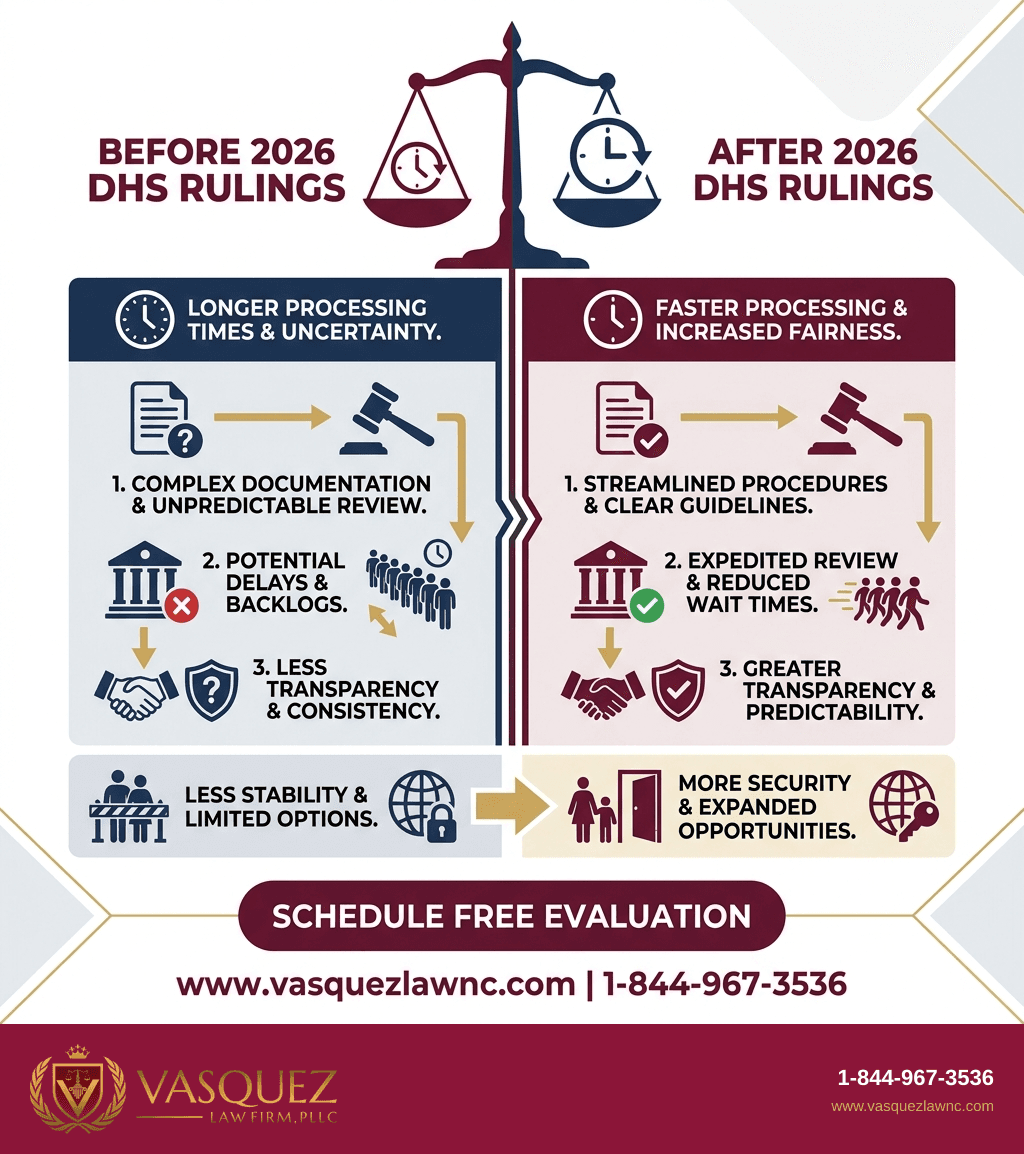
In 2026, DHS plays a central role in enforcing recent policy changes, including the impact of a court ruling that found DHS unlawfully froze certain legal immigration processing. This ruling in early 2026 reopened avenues for many immigrants whose applications had been paused. This development significantly affects immigrants in Raleigh and Orlando, where immigration cases process under DHS supervision.
For more information about how DHS functions in immigration, you can visit the U.S. Citizenship and Immigration Services website, the primary component of DHS responsible for processing immigration benefits.
DHS Agencies Relevant to Immigrants
- USCIS: Processes immigration benefits and petitions.
- ICE: Conducts enforcement, arrests, and detention.
- CBP: Manages border entries and exits.
Understanding the specific role each agency plays will help you better manage your immigration case and interact effectively with DHS.
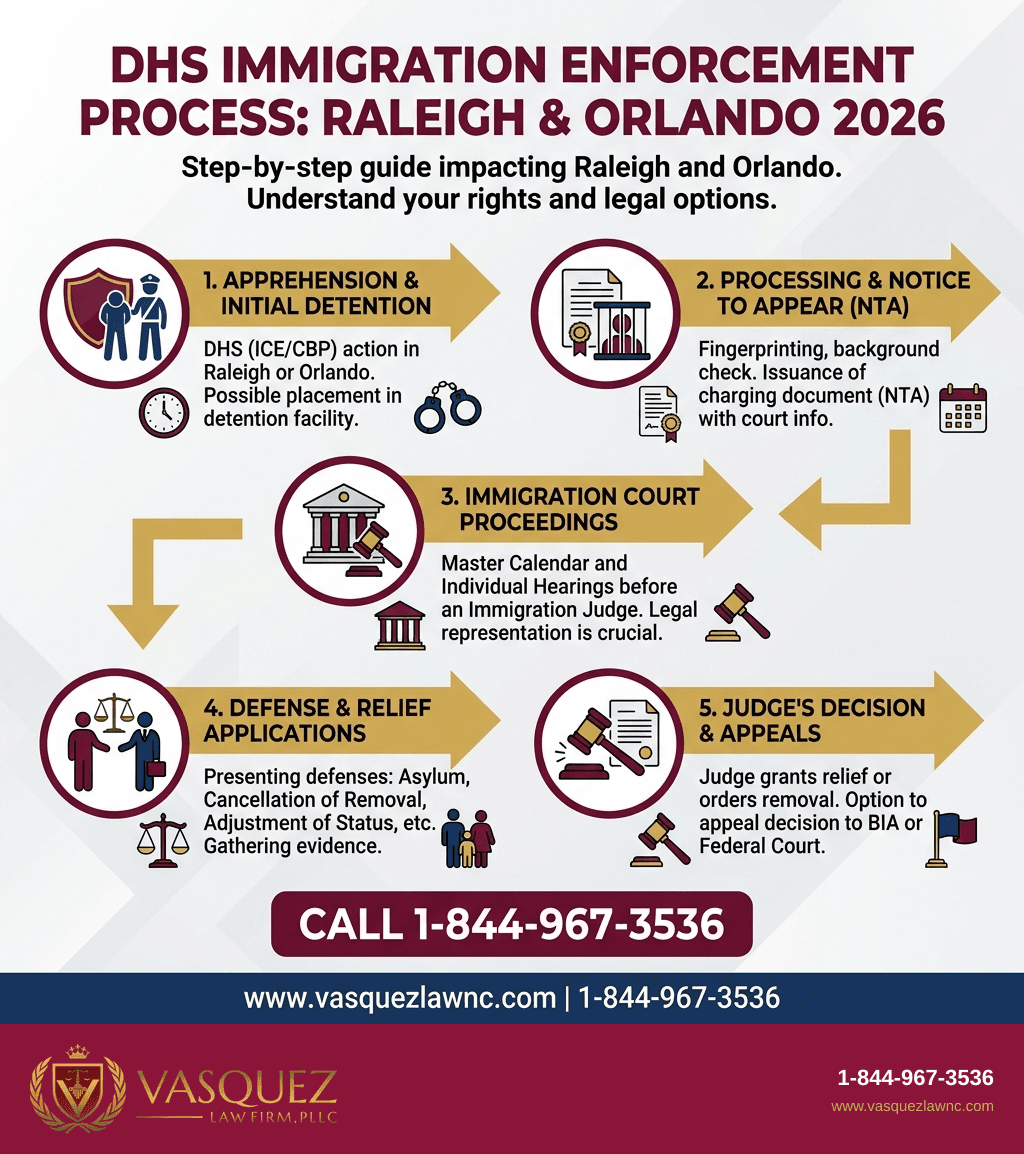
Step-by-Step: How DHS Immigration Enforcement Works
Imagine an immigrant applying for a work permit in Raleigh. The process starts with submitting form I-765 to USCIS, a DHS division. USCIS reviews the application and validates eligibility. Once approved, DHS issues a work permit allowing the immigrant to work legally. This is just one example of DHS immigration processing.
However, if enforcement comes into play, such as an ICE arrest, the scenario changes fundamentally. ICE agents might detain an individual if they believe deportation proceedings should begin. The person receives a Notice to Appear (NTA) in immigration court, which DHS also manages through the Executive Office for Immigration Review (EOIR).
In such cases, knowing your rights immediately is critical. DHS enforcement actions can lead to deportation unless legal defenses or relief apply. The legal process includes hearings, possible appeals, and final judgments. Understanding DHS procedures greatly impacts the outcome.
The DHS Immigration Enforcement Process
- Application Submission: Submit necessary forms to USCIS (e.g., I-485, I-765).
- DHS Review: USCIS or ICE reviews and processes requests.
- Enforcement Decisions: ICE may detain or issue NTA if removal is pursued.
- Immigration Court Hearings: EOIR manages court proceedings.
- Final Outcome: Cases resolved by approval, denial, or removal order.
DHS continuously updates policies affecting timelines and procedures, so staying informed is necessary.
Documents and Evidence to Prepare for DHS Cases
Handling a DHS-related immigration case requires thorough preparation. You need key documents to prove your identity, eligibility, and legal status. Below is a checklist of essential evidence to gather when dealing with DHS immigration processes:
- Valid government-issued photo ID (passport, driver’s license).
- Proof of lawful entry or status (visas, I-94 records).
- Copies of petitions or applications filed with USCIS.
- Work authorization documents or receipts (Form I-765 receipt).
- Evidence of family relationship for family-based petitions.
- Criminal and background check documents, if required.
- Any correspondence from DHS or EOIR regarding your case.
Keeping this documentation organized and accessible is crucial for successful interactions with DHS offices and courts. Vasquez Law Firm can assist in identifying necessary documents early to avoid delays.
Timeline: What to Expect from DHS in 2026
Immigration case timelines vary but typically follow a general sequence. For example, a work permit (Form I-765) processing currently averages 3 to 5 months according to USCIS processing times as of 2026. Other applications, such as adjustment of status (Form I-485), may take from 8 to 14 months depending on case complexity.
The recent court ruling against DHS freezing legal immigration means that some pending cases may advance faster than expected this year. However, expect some delays due to backlogs created by the prior freeze.
Immigration enforcement actions by ICE typically follow standard procedures: from a detention or notice to appear, there may be hearings within 1-3 months, followed by continued court proceedings that could extend over many months or years based on appeals and relief applications.
Typical DHS Timeline for Immigration Cases
- 0-2 Months: Initial application submission and receipt notice.
- 3-6 Months: DHS review and possibly a request for additional evidence.
- 6-12 Months: Immigration court hearings or final adjudication for enforcement cases.
- 12-18 Months: Appeals and final decisions if applicable.
Staying proactive and legal support can help navigate these timelines successfully.
Common DHS Immigration Mistakes and How to Avoid Them
- Missing deadlines: Late filing risks denial - fix by setting reminders and consulting legal aid early.
- Submitting incomplete documents: Leads to delays - always double-check forms and certifications.
- Ignoring DHS notices: Non-response can cause deportation - immediately read and respond or seek attorney help.
- Using incorrect forms: USCIS updates forms periodically - download current versions from official sources.
- Misunderstanding eligibility: Applying without qualifying evidence - verify eligibility with expert guidance first.
- Failing to disclose criminal history: Could harm case credibility - disclose fully and seek legal advice.
- Assuming local policies match federal: Raleigh and Orlando differ from other jurisdictions - use local legal counsel.
If you only remember one thing: Always consult an experienced immigration attorney at Vasquez Law Firm before submitting applications or responding to DHS enforcement actions to avoid costly mistakes.
Jurisdiction Notes: Raleigh, Orlando, and Nationwide Context
North Carolina Notes
In Raleigh, DHS offices coordinate with local immigration courts and ICE field offices overseeing enforcement and processing. Local USCIS service centers handle benefit applications, employing officers familiar with North Carolina immigrant communities. Due to state-specific policies and demographic factors, legal strategies differ from other states.
Florida Notes
In Orlando, DHS manages sizeable immigrant populations through USCIS and ICE. Florida’s enforcement approach also involves collaboration with local law enforcement, impacting immigrant safety and compliance conditions. Policy shifts in 2026, including greater access to work permits post-legal freeze, benefit many immigrants in Florida.
Nationwide Concepts (General Only, Rules Vary)
DHS immigration enforcement is federally controlled, but local implementations vary considerably. Policies pending in Congress or federal courts can impact case outcomes unevenly. National indexes and USCIS data help track trends but consult local counsel to understand how national changes apply specifically.
When to Call a Lawyer about DHS Immigration Matters
- If you receive a Notice to Appear from DHS or EOIR.
- After being detained or having immigration contact with ICE.
- When filing applications needing complex documentation like asylum or cancellation of removal.
- If DHS requests additional evidence or issues a Request for Evidence (RFE).
- If you are uncertain about eligibility for immigration benefits.
- Following receipt of any DHS immigration enforcement or removal orders.
- For help navigating recent DHS policy or court ruling impacts.
- If you are a DACA recipient needing renewal advice due to policy changes.
About Vasquez Law Firm
At Vasquez Law Firm, we combine compassion with aggressive representation. Our motto "Yo Peleo®" (I Fight) reflects our commitment to standing up for your rights. Our team serves clients in Raleigh, NC, Orlando, FL, and nationwide immigration matters. With over 30 years of collective experience, we have helped thousands of individuals understand and assert their rights amid DHS immigration procedures.
- Bilingual Support: Se Habla Español — Spanish-speaking attorneys and staff available.
- Service Areas: North Carolina, Florida, and nationwide immigration services.
- Experience: Over 30 years helping clients navigate complex legal matters.
- Results: Thousands of successful cases across multiple practice areas.
Attorney Trust and Experience
William J. Vásquez is admitted to the North Carolina State Bar (2011) and to the U.S. Courts of Appeals for the 4th, 5th, and 11th Circuits. Florida-jurisdiction matters at the firm are handled by Florida Bar attorney Harold Estrada-Rodriguez (FL Bar No. 1041171). The firm has provided dedicated legal representation since 2011, with personalized attention to each client's case.
Don't wait to get the help you deserve. Call us now for immediate assistance.
Se Habla Español
Frequently Asked Questions
What does DHS stand for?
DHS stands for the Department of Homeland Security, responsible for immigration enforcement, border protection, and disaster response nationwide. It was created in 2002 to consolidate various agencies handling national security.
Is DHS the same as ICE?
ICE is a branch within DHS focused on immigration enforcement and removal operations. DHS is the larger department that includes other agencies like USCIS and CBP handling benefits and border security.
What does the recent DHS legal immigration freeze ruling mean?
A court decision in 2026 found DHS unlawfully froze legal immigration programs. This means immigration case processing, delayed for many, can move forward, impacting applications in Raleigh and Orlando positively.
How do I check my DHS immigration case status?
You can check your case status using the USCIS online tool with your receipt number. DHS also offers portals for certain services. Always use official government sites for accurate information.
What documents does DHS require for immigration processing?
DHS requires identification, proof of entry, supporting forms like I-485 or I-765, and other documents proving eligibility. Missing documents can delay your case significantly.
Can DHS detain immigrants during their case process?
Yes, under regulation 8 C.F.R. § 236.1, DHS can detain individuals subject to removal proceedings if they pose risks, which can impact how your case proceeds.
What should I do if I receive a DHS immigration notice?
Read it carefully, keep records, and consult an immigration attorney immediately. Ignoring such notices may lead to deportation or legal penalties.
How does DHS affect Dreamers and DACA recipients?
DHS manages DACA work authorizations. Changes in policies and court rulings like the 2026 freeze impact renewals and protections. Timely renewals and legal assistance are essential.
Sources and References
- U.S. Citizenship and Immigration Services
- Executive Office for Immigration Review
- Legal Information Institute
Take the first step toward justice today. Our team is standing by to help. Se Habla Español.
Start Your Free Evaluation Now
Call us: 1-844-967-3536
Se Habla Español - Estamos aquí para ayudarle.
If you need legal assistance, learn more about experienced immigration attorneys in Charlotte, or call us at 1-844-967-3536 for a free evaluation.

William Vasquez
Founder & CEO, Vasquez Law Firm, PLLC
William Vasquez is the founder and CEO of Vasquez Law Firm, PLLC, a results-driven firm specializing in immigration, criminal defense, personal injury, and workers' compensation. A U.S. Air Force veteran and recipient of the Joint Service Achievement Medal, William is dedicated to fiercely fighting for his clients' rights.
Related Legal Services
Need legal help? Learn more about experienced immigration attorneys in Charlotte, or contact us for a free evaluation.
You can also visit immigration legal services throughout NC for more information.