How USCIS Court Stay Affects TPS and Asylum Policies in 2026?
The USCIS court stay issued July 21, 2026, pauses enforcement of new policies on TPS-based EAD expirations and asylum fee nonpayment. This affects TPS holders and asylum applicants in Raleigh, NC and Orlando, FL. Learn who is impacted, what the law says, and what steps to take now.
Published on July 23, 2026
Talk to an immigration attorney
Free call. A clear plan for your case.
Free & confidential · Se habla espanol · 24/7
Have questions? Talk to an attorney - free evaluation.
Call 1-844-967-3536Free Tool
Check Your USCIS Case Status Now
Enter your receipt number - get the official USCIS status in English or Spanish. No registration.
This article gives general legal information, not personalized legal advice. Reading it does not create a lawyer-client relationship. For advice about your own case, contact Vasquez Law Firm.
What did the court order about USCIS policies on TPS and asylum in July 2026?
Seeking Asylum in the US?
You must file within 1 year of arrival. Our attorneys can help build your case.
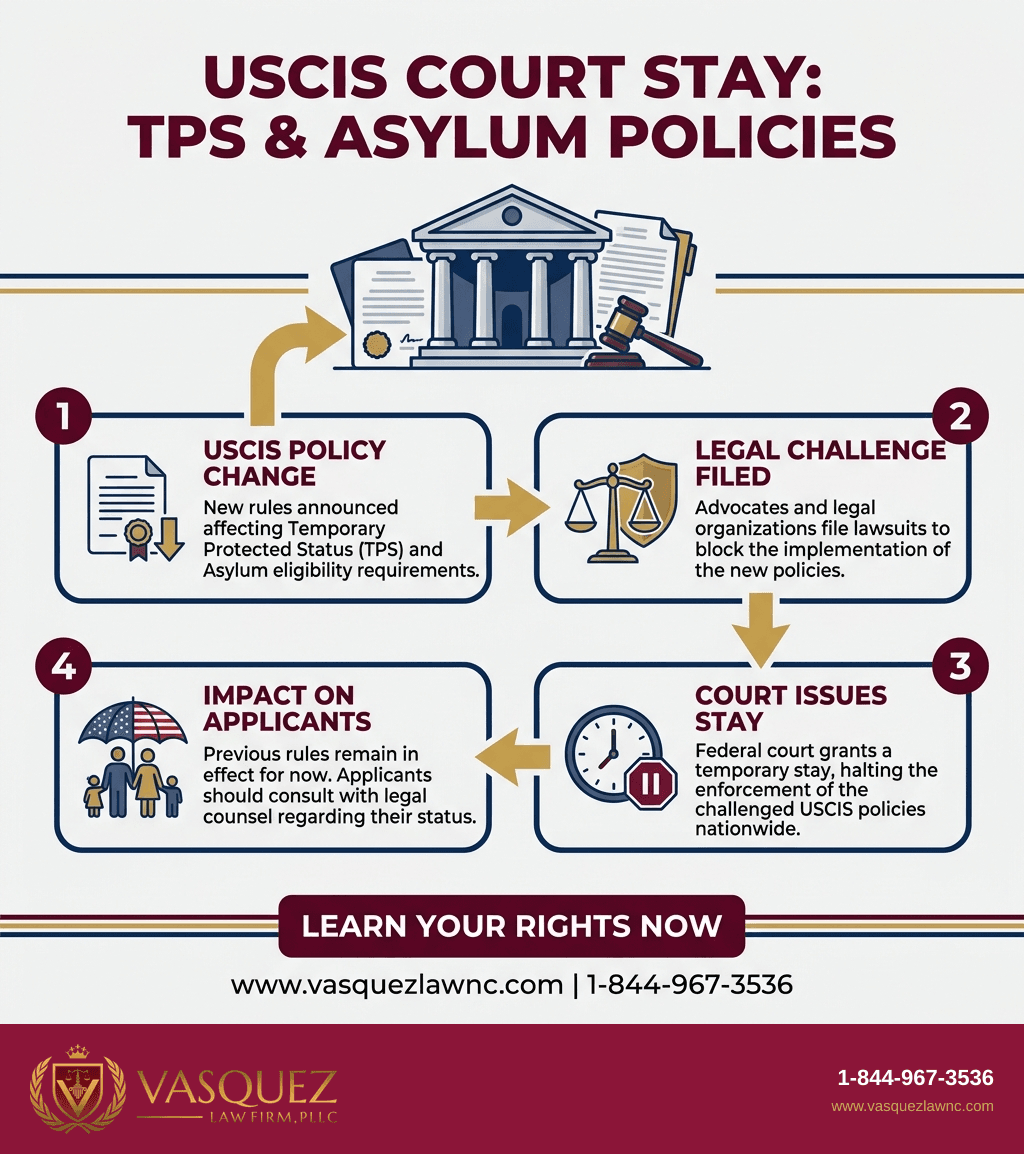
On July 21, 2026, the U.S. District Court for the District of Massachusetts issued an administrative stay. An administrative stay is a temporary pause on certain government actions. This stay stops some USCIS policies about Temporary Protected Status (TPS) and asylum applicants. TPS is a temporary immigration status that lets people from certain countries live and work in the U.S. if their home country is unsafe. The stay affects deadlines for TPS-based employment authorization documents (EADs), asylum application rejections for not paying the annual asylum fee (AAF), ending work authorization for not paying, and removal (deportation) actions based only on not paying the AAF.
This court order means USCIS must keep the old expiration dates for TPS-based EADs that were extended before. USCIS cannot reject asylum applications or end work authorization just because someone did not pay the AAF. But USCIS can still collect the AAF as usual.
The court’s decision came from the case Venez. Ass’n of Mass., et al. v. United States Citizenship and Immigr. Servs., et al., 26-cv-13038 -NMG (D. Mass.). The plaintiffs are groups representing TPS holders and people with pending asylum applications. They challenged USCIS policies based on H.R. 1, the Reconciliation Act of 2025.
This stay applies to parts of the July 2025 Federal Register Notice, the March 2026 USCIS website update, and the April 2026 Interim Final Rule (IFR) about these policies. USCIS will follow the court’s order while the case continues.
The court also said that all other fees and rules under H.R. 1 stay in effect. USCIS will update instructions as the case moves forward.
This ruling is an important court action affecting how USCIS applies new immigration fee and work authorization rules.
Who is affected by the USCIS administrative stay on TPS and asylum policies?
The stay mainly affects people with Temporary Protected Status (TPS) and those with pending asylum applications who face new USCIS rules about work authorization and fees. TPS holders with extended EADs will keep their old expiration dates. This stops sudden loss of work permission.
Asylum applicants who have not paid the annual asylum fee (AAF) will not have their applications rejected or work authorization ended just for not paying while the stay is active. This helps many vulnerable immigrants who depend on work permits and asylum protections.
In Raleigh, NC, a city with many immigrants including TPS holders and asylum seekers, this stay gives important relief to thousands at risk of losing legal work status. In Orlando, FL (where our Florida office is), many clients also benefit from the court’s temporary pause on these policies.
USCIS data shows about 300,000 people nationwide have TPS. Hundreds of thousands more have pending asylum claims. The main source does not give exact numbers for North Carolina or Orlando, but the local impact is large because of the immigrant population.
The stay also affects employers who hire TPS holders or asylum applicants with work authorization. They must keep following the old EAD expiration dates. They cannot use USCIS policy changes to end jobs based on fee nonpayment.
Importantly, the court’s order lets USCIS keep collecting the AAF. So affected people still need to pay fees if they get notices. Not paying may cause problems after the stay ends.
What does the law say about USCIS’s power over TPS and asylum fee policies?
USCIS’s power to control work authorization and fee collection for TPS holders and asylum applicants comes from federal laws and rules. The Immigration and Nationality Act (INA) gives USCIS discretion over work authorization under 8 U.S.C. A7 1255 and asylum procedures under 8 U.S.C. A7 1158.
The Reconciliation Act of 2025 (H.R. 1), also called the One Big Beautiful Bill Act, created new rules about TPS-based EAD expiration dates and added an annual asylum fee (AAF) for pending asylum applicants.
The court’s administrative stay challenges how USCIS applies these rules. It focuses on the agency’s power to end work authorization and start removal actions based on fee nonpayment.
The court’s order says:
"The courts order stays the following parts of the July 2025 Federal Register Notice (FRN), March 2026 website Update, and April 2026 Interim Final Rule (IFR): Application of H.R. 1 to TPS-based employment authorization document (EAD) expiration deadlines, meaning that any TPS-based EAD previously extended shall keep its prior expiration date; Rejection of asylum applications for failure to pay the annual asylum fee (AAF); Ending work authorization because of not paying the AAF; and Starting removal procedures based only on a persons failure to pay the AAF." (Source: USCIS, https://www.uscis.gov/newsroom/alerts/court-issues-administrative-stay-of-certain-uscis-policies)
This blockquote shows what the stay covers and how it limits USCIS enforcement temporarily.
Federal rules say work authorization for TPS holders is under 8 CFR A7 274a.12. This rule lists who can work legally. The stay stops USCIS from changing EAD expiration dates under the new rules.
Asylum procedures and fee rules are under 8 U.S.C. A7 1158 and related rules. The courts stay shows the court is concerned about whether it is legal or fair to enforce fee-related denials and removals.
What should TPS holders and asylum applicants do because of the USCIS court stay?
People with TPS or pending asylum claims should watch USCIS messages closely and keep following fee payment instructions. Even though the court stay stops USCIS from rejecting applications or ending work authorization just for not paying the annual asylum fee (AAF), USCIS still wants payment when it sends notices.
At our Raleigh, NC and Orlando, FL offices, many clients are confused about whether to pay the AAF during this legal uncertainty. We advise paying the fee quickly if you get a notice. This helps avoid problems after the stay ends.
Here are important steps for affected people:
- Keep all USCIS notices and papers about your TPS or asylum applications.
- Pay the annual asylum fee (AAF) if you get a payment notice. Follow the instructions carefully.
- Do not assume your work authorization will end because of USCIS policy changes; keep your work documents updated.
- Talk to an experienced immigration lawyer, especially if you get notices about ending work authorization or removal because of fee nonpayment.
- Stay updated on USCIS news and court decisions that affect your case.
Ignoring fee notices or not acting could cause problems after the stay ends. A lawyer can help you understand the rules during the stay and prepare for possible changes.
Below is a table that shows the main differences before and after the courts administrative stay:
| Policy Aspect | Before Court Stay | After Court Stay |
|---|---|---|
| TPS-based EAD Expiration | Extended EAD expiration dates updated under H.R. 1 | Keep old expiration dates for extended EADs |
| Asylum Application Rejection | Rejected for not paying annual asylum fee (AAF) | Cannot reject only for not paying AAF |
| Work Authorization Termination | Ended if AAF not paid | No ending just for AAF nonpayment |
| Removal Proceedings | Started for not paying AAF | No removal based only on AAF nonpayment |
| Fee Collection | USCIS collects AAF | USCIS keeps collecting AAF |
People should also check if they can apply for adjustment of status (getting a green card) under 8 U.S.C. A7 1255 and related rules. This may offer other immigration options.
Getting legal advice now is very important to avoid mistakes and follow changing USCIS rules.
What happens next with the USCIS policies and court case?
The administrative stay from the U.S. District Court is temporary. It will last while the court case Venez. Ass’n of Mass., et al. v. United States Citizenship and Immigr. Servs., et al., 26-cv-13038 -NMG (D. Mass.) continues.
The court is still deciding if H.R. 1 rules about TPS and asylum applicants are legal and how they should be applied. USCIS said it will give updated instructions as the case develops.
USCIS can still collect the annual asylum fee (AAF), but it cannot take enforcement actions for nonpayment right now. This shows the court is balancing agency power and immigrant rights.
The court’s order also says:
What's Your Immigration Situation?
Answer 3 questions - we'll tell you your options
Question 1 / 3
What best describes your situation?
Keep Reading
"USCIS will follow the courts order while the case continues. The courts order allows USCIS to keep collecting the AAF. So, anyone who gets a notice about the AAF must pay the fee as the notice says. All other fees and rules of H.R. 1 stay in effect." (Source: USCIS, https://www.uscis.gov/newsroom/alerts/court-issues-administrative-stay-of-certain-uscis-policies)
Immigration groups should watch for future court decisions or agreements that may change or end the stay. USCIS may also give new guidance or change policies to meet the courts concerns.
For people in Raleigh, NC and Orlando, FL, staying informed through trusted legal sources and talking to immigration lawyers will be key to respond quickly to any changes.
This ongoing case shows how laws, agency rules, and courts all work together in immigration policy.
Frequently Asked Questions about the USCIS court stay on TPS and asylum policies
What is the impact of the court stay on TPS-based EAD expiration dates?
The court stay requires USCIS to keep the old expiration dates for any TPS-based employment authorization documents (EADs) that were extended before. This means TPS holders will not lose work permission because of new expiration rules until the court decides more.
Can USCIS reject asylum applications for failure to pay the annual asylum fee during the stay?
No. The courts administrative stay stops USCIS from rejecting asylum applications just because the applicant did not pay the annual asylum fee (AAF). But applicants still must pay the fee if they get a notice.
Does the court stay affect USCISs ability to collect the annual asylum fee?
No. USCIS can keep collecting the annual asylum fee (AAF) even during the stay. Applicants must pay the fee as USCIS says to avoid future problems.
What should asylum applicants do if they receive a fee notice during the stay?
Applicants should follow the payment instructions in the USCIS notice and pay the annual asylum fee (AAF) on time. Not paying may cause problems after the stay ends.
How long will the USCIS policies remain stayed?
The stay is temporary and will last while the court case Venez. Ass’n of Mass., et al. v. USCIS continues. The exact time depends on future court decisions.
This article gives general legal information, not personalized legal advice. Reading it does not create a lawyer-client relationship. For advice about your own case, contact Vasquez Law Firm.
Reviewed by William Vasquez, Founder & CEO, Vasquez Law Firm, PLLC.
If you need legal help, learn more about how our immigration attorneys can help, or call us at 1-844-967-3536 for a free evaluation.
Related Topics

William Vasquez
Founder & CEO, Vasquez Law Firm, PLLC
William Vasquez is the founder and CEO of Vasquez Law Firm, PLLC, a results-driven firm specializing in immigration, criminal defense, personal injury, and workers' compensation. A U.S. Air Force veteran and recipient of the Joint Service Achievement Medal, William is dedicated to fiercely fighting for his clients' rights.
Related Legal Services
Need legal help? Learn more about how our immigration attorneys can help, or contact us for a free evaluation.
You can also visit North Carolina immigration law firm for more information.