How AI Adoption Impacts Workers Compensation Claims in 2026
Explore how AI adoption affects workers compensation claims in 2026. Learn key facts and get help from Vasquez Law. Contact us for a free consultation.
Published on March 20, 2026
Hurt on the job?
Free review of your workers' comp claim.
Free & confidential · Se habla espanol · 24/7
Have questions? Talk to an attorney - free evaluation.
Call 1-844-967-3536Hurt on the Job? Claim What You Are Owed
A review of your workers' comp claim - we handle the fight.
How AI Adoption Impacts Workers Compensation Claims in 2026
AI adoption is transforming how North Carolina and Florida handle workers compensation claims. In 2026, artificial intelligence helps process claims faster but also raises new challenges for injured workers. Understanding AI's role can protect your rights and improve your claim results. Vasquez Law Firm provides compassionate, bilingual support to guide you through this evolving landscape.
Need help with your case? Our experienced attorneys are ready to fight for you. Se Habla Español.
Schedule Your Free Case Evaluation
Or call us now: 1-844-967-3536
Quick Answer
AI adoption means using artificial intelligence to automate and improve workers compensation claims processing. It speeds decisions but may risk overlooking your proof. Know your rights and consult Vasquez Law Firm for help protecting your benefits.
- Automates claim evaluations
- Flags potential fraud
- Reduces processing time
- May cause claim denials
- Legal appeal is possible
Understanding AI Adoption in Workers Compensation
In 2026, AI adoption is no longer a futuristic concept but a present-day reality in North Carolina and Florida workers compensation systems. Approximately 40% of insurers have incorporated AI tools to analyze claims data, identify patterns, and speed administrative tasks. These tools include predictive analytics to estimate claim outcomes and natural language processing to review medical reports quickly.
AI adoption meaning in workers compensation revolves around automating repetitive tasks and assisting human adjusters in decision-making. However, some cases require nuanced human judgment that AI cannot fully replicate. This leads to challenges and risks for injured workers who may face denials based on automated algorithms rather than personalized evaluations.
The rapid rise in AI adoption comes as part of broader digital transformation efforts across insurance sectors. AI adoption strategy varies by company but focuses on cost reduction and improving accuracy. Yet no system is flawless, making legal counsel essential to protect your rights.
Learn more about our workers compensation services.
AI Adoption By Country and Region
Internationally, AI adoption rates vary. The US, especially in states like North Carolina and Florida, leads with higher integration compared to other regions. This is partly due to the complexity and volume of claims and the push for efficient service delivery. Workers in Orlando and across these states increasingly encounter AI-driven claim processes, affecting how benefits are approved or denied.
AI Adoption Challenges
While AI improves speed, problems arise when it defaults to data biases or incomplete medical records. Workers face higher failure rates in claims because AI systems might misinterpret symptoms or undervalue injuries. The "30% rule" in AI, indicating error rates in some algorithms, reminds users to keep an eye on automated decisions.
Legal Perspective
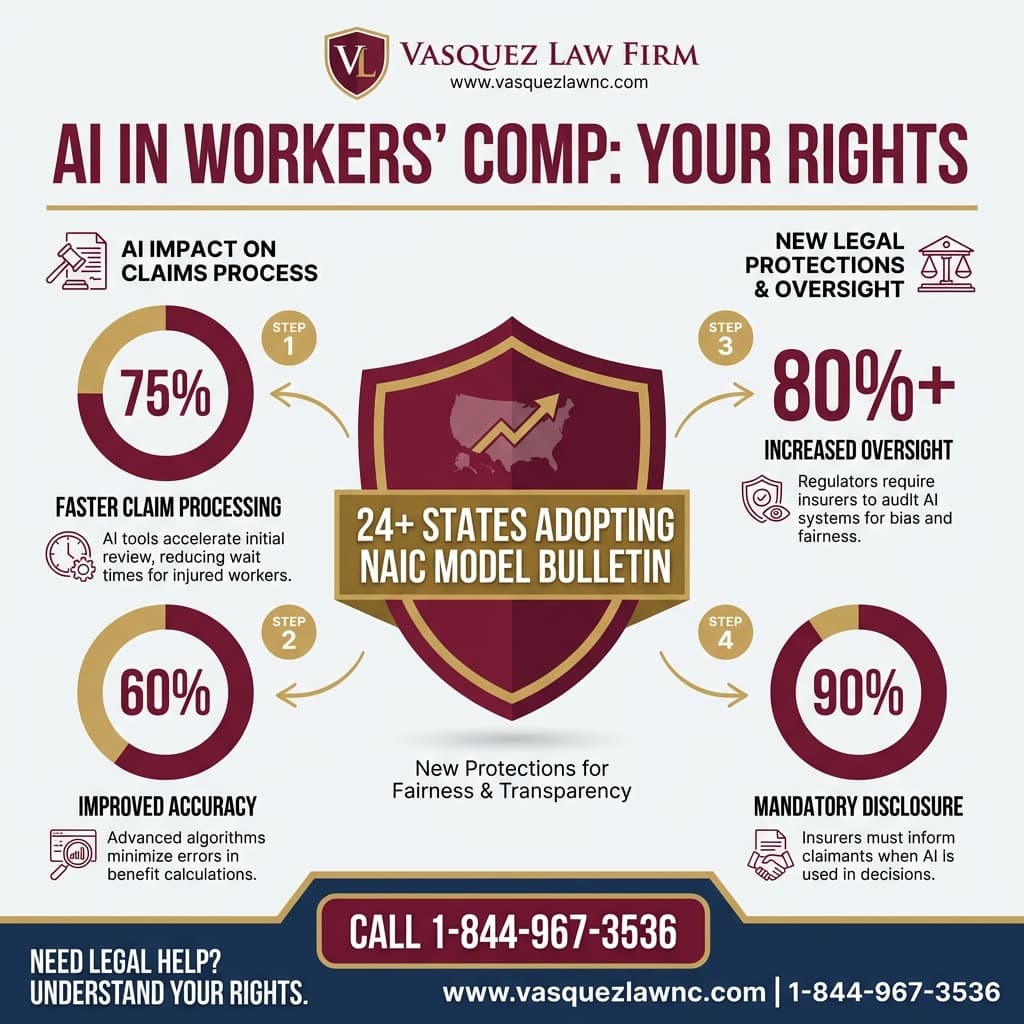
From a legal standpoint, the use of AI in workers compensation claims must comply with state statutes such as N.C. Gen. Stat. § 97-2 and Fla. Stat. § 440.015. Regulators monitor transparency and fairness, ensuring workers get proper notice and appeal rights if AI impacts decisions.
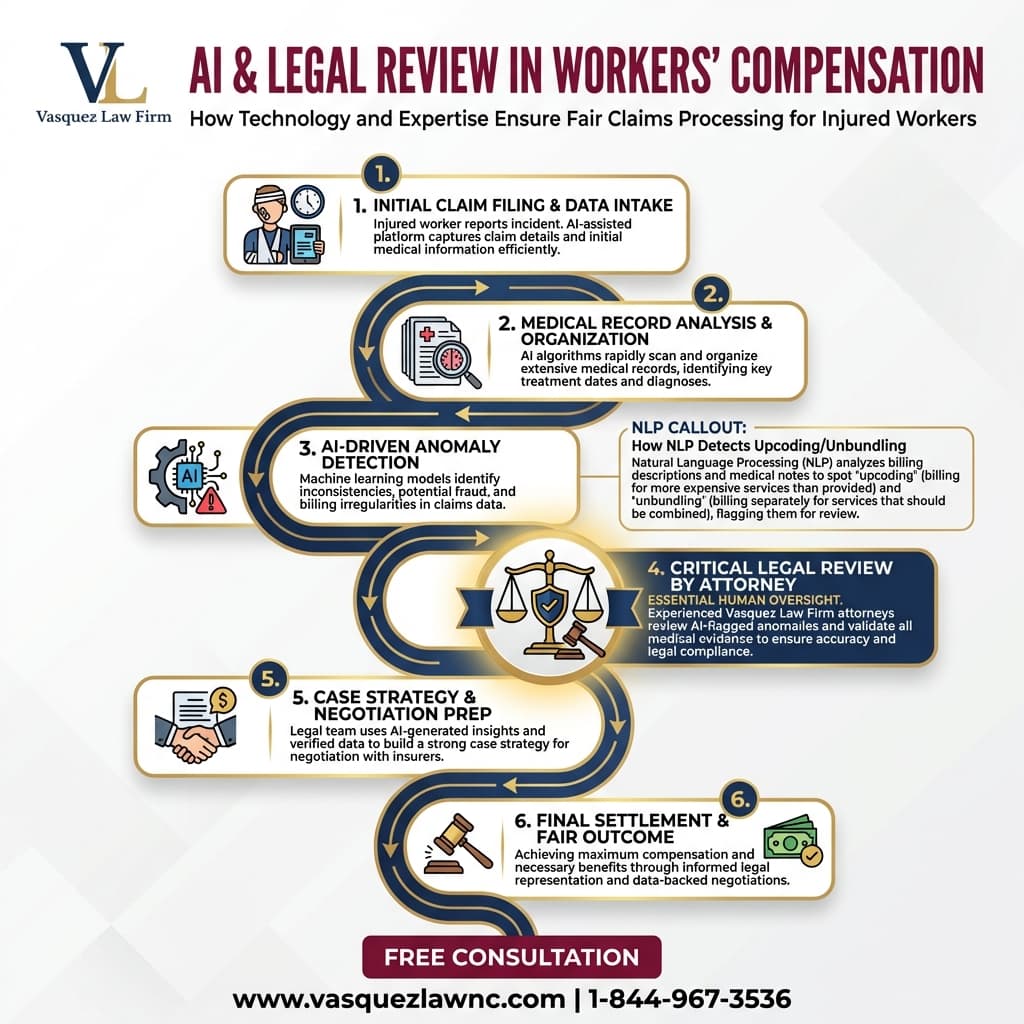
Step-by-Step: How AI Changes the Claims Process
- Claim Submission: Workers submit injury reports and medical documents electronically. AI systems begin screening for completeness.
- Initial AI Screening: Algorithms analyze injury descriptions and medical summaries to assess claim validity and detect anomalies.
- Risk Scoring: AI predicts potential fraud or claim complexity to prioritize human adjuster review.
- Decision Recommendation: AI suggests approval, further investigation, or denial based on data patterns.
- Human Review: A claims adjuster reviews AI findings alongside evidence to make final determinations.
- Notification and Appeal: Workers are notified of decisions. If denied, a formal appeal with legal assistance can follow.
Each step may involve automation but requires vigilance by the injured worker to ensure their case is fully and fairly considered.
Attorney Vasquez has extensive experience guiding clients through this modern claim process. Visit Attorney Vasquez's bio for more information.
Documents Needed for AI Processing
- Medical records and reports
- Accident or injury reports
- Employer correspondence
- Previous claim histories
Appeal Process Adapted for AI Cases
Appeals in AI-influenced claims require precise medical opinions and sometimes expert testimony to counter algorithm assessments. Timely legal help improves appeal success chances.
Common Mistakes to Avoid with AI in Workers Comp
- Ignoring automated claim denials: Always respond promptly to AI-related notices.
- Insufficient medical documentation: Provide detailed, doctor-signed records to support your claim.
- Delaying legal consultation: Early advice prevents missed appeal deadlines.
- Assuming AI is always accurate: Review decisions critically and challenge errors.
- Not understanding AI terminology: Ask for explanations to clarify AI-generated results.
- Failing to preserve evidence: Keep copies of all communications and reports.
- Ignoring state-specific rules: Follow North Carolina or Florida workers compensation laws carefully.
If you only remember one thing: AI helps process claims but cannot replace personalized legal support to protect your rights.
Timeline of AI Adoption Effects on Claims
- Immediate: Faster claim intake and initial screenings.
- Weeks 1-2: AI risk scoring and decision recommendations.
- Weeks 3-4: Human adjuster review and final decisions.
- Month 2 and beyond: Appeals and reviews if needed, potentially lengthened by AI disputes.
Expect quicker initial responses but prepare for extended timelines if appeals for AI decisions are necessary.
Costs and Fees: What Impacts the Price
- Insurer savings: AI reduces administrative costs, possibly lowering premiums.
- Legal fees: Increased complexity of AI disputes may raise attorney costs.
- Medical examinations: Additional expert reports may be needed to counter AI findings.
- Technology investments: Carriers bear initial costs deploying AI systems.
Understanding these factors helps workers anticipate financial implications of AI in claims.
North Carolina and Nationwide Notes
North Carolina Notes
North Carolina follows guidelines outlined by the Industrial Commission. AI adoption is growing, but workers must comply with strict filing requirements and deadlines under N.C. Gen. Stat. § 97. Prompt legal help is essential when AI-generated denials occur.
Nationwide Concepts
While AI adoption rates vary, federal standards govern some aspects of claim privacy and anti-discrimination. Workers compensation laws differ by state, so consult local experts. Technology may raise new legal questions about fairness and transparency long-term.
When to Call a Lawyer for AI-Related Claim Issues
- If your claim was denied after AI analysis
- If you received confusing or incomplete AI decision explanations
- If medical evidence was disregarded
- If you want to appeal an AI-based adjustment
- If the insurer delays responding beyond legal limits
- If you feel pressured to accept lower benefits without explanation
- If you suspect bias or discrimination in automated decisions
- If you need help gathering medical documentation
- If deadlines to file forms or appeals approach
- If you want an attorney’s review before submitting evidence
About Vasquez Law Firm
At Vasquez Law Firm, we combine compassion with aggressive representation. Our motto "Yo Peleo" (I Fight) reflects our commitment to standing up for your rights.
- Bilingual Support: Se Habla Español - our team is fully bilingual
- Service Areas: Workers compensation in North Carolina; immigration nationwide, including Florida
- Experience: Over 15 years helping clients navigate complex legal matters
- Results: Thousands of successful cases across multiple practice areas
Attorney Trust and Experience
Attorney Vasquez holds a Juris Doctor degree and is admitted to practice in the North Carolina State Bar. With over 15 years of dedicated legal experience, he has built a reputation for providing personalized attention and achieving favorable outcomes for his clients.
Don't wait to get the help you deserve. Call us now for immediate assistance.
Se Habla Español
Frequently Asked Questions
What is AI adoption?
AI adoption means using artificial intelligence technologies to automate and improve processes. In workers compensation, it speeds claims processing but can create challenges if decisions lack human review. Knowing your rights helps you respond to AI-influenced claim actions.
How does AI affect workers compensation claims?
AI analyzes claims quickly, flags potential fraud, and helps insurers decide faster. However, mistakes occur if AI overlooks key medical facts. Workers should review decisions carefully and seek legal help when needed.
What is the AI adoption rate in workers compensation?
By 2026, around 40% of workers comp insurers in NC and FL use AI tools. Rates are expected to increase as technology matures and cost benefits grow.
Can AI decisions be appealed in workers compensation cases?
Yes. If AI results in denial or reduced benefits, workers can appeal with medical evidence. An attorney can help challenge automated decisions effectively.
What mistakes should injured workers avoid when AI is involved?
Common mistakes are ignoring AI denials, lacking medical proof, delaying legal advice, and assuming AI is always correct. Avoid these by staying informed and consulting an attorney.
What costs are affected by AI adoption in workers compensation?
AI helps reduce administrative costs but may raise legal fees if disputes arise. Medical exam fees can increase if extra proofs are needed to counter AI decisions.
How does AI impact the timeline of workers compensation claims?
AI often shortens claim reviews but may prolong cases if appeals involving AI decisions occur. Expect faster initial notices but possible delays later on.
When should injured workers contact a lawyer regarding AI in claims?
Contact a lawyer immediately if your claim is denied or changed after AI review, if explanations are unclear, or if medical evidence seems ignored. Early help protects your benefits.
Sources and References
- U.S. Citizenship and Immigration Services (USCIS)
- North Carolina Courts
- North Carolina Industrial Commission
Take the first step toward justice today. Our team is standing by to help.
Start Your Free Case Evaluation Now
Call us: 1-844-967-3536
Se Habla Español - Estamos aquí para ayudarle.


William Vasquez
Founder & CEO, Vasquez Law Firm, PLLC
William Vasquez is the founder and CEO of Vasquez Law Firm, PLLC, a results-driven firm specializing in immigration, criminal defense, personal injury, and workers' compensation. A U.S. Air Force veteran and recipient of the Joint Service Achievement Medal, William is dedicated to fiercely fighting for his clients' rights.
Related Legal Services
Need legal help? Learn more about how our work injury attorneys can help, or contact us for a free evaluation.
You can also visit work injury attorneys serving all of North Carolina for more information.