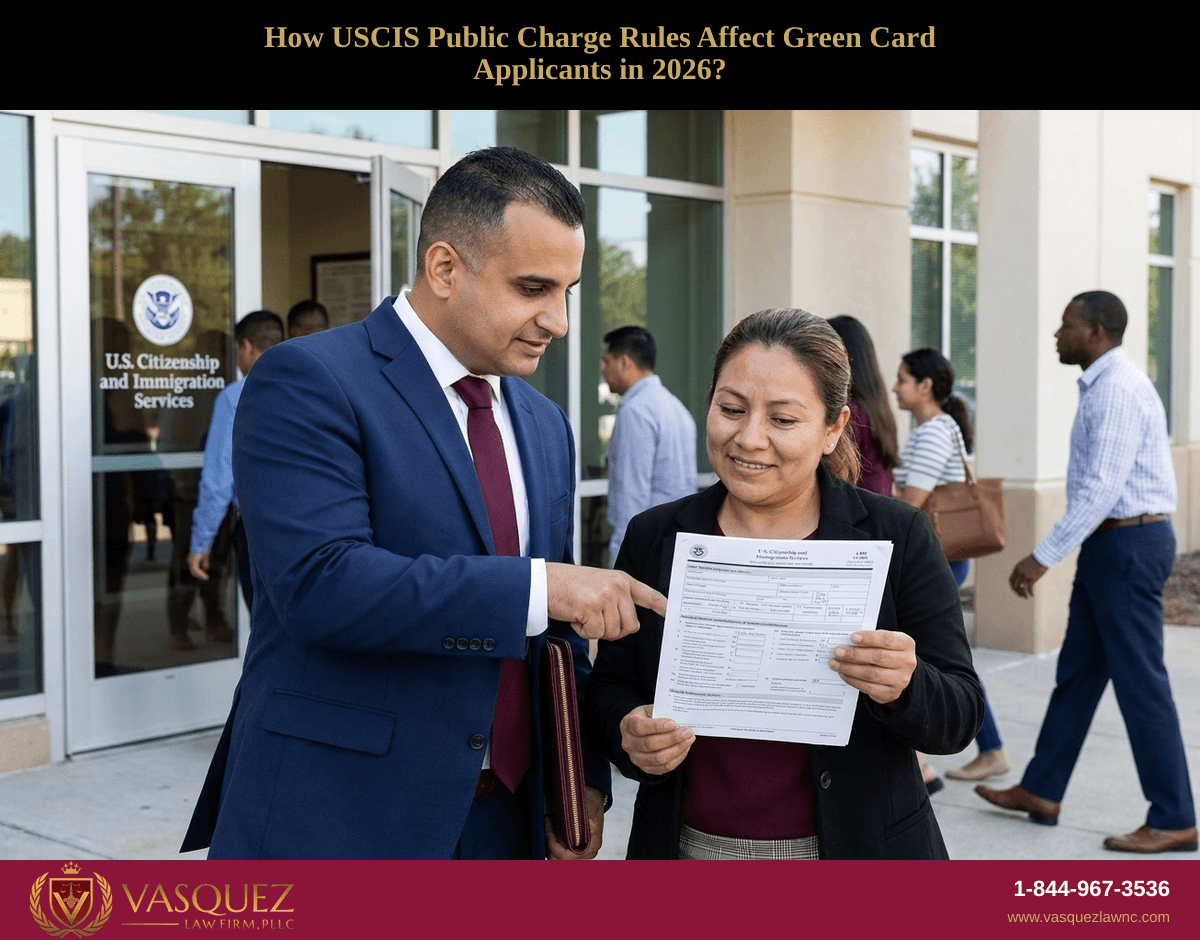
How USCIS Public Charge Rules Affect Green Card Applicants in 2026?
The USCIS public charge inadmissibility rules changed in 2026, affecting green card applicants in Raleigh, NC and Orlando, FL. The updated guidance, effective September 18, 2026, rescinds the 2022 regulations and broadens the scope of benefits considered. Applicants must understand if they are subject or exempt, prepare evidence of financial self-sufficiency, and may be invited to post a public charge bond. Read on for detailed analysis and practical steps.
Published on August 18, 2026
Have questions? Talk to an attorney - free evaluation.
Call 1-844-967-3536Free Tool
Check Your USCIS Case Status Now
Enter your receipt number - get the official USCIS status in English or Spanish. No registration.
This article provides general legal information, not individualized legal advice. Reading does not create an attorney-client relationship. For advice specific to your situation, contact Vasquez Law Firm.
What changed in USCIS public charge inadmissibility rules in 2026?
Ready to Apply for a Green Card?
Family-based, employment-based, or other paths — we guide you through every step.
On August 18, 2026, USCIS issued updated guidance on public charge inadmissibility determinations for adjustment of status applicants. This follows the Department of Homeland Security's July 16, 2026 final rule that rescinded the 2022 Biden-era public charge regulations. The new guidance, effective September 18, 2026, aligns with congressional intent emphasizing self-sufficiency and limits on dependency on taxpayer-funded benefits.
The updated USCIS Policy Manual explains which immigrant categories are subject to or exempt from the public charge ground. It clarifies factors considered in public charge determinations and the evidence USCIS will review. It also details the public charge bond process, a financial guarantee option for applicants found likely to become public charges.
This change marks a significant shift from the 2022 regulations by broadening the scope of benefits considered and reinstating a stricter standard for inadmissibility based on potential public charge status. The final rule was published in the Federal Register on July 20, 2026, and goes into effect on September 18, 2026.
The updated guidance supersedes prior USCIS instructions, including the 1999 Interim Field Guidance. It applies to all Form I-485 applications postmarked or submitted electronically on or after September 18, 2026, that are subject to the public charge ground.
For more details, see the official USCIS alert: USCIS Public Charge Guidance.
Who is affected by the new public charge inadmissibility guidance in North Carolina?
The new USCIS public charge rules affect all aliens applying for adjustment of status to lawful permanent resident (green card) in the United States, except those in exempt categories. In North Carolina, with its growing immigrant population, many adjustment applicants will face this updated policy starting September 18, 2026.
Categories subject to the public charge ground include spouses, children, and parents of lawful permanent residents (LPRs); unmarried sons and daughters of U.S. citizens and LPRs; married sons and daughters of U.S. citizens and their families; and other family-based immigrants. Employment-based applicants such as priority workers, professionals, skilled workers, investors, and religious workers are also subject.
Exempt categories include immediate relatives of U.S. citizens (spouses, children, parents), asylees and refugees, Amerasian immigrants, Afghan and Iraqi interpreters employed by the U.S. government, Cuban and Haitian entrants, victims of trafficking and qualifying criminal activity, applicants under Temporary Protected Status, and others listed in the USCIS guidance.
In Raleigh, NC, where our office is located, many clients applying for adjustment of status fall into family-based categories subject to the public charge ground. The updated rules mean these applicants must carefully prepare evidence to demonstrate they are not likely to become public charges.
Understanding whether an applicant is subject to or exempt from public charge inadmissibility is critical. The USCIS guidance provides a comprehensive list of categories affected, helping applicants and attorneys determine applicability.
What does the law say about public charge inadmissibility and adjustment of status?
The Immigration and Nationality Act (INA) does not define "public charge" or "likely at any time to become a public charge" explicitly. However, Congress mandates that USCIS officers consider five statutory factors when making public charge inadmissibility determinations: age; health; family status; assets, resources, and financial status; and education and skills.
USCIS officers may also consider Form I-864, the Affidavit of Support under Section 213A of the INA, where a sponsor agrees to financially support the applicant. The statute governing adjustment of status is 8 U.S.C. § 1255 (INA § 245(a)). This statute allows certain aliens to apply for lawful permanent residence while in the U.S.
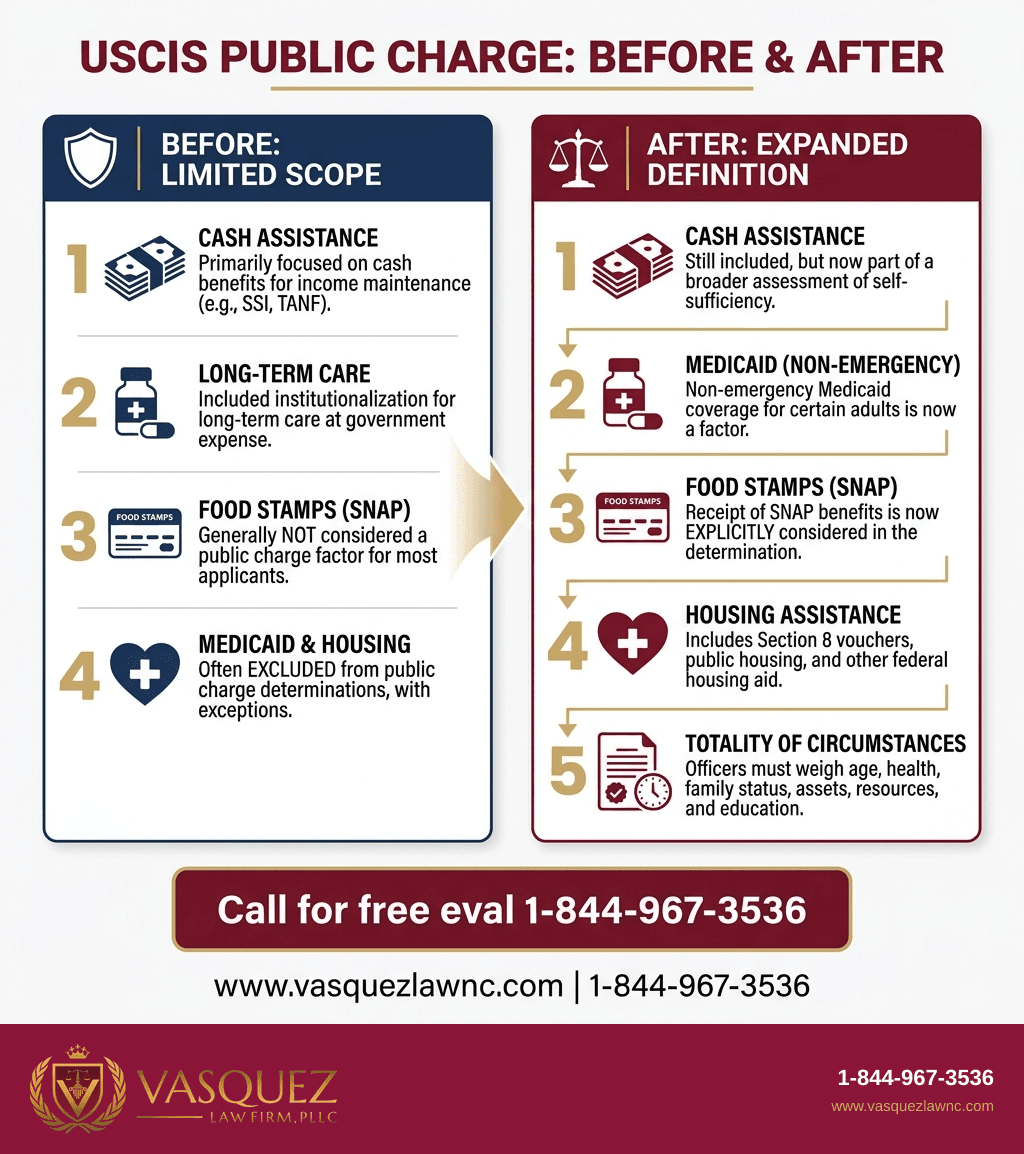
The updated USCIS guidance explains that officers will review all relevant evidence in the applicant's record and make case-by-case decisions based on the totality of circumstances. Receipt of means-tested public benefits is a key factor. For benefits received before September 18, 2026, only cash assistance for income maintenance and long-term institutionalization at government expense are considered. For benefits received on or after that date, all means-tested benefits are considered.
"USCIS officers will consider the five statutory factors and any other factor relevant to assessing the alien’s likelihood at any time of becoming a public charge, including the alien’s receipt of means-tested public benefits, such as cash assistance for income maintenance, housing assistance, food stamps, financial aid for college, or any other similar benefit." (Source: USCIS, https://www.uscis.gov/newsroom/alerts/uscis-issues-guidance-on-making-public-charge-inadmissibility-determination)
This approach reflects congressional intent that immigrants be self-sufficient and not reliant on taxpayer-funded benefits. The INA and implementing regulations require USCIS to weigh these factors carefully in each case.
In addition to the INA, USCIS officers apply regulations at 8 CFR § 245.1, which govern eligibility for adjustment of status, including grounds of inadmissibility such as public charge.
What should applicants do to prepare for public charge inadmissibility determinations?
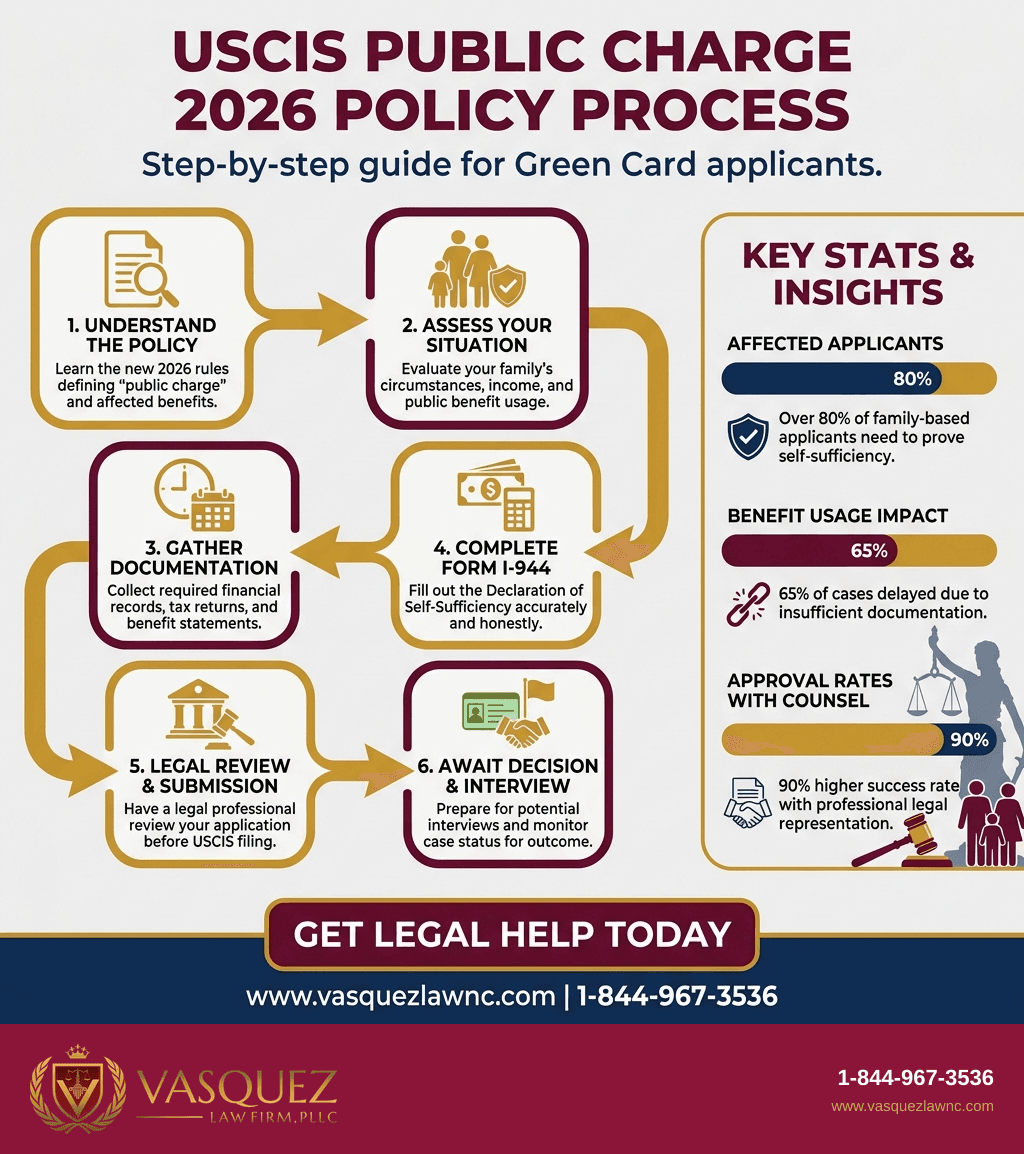
Applicants for adjustment of status in Raleigh, NC and Orlando, FL should take proactive steps to prepare for the public charge inadmissibility review effective September 18, 2026. Careful documentation and legal guidance are essential.
At our Raleigh, NC and Orlando, FL offices, we typically see applicants struggle with gathering sufficient evidence of financial stability and resources. Common mistakes include incomplete affidavits of support, failure to document income or assets, and not addressing health or family status factors comprehensively.
To prepare, applicants should:
- Review whether their immigration category is subject to the public charge ground or exempt, using the USCIS list.
- Gather evidence of income, assets, savings, and employment history to demonstrate financial self-sufficiency.
- Submit a properly completed Form I-864 Affidavit of Support from a sponsor, if applicable.
- Document any receipt of public benefits carefully, noting dates and types of benefits received.
- Provide medical records or health evaluations to address the health factor.
- Include evidence of education, skills, and family status to support a positive determination.
Applicants invited to post a public charge bond should respond promptly. The bond amount is based on estimated government assistance over five years. Bonds can be cash or surety bonds submitted via Form I-945, but only if USCIS issues a Notice of Intent to Deny and invites bond submission.
| Step | Action | Notes |
|---|---|---|
| 1 | Determine if subject to public charge ground | Refer to USCIS exempt categories list |
| 2 | Gather financial evidence | Income, assets, employment verification |
| 3 | Submit Form I-864 Affidavit of Support | Required for most family-based applicants |
| 4 | Document public benefits received | Include dates and types; benefits after Sept 18, 2026 considered fully |
| 5 | Prepare health and education evidence | Medical records, diplomas, skill certifications |
| 6 | Respond to public charge bond invitation if issued | Submit Form I-945 and bond payment timely |
Legal counsel can help applicants compile and organize evidence to present a strong case. Early preparation reduces the risk of denial or delays.
What happens next with USCIS public charge policy after September 2026?
After September 18, 2026, USCIS will apply the updated public charge guidance to all adjustment of status applications subject to this ground. Officers will conduct individualized, case-by-case analyses considering the five statutory factors and any other relevant evidence.
If an applicant is found inadmissible only due to likelihood of becoming a public charge, USCIS may invite the applicant to post a public charge bond. Posting the bond can allow approval of the adjustment application and lawful permanent residence status.
USCIS emphasizes discretion in these determinations, guided by the new policy but tailored to each applicant's circumstances.
"This guidance is intended to guide but not prescribe how USCIS officers exercise their discretion in making case-by-case public charge inadmissibility determinations." (Source: USCIS, https://www.uscis.gov/newsroom/alerts/uscis-issues-guidance-on-making-public-charge-inadmissibility-determination)
What's Your Immigration Situation?
Answer 3 questions - we'll tell you your options
Question 1 / 3
What best describes your situation?
Keep Reading
Applicants and attorneys should monitor USCIS announcements for any further updates or procedural changes. Staying informed and prepared is crucial for successful adjustment of status applications in Raleigh, NC and Orlando, FL.
Frequently Asked Questions about USCIS public charge inadmissibility?
What is the public charge ground of inadmissibility?
The public charge ground of inadmissibility refers to the legal basis for denying admission or adjustment of status to immigrants likely to become primarily dependent on government benefits. USCIS evaluates this using factors like age, health, family status, financial resources, and skills.
Who is exempt from public charge inadmissibility?
Exempt categories include immediate relatives of U.S. citizens, refugees, asylees, certain humanitarian immigrants, Afghan and Iraqi interpreters, Cuban and Haitian entrants, victims of trafficking, and others listed in USCIS guidance effective September 18, 2026.
What public benefits does USCIS consider in public charge determinations?
For benefits received on or after September 18, 2026, USCIS considers all means-tested public benefits, including cash assistance, housing aid, food stamps, and financial aid for education. Benefits before that date are limited to cash assistance and long-term institutionalization.
Can an applicant post a public charge bond?
Yes. If USCIS finds an applicant inadmissible only due to likely public charge, they may invite the applicant to post a public charge bond. This bond is a financial guarantee that the applicant will not become a public charge and can lead to approval of the application.
How can I prepare for a public charge inadmissibility review?
Applicants should gather evidence of financial stability, submit a complete Form I-864 affidavit of support, document any public benefits received, provide health and education records, and consult an experienced immigration attorney to build a strong case.
This article provides general legal information, not individualized legal advice. Reading does not create an attorney-client relationship. For advice specific to your situation, contact Vasquez Law Firm.
Reviewed by William Vasquez, Founder & CEO, Vasquez Law Firm, PLLC.
If you need legal assistance, learn more about get immigration legal help today, or call us at 1-844-967-3536 for a free evaluation.
Related Topics

William Vasquez
Founder & CEO, Vasquez Law Firm, PLLC
William Vasquez is the founder and CEO of Vasquez Law Firm, PLLC, a results-driven firm specializing in immigration, criminal defense, personal injury, and workers' compensation. A U.S. Air Force veteran and recipient of the Joint Service Achievement Medal, William is dedicated to fiercely fighting for his clients' rights.
Related Legal Services
Need legal help? Learn more about get immigration legal help today, or contact us for a free evaluation.
You can also visit North Carolina immigration lawyers for more information.