What NC Law Says About Marijuana and Gun Rights in 2026
Understand your marijuana gun rights in North Carolina for 2026. Learn about federal and state laws affecting cannabis users and firearms. Contact Vasquez Law Firm for a free consultation.
Published on March 3, 2026
Protect your record and your freedom
Free, confidential review. 24/7.
Free & confidential · Se habla espanol · 24/7

Have questions? Talk to an attorney - free evaluation.
Call 1-844-967-3536Protect Your Record and Your Freedom
A confidential case review - available 24/7 for emergencies.
What NC Law Says About Marijuana and Gun Rights in 2026
The landscape of marijuana gun rights is complex and constantly evolving, especially in 2026, as states like North Carolina navigate the intersection of state-level cannabis laws and federal firearm regulations. For individuals who use marijuana, even legally under state law, understanding the implications for their right to possess firearms is crucial. Federal law continues to classify marijuana as an illegal substance, creating a significant conflict that can lead to severe penalties for gun owners. This comprehensive guide details the current legal framework, potential risks, and essential steps to protect your rights.
Navigating the complexities of marijuana and gun laws requires expert legal guidance. Our experienced attorneys are ready to fight for you. Se Habla Español.
Schedule Your Free Case Evaluation
Or call us now: 1-844-967-3536
Quick Answer
In 2026, federal law prohibits individuals who use or are addicted to marijuana from possessing firearms, regardless of state cannabis laws. This means that even if medical or recreational marijuana is legal in North Carolina or Florida, federal restrictions on gun ownership still apply. Violating these federal laws can lead to serious criminal charges and loss of gun rights.
- Federal law classifies marijuana as a Schedule I controlled substance, making its use federally illegal.
- The Gun Control Act of 1968 prohibits unlawful users of controlled substances from possessing firearms.
- This federal prohibition applies even in states where marijuana is legal for medicinal or recreational purposes.
- Possessing a firearm while using marijuana can result in federal felony charges, including imprisonment and fines.
- Recent court challenges have not yet overturned this federal restriction, maintaining the conflict for users.
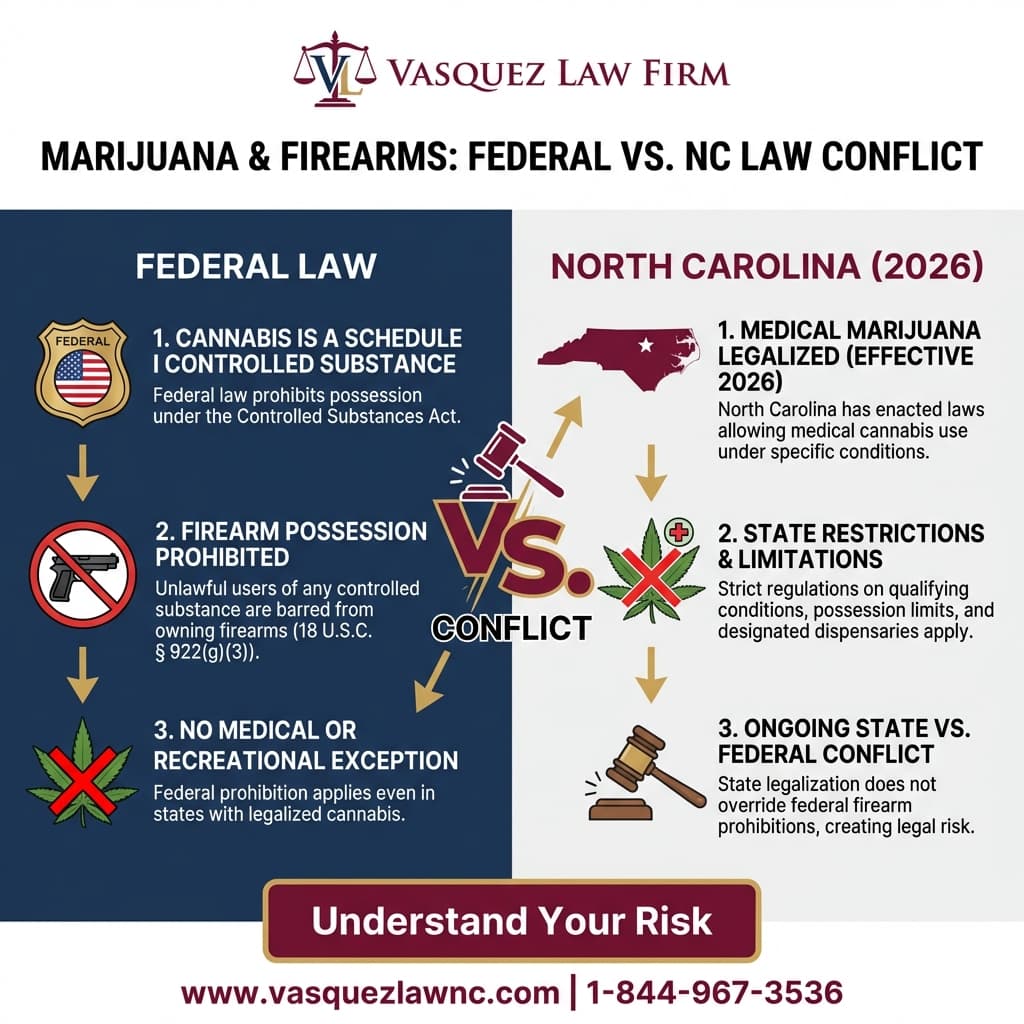
Infographic: Understanding the Marijuana Gun Rights Conflict
This infographic illustrates the core conflict between state marijuana laws and federal gun laws, highlighting the risks for individuals in North Carolina and Florida.
Call Vasquez Law Firm today for help navigating these complex laws.
Federal vs. State Laws: The Core Conflict
The fundamental issue surrounding marijuana gun rights stems from the stark contrast between federal and state laws. While many states, including North Carolina and Florida for medical cannabis, have legalized or decriminalized marijuana, the federal government maintains its classification as a Schedule I controlled substance under the Controlled Substances Act. This federal stance has direct and significant implications for firearm ownership.
Under federal law, specifically the Gun Control Act of 1968, it is illegal for any person who is an "unlawful user of or addicted to any controlled substance" to possess a firearm or ammunition. Since marijuana remains federally illegal, any use of it is considered "unlawful" in the eyes of federal authorities, regardless of state-level legality. This creates a precarious situation for millions of Americans who lawfully use cannabis under state laws but face federal criminal charges if they also own guns.
The Bureau of Alcohol, Tobacco, Firearms and Explosives (ATF) has issued clear guidance on this matter, stating that a federal firearms licensee (FFL) cannot sell a firearm to any person they know or have reasonable cause to believe is an unlawful user of marijuana. Furthermore, applicants for firearm permits are required to answer questions about their use of controlled substances, and admitting to marijuana use can lead to denial of a permit or even federal prosecution. This dual legal framework makes understanding your marijuana gun rights critical.
North Carolina's Stance on Cannabis
As of 2026, North Carolina has not legalized recreational marijuana. However, limited medical cannabis programs exist. Despite these state-level relaxations, the federal prohibition on marijuana use for gun owners remains. This means that even a person with a valid medical marijuana card in North Carolina, if such a program were fully implemented statewide, would still be considered an "unlawful user" under federal law and prohibited from possessing firearms.
The state's approach to cannabis, while evolving, does not override federal statutes concerning firearms. Individuals in Raleigh and across North Carolina must be acutely aware that their state-sanctioned marijuana use does not grant them immunity from federal gun laws. This legal gap poses a significant risk for those who believe their state-level compliance protects them fully. Seeking advice from a criminal defense lawyer in North Carolina is essential to understanding specific local implications.
Florida's Medical Marijuana & Federal Gun Rights
Florida has a well-established medical marijuana program, allowing qualifying patients to obtain cannabis legally for therapeutic purposes. However, like North Carolina, Florida's state laws do not supersede federal regulations. Therefore, a registered medical marijuana patient in Florida is still considered an "unlawful user of a controlled substance" by federal standards, making them ineligible to possess firearms under federal law.
The conflict in Florida is particularly acute given the large number of medical marijuana cardholders and the state's strong gun culture. This situation leaves many Floridians in a legal dilemma, potentially facing federal charges for exercising what they perceive as their constitutional rights. Understanding these nuances is crucial for protecting yourself from unforeseen legal issues concerning marijuana gun rights.
Recent Legal Challenges and the Supreme Court
The conflict between marijuana use and gun rights has been a subject of intense legal debate, reaching the highest levels of the U.S. judicial system. In 2026, the Supreme Court continues to grapple with cases that challenge the federal prohibition on firearm ownership for marijuana users. The core of these challenges often centers on the Second Amendment and whether the federal government's ban infringes upon an individual's right to bear arms, especially when marijuana use is legal at the state level.
One significant case that has drawn national attention is United States v. Daniels, a federal appeals court ruling that found the federal ban on gun ownership for medical marijuana users to be unconstitutional. This ruling, however, was later stayed, and the legal battle continues. The Supreme Court's decision in New York State Rifle & Pistol Association Inc. v. Bruen (2022) established a new standard for Second Amendment cases, requiring gun laws to be consistent with the nation's historical tradition of firearm regulation. This new standard has fueled optimism among advocates for marijuana users' gun rights, suggesting that the federal ban might not withstand historical scrutiny.
Despite these legal challenges, as of 2026, the federal prohibition remains in effect. The Supreme Court ponders law making it a crime for marijuana users to possess a gun. While the legal landscape is fluid and future rulings could alter the current situation, individuals who use marijuana and possess firearms are still at risk of federal prosecution. It is imperative to stay informed about these developments and consult with legal counsel to understand how they might impact your personal situation and marijuana gun rights.
Infographic: Timeline of Key Marijuana Gun Rights Cases
This infographic outlines the progression of significant legal challenges to federal marijuana gun laws, helping you understand the historical context.
Contact us to discuss how these cases might affect you.
Potential Consequences for Marijuana Users with Firearms
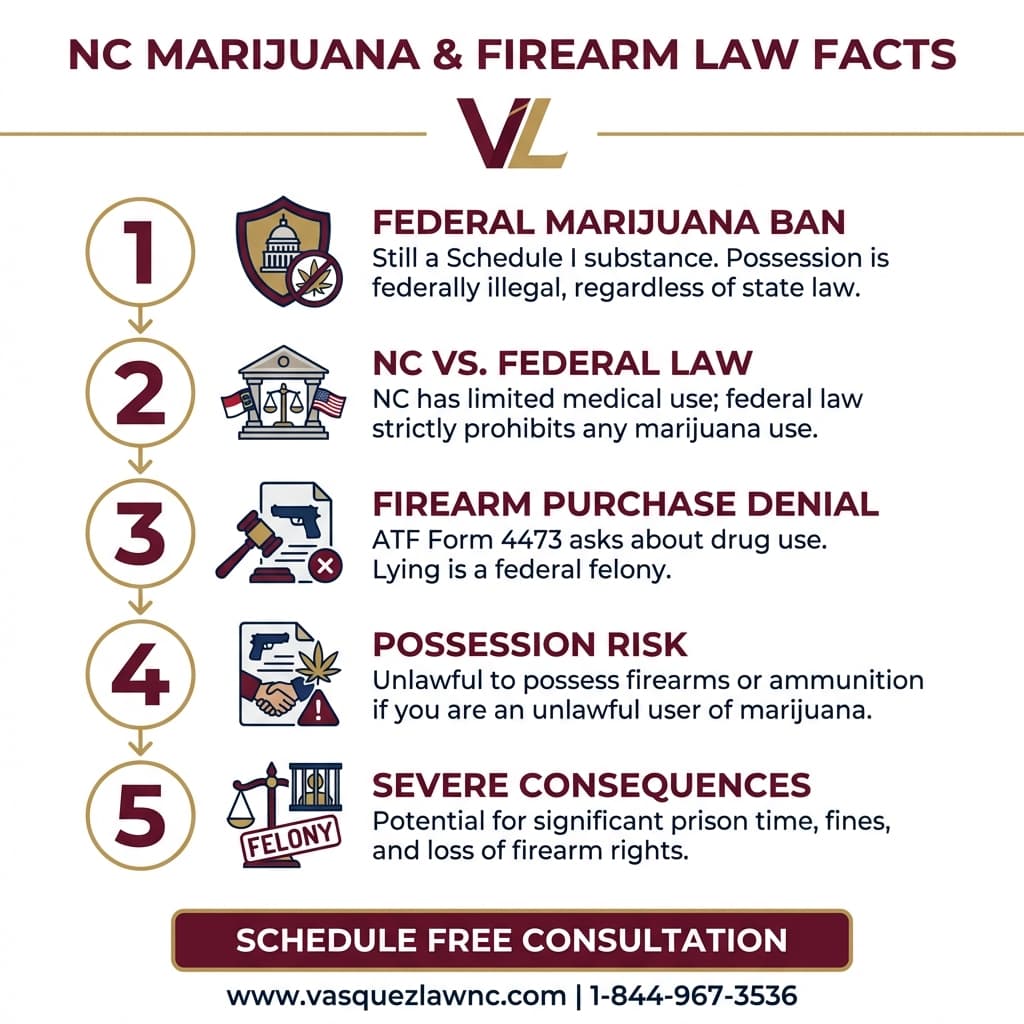
The potential consequences for individuals who use marijuana and possess firearms are severe and can include both federal and state charges. Under federal law, possessing a firearm while being an "unlawful user" of a controlled substance is a felony, punishable by up to 10 years in prison and substantial fines. This applies whether the marijuana is for medical or recreational use, as long as it is federally illegal. The same law applies to those who make false statements on ATF Form 4473, which is required for firearm purchases.
Beyond direct criminal penalties, individuals can also face the permanent loss of their gun rights. A federal felony conviction for this offense would strip you of your right to own or possess firearms in the future. Additionally, state-level consequences might arise, depending on North Carolina's specific laws regarding drug offenses and firearm possession. Even if state charges are less severe, the federal implications can be life-altering.
Furthermore, federal law enforcement agencies, such as the Drug Enforcement Administration (DEA) and the Bureau of Alcohol, Tobacco, Firearms and Explosives (ATF), actively enforce these prohibitions. This means that individuals in Raleigh, Florida, or anywhere in the U.S. who are found to be in violation could face federal investigation and prosecution. It is critical to understand these risks and seek proactive legal advice to avoid becoming entangled in this complex legal web regarding marijuana gun rights.
ATF Form 4473 and False Statements
When purchasing a firearm from a licensed dealer, you must complete ATF Form 4473. Question 21e on this form asks, "Are you an unlawful user of, or addicted to, marijuana or any depressant, stimulant, narcotic drug, or any other controlled substance?" Answering "No" if you are a marijuana user, even if your use is legal under state law, can be considered a false statement on a federal document. This false statement itself is a federal felony, punishable by up to five years in prison and significant fines.
Many individuals mistakenly believe that if medical or recreational marijuana is legal in their state, they can truthfully answer "No" to this question. However, because marijuana remains federally illegal, any use of it qualifies as "unlawful" under federal law. This nuance is often overlooked and can lead to serious legal trouble. Always be truthful on federal forms, and if you are a marijuana user, understand that this question has federal implications for your marijuana gun rights.
Protecting Your Rights: What to Do
Given the severe consequences, protecting your marijuana gun rights requires careful consideration and proactive steps. The most straightforward way to avoid federal prosecution is to choose between marijuana use and firearm ownership. If you use marijuana, you should not possess firearms, and vice versa. This clear separation helps mitigate the risk of violating federal law.
If you currently possess firearms and use marijuana, it is critical to consult with an experienced criminal defense attorney immediately. An attorney can advise you on the best course of action, which may include safely and legally divesting yourself of your firearms. This could involve selling them to a licensed dealer or transferring them to a family member who is not a prohibited person, in accordance with all applicable laws.
Furthermore, if you are facing charges related to marijuana gun rights, securing legal representation is paramount. A skilled attorney can assess the specifics of your case, challenge any unconstitutional applications of the law, and work to protect your freedom and future. Do not attempt to navigate these complex legal waters alone. The stakes are too high to risk making further mistakes.
The Importance of Legal Counsel
An attorney specializing in criminal defense, particularly one familiar with federal firearms and drug laws, can provide invaluable assistance. They can explain the nuances of federal vs. state law, advise on recent court decisions, and help you understand your options. For residents of Raleigh, North Carolina, or Florida, finding a lawyer who understands both state-specific cannabis laws and overarching federal regulations is crucial.
Vasquez Law Firm has extensive experience defending clients in complex criminal cases, including those involving firearms and controlled substances. Our team is dedicated to providing aggressive representation and personalized guidance to protect your rights. When dealing with issues as serious as marijuana gun rights, having a knowledgeable advocate on your side can make all the difference.
Don't face your legal challenges alone. Our team is here to help you every step of the way.
Call today: 1-844-967-3536 | Se Habla Español
When to Call a Lawyer Now About Marijuana Gun Rights
The moment you suspect your marijuana use might intersect with your firearm ownership, or if you are facing any legal questions regarding marijuana gun rights, it is crucial to contact a lawyer immediately. Early intervention can often prevent more severe consequences. Here are several situations where you should seek legal counsel without delay:
- You are a marijuana user and currently possess firearms.
- You have been questioned by law enforcement about your marijuana use or firearm ownership.
- You are considering purchasing a firearm but use marijuana, even legally under state law.
- You have been denied a firearm purchase due to admitted marijuana use.
- You are facing state or federal charges related to drug possession and firearms.
- You completed ATF Form 4473 and are concerned about a potential false statement.
- You want to understand the legal process for safely divesting firearms if you use marijuana.
- There are new legal developments or court rulings that might impact your situation.
If you only remember one thing: The conflict between federal and state laws regarding marijuana and gun rights is real and carries severe penalties. Always prioritize legal advice to protect your freedom and future.
About Vasquez Law Firm
At Vasquez Law Firm, we combine compassion with aggressive representation. Our motto "Yo Peleo" (I Fight) reflects our commitment to standing up for your rights. We understand the stress and uncertainty that legal challenges bring, and we are dedicated to providing personalized attention and strategic advocacy for every client. With a deep understanding of both state and federal laws, we are well-equipped to handle complex cases like those involving marijuana gun rights.
- Bilingual Support: Se Habla Español - our team is fully bilingual and ready to assist clients in both English and Spanish, ensuring clear communication and understanding.
- Service Areas: Criminal defense in Johnston and Harnett counties, NC; immigration nationwide, including Florida
- Experience: With over 15 years of dedicated legal experience, Attorney Vasquez has a proven track record of helping clients navigate complex legal matters and achieving favorable outcomes.
- Results: Our firm has successfully handled thousands of cases across multiple practice areas, demonstrating our commitment to fighting for justice and protecting our clients' futures.
Attorney Trust and Experience
Attorney Vasquez holds a Juris Doctor degree and is admitted to practice in both the North Carolina State Bar and Florida Bar. With over 15 years of dedicated legal experience, he has built a reputation for providing personalized attention and achieving favorable outcomes for his clients. His commitment to justice and his aggressive approach to legal defense make him a trusted advocate for those facing serious charges, including those related to marijuana gun rights. You can learn more about our team and approach on our attorneys page.
Frequently Asked Questions
Can I own a gun if I have a medical marijuana card in North Carolina?
No, not under federal law. Even if North Carolina fully legalizes medical marijuana, federal law still prohibits individuals who use marijuana from possessing firearms. The federal government classifies marijuana as a Schedule I controlled substance, making its use federally illegal regardless of state laws. This means having a medical marijuana card does not grant you an exception to federal gun prohibitions. Violating this can lead to serious federal charges.
What happens if I admit to marijuana use on ATF Form 4473?
Admitting to marijuana use on ATF Form 4473 will result in a denial of your firearm purchase. Furthermore, if you falsely answer "No" to the question about unlawful drug use while being a marijuana user, you could face federal felony charges for making a false statement on a federal document. This can lead to significant prison time and fines, highlighting the serious implications for marijuana gun rights.
Does North Carolina law address marijuana gun rights specifically?
North Carolina state law primarily defers to federal regulations regarding firearm possession for controlled substance users. While North Carolina has specific laws concerning marijuana possession and use, it generally does not create an exception for marijuana users to federal gun prohibitions. This means individuals in North Carolina must comply with federal law, even if their marijuana use is decriminalized or medically approved at the state level. Always consult an attorney for specific guidance.
Can I lose my gun rights permanently for marijuana use?
Yes, a federal felony conviction for possessing a firearm as an "unlawful user" of marijuana can result in the permanent loss of your gun rights. This prohibition extends to owning, possessing, or transporting firearms in the future. Even if you avoid a felony conviction, any admission of marijuana use can affect your ability to purchase or possess firearms under federal guidelines. Protecting your marijuana gun rights requires careful legal planning.
Are there any ongoing legal challenges to these federal laws in 2026?
Yes, as of 2026, there are ongoing legal challenges, including cases being reviewed by federal appeals courts and potentially the Supreme Court. These cases often argue that the federal ban on gun ownership for marijuana users violates Second Amendment rights, especially in states where cannabis is legal. However, despite these challenges, the federal prohibition remains in effect until a definitive ruling overturns it. Stay informed about developments impacting marijuana gun rights.
What should I do if I use marijuana and own guns?
If you use marijuana and own guns, you should immediately consult with an experienced criminal defense attorney. An attorney can advise you on the safest and most legal way to divest your firearms, such as selling them to a licensed dealer or transferring them to a non-prohibited person. This proactive step can help you avoid federal felony charges and protect your future. Do not attempt to navigate this complex situation alone.
Does this apply to all types of firearms and ammunition?
Yes, the federal prohibition against "unlawful users" of controlled substances possessing firearms applies to all types of firearms and ammunition. This includes handguns, rifles, shotguns, and any components considered ammunition. There are no distinctions made based on the type of firearm or its intended use. Any possession of a firearm or ammunition by a marijuana user is a violation of federal law, impacting marijuana gun rights broadly.
Can a state law protect me from federal charges related to marijuana gun rights?
No, state laws, even those legalizing medical or recreational marijuana, cannot protect you from federal charges. The Supremacy Clause of the U.S. Constitution dictates that federal law takes precedence over state law when there is a conflict. Therefore, as long as marijuana remains a Schedule I controlled substance under federal law, federal prohibitions on firearm possession for users will apply, regardless of state statutes. This is a critical point for marijuana gun rights.
What if I used marijuana in the past but no longer do?
The federal prohibition applies to "unlawful users" of controlled substances, which generally refers to current or recent use. If you have genuinely ceased all marijuana use, you may no longer be considered an "unlawful user." However, determining when past use no longer qualifies you as a prohibited person can be ambiguous. It is highly advisable to consult with a legal professional to discuss your specific history and ensure you meet federal guidelines before possessing firearms to protect your marijuana gun rights.
Where can I find reliable information on federal gun laws?
Reliable information on federal gun laws, including those related to controlled substances, can be found on official government websites. The Bureau of Alcohol, Tobacco, Firearms and Explosives (ATF) and the U.S. Department of Justice (DOJ) provide comprehensive resources. Additionally, legal research sites like Cornell Law School's Legal Information Institute offer access to the U.S. Code and federal regulations. Always cross-reference information and consult a lawyer for personalized advice on marijuana gun rights.
Sources and References
- Bureau of Alcohol, Tobacco, Firearms and Explosives (ATF)
- 18 U.S. Code § 922 - Unlawful acts
- North Carolina Courts
- Florida Courts
Facing charges? Our criminal defense attorneys can review your case.
Ready to take the next step? Contact Vasquez Law Firm today for a free, confidential consultation. We're committed to fighting for your rights and achieving the best possible outcome for your case.
Start Your Free Case Evaluation Now
Call us: 1-844-967-3536
Se Habla Español - Estamos aquí para ayudarle.

William Vasquez
Founder & CEO, Vasquez Law Firm, PLLC
William Vasquez is the founder and CEO of Vasquez Law Firm, PLLC, a results-driven firm specializing in immigration, criminal defense, personal injury, and workers' compensation. A U.S. Air Force veteran and recipient of the Joint Service Achievement Medal, William is dedicated to fiercely fighting for his clients' rights.
Related Legal Services
Need legal help? Learn more about criminal defense lawyers in North Carolina, or contact us for a free evaluation.
You can also visit Smithfield criminal defense attorneys for more information.