How to Go From an L1A Visa to a Green Card in 2026
Discover the L1A to Green Card pathway for executives and managers. Learn eligibility, process, and how Vasquez Law Firm can help. Contact us for a free consultation.
Published on March 6, 2026
Talk to an immigration attorney
Free call. A clear plan for your case.
Free & confidential · Se habla espanol · 24/7
Have questions? Talk to an attorney - free evaluation.
Call 1-844-967-3536Free Tool
Check Your USCIS Case Status Now
Enter your receipt number - get the official USCIS status in English or Spanish. No registration.
How to Go From an L1A Visa to a Green Card in 2026
Navigating the complex U.S. immigration system to transition from an L1A visa to a Green Card can feel overwhelming for executives and managers. This pathway, often through an employment-based first preference (EB-1) immigrant visa, offers a direct route to permanent residency for eligible individuals. Understanding the specific requirements, processes, and potential challenges is crucial for a successful transition. As of 2026, the landscape for an L1A to Green Card conversion remains a viable option for many international professionals.
Need expert guidance on your L1A to Green Card journey? Our experienced immigration attorneys are ready to fight for you. Se Habla Español.
Schedule Your Free Case Evaluation
Or call us now: 1-844-967-3536
Quick Answer
Transitioning from an L1A visa to a Green Card primarily involves adjusting status to an EB-1C immigrant visa. This pathway is for multinational executives and managers who meet specific criteria related to their employment in the U.S. and abroad, often bypassing the PERM labor certification process. It's generally considered one of the faster routes to permanent residency.
- L1A visa holders can often transition to an EB-1C Green Card.
- The EB-1C category is for multinational executives and managers.
- No PERM labor certification is typically required for EB-1C.
- The process involves filing Form I-140 and then Form I-485.
- A strategic approach is key for a successful L1A to Green Card conversion.
Understanding the L1A to Green Card Pathway
The L1A visa, or Intracompany Transferee Executive or Manager visa, allows foreign companies to transfer certain executives and managers to a U.S. parent, subsidiary, affiliate, or branch office. This nonimmigrant visa is a temporary solution, but it often serves as a stepping stone to permanent residency. The most common and direct path for L1A holders to obtain a Green Card is through the EB-1C (Employment-Based First Preference, Multinational Executive or Manager) immigrant visa category.
The EB-1C category is highly advantageous because it does not require a PERM labor certification from the Department of Labor. This significantly streamlines the process, making it faster than many other employment-based Green Card categories. To qualify, the L1A visa holder must demonstrate that they have been employed abroad by a qualifying organization for at least one year in the three years preceding their transfer to the U.S., and that they will be employed in the U.S. in an executive or managerial capacity.
The transition from an L1A to Green Card requires careful planning and adherence to strict USCIS guidelines. It involves proving the qualifying relationship between the U.S. and foreign entities, and that the individual's role truly meets the executive or managerial definitions. Attorney Vasquez, with over 15 years of experience, understands the nuances of these applications and can help you build a strong case.
Eligibility Requirements for the EB-1C Green Card
To successfully transition from an L1A to Green Card via the EB-1C category, both the petitioner (the U.S. employer) and the beneficiary (the L1A visa holder) must meet specific criteria. These requirements are outlined by U.S. Citizenship and Immigration Services (USCIS) and are rigorously evaluated. Understanding these foundational elements is crucial before initiating the application process in 2026.
For the employer, there must be a qualifying relationship between the U.S. entity and the foreign entity. This means the U.S. company must be a parent, subsidiary, affiliate, or branch of the foreign company. The U.S. company must also have been doing business for at least one year. For the L1A visa holder, they must have been employed outside the U.S. in an executive or managerial capacity for at least one year in the three years immediately preceding their entry into the U.S. or the filing of the petition.
Furthermore, the L1A holder must continue to be employed in the U.S. in an executive or managerial capacity. An "executive capacity" generally refers to directing the management of the organization or a major component/function, while a "managerial capacity" involves supervising other managers or a key function within the organization. Simply performing day-to-day operational tasks, even at a high level, may not qualify. This distinction is critical and often requires detailed documentation and a persuasive argument to USCIS.
Executive vs. Managerial Capacity
The distinction between executive and managerial capacity is often a point of scrutiny for USCIS. An executive primarily directs the organization's or a major component's management, establishes goals and policies, exercises wide discretion, and receives only general supervision. A manager, on the other hand, manages the organization, department, subdivision, function, or component, supervises other supervisory, professional, or managerial employees, or manages an essential function within the organization.
Crucially, a first-line supervisor is not generally considered a manager unless the employees supervised are professionals. The key is to demonstrate that the L1A holder's primary duties involve managing people, a function, or a component of the organization, rather than directly performing the services or producing the goods of the company. Clear organizational charts, detailed job descriptions, and letters from the employer are essential for this aspect of the L1A to Green Card application.
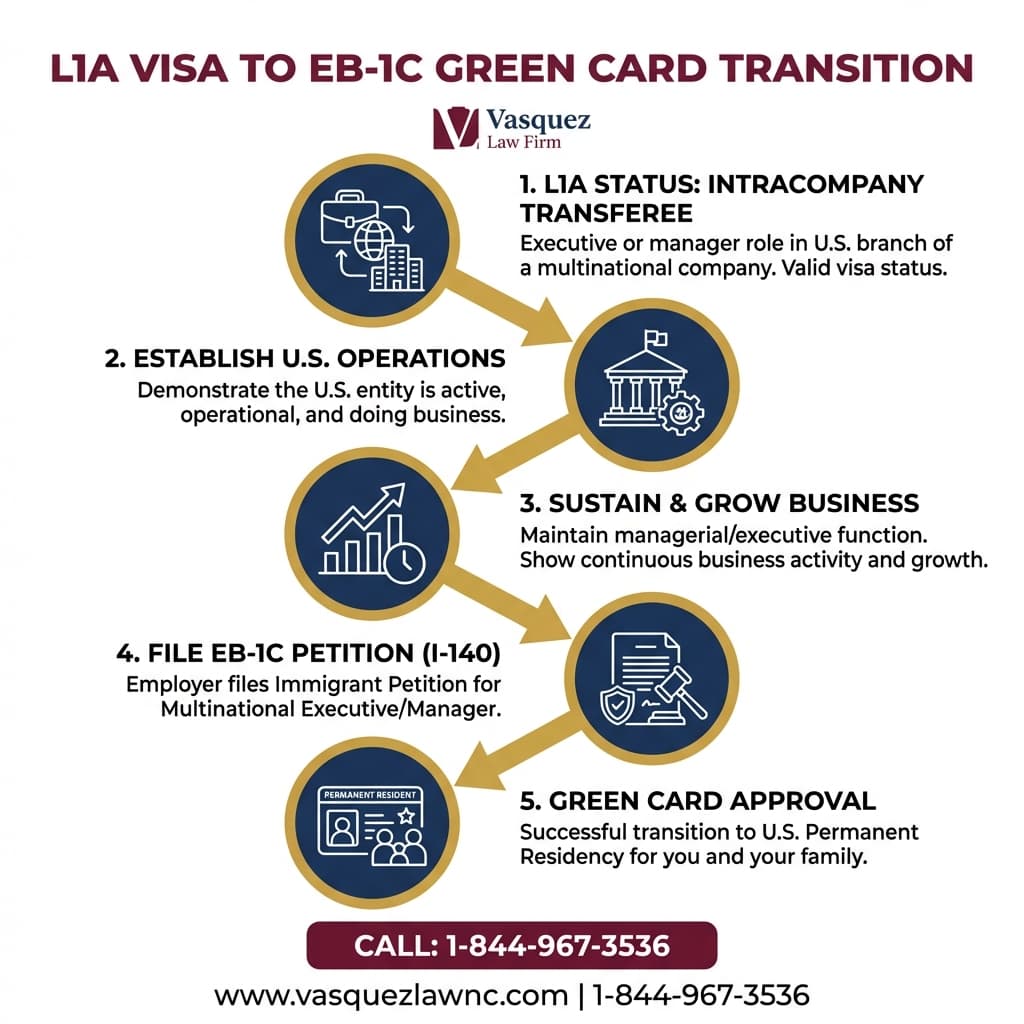
The L1A to Green Card Process: Step-by-Step
The journey from an L1A visa to a Green Card involves several key stages, each requiring meticulous preparation and submission of specific forms and supporting documents. While the overall process can vary based on individual circumstances and current USCIS processing times, the general steps remain consistent for those seeking an L1A to Green Card transition in 2026. Understanding this roadmap is vital for a smooth application.
Step 1: Form I-140, Immigrant Petition for Alien Worker
The first major step is for the U.S. employer to file Form I-140, Immigrant Petition for Alien Worker, on behalf of the L1A visa holder. This petition establishes the beneficiary's eligibility for the EB-1C category. The employer must submit extensive documentation proving the qualifying relationship between the U.S. and foreign entities, the L1A holder's executive or managerial capacity both abroad and in the U.S., and the U.S. company's ability to pay the offered wage.
This phase is critical, as USCIS will scrutinize all submitted evidence. A well-prepared I-140 petition, supported by detailed letters, organizational charts, and financial documents, significantly increases the chances of approval. This is where the expertise of an immigration lawyer like those at Vasquez Law Firm becomes invaluable, ensuring all requirements are met under 8 U.S.C. § 1153(b)(1)(C).
Step 2: Form I-485, Application to Adjust Status
Once the I-140 petition is approved and an immigrant visa number is immediately available (which is typically the case for EB-1 categories), the L1A visa holder can file Form I-485, Application to Register Permanent Residence or Adjust Status. This form is for individuals already in the U.S. seeking to adjust their nonimmigrant status to permanent resident status. Concurrent filing of Form I-140 and Form I-485 is often possible for EB-1 applicants, which can expedite the overall process.
Along with Form I-485, applicants typically submit applications for employment authorization (Form I-765) and advance parole (Form I-131), which allow them to work and travel internationally while their Green Card application is pending. Medical examinations and biometric appointments are also part of this stage. Vasquez Law Firm can help you prepare these complex forms and ensure all supporting documentation is complete and accurate, aligning with 8 C.F.R. § 245.1.
L1A to Green Card Timeline and Processing
The timeline for an L1A to Green Card transition can vary significantly based on several factors, including current USCIS processing times, whether premium processing is utilized for the I-140, and the applicant's country of chargeability. Generally, the EB-1C category is known for its relatively faster processing compared to other employment-based Green Card options, making the L1A to Green Card pathway attractive for many multinational executives and managers.
For the I-140 petition, regular processing can take anywhere from a few months to over a year. However, premium processing is available for Form I-140, allowing for a decision within 15 calendar days for an additional fee. This can significantly shorten the initial waiting period. Once the I-140 is approved, the I-485 adjustment of status application can take several months to over a year to process, depending on the service center and caseload. The total L1A to Green Card timeline can therefore range from approximately 6 months to 2 years, often less if premium processing is used and no issues arise.
Current priority dates, as published by the U.S. Department of State's Visa Bulletin, are crucial. While EB-1 categories often remain current for most countries, specific countries, such as India or China, may experience backlogs, which can extend the overall timeline for an L1A to Green Card for Indian nationals. It is essential to monitor these bulletins closely. Our firm can provide up-to-date information and strategic advice based on your specific situation.
Common Challenges and How to Overcome Them
While the L1A to Green Card path offers significant advantages, applicants often encounter challenges that can delay or even jeopardize their case. Being aware of these common pitfalls and understanding how to address them is crucial for a successful outcome. Proactive preparation and experienced legal counsel are your best defenses against these hurdles.
- Proving Executive or Managerial Capacity: This is arguably the most common challenge. USCIS often issues Requests for Evidence (RFEs) if they are not convinced that the L1A holder's duties truly meet the executive or managerial definitions. To overcome this, provide detailed job descriptions, organizational charts, and letters from senior management clearly outlining responsibilities, direct reports, and the functional areas managed.
- Maintaining a Qualifying Relationship: The relationship between the U.S. and foreign entities must remain intact throughout the process. Any changes in ownership, structure, or business operations could impact eligibility. Ensure all corporate documentation is current and reflects the qualifying relationship.
- Small or Startup U.S. Entities: For smaller U.S. offices, particularly those that are relatively new, it can be challenging to demonstrate that the L1A holder is truly functioning in an executive or managerial capacity, with sufficient staff to manage. Provide a clear business plan showing growth projections and staffing plans, along with evidence of substantial business activity.
- Requests for Evidence (RFEs): RFEs are common and can ask for additional documentation or clarification on any aspect of the petition. Responding comprehensively and accurately within the given timeframe is vital. An attorney can help craft a strong RFE response to address USCIS concerns effectively.
- Changes in Company Structure: Mergers, acquisitions, or significant changes in the company's business model can complicate the L1A to Green Card process. Consult with an immigration attorney immediately if such changes occur to assess their impact and strategize accordingly.
- Priority Date Backlogs: While EB-1 generally has current priority dates, backlogs can occur for certain high-demand countries. If a backlog emerges, applicants may have to wait for their priority date to become current before filing Form I-485. Monitor the Visa Bulletin closely and plan accordingly.
- Maintaining L1A Status: It's important to maintain valid L1A nonimmigrant status while the Green Card application is pending. Any lapse in status could lead to complications or even render an applicant ineligible for adjustment of status.
If you only remember one thing: The most critical aspect of the L1A to Green Card process is clearly demonstrating the executive or managerial capacity of the applicant, both abroad and in the U.S., supported by robust documentation.
Don't face your legal challenges alone. Our team is here to help you every step of the way.
Call today: 1-844-967-3536 | Se Habla Español
Nationwide Immigration Guidance from Vasquez Law Firm
At Vasquez Law Firm, our immigration services extend across North Carolina, Florida, and nationwide, providing comprehensive support for individuals and businesses navigating the U.S. immigration system. The L1A to Green Card pathway, being a federal process, is governed by nationwide USCIS regulations, meaning our expertise is applicable regardless of your physical location within the United States.
Whether you are an executive in Charlotte, North Carolina, a manager in Miami, Florida, or anywhere else in the country, our team is equipped to handle your case. We understand the specific regional considerations that might arise, such as varying USCIS field office processing times or local documentation requirements, and tailor our approach to best serve your needs. Our commitment is to provide consistent, high-quality legal representation across all states.
We regularly assist clients from various industries and backgrounds in transitioning from their L1A visas to permanent residency. Our deep understanding of federal immigration law, coupled with practical experience in managing complex EB-1C petitions, ensures that you receive knowledgeable and strategic counsel. Trust Vasquez Law Firm to be your advocate throughout this significant immigration journey.
When to Call an Immigration Lawyer Now
The L1A to Green Card process is complex, and timely legal intervention can make a significant difference in the outcome. Knowing when to seek professional help from an experienced immigration lawyer is crucial to avoid delays, denials, or complications. If any of the following situations apply to you, it's time to contact Vasquez Law Firm immediately:
- You are an L1A visa holder considering applying for a Green Card and need to understand your eligibility.
- Your employer is sponsoring your EB-1C petition, and you need assistance gathering documentation and understanding the requirements.
- You have received a Request for Evidence (RFE) from USCIS regarding your I-140 or I-485 petition.
- Your company's structure or your job duties have changed since your L1A approval, potentially impacting your EB-1C eligibility.
- You are concerned about potential priority date backlogs, especially if you are from a country with high demand for Green Cards.
- You need to travel internationally while your I-485 application is pending and require advance parole guidance.
- Your L1A visa is nearing its expiration, and you need to ensure a seamless transition to avoid a lapse in status.
- You have previously had an immigration petition denied or encountered other immigration issues.
- You simply want peace of mind knowing that your L1A to Green Card application is handled by experienced professionals.
About Vasquez Law Firm
At Vasquez Law Firm, we combine compassion with aggressive representation. Our motto "Yo Peleo" (I Fight) reflects our commitment to standing up for your rights. We understand the profound impact immigration matters have on individuals and families, which is why we approach every case with dedication and personalized attention.
- Bilingual Support: Se Habla Español - our team is fully bilingual, ensuring clear communication and understanding.
- Service Areas: We provide comprehensive immigration services across North Carolina, Florida, and nationwide.
- Experience: With over 15 years helping clients navigate complex legal matters, we have a proven track record of success.
- Results: Thousands of successful cases across multiple practice areas demonstrate our commitment to achieving favorable outcomes.
Attorney Trust and Experience
Attorney Vasquez holds a Juris Doctor degree and is admitted to practice in both the North Carolina State Bar and Florida Bar. With over 15 years of dedicated legal experience, he has built a reputation for providing personalized attention and achieving favorable outcomes for his clients. His strategic approach and deep knowledge of immigration law make him a trusted advocate for those seeking an L1A to Green Card transition.
Frequently Asked Questions
Can an L1A be extended beyond 7 years?
Yes, under certain circumstances, an L1A visa can be extended beyond the standard seven-year limit. This typically occurs if the L1A holder has a pending I-140 immigrant petition and an immigrant visa number is not yet available, or if they are in the process of adjusting status. Extensions are usually granted in one-year increments until the Green Card process is complete. This provision helps maintain legal status during the transition.
What is the 2-year rule for green cards?
The "2-year rule" (or two-year home-country physical presence requirement) primarily applies to J-1 exchange visitors, requiring them to return to their home country for two years before being eligible for certain visas or a Green Card. This rule generally does not apply to L1A visa holders seeking a Green Card, unless they previously held a J-1 visa subject to this requirement. It's crucial to confirm if this rule applies to your specific immigration history.
Can I get a Green Card after an L1 visa?
Yes, an L1A visa is often a direct pathway to a Green Card, particularly through the EB-1C category for multinational executives and managers. This is one of the most common and efficient ways for L1A holders to obtain permanent residency without requiring a PERM labor certification. The L1B visa can also lead to a Green Card, though often through other employment-based categories like EB-2 or EB-3, which may require PERM.
Is L1A visa better than H-1B?
The "better" visa depends on individual circumstances. L1A visas are for intracompany transferees in executive/managerial roles, offering a clear path to an EB-1C Green Card without PERM. H-1B visas are for specialty occupations and require a lottery, often facing backlogs. L1A has no quota, is generally faster for Green Card processing, and allows dual intent from the start. H-1B offers more employer flexibility but a longer Green Card wait.
What is the L1A to Green Card timeline for Indian nationals?
The L1A to Green Card timeline for Indian nationals can be longer than for other nationalities due to potential backlogs in the EB-1 category priority dates. While EB-1 is generally current, high demand from India can sometimes lead to retrogression. It is crucial to monitor the U.S. Department of State's Visa Bulletin for current priority dates. Premium processing for Form I-140 can expedite the initial stage, but the I-485 still depends on visa availability.
Can I apply for a Green Card directly from L1A?
Yes, you can apply for a Green Card directly from L1A status. The L1A visa is considered a "dual intent" visa, meaning you can legally hold it while simultaneously seeking permanent residency. The most common route is through the EB-1C immigrant visa category, which allows the employer to file Form I-140 on your behalf, followed by Form I-485 for adjustment of status. This direct pathway is a major advantage of the L1A visa.
What happens if my L1A visa expires while my Green Card is pending?
If your L1A visa expires while your Green Card application (Form I-485) is pending, you are generally permitted to remain in the U.S. legally under "period of authorized stay." You would typically have filed for an Employment Authorization Document (EAD) and Advance Parole (AP) along with your I-485, allowing you to continue working and traveling. However, it is crucial to avoid any gaps in authorized stay and consult an attorney to ensure continuous legal status.
Is an L1A to Green Card faster than an H-1B to Green Card?
Generally, an L1A to Green Card pathway through the EB-1C category is faster than an H-1B to Green Card. The EB-1 category typically has current priority dates, meaning no long waits for a visa number, and it often bypasses the PERM labor certification requirement. H-1B holders often pursue EB-2 or EB-3 Green Cards, which frequently involve PERM and significant priority date backlogs, especially for certain countries like India or China.
What documents are needed for an L1A to Green Card application?
Key documents include the approved L1A petition, corporate documents proving the qualifying relationship between U.S. and foreign entities, detailed organizational charts, job descriptions for both foreign and U.S. executive/managerial roles, financial statements, educational credentials, birth certificates, marriage certificates (if applicable), medical examination results, and police clearance certificates. A comprehensive list will be provided by your immigration attorney.
Sources and References
- U.S. Citizenship and Immigration Services (USCIS)
- U.S. Department of State
- Executive Office for Immigration Review (EOIR)
- 8 U.S. Code § 1153 - Allocation of immigrant visas
- 8 CFR Part 204 - Immigrant petitions
Need immigration help? Our immigration attorneys can review your case.
Ready to take the next step towards permanent residency? Contact Vasquez Law Firm today for a free, confidential consultation. We're committed to fighting for your rights and achieving the best possible outcome for your case.
Start Your Free Case Evaluation Now
Call us: 1-844-967-3536
Se Habla Español - Estamos aquí para ayudarle.


William Vasquez
Founder & CEO, Vasquez Law Firm, PLLC
William Vasquez is the founder and CEO of Vasquez Law Firm, PLLC, a results-driven firm specializing in immigration, criminal defense, personal injury, and workers' compensation. A U.S. Air Force veteran and recipient of the Joint Service Achievement Medal, William is dedicated to fiercely fighting for his clients' rights.
Related Legal Services
Need legal help? Learn more about our immigration legal services, or contact us for a free evaluation.
You can also visit our NC immigration team for more information.