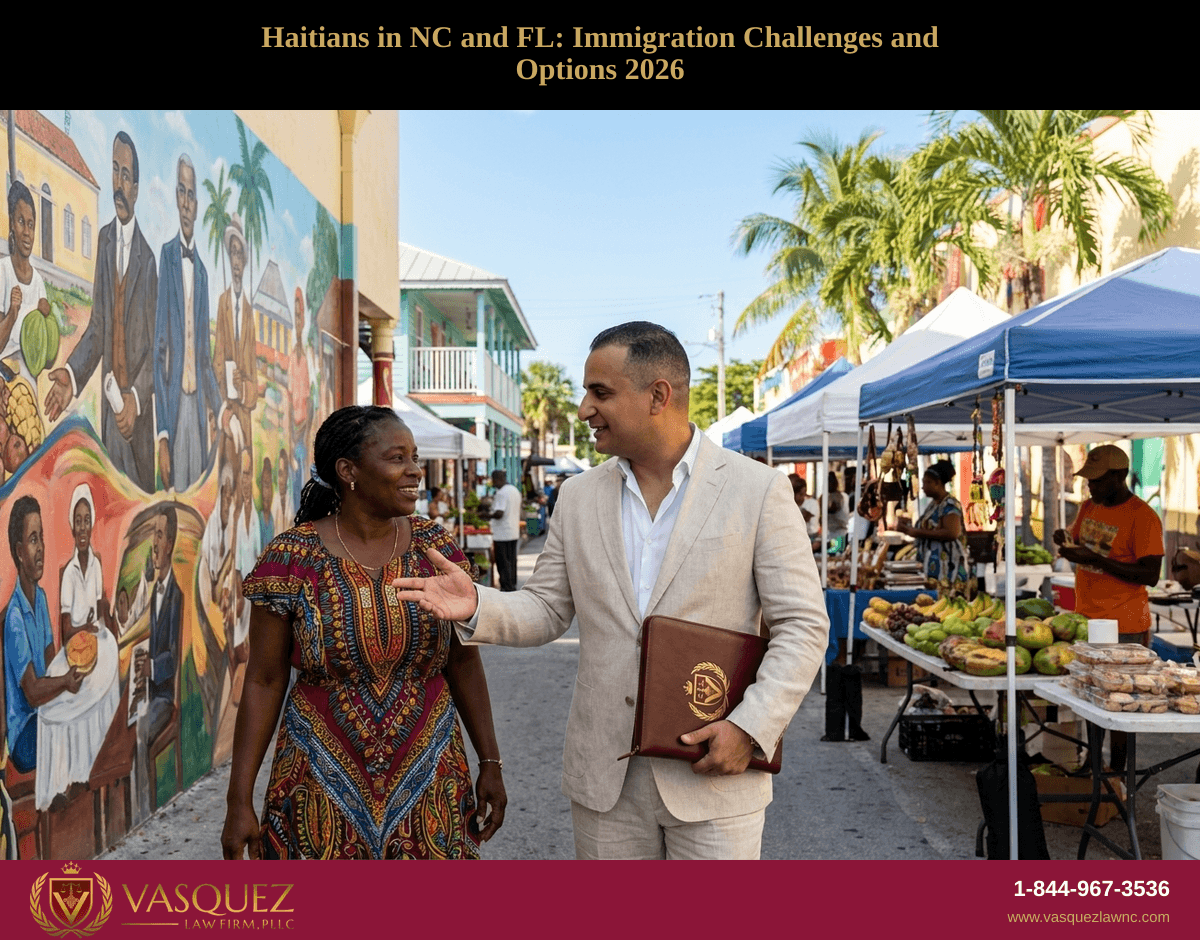
Haitians in NC and FL: Immigration Challenges and Options 2026
Haitians in NC and FL face new immigration challenges in 2026. Learn your options and how Vasquez Law can help. Start now with a free consultation.
Published on June 29, 2026· Updated September 9, 2026
Talk to an immigration attorney
Free call. A clear plan for your case.
Free & confidential · Se habla espanol · 24/7
Have questions? Talk to an attorney - free evaluation.
Call 1-844-967-3536Worried how the latest immigration news affects you?
Schedule a confidential case review with an immigration attorney - know exactly where you stand.
USCIS Case Status
Check your USCIS case status
Enter your receipt number and get the official status. Free, no registration.
Haitians in NC and FL: Immigration Challenges and Options 2026
Haitians living in North Carolina and Orlando, Florida, face big immigration problems in 2026 because Temporary Protected Status (TPS) for Haitians and Syrians will end. This article explains what this change means. It also tells you important steps to protect your status and the legal choices you have under U.S. immigration law. Whether you have TPS now or want other immigration benefits, it is important to understand the law. Our Raleigh, NC and Orlando, FL immigration lawyers give clear advice and help Haitians with these hard immigration issues in 2026.
Need help with your case? Our experienced lawyers are ready to fight for you. Se Habla Español.
Or call us now: 1-844-967-3536
Quick Answer
Haitians in North Carolina and Orlando lose TPS protection in 2026. This means they must find other immigration status to avoid deportation. Legal choices include asylum, applying for a green card, or cancellation of removal. These depend on each person’s situation.
- TPS ended for Haitians July 2026
- Risk of deportation if no other status
- Options: asylum, green card applications, cancellation
- Work with an immigration lawyer early
- Prepare needed documents quickly
Understanding Immigration Challenges for Haitians
Since 2010, Haitians had Temporary Protected Status (TPS). TPS is a special humanitarian benefit that lets people live and work legally in the U.S. when their home country is unsafe. It was given because of the 2010 earthquake and ongoing problems in Haiti. But on July 22, 2026, TPS for Haitians ended. This creates legal uncertainty. People with TPS no longer have automatic protection from deportation. This makes it hard to stay legally in North Carolina, Florida, and across the U.S.
TPS is a humanitarian benefit given by the Secretary of Homeland Security under 8 C.F.R. § 214.2(t). When TPS ends, affected people must find other options under the Immigration and Nationality Act (INA) or face removal (deportation). Many Haitians in Raleigh, NC, and Orlando, FL, now face hard choices about their immigration future.
It is very important to understand that losing TPS does not mean you lose the right to apply for other legal statuses. You may be able to adjust your status (apply for a green card) if you qualify. You may also apply for asylum if you file on time. Other relief from removal is possible under INA § 240A, such as cancellation of removal. This requires you to show you have lived in the U.S. continuously and that removal would cause serious hardship.
Our immigration lawyers in Raleigh and Orlando help Haitian clients with these complex problems. We explain your options clearly. We help you collect documents. We represent you before USCIS and immigration courts if needed.
Key Steps for Haitians After TPS Ends
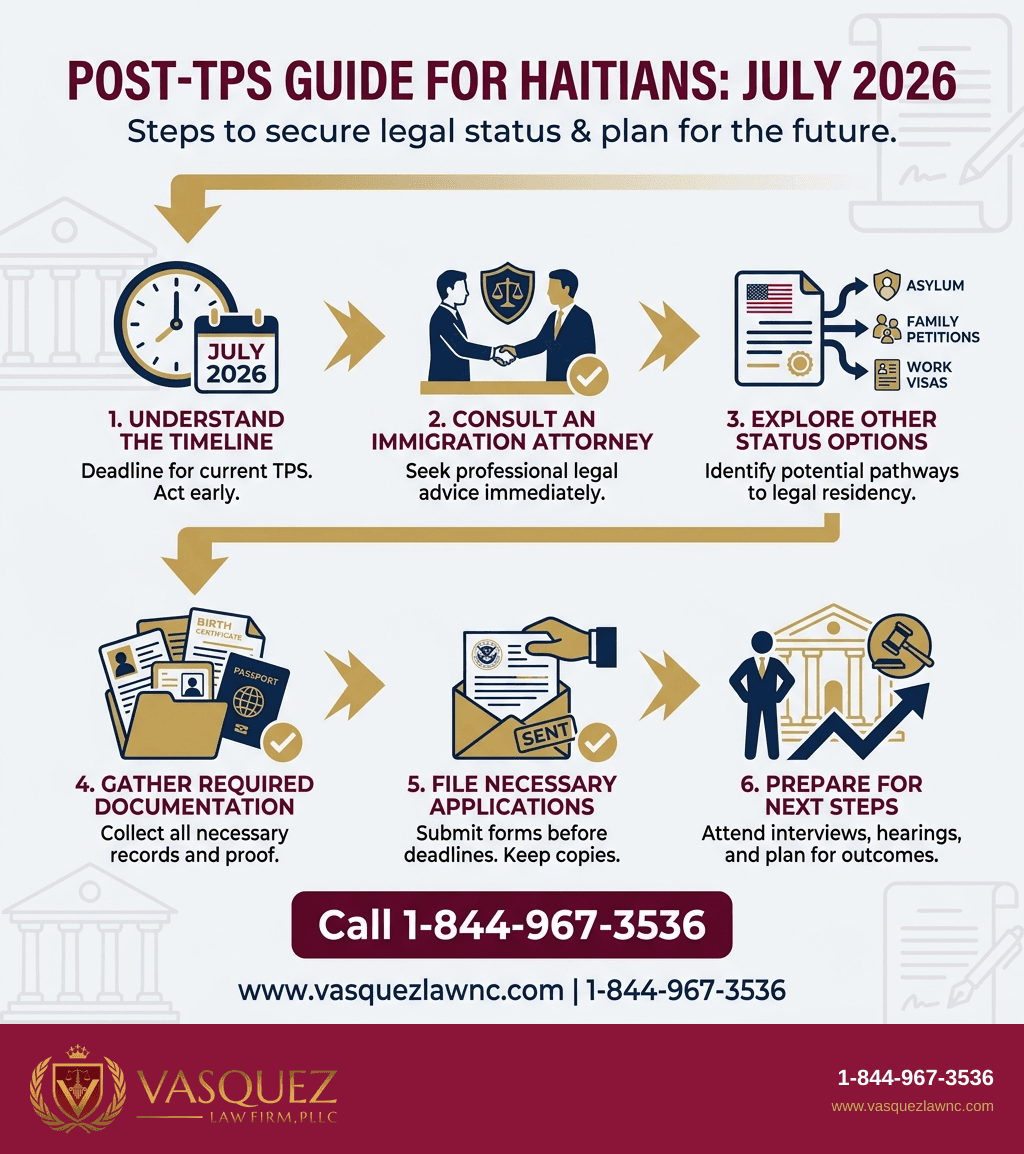
- Check Your TPS Status and End Date: Know your last valid TPS document and the official end date, July 22, 2026. Make sure you keep legal status during any change.
- Collect Documents: Get proof of your identity, TPS registration, continuous residence, and family ties. You need correct documents for most immigration applications.
- See If You Qualify for Other Immigration Help: Find out if you can get a family-based green card, asylum, or cancellation of removal under INA § 240A.
- File Applications Quickly: Send forms like I-485 (Adjustment of Status) or I-589 (Asylum) before deadlines. Waiting too long can lead to removal proceedings.
- Get Ready for Biometrics and Interviews: USCIS will ask for your fingerprints and interviews to check your identity and eligibility.
- Talk to Experienced Lawyers: Working with lawyers in Raleigh and Orlando helps your case go smoothly and on time. This avoids mistakes that can delay or deny your relief.
Our team helps you understand USCIS processing times. These now take about 8-14 months for adjustment applications. See USCIS processing times for updates.
Don't wait to get the help you need. Call us now for fast assistance. Se Habla Español.
Common Immigration Mistakes to Avoid
- Missing Deadlines: Filing late can cause you to lose eligibility or face removal. File important forms on time.
- Incomplete Documents: Not having proof of continuous residence or identity can cause your application to be denied.
- Thinking TPS Automatically Changes to Other Status: TPS is temporary. It does not give permanent status. You must apply separately.
- Ignoring Removal Notices: Not going to immigration court can lead to deportation orders.
- Applying Without Legal Help: Some cases need special strategies to improve chances of success.
- Giving False Information: Wrong facts or fake documents can cause criminal charges and permanent bans.
- Not Preparing for Interviews: Not knowing your case details can hurt your credibility.
If you remember only one thing: Act fast to find relief options before TPS ends. Early legal help can save your case.
Immigration Timeline and What to Expect
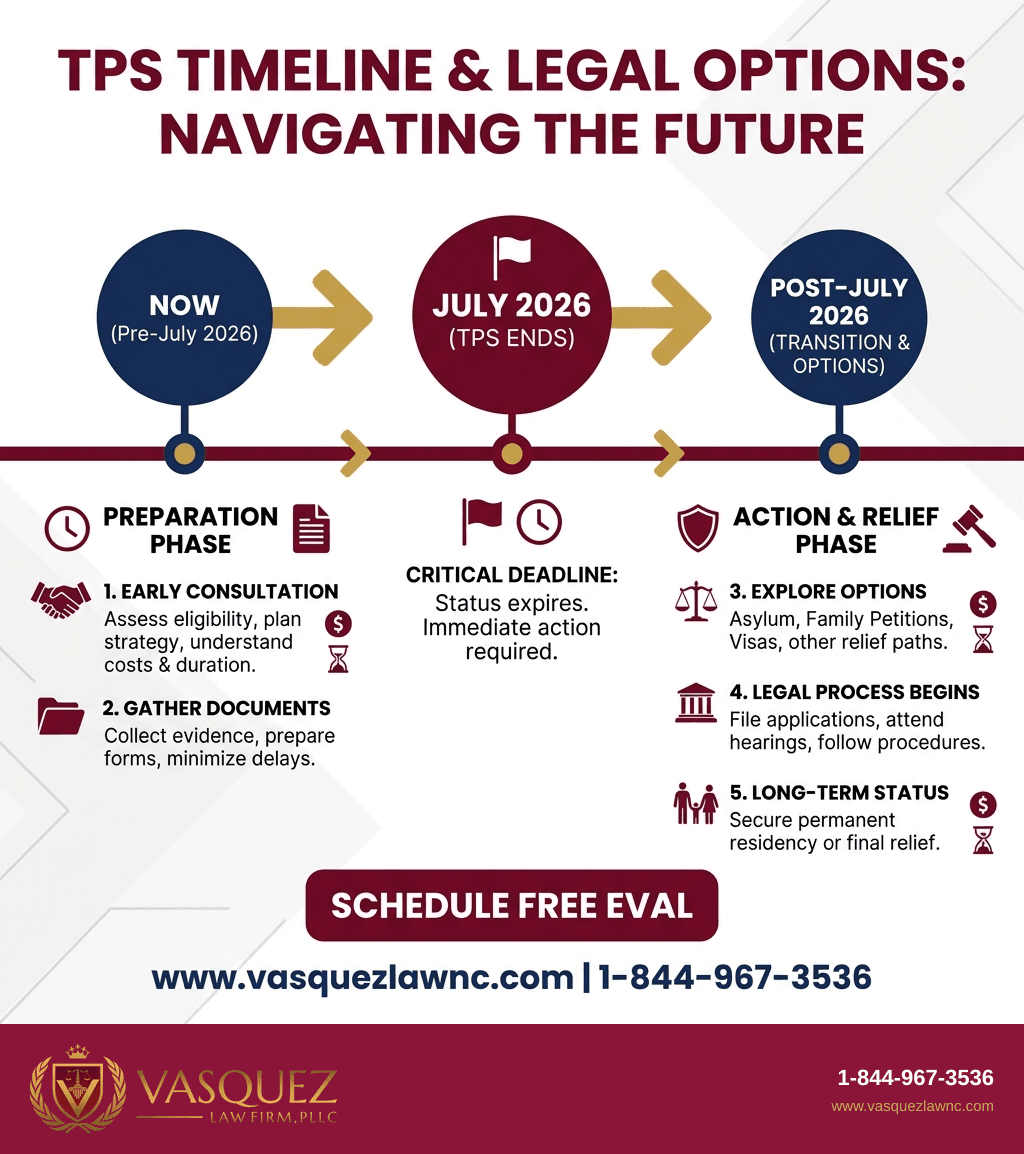
- July 2026: TPS ends. Start looking for other options right away.
- Month 1-3: Collect documents, talk to a lawyer, and find your options.
- Month 3-6: File applications like I-485 or I-589.
- Month 6-8: Go to biometrics appointment; USCIS does security checks.
- Month 8-14: Attend USCIS interview and wait for decision.
- If Approved: Get work permission, green card, or asylum status.
- If Denied: Quickly look at appeals or other legal options.
Processing times can change based on USCIS workload and policies. Check USCIS processing times often for your case type.
Costs and Fees: What Affects the Price
- USCIS fees differ by form. For example, the I-485 fee is about $1,225 including biometrics in 2026.
- Lawyer fees depend on how complex your case is, document help, and court work.
- Other fees may be for medical exams, translations, and appeals.
- Fee waivers may be possible if you show financial hardship.
NC, FL, and Nationwide Immigration Notes
North Carolina Notes
Haitians living in Raleigh and other NC cities should know about local immigration courts and USCIS offices. The Raleigh USCIS office handles many TPS cases, so knowing its rules is important.
Florida Notes
In Orlando, Haitians can find special immigration legal help and community groups for Haitian immigrants. The Orlando USCIS office and immigration courts handle removal cases and relief requests for Haitians.
Nationwide Concepts
TPS is a federal benefit under 8 C.F.R. § 214.2(t). Legal protections, filing rules, and removal hearings apply across the U.S. But procedures can differ by district. Always keep up with USCIS and EOIR updates.
When to Call a Lawyer Now
- If you got a notice that your TPS is ending or has ended.
- If USCIS sent a Request for Evidence (RFE) on your application.
- If you have a removal or deportation order in immigration court.
- If you don’t know how to apply for adjustment of status or asylum.
- If you worry about being detained by immigration officers.
- If you need help appealing a denial or reopening your case.
About Vasquez Law Firm
At Vasquez Law Firm, we mix care with strong representation. Our motto "Yo Peleo®" (I Fight) shows our promise to stand up for your rights.
- Bilingual Support: Se Habla Español - Spanish-speaking lawyers and staff are ready to help
- Service Areas: North Carolina, Florida, and nationwide immigration help
- Experience: Over 30 years helping clients with hard legal matters
- Results: Thousands of successful cases in many practice areas
Attorney Trust and Experience
William J. Vásquez joined the North Carolina State Bar in 2011. He is also admitted to the U.S. Courts of Appeals for the 4th, 5th, 6th, and 11th Circuits. Florida cases at the firm are handled by Florida Bar lawyer Alekssandra Lopez. The firm has given focused legal help since 2011, with personal attention to each client.
Don't face your legal problems alone. Our team is here to help you every step.
Call today: 1-844-967-3536 | Se Habla Español
Frequently Asked Questions
What does the end of TPS mean for Haitians in NC and FL?
The termination of Temporary Protected Status (TPS) means that Haitians living in North Carolina and Orlando, FL, may lose their legal protections from deportation. This requires them to seek alternative lawful immigration status or prepare for possible removal proceedings unless they qualify for other forms of relief under immigration law.
Can Haitians apply for green cards after TPS ends?
Some Haitians may be eligible to apply for adjustment of status to obtain a green card if they have an immediate relative who is a U.S. citizen or meet other eligibility criteria. Filing form I-485 is the first step, but approval depends on individual circumstances and available visas.
What legal options exist for Haitians after TPS termination?
Options may include applying for asylum, cancellation of removal, adjustment of status, or other humanitarian relief. Each option has strict eligibility rules. Consulting an immigration attorney in Raleigh or Orlando is crucial to identify the best path.
How long does the immigration process take for Haitians in 2026?
Processing times vary by case type and USCIS service center. For example, adjustment of status (form I-485) currently averages 8 to 14 months according to USCIS.gov. Timelines depend on background checks, interviews, and case complexity.
Are Haitians at risk of deportation now that TPS has ended?
Yes, losing TPS protection increases the risk of removal unless other legal status is obtained. Defense options might include motions to reopen cases if previously ordered removed. Early legal advice is essential to avoid deportation.
What documents are needed to apply for immigration relief after TPS?
Commonly required documents include proof of TPS registration, identity documents, family relationship evidence, financial records, and any prior immigration paperwork. Proper documentation ensures a more efficient application process.
Can Haitians appeal a denial of their immigration application?
Yes, many immigration decisions can be appealed or reopened. Deadlines and procedures vary by case type and jurisdiction. Working with an immigration attorney ensures timely and proper appeal filings.
How can Haitian immigrants in Raleigh and Orlando get legal help?
Haitians in Raleigh, NC, and Orlando, FL, can contact Vasquez Law Firm for bilingual, experienced immigration legal support. Free case evaluations are available to assess options and plan next steps confidentially.
Sources and References
- U.S. Citizenship and Immigration Services
- Executive Office for Immigration Review
- Legal Information Institute
Ready to take the next step? Contact Vasquez Law Firm today for a free, confidential consultation. We're committed to fighting for your rights and achieving the best possible outcome for your case.
Start Your Free Evaluation Now
Call us: 1-844-967-3536
Se Habla Español - Estamos aquí para ayudarle.


William Vasquez
Founder & CEO, Vasquez Law Firm, PLLC
William Vasquez is the founder and CEO of Vasquez Law Firm, PLLC, a results-driven firm specializing in immigration, criminal defense, personal injury, and workers' compensation. A U.S. Air Force veteran and recipient of the Joint Service Achievement Medal, William is dedicated to fiercely fighting for his clients' rights.
Related Legal Services
Need legal help? Learn more about NC immigration legal team, or contact us for a free evaluation.
You can also visit statewide immigration attorneys for more information.