Fentanyl Seizure Tri-Cities: What Drug Charges Mean in 2026
A Fentanyl seizure in the Tri-Cities can lead to severe drug charges. Understand your rights and defense options in NC for 2026. Contact Vasquez Law for a free consultation.
Published on March 7, 2026
Protect your record and your freedom
Free, confidential review. 24/7.
Free & confidential · Se habla espanol · 24/7

Have questions? Talk to an attorney - free evaluation.
Call 1-844-967-3536Protect Your Record and Your Freedom
A confidential case review - available 24/7 for emergencies.
Fentanyl Seizure Tri-Cities: What Drug Charges Mean in 2026
Reports of a significant Fentanyl seizure in the Tri-Cities area have understandably raised concerns about drug-related offenses and their legal consequences. When law enforcement agencies like the DEA conduct operations resulting in a large Fentanyl seizure, individuals involved can face severe criminal charges, including drug trafficking, possession with intent to distribute, and simple possession. Understanding the complexities of these charges, especially concerning a dangerous substance like fentanyl, is crucial for anyone facing such allegations in North Carolina. This article provides essential information for those navigating the aftermath of a fentanyl seizure in Tri-Cities as of 2026.
Need help with your case? Our experienced attorneys are ready to fight for you. Se Habla Español.
Schedule Your Free Case Evaluation
Or call us now: 1-844-967-3536
Quick Answer
A Fentanyl seizure in the Tri-Cities can result in serious federal or state drug charges, including trafficking or possession. Penalties are severe, often involving mandatory prison sentences and substantial fines. Immediate legal representation is critical to protect your rights and explore all possible defenses.
- Federal charges often arise from large-scale seizures.
- North Carolina has strict laws against fentanyl possession and distribution.
- A conviction can lead to lengthy prison terms and significant fines.
- Defense strategies may include challenging search warrants or evidence.
- Early intervention by a criminal defense lawyer can significantly impact your case outcome.
Understanding Fentanyl Seizures and Criminal Charges
When authorities report a Fentanyl seizure, like the recent operations in the Tri-Cities, it highlights the intense focus on combating opioid distribution. Fentanyl, a synthetic opioid 50 to 100 times more potent than morphine, is a Schedule II controlled substance under federal law, meaning its illegal possession or distribution carries severe penalties. In 2026, law enforcement agencies are increasingly aggressive in targeting fentanyl-related crimes due to the ongoing opioid crisis.
The type of criminal charges you face depends heavily on the quantity of fentanyl involved in the seizure and the evidence collected by law enforcement. For instance, possession of a small amount for personal use might result in a simple possession charge. However, if the amount suggests intent to sell or distribute, or if it crosses certain weight thresholds, charges can escalate to drug trafficking or possession with intent to distribute, which carry mandatory minimum sentences in North Carolina.
For example, a person found with 4 grams or more of fentanyl can face felony trafficking charges in North Carolina, even without direct evidence of selling. This threshold is significantly lower than for many other controlled substances, reflecting the drug's extreme danger. The recent DEA search warrants in the Tri-Cities resulting in the largest drug seizure in the Eastern District further emphasize the federal government's commitment to prosecuting these cases.
Federal vs. State Charges in Fentanyl Seizures
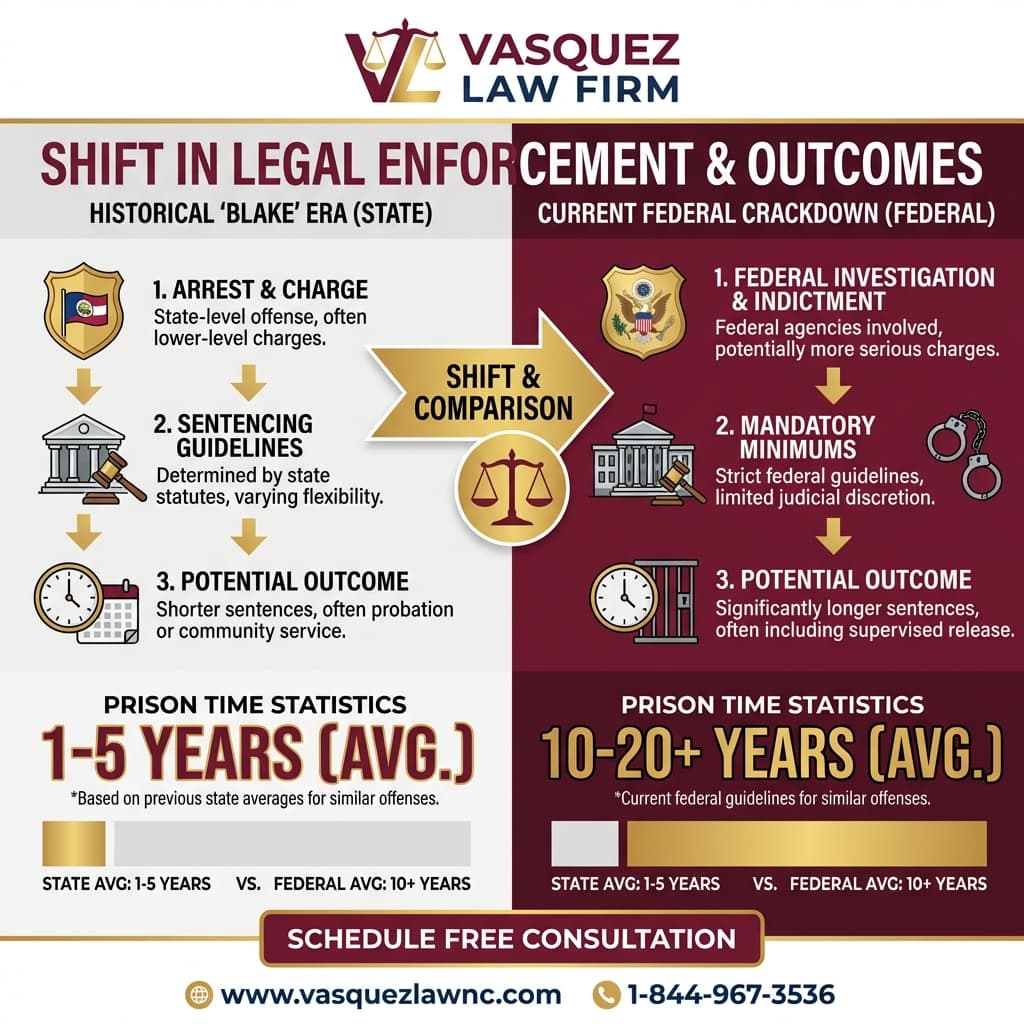
A Fentanyl seizure in the Tri-Cities could lead to either state or federal charges. Federal charges often arise from large-scale operations, like those involving the DEA, or cases crossing state lines. Federal drug laws, such as those found in 21 U.S. Code § 841, often carry harsher penalties, including mandatory minimum sentences, especially for drug trafficking offenses. These cases are investigated by federal agencies like the DEA or FBI and prosecuted by the U.S. Attorney's Office.
Conversely, state charges, handled by local law enforcement and prosecutors, typically involve smaller quantities or cases confined to state jurisdiction. In North Carolina, drug offenses are primarily governed by the North Carolina Controlled Substances Act, G.S. Chapter 90, Article 5. While still serious, state penalties might offer more flexibility in sentencing, depending on the specific facts and the defendant's criminal history. Understanding which jurisdiction is pursuing charges is a critical first step in building a defense strategy.
Steps to Take After a Fentanyl Seizure Arrest
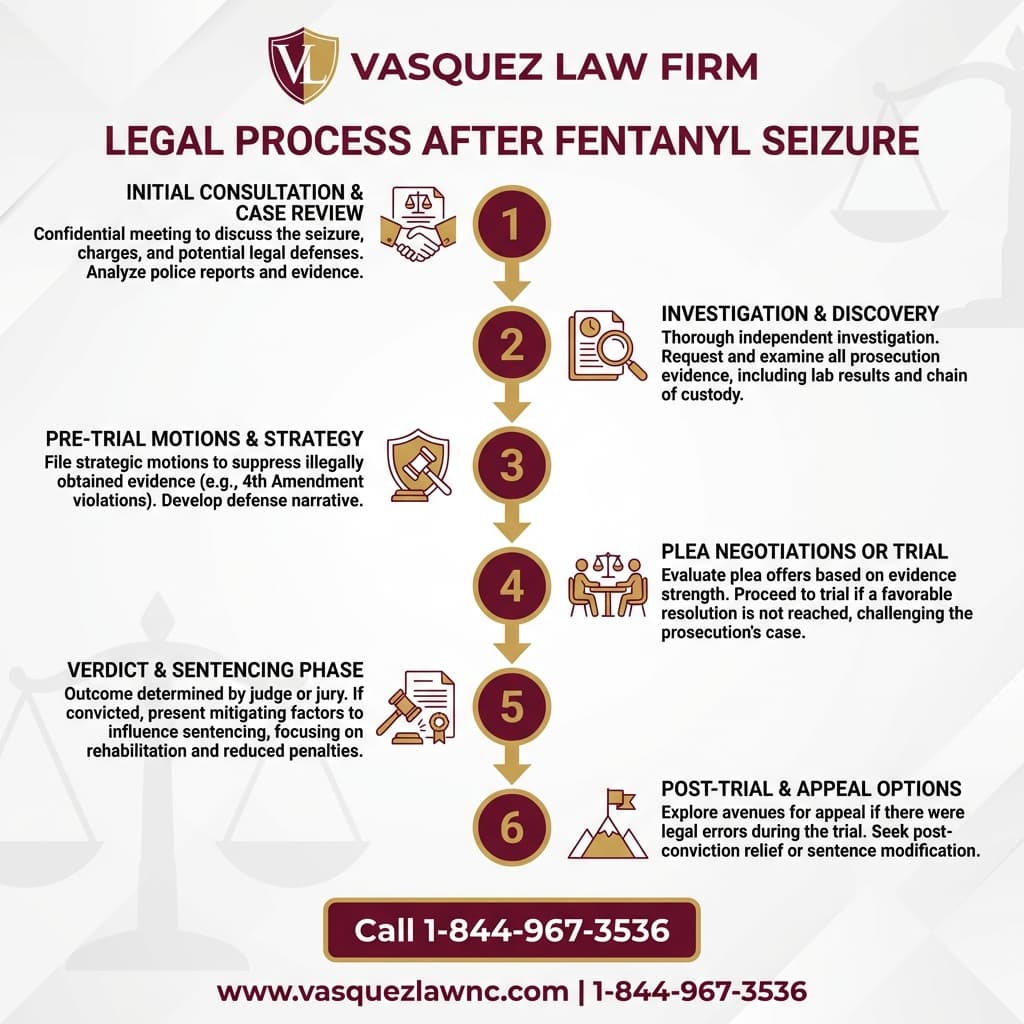
If you or a loved one is arrested following a Fentanyl seizure in the Tri-Cities, your immediate actions can profoundly impact the outcome of your case. The moments directly after an arrest are critical and require careful consideration. Knowing what to do, and more importantly, what not to do, can protect your rights and lay the groundwork for a strong defense.
- Remain Silent: You have the right to remain silent. Exercise it. Anything you say can and will be used against you in court. Do not answer questions about the Fentanyl seizure or your involvement without a lawyer present.
- Do Not Resist Arrest: Cooperate physically with law enforcement. Resisting arrest can lead to additional charges, regardless of the validity of the initial arrest.
- Request an Attorney Immediately: Clearly state that you wish to speak with an attorney. Do not waive this right. Law enforcement must stop questioning you once you invoke your right to counsel.
- Do Not Consent to Searches: You have the right to refuse a search of your person, vehicle, or home unless officers have a warrant or probable cause. If officers claim to have a warrant, ask to see it.
- Document Everything You Remember: As soon as you are able, write down everything you recall about the arrest, including officers' names, what was said, the location, and any specific details about the Fentanyl seizure.
- Contact a Criminal Defense Lawyer: This is the most crucial step. An experienced criminal defense attorney can intervene on your behalf, protect your rights, and begin building a defense strategy immediately. They can advise you on how to proceed during questioning and throughout the legal process.
Potential Penalties for Fentanyl Charges in North Carolina
North Carolina has some of the toughest drug laws in the nation, particularly concerning fentanyl. The penalties for a Fentanyl seizure conviction can be severe, ranging from substantial fines to lengthy prison sentences, depending on the specific charge and the quantity of the drug involved. These consequences can be life-altering, affecting your freedom, finances, and future opportunities.
Fentanyl Possession Charges
Simple possession of fentanyl, even a trace amount, is a felony in North Carolina. According to N.C. Gen. Stat. § 90-95(d)(2), possession of any amount of fentanyl is a Class I felony. A conviction can result in a prison sentence of 3 to 12 months, along with significant fines. The exact sentence depends on your prior criminal record and other aggravating or mitigating factors. Even a first-time offense carries serious implications for your future.
Possession with Intent to Distribute or Sell
If you are accused of possessing fentanyl with the intent to distribute or sell, the penalties increase dramatically. This charge is also a felony and can lead to longer prison terms and higher fines. Factors that indicate intent to distribute include larger quantities, packaging materials, scales, large sums of cash, or statements from informants. This type of charge is often associated with a significant Fentanyl seizure.
Fentanyl Trafficking Penalties
Fentanyl trafficking carries mandatory minimum prison sentences, meaning judges have limited discretion. Under N.C. Gen. Stat. § 90-95(h)(4c), the penalties are as follows:
- 4 grams or more, but less than 14 grams: Class G felony, mandatory minimum 70 months (approx. 5 years, 10 months) to 93 months (approx. 7 years, 9 months) in prison, and a fine of $50,000.
- 14 grams or more, but less than 28 grams: Class F felony, mandatory minimum 90 months (approx. 7 years, 6 months) to 117 months (approx. 9 years, 9 months) in prison, and a fine of $100,000.
- 28 grams or more: Class D felony, mandatory minimum 225 months (approx. 18 years, 9 months) to 279 months (approx. 23 years, 3 months) in prison, and a fine of $200,000.
These severe penalties underscore the critical need for aggressive legal representation if you are facing fentanyl charges in North Carolina, especially after a Fentanyl seizure in the Tri-Cities.
Common Mistakes and How to Avoid Them
Facing drug charges, particularly those stemming from a Fentanyl seizure, can be daunting. In such high-stakes situations, it is easy to make errors that could severely compromise your defense. Avoiding these common pitfalls is essential for protecting your rights and improving your case's outcome.
- Talking to Law Enforcement Without a Lawyer: Any statements you make, even if you believe them to be innocent, can be used against you. Always invoke your right to remain silent and request an attorney.
- Consenting to Searches: Unless officers have a warrant, you are not obligated to consent to searches of your property. Giving consent can eliminate your ability to challenge the search later.
- Destroying or Hiding Evidence: Tampering with evidence is a separate criminal offense and will only worsen your situation. Do not attempt to dispose of or conceal any items related to the Fentanyl seizure.
- Delaying Legal Counsel: The sooner you retain a criminal defense attorney, the better. They can investigate the arrest, identify procedural errors, and begin building a defense before crucial evidence or witness memories fade.
- Discussing Your Case on Social Media: Any posts, messages, or comments about your arrest or the Fentanyl seizure can be found and used by prosecutors. Avoid discussing your case online or with anyone other than your attorney.
- Failing to Understand Your Charges: Many people don't fully grasp the severity of their charges. Your attorney will explain everything, including potential penalties and legal strategies.
- Ignoring Court Dates or Legal Deadlines: Missing court appearances or failing to meet deadlines can lead to warrants for your arrest or the automatic loss of certain rights and defenses.
If you only remember one thing: Always exercise your right to remain silent and immediately request a lawyer if you are questioned or arrested in connection with a Fentanyl seizure. This single action is your strongest protection.
Defense Strategies for Fentanyl Charges in North Carolina
Facing charges related to a Fentanyl seizure requires a robust and strategic defense. An experienced criminal defense attorney can analyze the specifics of your case and identify the most effective legal arguments. There are several avenues to explore, depending on the circumstances of your arrest and the evidence presented by the prosecution.
Challenging the Search and Seizure
A common defense strategy involves questioning the legality of how the fentanyl was seized. If law enforcement conducted an illegal search or seizure, any evidence obtained might be inadmissible in court. This could include:
- Lack of Probable Cause: Did officers have a legitimate reason to believe a crime was being committed before the search?
- Invalid Search Warrant: Was the search warrant properly obtained, specific in its scope, and executed correctly? Evidence from the Tri-Cities Fentanyl seizure involving DEA search warrants can be scrutinized.
- Consent Issues: Was your consent to search truly voluntary, or were you coerced?
- Plain View Doctrine Violations: Was the fentanyl truly in plain view, or did officers manipulate items to discover it?
Disputing Possession or Knowledge
Another defense involves arguing that you did not actually possess the fentanyl or were unaware of its presence. For example:
- Lack of Actual Possession: The fentanyl was not on your person.
- Lack of Constructive Possession: Even if the fentanyl was in an area you controlled, such as your car or home, the prosecution must prove you knew it was there and intended to exercise control over it.
- Unknowing Possession: You may have been unaware that the substance was fentanyl, or that it was present in your belongings.
Challenging the Quantity or Identity of the Substance
In cases involving a Fentanyl seizure, especially for trafficking charges, the quantity of the drug is paramount. Your attorney can challenge the prosecution's evidence regarding the weight or chemical composition of the substance. Lab errors, improper handling, or contamination could all lead to a dispute over the evidence. Furthermore, the defense can argue that the substance was not, in fact, fentanyl, requiring expert testimony to challenge the prosecution's forensic analysis.
When to Call a Lawyer Now
The legal consequences of a Fentanyl seizure, particularly in the Tri-Cities, are severe and demand immediate attention from a skilled criminal defense attorney. Waiting to seek legal counsel can jeopardize your rights and limit your defense options. If any of the following situations apply to you, contact Vasquez Law Firm without delay:
- You have been arrested or charged in connection with a Fentanyl seizure.
- Law enforcement has questioned you about fentanyl or other drug-related activities.
- Your property has been searched, or you believe it may be searched in connection with a Fentanyl seizure.
- You received a grand jury subpoena related to drug offenses.
- You are concerned about potential federal charges, which carry mandatory minimum sentences.
- You need help understanding the specific drug laws in North Carolina that apply to your situation.
- You want to explore options for bail or bond after an arrest.
- You believe your constitutional rights were violated during an arrest or search.
About Vasquez Law Firm
At Vasquez Law Firm, we combine compassion with aggressive representation. Our motto "Yo Peleo" (I Fight) reflects our commitment to standing up for your rights. When you are facing serious criminal charges, especially those stemming from a Fentanyl seizure in the Tri-Cities, you need a legal team that understands the gravity of your situation and is prepared to fight tirelessly on your behalf.
- Bilingual Support: Se Habla Español - our team is fully bilingual and ready to assist clients in both English and Spanish, ensuring clear communication and understanding.
- Service Areas: Criminal defense in Johnston and Harnett counties, NC; immigration nationwide, including Florida
- Experience: With over 15 years of dedicated experience, Attorney Vasquez has successfully handled thousands of cases, including complex drug charges, providing clients with expert legal guidance.
- Results: Our firm is dedicated to achieving the best possible outcomes for our clients, leveraging deep legal knowledge and aggressive advocacy.
Attorney Trust and Experience
Attorney Vasquez holds a Juris Doctor degree and is admitted to practice in both the North Carolina State Bar and Florida Bar. With over 15 years of dedicated legal experience, he has built a reputation for providing personalized attention and achieving favorable outcomes for his clients. His commitment to justice and client advocacy makes Vasquez Law Firm a trusted ally in your legal battle.
Don't face your legal challenges alone. Our team is here to help you every step of the way.
Call today: 1-844-967-3536 | Se Habla Español
Frequently Asked Questions
What is fentanyl and why are charges so severe?
Fentanyl is a powerful synthetic opioid, significantly more potent than heroin or morphine. Its extreme potency makes it highly dangerous, leading to a high risk of overdose. Due to the ongoing opioid crisis and the drug's lethality, law enforcement and prosecutors pursue fentanyl-related charges with maximum severity, often resulting in mandatory minimum sentences for even small quantities.
What's the difference between possession and trafficking charges for fentanyl?
Possession generally refers to having fentanyl for personal use, typically in smaller quantities. Trafficking, however, involves larger amounts and implies intent to sell, transport, or distribute. In North Carolina, possessing 4 grams or more of fentanyl automatically triggers trafficking charges, which carry much harsher mandatory minimum prison sentences and fines than simple possession.
Can I be charged federally for a fentanyl seizure in North Carolina?
Yes, especially if the Fentanyl seizure involved federal agencies like the DEA, or if the case has interstate connections. Federal charges often apply to larger quantities and can result in more severe penalties, including longer mandatory minimum sentences, than state charges. A lawyer can help determine if your case is being investigated or prosecuted at the federal level.
What if I didn't know the substance was fentanyl?
Lack of knowledge can be a defense. If you genuinely did not know the substance you possessed was fentanyl, or even that you possessed an illegal substance at all, your attorney might argue for an unknowing possession defense. However, proving this can be challenging and requires skilled legal advocacy to present compelling evidence of your lack of awareness.
How can a criminal defense lawyer help with fentanyl charges?
A criminal defense lawyer can protect your rights, challenge evidence, negotiate with prosecutors, and represent you in court. They can investigate the legality of the Fentanyl seizure, challenge search warrants, dispute the quantity or identity of the substance, and develop a strong defense strategy aimed at reducing charges, securing an acquittal, or minimizing penalties.
What are the mandatory minimums for fentanyl trafficking in NC?
In North Carolina, fentanyl trafficking carries strict mandatory minimums. For 4-14 grams, it's a Class G felony with 70-93 months imprisonment and a $50,000 fine. For 14-28 grams, it's a Class F felony with 90-117 months and a $100,000 fine. For 28 grams or more, it's a Class D felony with 225-279 months and a $200,000 fine. These are severe penalties.
What if the search that led to the fentanyl seizure was illegal?
If the search and seizure of fentanyl were conducted illegally, violating your Fourth Amendment rights, the evidence obtained might be excluded from your case. This is known as the "exclusionary rule." Your attorney can file a motion to suppress this evidence, potentially weakening the prosecution's case significantly or leading to dismissal of charges.
Will my prior criminal record affect my fentanyl charges?
Yes, a prior criminal record can significantly impact the severity of your sentence for fentanyl charges in North Carolina. Judges consider your prior convictions when determining sentencing, potentially placing you in a higher sentencing grid cell, which could result in longer prison terms and higher fines. An attorney can assess how your record may affect your case.
What should I do if I am questioned by the DEA or other federal agents?
If federal agents question you regarding a Fentanyl seizure or other drug offenses, politely but firmly state that you wish to remain silent and will not answer any questions without your attorney present. Do not make any statements or sign any documents. Immediately contact an experienced criminal defense lawyer who handles federal cases.
Is bail possible for fentanyl charges in North Carolina?
Bail for fentanyl charges can be set high due to the severity of the offense, especially for trafficking. While bail is generally possible, the amount will depend on factors like the quantity of fentanyl, your criminal history, and flight risk. An attorney can argue for a reasonable bail amount and help you navigate the bail process.
Sources and References
Facing charges? Our criminal defense attorneys can review your case.
Ready to take the next step? Contact Vasquez Law Firm today for a free, confidential consultation. We're committed to fighting for your rights and achieving the best possible outcome for your case.
Start Your Free Case Evaluation Now
Call us: 1-844-967-3536
Se Habla Español - Estamos aquí para ayudarle.

William Vasquez
Founder & CEO, Vasquez Law Firm, PLLC
William Vasquez is the founder and CEO of Vasquez Law Firm, PLLC, a results-driven firm specializing in immigration, criminal defense, personal injury, and workers' compensation. A U.S. Air Force veteran and recipient of the Joint Service Achievement Medal, William is dedicated to fiercely fighting for his clients' rights.
Related Legal Services
Need legal help? Learn more about NC criminal defense legal team, or contact us for a free evaluation.
You can also visit NC criminal defense legal help for more information.