What Happens to Your Drug Charges Case in North Carolina in 2026
Facing drug charges in North Carolina? Understand NC drug laws, penalties, and defense strategies for 2026. Contact Vasquez Law Firm for a free consultation.
Published on February 27, 2026
Protect your record and your freedom
Free, confidential review. 24/7.
Free & confidential · Se habla espanol · 24/7

Have questions? Talk to an attorney - free evaluation.
Call 1-844-967-3536Protect Your Record and Your Freedom
A confidential case review - available 24/7 for emergencies.
What Happens to Your Drug Charges Case in North Carolina in 2026
Facing drug charges in North Carolina can be a frightening and overwhelming experience. The legal system for drug offenses is complex, with potential penalties ranging from significant fines to lengthy prison sentences, depending on the nature and severity of the charge. Understanding your rights, the specific laws involved, and the potential consequences is crucial for anyone accused of a drug-related crime. This guide provides a comprehensive overview of drug charges in North Carolina as of 2026, outlining common offenses, penalties, and critical defense strategies to help you navigate this challenging time. Securing experienced legal representation early is your best defense against serious repercussions.
Need help with your drug charges case? Our experienced attorneys are ready to fight for you. Se Habla Español.
Schedule Your Free Case Evaluation
Or call us now: 1-844-967-3536
Quick Answer
In North Carolina, drug charges encompass a wide range of offenses, from simple possession to felony trafficking, with penalties varying based on the type and quantity of the substance, prior convictions, and specific circumstances. Convictions can lead to severe fines, imprisonment, and a criminal record affecting future opportunities. Navigating these complex laws requires immediate legal counsel to protect your rights and explore all available defense options.
- Drug possession, manufacturing, and trafficking are serious offenses.
- Penalties are determined by drug schedule, quantity, and intent.
- Experienced legal defense is crucial for challenging drug charges.
- North Carolina's structured sentencing guidelines apply to most drug convictions.
Understanding Drug Charges in North Carolina
North Carolina's drug laws are codified primarily under Chapter 90, Article 5 of the General Statutes, known as the North Carolina Controlled Substances Act. This act categorizes controlled substances into six schedules (I through VI), with Schedule I drugs having the highest potential for abuse and no accepted medical use, and Schedule VI having the lowest. The severity of drug charges and their associated penalties are directly tied to which schedule the drug falls under, the quantity involved, and the specific nature of the offense.
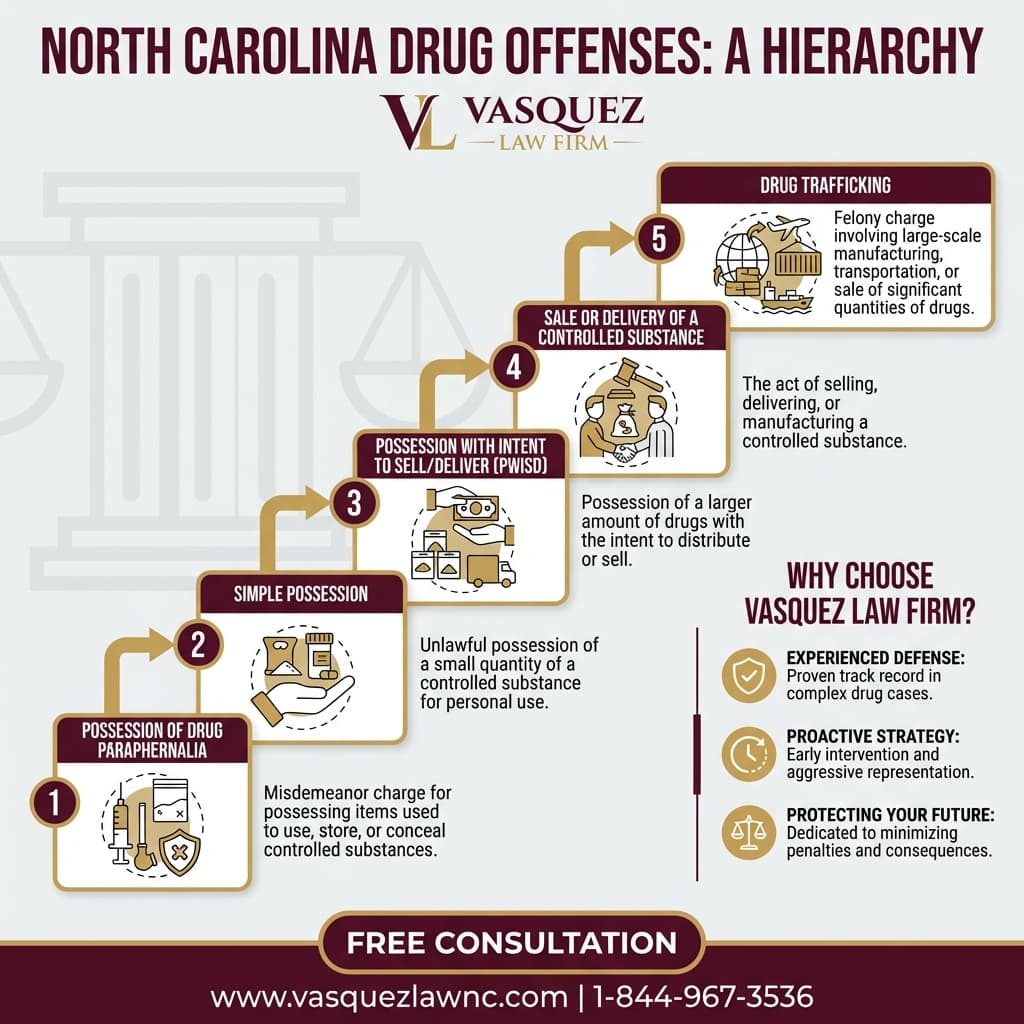
Common drug charges in North Carolina include possession, manufacturing, selling, and trafficking. Each of these offenses carries different legal thresholds and sentencing guidelines. For instance, simple possession of a small amount of marijuana (Schedule VI) is typically a misdemeanor, while possession of heroin (Schedule I) is a felony, regardless of the quantity. Understanding these distinctions is the first step in comprehending the legal challenges you might face when accused of drug distribution charges NC.
The legal landscape surrounding drug charges can be intricate, often involving constitutional questions related to search and seizure, proper police procedure, and evidence handling. A strong defense strategy requires a thorough understanding of both state and federal drug laws, as well as the procedural rules that govern criminal cases. Vasquez Law Firm is dedicated to helping clients in Smithfield and across North Carolina navigate these complexities, providing aggressive representation for all types of drug offenses.
Types of Drug Offenses and Penalties
Drug charges in North Carolina can be broadly categorized into several types, each with its own specific elements and potential penalties. The consequences of a conviction can significantly impact your life, making it essential to understand the specific charges against you. Below are some of the most common drug offenses and their general penalties in North Carolina as of 2026.
Drug Possession Charges
Possession of a controlled substance is one of the most common drug charges. The severity depends on the drug's schedule and quantity. Simple possession of a small amount of a Schedule VI substance (like marijuana) is a misdemeanor. However, possession of any amount of a Schedule I or II substance (like heroin, cocaine, or methamphetamine) is a felony. For example, possession of up to 0.5 ounces of marijuana is a Class 3 misdemeanor, while possession of any amount of cocaine is a Class I felony. Penalties can include fines, probation, and jail time, increasing with the drug's schedule and quantity.
Drug Manufacturing and Distribution
Manufacturing a controlled substance involves producing, preparing, or processing illegal drugs. Distribution refers to selling, delivering, or providing a controlled substance to another person. Both are serious felony offenses. The penalties are determined by the drug's schedule and the amount involved. For example, manufacturing or distributing any amount of a Schedule I or II drug is a felony, with more severe penalties for larger quantities. These charges often involve complex investigations and can lead to substantial prison sentences and hefty fines. If you are facing drug trafficking defense guide, it's vital to seek legal counsel immediately.
Drug Trafficking Charges
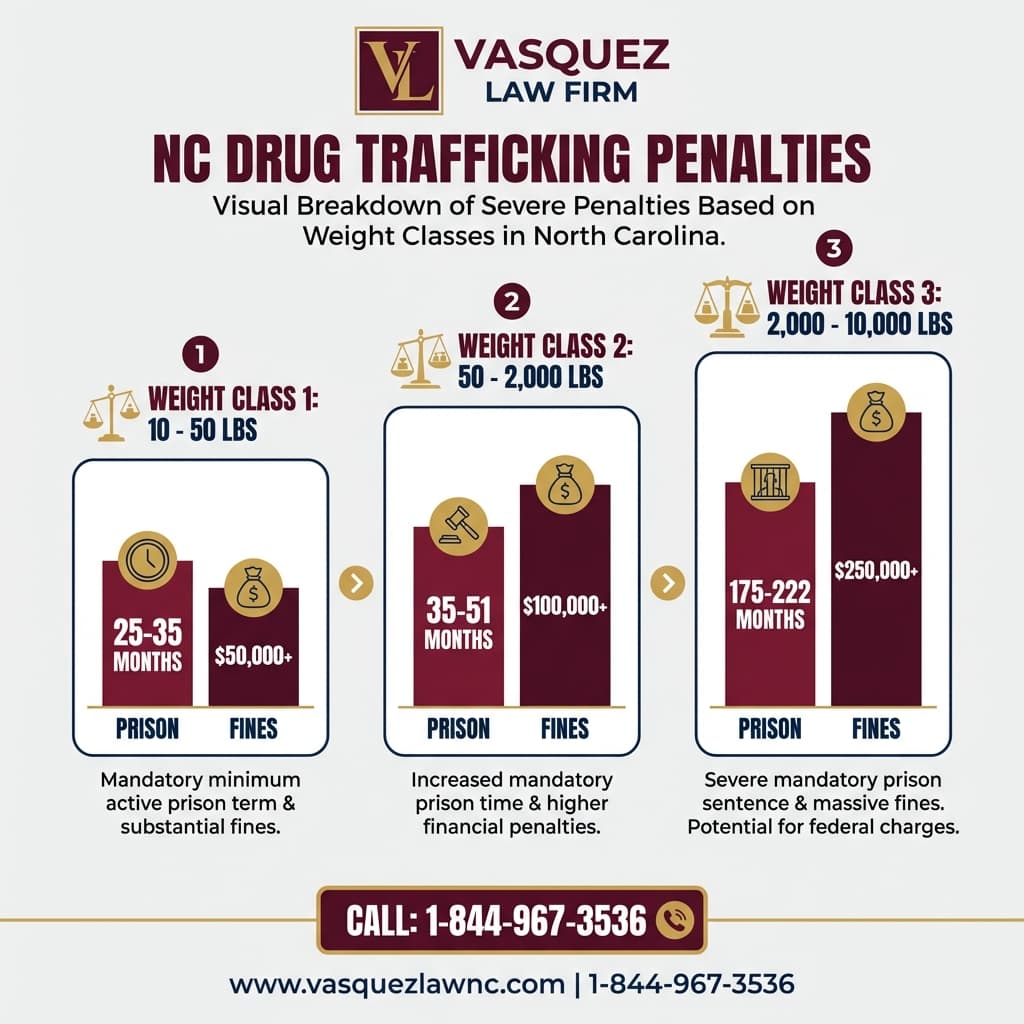
Drug trafficking is the most serious category of drug charges, involving possessing, manufacturing, selling, or delivering controlled substances above specific weight thresholds. These thresholds vary by drug type. Trafficking charges carry mandatory minimum prison sentences and extremely high fines, regardless of prior criminal history. For instance, trafficking cocaine can result in a minimum of 35 months in prison and a $50,000 fine for quantities between 28 and 200 grams, escalating significantly for larger amounts. These cases often involve federal agencies and require a skilled defense attorney.
North Carolina Sentencing Guidelines for Drug Offenses
North Carolina utilizes a structured sentencing system for criminal offenses, including drug charges. This system takes into account both the severity of the offense and the defendant's prior criminal record. For felony drug offenses, the law specifies presumptive sentences within a grid, often allowing for active prison time, intermediate punishment (like probation with special conditions), or community punishment (like probation with minimal supervision). Misdemeanor drug offenses also have structured sentencing, typically resulting in fines, probation, or short jail sentences.
The judge has some discretion within these guidelines, but mandatory minimums exist for certain serious drug charges, particularly trafficking. For example, N.C. Gen. Stat. § 90-95 outlines specific penalties for various drug offenses, including mandatory minimum sentences for trafficking. Factors that can influence sentencing include the defendant's role in the offense, whether a firearm was involved, and if the offense occurred near a school or minor. An experienced attorney can advocate for the lowest possible sentence and explore alternatives to incarceration, such as drug treatment programs, where applicable. Understanding these guidelines is critical when facing felony drug charges.
Common Defense Strategies for Drug Charges
When facing drug charges in North Carolina, a robust defense strategy is paramount. An experienced criminal defense attorney can meticulously examine the details of your case, challenge the prosecution's evidence, and protect your constitutional rights. There are several common defense strategies that may be employed, depending on the specifics of your situation.
Challenging Illegal Search and Seizure
One of the most powerful defenses involves challenging how evidence was obtained. The Fourth Amendment protects individuals from unreasonable searches and seizures. If law enforcement conducted a search without a warrant, probable cause, or valid consent, any evidence found might be deemed inadmissible in court. This could lead to the dismissal of your drug charges. Your attorney will scrutinize police reports, witness statements, and body camera footage to identify any violations of your rights. For example, if you were stopped without reasonable suspicion or your vehicle was searched without proper justification, the evidence could be suppressed.
Lack of Possession or Knowledge
To secure a conviction for possession, the prosecution must prove that you knowingly and intentionally possessed the controlled substance. If the drugs were found in a shared space (like a car or house with multiple occupants), or if you were unaware of their presence, it might be argued that you did not have actual or constructive possession. Similarly, if you were unaware of the illicit nature of a substance you possessed, this could also serve as a defense. Proving lack of knowledge or possession requires strong evidence and a compelling argument from your legal team.
Entrapment and Mistaken Identity
Entrapment occurs when law enforcement induces an individual to commit a crime they would not have otherwise committed. This defense is often complex and requires demonstrating that police tactics went beyond merely providing an opportunity to commit a crime. Mistaken identity, while less common in drug cases, can be a valid defense if you were wrongly identified as the perpetrator. These defenses rely heavily on the specific facts of the case and require skilled legal advocacy to present effectively in court. Understanding these nuances is crucial for navigating federal drug charges.
What to Expect When Facing Drug Charges
Navigating the criminal justice system after being accused of drug charges can be daunting. Knowing the general process can help you prepare and understand the importance of immediate legal representation. The journey from arrest to resolution involves several key stages, each with its own legal complexities.
Arrest and Initial Appearance
Following an arrest for drug charges, you will typically be booked into jail. This involves fingerprinting, photographing, and collecting personal information. Within 24-48 hours, you will likely have an initial appearance before a magistrate or judge. During this appearance, you will be informed of the charges against you, and bail will be set. This is a critical juncture where an attorney can argue for a reasonable bail amount or even release on your own recognizance. Vasquez Law Firm is ready to assist clients in Smithfield and surrounding areas from the moment of arrest.
Pre-Trial Hearings and Discovery
After the initial appearance, your case will proceed to various pre-trial hearings. During this phase, your attorney will engage in discovery, which involves obtaining all evidence the prosecution intends to use against you. This includes police reports, lab results, witness statements, and any surveillance footage. Your attorney will analyze this evidence for weaknesses, constitutional violations, or inconsistencies that can be used to build your defense. Motions to suppress evidence, challenge search warrants, or dismiss charges may be filed during this stage.
Negotiation, Trial, and Sentencing
Many drug cases are resolved through plea negotiations, where your attorney will work to secure a favorable plea bargain, potentially reducing charges or penalties. If a plea agreement cannot be reached, your case may proceed to trial. At trial, the prosecution must prove your guilt beyond a reasonable doubt. If convicted, the judge will impose a sentence based on North Carolina's structured sentencing guidelines, considering the offense's severity and your criminal history. Having a skilled attorney by your side throughout these stages is essential for protecting your rights and achieving the best possible outcome.
Don't face your legal challenges alone. Our team is here to help you every step of the way.
Call today: 1-844-967-3536 | Se Habla Español
When to Call a Lawyer Now for Drug Charges
The moment you suspect you are under investigation or are formally charged with drug charges, contacting an attorney should be your immediate priority. Early intervention by legal counsel can significantly impact the outcome of your case. Do not wait for your first court date to seek help. Here are critical situations when you should call a lawyer right away:
- If You Have Been Arrested: Do not answer any questions from law enforcement without your attorney present. Invoke your right to remain silent and request legal counsel immediately.
- If You Are Under Investigation: Even if you haven't been arrested, if you believe you are a target of a drug investigation, a lawyer can advise you on how to proceed without incriminating yourself.
- If You Are Served a Search Warrant: If police arrive with a search warrant, contact an attorney. They can ensure the search is conducted legally and protect your rights.
- If You Are Facing Felony Drug Charges: Felony charges carry severe penalties, including mandatory prison time. An attorney can begin building a strong defense from the outset.
- If You Have Prior Convictions: A history of drug-related offenses can lead to enhanced penalties. A lawyer can navigate these complexities and mitigate potential consequences.
- If You Believe Your Rights Were Violated: If you suspect an illegal search, seizure, or coerced confession, an attorney can file motions to suppress evidence.
- If You Are Offered a Plea Deal: Never accept a plea deal without first consulting with an attorney who can evaluate its fairness and explore better options.
About Vasquez Law Firm
At Vasquez Law Firm, we combine compassion with aggressive representation. Our motto "Yo Peleo" (I Fight) reflects our commitment to standing up for your rights, especially when facing serious criminal accusations like drug charges. We understand the fear and uncertainty that come with legal challenges and are dedicated to providing personalized, strategic defense for every client.
- Bilingual Support: Se Habla Español - our team is fully bilingual, ensuring clear communication and understanding throughout your case.
- Service Areas: We proudly serve clients across North Carolina, including Smithfield, and also offer nationwide immigration services.
- Experience: With over 15 years of dedicated legal experience, we have a proven track record of helping clients navigate complex legal matters and achieving favorable outcomes.
- Results: Our firm has successfully handled thousands of cases across multiple practice areas, demonstrating our commitment to fighting for justice.
Attorney Trust and Experience
Attorney Vasquez holds a Juris Doctor degree and is admitted to practice in both the North Carolina State Bar and Florida Bar. With over 15 years of dedicated legal experience, he has built a reputation for providing personalized attention and achieving favorable outcomes for his clients. His deep understanding of criminal defense, particularly in cases involving drug charges, makes him a formidable advocate in the courtroom. Our team at Vasquez Law Firm is committed to upholding the highest standards of legal ethics and client advocacy, ensuring you receive the best possible defense.
Frequently Asked Questions
What is the most common drug charge in North Carolina?
The most common drug charge in North Carolina is possession of a controlled substance. This can range from misdemeanor possession of small amounts of marijuana to felony possession of Schedule I or II drugs like cocaine or heroin. The specific charge and penalty depend heavily on the type and quantity of the drug involved, as well as any prior criminal history. These charges are frequently encountered by individuals across the state.
What is the charge of drug possession in NC?
In North Carolina, drug possession charges vary significantly based on the drug's schedule and quantity. For example, possession of up to 0.5 ounces of marijuana is a Class 3 misdemeanor, while possession of any amount of cocaine or heroin is a felony, typically a Class I felony for Schedule I and II substances. Penalties include fines, probation, and potential jail time, increasing with the severity of the offense. It's crucial to understand these distinctions.
What is the minimum sentence for drug trafficking in North Carolina?
Drug trafficking in North Carolina carries mandatory minimum prison sentences, which vary based on the type and quantity of the drug. For instance, trafficking cocaine (28 to 200 grams) has a mandatory minimum of 35 months imprisonment and a $50,000 fine. These sentences escalate significantly for larger quantities and certain drug types. There is often limited judicial discretion below these minimums, making a strong defense essential.
Can I get probation for felony drug charges in NC?
Whether you can get probation for felony drug charges in North Carolina depends on the specific felony class, your prior criminal record, and the judge's discretion within the structured sentencing guidelines. For some lower-level felonies, probation (community or intermediate punishment) is a possibility. However, serious charges like drug trafficking carry mandatory minimum active prison sentences, making probation highly unlikely or impossible. An attorney can assess your eligibility.
What is the difference between possession with intent to sell and drug trafficking?
Possession with intent to sell or deliver (PWISD) is a felony that requires proof you intended to distribute the drug. Drug trafficking is a more severe felony that applies when the quantity of a controlled substance exceeds a specific statutory threshold, regardless of intent to distribute. Trafficking charges carry mandatory minimum prison sentences and higher fines. PWISD focuses on intent, while trafficking focuses on quantity.
What are the penalties for selling drugs near a school in NC?
Selling drugs near a school in North Carolina can lead to enhanced penalties. If a drug offense occurs within 1,000 feet of a school, the defendant may face additional fines and a longer prison sentence, even if the primary drug charge is not a trafficking offense. This enhancement reflects the state's commitment to protecting children and school zones from drug activity. These charges are taken very seriously.
What evidence do prosecutors use in drug charge cases?
Prosecutors use various types of evidence in drug charge cases, including the controlled substance itself (often with lab analysis), witness testimony (from police, informants, or co-defendants), surveillance footage, financial records, text messages, phone calls, and evidence of drug paraphernalia. The legality of how this evidence was obtained (e.g., through search warrants or consent) is often a critical point of defense, as outlined by the Fourth Amendment.
Can a first-time offender avoid jail time for drug charges in NC?
For first-time offenders facing lower-level misdemeanor or certain felony drug charges in North Carolina, it may be possible to avoid jail time, especially if the offense is non-violent and involves smaller quantities. Options like probation, diversion programs, or drug treatment courts might be available. However, for serious felony charges, particularly trafficking, mandatory minimum sentences often preclude avoiding incarceration, regardless of first-time offender status. Legal counsel is essential.
What are federal drug charges, and how do they differ from state charges?
Federal drug charges typically involve larger quantities of drugs, interstate trafficking, or offenses that cross state lines or international borders. They are prosecuted by federal agencies like the DEA and FBI and are heard in federal courts. State drug charges are prosecuted by local or state authorities in state courts. Federal penalties are often more severe, with stricter sentencing guidelines and mandatory minimums than state charges, making federal defense highly specialized. If you are facing federal drug trafficking guide, you need a specialized attorney.
How can a criminal defense lawyer help with drug charges?
A criminal defense lawyer can help with drug charges by challenging the evidence, negotiating with prosecutors, protecting your constitutional rights, and representing you in court. They can investigate illegal searches, question witness credibility, argue for reduced charges or alternative sentencing, and build a strong defense tailored to your specific case. Their expertise is crucial in navigating the complex legal system and striving for the best possible outcome. Contact Vasquez Law Firm for assistance.
Ready to take the next step? Contact Vasquez Law Firm today for a free, confidential consultation. We're committed to fighting for your rights and achieving the best possible outcome for your case.
Start Your Free Case Evaluation Now
Call us: 1-844-967-3536
Se Habla Español - Estamos aquí para ayudarle.


William Vasquez
Founder & CEO, Vasquez Law Firm, PLLC
William Vasquez is the founder and CEO of Vasquez Law Firm, PLLC, a results-driven firm specializing in immigration, criminal defense, personal injury, and workers' compensation. A U.S. Air Force veteran and recipient of the Joint Service Achievement Medal, William is dedicated to fiercely fighting for his clients' rights.
Related Legal Services
Need legal help? Learn more about experienced defense attorneys in Smithfield, or contact us for a free evaluation.
You can also visit criminal defense services in Harnett County for more information.