What You Need to Know About Drug Distribution Charges in NC in 2026
Facing drug distribution charges in North Carolina? Understand the law, potential penalties, and how to defend your rights. Contact Vasquez Law Firm for a free consultation today. Se Habla Español.
Published on February 14, 2026
Protect your record and your freedom
Free, confidential review. 24/7.
Free & confidential · Se habla espanol · 24/7
Have questions? Talk to an attorney - free evaluation.
Call 1-844-967-3536Protect Your Record and Your Freedom
A confidential case review - available 24/7 for emergencies.
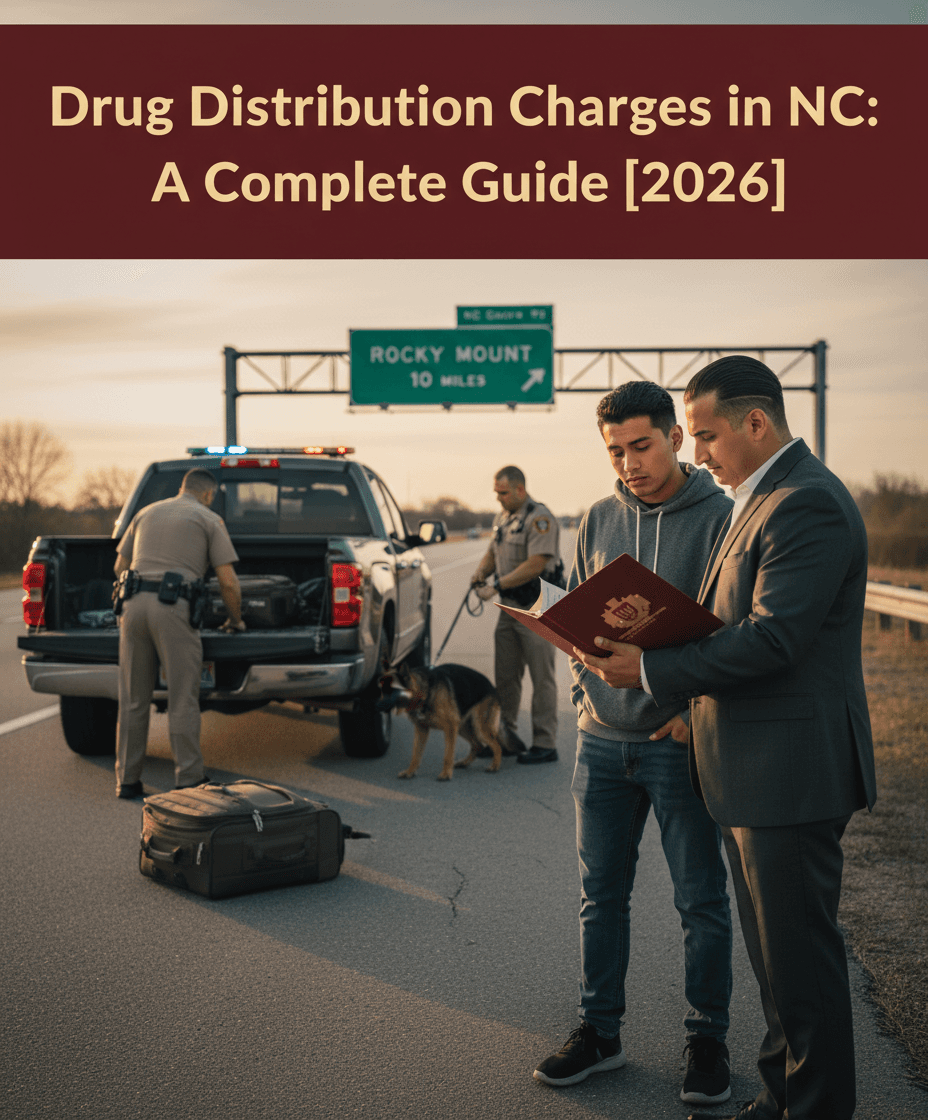
What You Need to Know About Drug Distribution Charges in NC in 2026
Facing drug distribution charges in North Carolina can be an overwhelming and frightening experience. These serious felony offenses carry severe penalties, including lengthy prison sentences, substantial fines, and a lasting criminal record that can impact your life for decades. Understanding the intricacies of North Carolina's drug laws, particularly North Carolina General Statute (NCGS) 90-95, is crucial for anyone accused of such a crime. Whether you're dealing with charges related to marijuana, cocaine, opioids, or other controlled substances, the legal process is complex and demands immediate, skilled legal representation. At Vasquez Law Firm, we are dedicated to providing aggressive and compassionate defense for individuals facing drug distribution charges across North Carolina, including Raleigh and surrounding areas. We understand the stakes and are ready to fight for your future in 2026.
Need help with your case? Our experienced attorneys are ready to fight for you. Se Habla Español.
Schedule Your Free Case Evaluation
Or call us now: 1-844-967-3536
Quick Answer
Drug distribution charges in North Carolina involve possessing, selling, manufacturing, or delivering controlled substances. Penalties are severe, often involving felony convictions, significant prison time, and hefty fines, varying based on the type and quantity of the drug, as well as prior criminal history. Immediate legal counsel is critical to build a strong defense.
- Distribution charges are serious felonies under NCGS 90-95.
- Penalties depend on drug schedule, quantity, and prior convictions.
- Defenses may include illegal search, lack of intent, or entrapment.
- An experienced criminal defense attorney can significantly impact your outcome.
- North Carolina law distinguishes distribution from simple possession and trafficking.
Understanding Drug Distribution Charges in North Carolina
Drug distribution charges in North Carolina are among the most serious offenses a person can face, carrying the potential for life-altering consequences. Unlike simple possession, which generally involves having a small amount of a controlled substance for personal use, distribution implies an intent to transfer drugs to another person. This intent can be inferred from various factors, such as the quantity of drugs, the presence of drug paraphernalia like scales or packaging materials, large amounts of cash, or even text messages and witness testimony. The specific charge and its severity hinge on the type and quantity of the controlled substance involved, as outlined in the North Carolina Controlled Substances Act, NCGS 90-95. For example, distributing Schedule I or II drugs, such as heroin, cocaine, or methamphetamine, carries much harsher penalties than distributing marijuana.
The law categorizes controlled substances into schedules based on their potential for abuse and accepted medical use. Schedule I drugs have a high potential for abuse and no accepted medical use, while Schedule VI drugs have a low potential for abuse. Understanding which schedule a drug falls under is vital for comprehending the potential legal ramifications. For instance, possession with intent to distribute (PWIS) or actual distribution of a Schedule II controlled substance, like oxycodone or crack cocaine, is a felony offense that can lead to years in state prison. The legal framework is designed to deter drug-related activities aggressively, making a robust defense strategy absolutely essential for anyone accused of these crimes in 2026.
Distribution vs. Trafficking vs. Possession: Key Distinctions
It's crucial to understand the differences between simple possession, possession with intent to distribute (PWIS), distribution, and drug trafficking under North Carolina law. These terms are often confused, but they represent distinct legal offenses with vastly different penalties. Simple possession refers to having a small amount of a controlled substance for personal use without any intent to sell or distribute. This is typically a misdemeanor for smaller quantities, though it can become a felony depending on the drug type and amount. PWIS, on the other hand, means you possessed a controlled substance and the state believes you intended to sell or give it to someone else. This intent is often inferred by the presence of large quantities, packaging, or sales records, making it a felony.
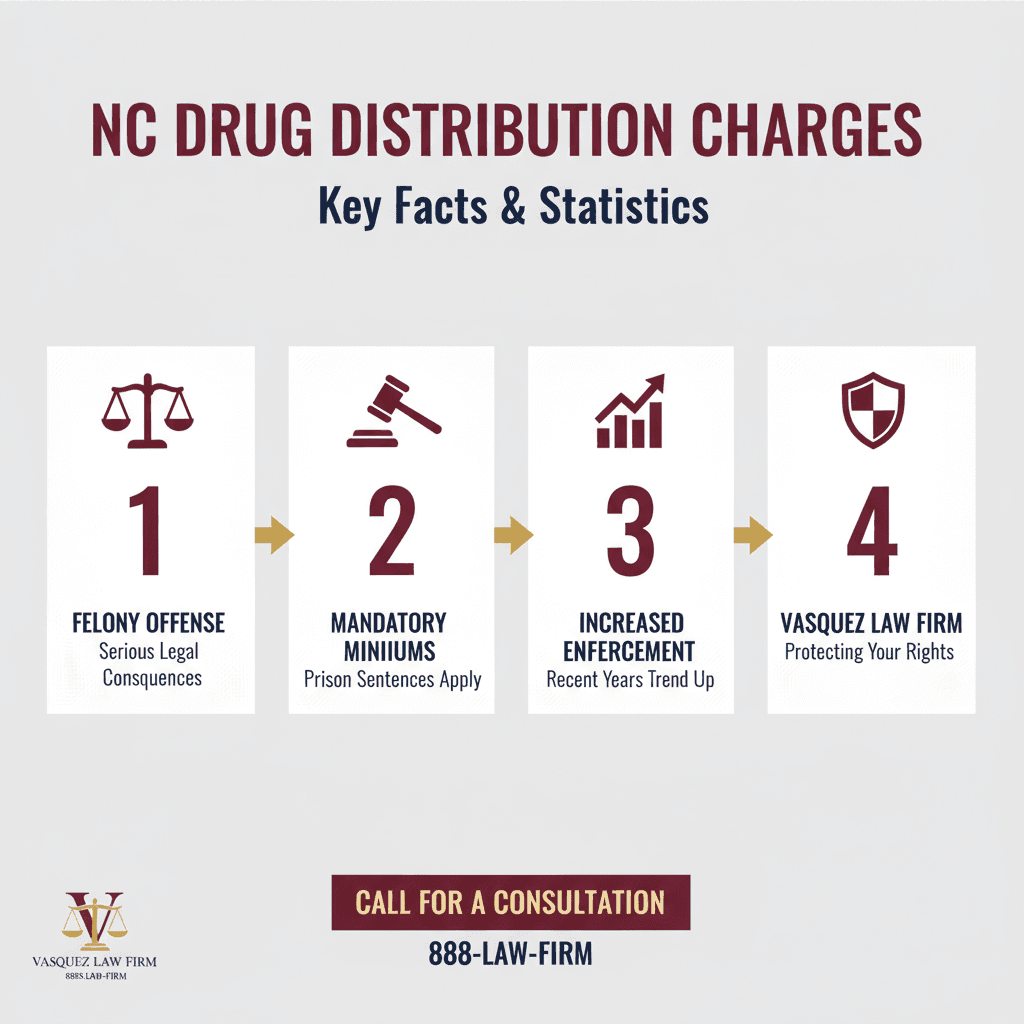
Distribution is the actual act of selling, delivering, or giving a controlled substance to another person. This can be a felony even for small amounts, depending on the drug schedule. Drug trafficking is the most severe of these charges, involving large quantities of controlled substances. Trafficking charges are unique because they carry mandatory minimum prison sentences and fines, regardless of prior criminal history. The threshold for trafficking is based purely on weight, not intent. For example, possessing a certain weight of cocaine automatically triggers a trafficking charge, whether you intended to sell it or not. Navigating these distinctions requires deep legal knowledge, and an attorney from Vasquez Law Firm can help clarify your specific situation and build a strong defense against these serious allegations.
Penalties for Drug Distribution Charges in NC
The penalties for drug distribution charges in North Carolina are severe and depend heavily on several factors: the type and schedule of the drug, the quantity involved, and the defendant's prior criminal record. North Carolina employs a structured sentencing system, meaning the judge refers to a grid to determine the appropriate sentence. For felony possession with intent to distribute or actual distribution, penalties can range from probation to decades in prison. For example, distributing a Schedule I or II controlled substance is typically a Class H or Class G felony, which can result in active prison sentences of several years, even for first-time offenders. North Carolina's structured sentencing guidelines provide specific ranges based on the felony class and prior record level.
Beyond incarceration, individuals facing drug distribution charges also face substantial fines, which can range from thousands to hundreds of thousands of dollars. A conviction will result in a permanent felony record, impacting future employment, housing, educational opportunities, and even voting rights. In some cases, asset forfeiture laws allow the state to seize property believed to be connected to drug activities, such as vehicles, cash, or real estate. Given these harsh consequences, it is imperative to secure experienced legal representation immediately. Attorney Vasquez and our team are committed to meticulously examining every detail of your case to challenge the prosecution's evidence and protect your rights against these serious penalties in 2026.
Common Defenses Against Drug Distribution Allegations
Building a strong defense against drug distribution charges requires a thorough understanding of legal strategies and meticulous attention to detail. Several common defenses can be employed, depending on the specific facts of your case. One primary defense involves challenging the legality of the police search and seizure. If law enforcement obtained evidence through an illegal search without a warrant or probable cause, that evidence might be inadmissible in court, potentially leading to a dismissal of charges. This falls under the Fourth Amendment of the U.S. Constitution, which protects against unreasonable searches and seizures. Another defense focuses on proving a lack of intent to distribute. If the drugs were for personal use, or if you were unaware of their presence, an attorney can argue against the intent element, which is critical for distribution charges.
Entrapment is another possible defense, where law enforcement induces an individual to commit a crime they would not have otherwise committed. This often arises in undercover operations. Challenging the chain of custody for the evidence, disputing the weight or identity of the substance, or arguing mistaken identity are also viable strategies. Sometimes, the defense may involve demonstrating that the defendant was merely present where drugs were found, but had no actual possession or control over them. Each case is unique, and an experienced criminal defense attorney will investigate all aspects, including witness statements, police reports, and forensic evidence, to determine the most effective defense strategy for your particular drug distribution charges. Our team at Vasquez Law Firm has extensive experience in challenging these types of charges.
The Investigative and Court Process for Drug Cases
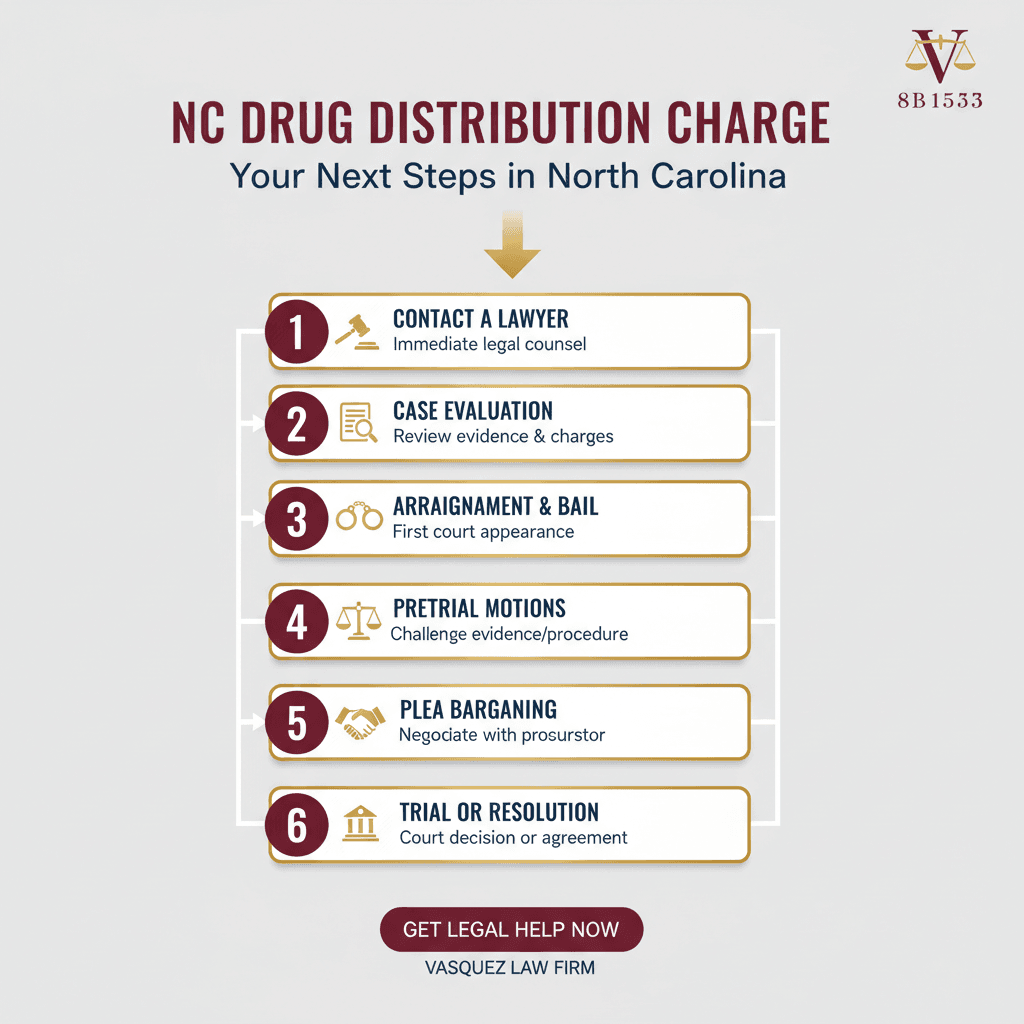
Navigating the criminal justice system after being charged with drug distribution in North Carolina involves several critical stages, each requiring expert legal guidance. The process typically begins with an arrest, often followed by an initial appearance before a magistrate to set bond. Following this, a probable cause hearing may be held, or the case may proceed directly to indictment by a grand jury, particularly for felony drug distribution charges. At this stage, the prosecution formally presents the charges. Your attorney will then engage in discovery, which involves reviewing all evidence the prosecution intends to use against you, including police reports, lab results, witness statements, and any surveillance footage. This is a crucial phase where weaknesses in the prosecution's case can be identified. Understanding your rights during an arrest is vital.
Pre-trial motions are often filed to suppress illegally obtained evidence or to challenge other procedural issues. Plea negotiations may occur, where the prosecution offers a deal in exchange for a guilty plea to a lesser charge or a reduced sentence. If no plea agreement is reached, the case proceeds to trial, where a jury or judge will hear evidence and determine guilt or innocence. If convicted, a sentencing hearing will follow. Throughout this complex process, having a skilled criminal defense attorney from Vasquez Law Firm by your side is essential. We will explain each step, protect your rights, and advocate tirelessly on your behalf, striving for the best possible outcome in your drug distribution charges, whether in Raleigh or elsewhere in NC.
Don't face your legal challenges alone. Our team is here to help you every step of the way.
Call today: 1-844-967-3536 | Se Habla Español
What to Expect When Facing Drug Distribution Charges
Being accused of drug distribution charges can feel like your world has been turned upside down. The initial shock and fear are normal, but understanding what to expect can help you prepare. Immediately after an arrest, you will be processed, fingerprinted, and photographed. A bond will likely be set, which you or your family will need to pay to secure your release. Once released, the legal battle truly begins. You should expect to attend multiple court dates, including arraignments, pre-trial conferences, and potentially a trial. Each step requires careful preparation and adherence to court procedures. The prosecution will work to build a strong case against you, often relying on witness testimony, forensic evidence, and any statements you may have made.
Your attorney will play a critical role, conducting their own investigation, interviewing witnesses, and examining all evidence. You will need to be open and honest with your legal team about all aspects of your case, as this information is crucial for developing an effective defense. Expect periods of waiting, as the legal process can be lengthy, sometimes taking months or even over a year to resolve, especially for complex felony drug distribution charges. Throughout this time, maintaining contact with your attorney and following their advice is paramount. The team at Vasquez Law Firm will ensure you are informed and supported at every stage, helping to alleviate the stress and uncertainty that comes with facing such serious allegations in North Carolina in 2026.
When to Call a Lawyer Now
The moment you suspect you are under investigation or are arrested for drug distribution charges, it is critical to contact an attorney immediately. Time is of the essence in these cases, as early intervention can significantly impact the outcome. Delaying legal counsel can lead to missed opportunities for defense, such as challenging evidence or preserving crucial information. Do not speak to law enforcement without an attorney present, as anything you say can be used against you. Even seemingly innocent statements can be misinterpreted or used to bolster the prosecution's case. Your right to remain silent and your right to an attorney are fundamental protections that you should always exercise.
- You've been arrested: The absolute first step should be to request an attorney.
- Police want to question you: Never answer questions without legal representation.
- You're served with a search warrant: Contact a lawyer immediately if your property is being searched.
- You believe you're under investigation: Proactive legal advice can prevent charges or strengthen your defense.
- You've been charged: Your attorney will guide you through arraignment, bond hearings, and all subsequent steps.
- You're facing a grand jury indictment: This signifies serious felony charges are likely.
- You have questions about drug laws: Even general inquiries about potential exposure warrant a confidential discussion.
At Vasquez Law Firm, we offer free case evaluations to discuss your specific situation, provide clarity on your drug distribution charges, and outline your legal options. Our aggressive and compassionate approach ensures that your rights are protected from the very beginning.
About Vasquez Law Firm
At Vasquez Law Firm, we combine compassion with aggressive representation. Our motto "Yo Peleo" (I Fight) reflects our commitment to standing up for your rights. We understand the profound impact that criminal charges, especially serious drug distribution charges, can have on an individual's life and their family. Our team is dedicated to providing personalized legal strategies tailored to the unique circumstances of each client. We pride ourselves on being accessible, responsive, and relentless in our pursuit of justice.
- Bilingual Support: Se Habla Español - our team is fully bilingual, ensuring clear communication and understanding for all clients.
- Service Areas: We primarily serve clients in North Carolina for criminal defense matters, including the Raleigh area, and offer nationwide immigration services.
- Experience: With over 15 years of dedicated legal experience, our firm has a proven track record of helping clients navigate complex legal matters.
- Results: We have successfully handled thousands of cases across various practice areas, always striving for the best possible outcomes.
Attorney Trust and Experience
Attorney Vasquez holds a Juris Doctor degree and is admitted to practice in the North Carolina State Bar. With over 15 years of dedicated legal experience, he has built a reputation for providing personalized attention and achieving favorable outcomes for his clients. His commitment to justice and his aggressive advocacy make him a formidable ally for anyone facing serious criminal allegations, including complex drug distribution charges. He leads a team that shares his passion for defending client rights.
Frequently Asked Questions
What exactly constitutes drug distribution in North Carolina?
In North Carolina, drug distribution refers to the act of selling, delivering, manufacturing, or possessing with the intent to sell or deliver a controlled substance. This is governed by NCGS 90-95. The key element is the intent to transfer drugs to another person, which can be inferred from the quantity of drugs, presence of paraphernalia, or other circumstantial evidence, making it a serious felony charge.
What are the potential penalties for drug distribution charges in NC?
Penalties vary significantly based on the drug type, quantity, and your criminal history. They can range from probation to decades in prison, along with substantial fines. For example, distributing Schedule I or II drugs often results in Class H or G felonies, carrying active prison sentences under North Carolina's structured sentencing guidelines. A conviction also leads to a permanent criminal record.
How is drug distribution different from drug trafficking?
Drug distribution involves selling, delivering, or intending to transfer a controlled substance. Drug trafficking, however, is a more severe charge based purely on possessing large quantities of specific drugs, regardless of intent. Trafficking carries mandatory minimum prison sentences and fines, which are typically much harsher than those for distribution, even for first-time offenders.
Can I be charged with drug distribution if I didn't actually sell anything?
Yes, you can. North Carolina law includes "possession with intent to distribute" (PWIS) as a felony. If law enforcement believes you had the intent to sell or deliver drugs, even if no transaction occurred, you can be charged. Evidence like large quantities of drugs, scales, packaging, or large amounts of cash can be used to infer this intent.
What are common defenses against drug distribution charges?
Common defenses include challenging illegal searches and seizures, arguing lack of intent to distribute, claiming entrapment by law enforcement, disputing the identity or quantity of the substance, or asserting mistaken identity. An experienced attorney will analyze all evidence to build the strongest possible defense tailored to your unique circumstances and legal protections.
What should I do if I am arrested for drug distribution in Raleigh?
If arrested in Raleigh or anywhere in NC for drug distribution charges, immediately exercise your right to remain silent and request an attorney. Do not answer any questions or make any statements to law enforcement without your lawyer present. Contact an experienced criminal defense attorney, like those at Vasquez Law Firm, as soon as possible to protect your rights.
How does a prior criminal record affect drug distribution penalties?
A prior criminal record significantly impacts sentencing for drug distribution charges in North Carolina. Under the structured sentencing system, individuals with higher prior record levels face more severe penalties, including longer prison sentences and higher fines, for the same felony class offense compared to those with minimal or no prior record.
Are there federal drug distribution charges in addition to state charges?
Yes, drug distribution can be prosecuted under both state and federal law. Federal charges often apply to larger-scale operations, those crossing state lines, or involving specific federal properties. Federal penalties are typically much more severe, with mandatory minimum sentences. An attorney familiar with both state and federal drug laws is essential if you face such complex charges.
Can drug distribution charges be expunged from my record?
Expungement of drug distribution charges in North Carolina is very difficult, especially for felony convictions. While some misdemeanor drug offenses or dismissed charges may be eligible, felony drug distribution convictions are generally not expungeable. This underscores the critical importance of fighting these charges vigorously from the outset to avoid a permanent criminal record.
What is the role of a criminal defense attorney in a drug distribution case?
A criminal defense attorney plays a crucial role by protecting your rights, investigating the charges, challenging evidence, negotiating with prosecutors, and representing you in court. They work to minimize penalties, secure dismissals, or achieve favorable plea agreements. Their expertise in North Carolina drug laws is vital for navigating the complex legal system and building an effective defense.
Sources and References
- North Carolina Courts - Structured Sentencing Grid
- North Carolina General Statutes - Chapter 90, Article 5, Section 90-95 (Controlled Substances Act)
- U.S. Drug Enforcement Administration (DEA)
Ready to take the next step? Contact Vasquez Law Firm today for a free, confidential consultation. We're committed to fighting for your rights and achieving the best possible outcome for your case.
Start Your Free Case Evaluation Now
Call us: 1-844-967-3536
Se Habla Español - Estamos aquí para ayudarle.


William Vasquez
Founder & CEO, Vasquez Law Firm, PLLC
William Vasquez is the founder and CEO of Vasquez Law Firm, PLLC, a results-driven firm specializing in immigration, criminal defense, personal injury, and workers' compensation. A U.S. Air Force veteran and recipient of the Joint Service Achievement Medal, William is dedicated to fiercely fighting for his clients' rights.
Related Legal Services
Need legal help? Learn more about criminal defense case consultation, or contact us for a free evaluation.
You can also visit NC criminal defense legal help for more information.