How the DOT Immigrant Truck Driver Rule Affects You in 2026
Understand the DOT immigrant truck driver rule and its impact on your career in 2026. Get expert legal guidance from Vasquez Law Firm. Contact us today!
Published on March 6, 2026
Talk to an immigration attorney
Free call. A clear plan for your case.
Free & confidential · Se habla espanol · 24/7
Have questions? Talk to an attorney - free evaluation.
Call 1-844-967-3536Worried how the latest immigration news affects you?
Schedule a confidential case review with an immigration attorney - know exactly where you stand.
How the DOT Immigrant Truck Driver Rule Affects You in 2026
The landscape for immigrant truck drivers in the United States is constantly evolving, with federal regulations from the Department of Transportation (DOT) playing a crucial role. Understanding the latest updates to the DOT immigrant truck driver rule is essential for anyone pursuing or maintaining a commercial driver's license (CDL) in 2026. These rules can significantly impact eligibility, training requirements, and overall career prospects, particularly for non-domiciled CDL holders and those navigating complex immigration statuses. Staying informed helps protect your livelihood and ensures compliance with federal and state laws, whether you are in North Carolina, Florida, or elsewhere nationwide. This guide provides a comprehensive overview of the current regulations and what they mean for you.
Need help understanding complex immigration and DOT regulations? Our experienced attorneys are ready to fight for you. Se Habla Español.
Schedule Your Free Case Evaluation
Or call us now: 1-844-967-3536
Quick Answer
The DOT immigrant truck driver rule, as of 2026, primarily concerns the eligibility of non-U.S. citizens to obtain and maintain a Commercial Driver's License (CDL), particularly focusing on documentation and domicile requirements. Recent changes emphasize stricter verification of legal status and may affect non-domiciled CDL holders.
- Non-domiciled CDLs are issued to individuals not residing in the U.S. or its territories.
- Proof of legal presence is mandatory for all CDL applicants.
- English language proficiency is often a key requirement for safety.
- Federal regulations aim to standardize driver qualifications across states.
- Consulting an immigration attorney is vital for status-related CDL issues.
Understanding DOT Regulations for Immigrant Truck Drivers
The Department of Transportation (DOT) sets forth federal regulations governing commercial motor vehicle (CMV) operators, including truck drivers. These rules are crucial for public safety and apply uniformly across the United States. For immigrant truck drivers, these regulations intersect significantly with immigration law, creating a complex web of requirements that must be carefully navigated. As of 2026, the focus remains on ensuring that all CDL holders meet stringent safety and legal standards.
One of the primary areas of concern is the legal status of an individual. To obtain a CDL, applicants must demonstrate a lawful presence in the U.S. This typically means holding a valid visa that permits employment, a Green Card (permanent residency), or other authorized immigration documents. The DOT immigrant truck driver rule aims to prevent individuals without proper authorization from operating commercial vehicles, thereby enhancing national security and road safety.
Moreover, the concept of "domicile" plays a significant role. A domiciled CDL is issued by the state where an individual resides, while a non-domiciled CDL is for those who are not U.S. residents but are authorized to work here, often under specific visa programs. The rules surrounding non-domiciled CDLs have seen updates and stricter interpretations, especially regarding the validity periods and the types of immigration documents accepted. Staying current with these distinctions is vital for immigrant drivers in Orlando, North Carolina, Florida, and across the nation.
Key Federal Agencies and Their Roles
Several federal agencies contribute to the regulatory framework that impacts immigrant truck drivers. The Federal Motor Carrier Safety Administration (FMCSA), an agency within the DOT, is primarily responsible for issuing and enforcing regulations related to commercial motor vehicles. This includes rules on driver qualifications, hours of service, and vehicle maintenance. Their guidelines directly influence who can obtain a CDL and under what conditions. For instance, FMCSA regulations often dictate the physical and medical standards required for drivers.
U.S. Citizenship and Immigration Services (USCIS) is another critical agency. USCIS handles all aspects of immigration, from visa applications to Green Card processing. An immigrant truck driver's eligibility for a CDL is directly tied to their immigration status as determined by USCIS. Any changes in immigration policy or status can have immediate repercussions on a driver's ability to hold a CDL. Therefore, coordinating between DOT and USCIS requirements is essential for immigrant drivers.
Immigration and Customs Enforcement (ICE) also plays a role, particularly in enforcement actions. While not directly involved in CDL issuance, ICE's activities can impact an immigrant driver's ability to maintain legal status, which in turn affects their CDL. Understanding the interplay between these agencies is fundamental for any immigrant considering a career in trucking. For more information on immigration status, you can visit the USCIS official website.
Impact on Non-Domiciled CDL Holders and Visa Holders
The DOT immigrant truck driver rule has specific implications for individuals holding non-domiciled CDLs or those on various work visas. A non-domiciled CDL is typically issued to foreign nationals who meet federal CDL requirements but are not residents of a U.S. state or the District of Columbia. These individuals often hold temporary work visas, such as H-2B visas for seasonal workers or other nonimmigrant visas that permit employment in the U.S. The regulations ensure that even non-residents meet the same safety and qualification standards as U.S. citizens and permanent residents.
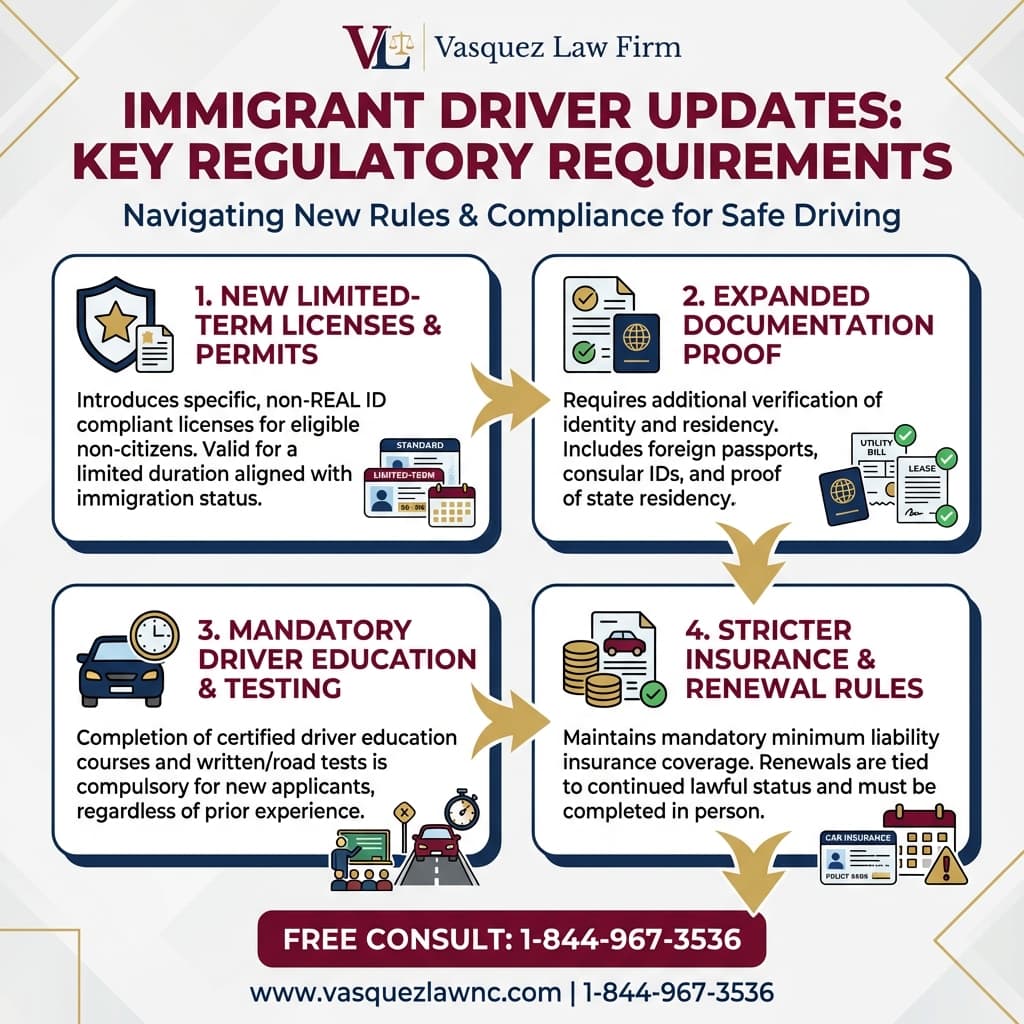
Recent updates in 2026 have focused on tightening the verification process for non-domiciled CDLs, often requiring more rigorous documentation of legal status and the duration of authorized stay. This means that visa holders must ensure their immigration documents are current and valid for the entire period they intend to operate a commercial vehicle. Any lapse in visa status could lead to the invalidation of their CDL, posing a significant threat to their employment and legal standing.
Furthermore, the ability to obtain a CDL for certain visa categories, like those for students or tourists, is generally restricted because these visas do not authorize employment. The DOT immigrant truck driver rule is clear that a CDL is a professional license tied to commercial activity, which requires specific work authorization. Therefore, if you are an immigrant in Orlando or anywhere in North Carolina or Florida considering a trucking career, it is crucial to consult with an immigration attorney to understand your specific visa's limitations and requirements before pursuing a CDL. This proactive step can prevent costly mistakes and legal complications.
Language Proficiency and Safety Regulations
Beyond immigration status, the DOT immigrant truck driver rule places significant emphasis on safety regulations, including language proficiency. Federal regulations, specifically 49 CFR § 391.11, require that commercial motor vehicle drivers be able to "read and speak the English language sufficiently to converse with the general public, to understand highway traffic signs and signals in the English language, to respond to official inquiries, and to make entries on reports and records." This requirement is not new but remains a critical component for all CDL holders, including immigrant truck drivers.
The rationale behind the English language proficiency rule is clear: safety. Effective communication is paramount in the trucking industry, from understanding dispatch instructions and road signs to communicating with law enforcement, emergency personnel, and the public. A driver's inability to communicate effectively in English can lead to misunderstandings, accidents, and dangerous situations on the road. This rule applies equally to all drivers, regardless of their country of origin or primary language.
For immigrant truck drivers, meeting this requirement means demonstrating a functional level of English. This is often assessed during the CDL testing process and can be a point of challenge for individuals whose native language is not English. While no specific English proficiency test is federally mandated for CDL holders, state DMVs may have their own methods of assessment. Vasquez Law Firm understands these challenges and can help clients understand how to meet all requirements, ensuring they comply with every aspect of the DOT immigrant truck driver rule.
Steps to Obtain a CDL as an Immigrant in 2026
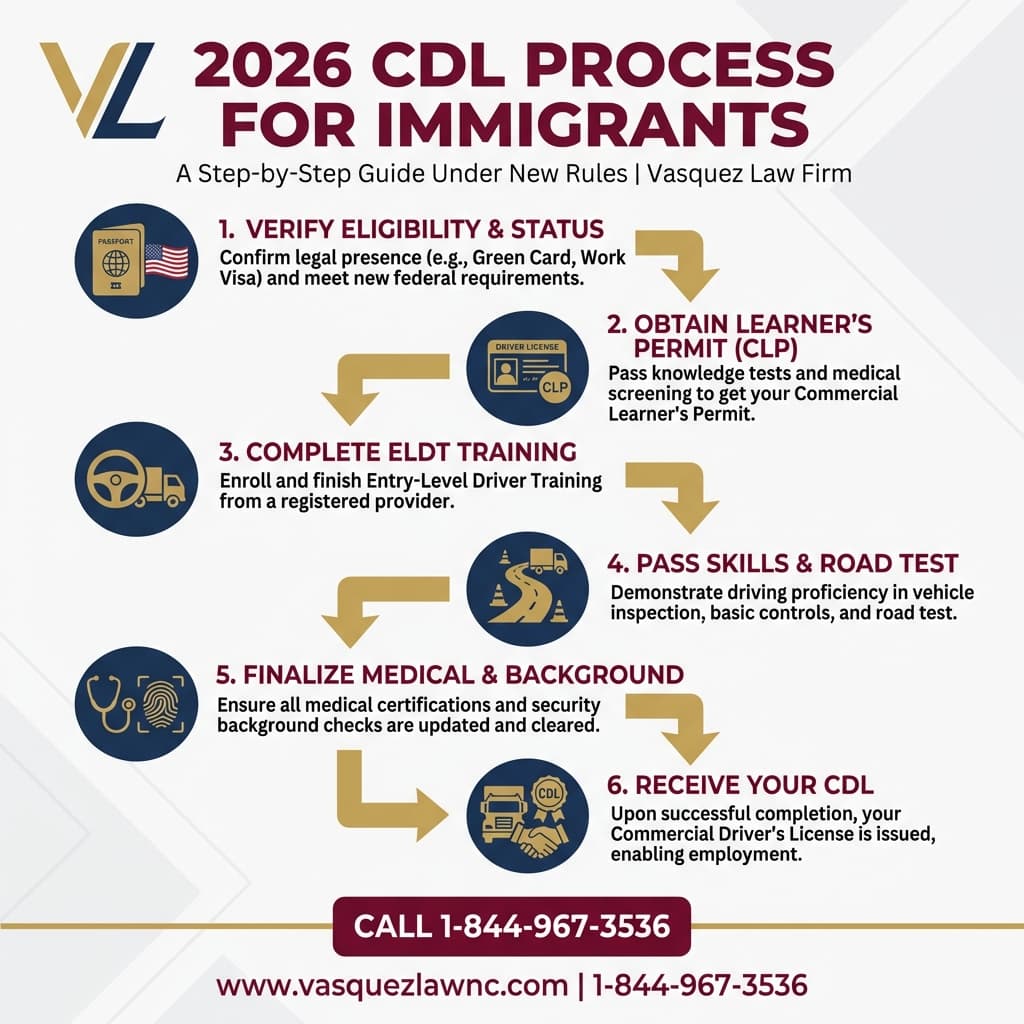
Obtaining a Commercial Driver's License (CDL) as an immigrant in 2026 involves several key steps, beginning with ensuring your immigration status permits such licensure. The process is stringent and requires careful attention to detail. First, you must confirm that you have a lawful presence in the United States and that your immigration documents, such as a Green Card or a valid work visa, are current and permit employment. This is the foundational requirement under the DOT immigrant truck driver rule.
Once your immigration status is verified, the next step involves meeting state-specific requirements. While federal regulations set a baseline, individual states like North Carolina and Florida may have additional criteria. You will typically need to obtain a Commercial Learner's Permit (CLP) by passing a knowledge test. This permit allows you to practice driving a CMV with a qualified CDL holder in the vehicle. Following a period of practice, you must pass a skills test, which includes a pre-trip inspection, basic controls test, and a road test.
Throughout this process, it is essential to have all required documentation readily available. This includes proof of identity, legal presence, residency, and any necessary medical certifications. For immigrant drivers, this often means providing original immigration documents, such as your I-551 (Green Card) or an Employment Authorization Document (EAD). Any discrepancies or expired documents can cause significant delays or outright denial of your CDL application. An attorney can help ensure you have all the correct paperwork and understand the nuances of the DOT immigrant truck driver rule.
Required Documentation Checklist
- Proof of Legal Presence: Valid Green Card (Form I-551), Employment Authorization Document (EAD), or an unexpired foreign passport with an I-94 Arrival/Departure Record indicating an immigration status that authorizes employment.
- Social Security Number (SSN): Your original Social Security card or official documentation showing your SSN.
- Proof of Residency: Two documents showing your current residential address (e.g., utility bills, lease agreement, bank statements).
- Medical Examiner's Certificate (DOT Medical Card): Issued by a certified medical examiner listed on the FMCSA National Registry.
- Commercial Learner's Permit (CLP): Proof of passing the CDL knowledge tests.
- Driver's License: Your current, valid driver's license.
Common Mistakes to Avoid When Pursuing a CDL
Navigating the path to becoming a truck driver as an immigrant can be fraught with potential pitfalls. Avoiding common mistakes is crucial for a smooth application process and to prevent legal complications. One of the most frequent errors is failing to verify the validity of one's immigration status for CDL purposes. Not all visas permit CDL acquisition, and attempting to apply without proper authorization can lead to denials and even issues with your immigration record. Always confirm your status with an immigration attorney before proceeding.
Another common mistake is neglecting the English language proficiency requirement. Some applicants underestimate the importance of being able to read road signs, communicate with officials, and complete logs in English. This oversight can result in failing the CDL tests or facing difficulties during roadside inspections. Dedicate time to improving your English skills, especially those related to commercial driving terminology and communication.
Furthermore, many applicants make the error of not gathering all necessary documentation in advance or presenting expired documents. The DOT immigrant truck driver rule is strict about current and valid paperwork, including your Green Card, EAD, SSN, and proof of residency. A single missing or outdated document can halt your application. Double-check all requirements specific to North Carolina or Florida and prepare a comprehensive file. Finally, failing to disclose any past traffic violations or criminal history can lead to severe consequences, including permanent disqualification. Transparency is always the best approach.
If you only remember one thing: always verify your immigration status and all required documentation with an experienced immigration attorney before starting the CDL application process to avoid unnecessary delays or legal issues.
Don't face your legal challenges alone. Our team is here to help you every step of the way.
Call today: 1-844-967-3536 | Se Habla Español
NC, FL, and Nationwide Notes for Immigrant Truck Drivers
The DOT immigrant truck driver rule is a federal regulation, meaning it applies nationwide. However, the specific implementation and additional state-level requirements can vary significantly. For immigrant truck drivers in North Carolina and Florida, understanding these nuances is critical. While the core federal eligibility criteria for CDLs remain consistent across all states, the process of applying, the documentation accepted by the DMV, and the specific training requirements might differ.
North Carolina Notes
In North Carolina, the Department of Motor Vehicles (NCDMV) is responsible for issuing CDLs. Immigrant applicants must meet federal DOT standards and also comply with NCDMV's specific documentation requirements for proof of identity, legal presence, and residency. North Carolina has several CDL testing sites, and it is crucial to schedule appointments well in advance. The NCDMV website provides detailed guides on CDL applications, including specific forms for non-U.S. citizens. Always check the latest NCDMV guidelines as of 2026, as regulations can be updated frequently. For North Carolina specific legal guidance, our firm is well-versed in local regulations and can assist you.
Florida Notes
Similarly, in Florida, the Department of Highway Safety and Motor Vehicles (FLHSMV) oversees CDL issuance. Florida has a large population of immigrant workers, and the state's CDL regulations reflect this. Applicants in Florida, including those in Orlando, must present valid immigration documents that demonstrate lawful presence and work authorization. Florida also emphasizes the importance of completing an approved CDL training program. The FLHSMV website offers comprehensive information on CDL eligibility and application procedures for non-citizens. Ensuring all documentation is current and correctly submitted is vital to avoid delays in Florida. Vasquez Law Firm serves clients in Florida, offering expert immigration assistance.
Nationwide Concepts (General Only, Rules Vary)
Nationwide, the overarching principle is that all CDL holders, regardless of immigration status, must meet the safety and legal standards set by the FMCSA. This includes passing medical examinations, adhering to hours-of-service rules, and maintaining a clean driving record. The national push for enhanced driver verification means that states are increasingly rigorous in checking immigration status. While the DOT immigrant truck driver rule provides a federal framework, the day-to-day application and specific paperwork can vary by state DMV. Therefore, a thorough understanding of both federal and state laws is essential for any immigrant truck driver operating across state lines or considering relocation. For more information on U.S. immigration laws, refer to the U.S. Department of State website.
When to Call a Lawyer Now
The complexities surrounding the DOT immigrant truck driver rule and immigration law mean that legal challenges can arise unexpectedly. Knowing when to seek immediate legal counsel can protect your rights and your career. You should call a lawyer now if:
- Your CDL application has been denied due to issues with your immigration status or documentation.
- You are facing a potential deportation or removal proceeding that could impact your legal presence and CDL eligibility.
- You have received a notice from the DMV or DOT questioning the validity of your CDL based on your immigration status.
- There are discrepancies or errors in your immigration documents that need to be corrected.
- You are unsure whether your current visa allows you to obtain or maintain a CDL.
- You have been involved in a traffic incident or accident and your immigration status is being questioned.
- You need assistance understanding new regulations or policy changes related to immigrant truck drivers in 2026.
- You are a Dreamer seeking to understand pathways to CDL eligibility and permanent residency.
- You face discrimination or unfair treatment related to your immigrant status in the trucking industry.
Attorney Vasquez and the team at Vasquez Law Firm specialize in immigration law and can provide the aggressive yet compassionate representation you need. We are committed to fighting for your rights and helping you navigate these intricate legal waters.
About Vasquez Law Firm
At Vasquez Law Firm, we combine compassion with aggressive representation. Our motto "Yo Peleo" (I Fight) reflects our commitment to standing up for your rights and ensuring justice is served. We understand the unique challenges faced by immigrant communities, and our team is dedicated to providing personalized and effective legal solutions.
- Bilingual Support: Se Habla Español - our team is fully bilingual, ensuring clear communication and understanding.
- Service Areas: We proudly serve clients across North Carolina, Florida, and provide comprehensive immigration services nationwide.
- Experience: With over 15 years of dedicated legal experience, we have a proven track record of helping clients navigate complex legal matters.
- Results: We have successfully handled thousands of cases across multiple practice areas, including immigration, personal injury, and criminal defense.
Attorney Trust and Experience
Attorney Vasquez holds a Juris Doctor degree and is admitted to practice in both the North Carolina State Bar and Florida Bar. With over 15 years of dedicated legal experience, he has built a reputation for providing personalized attention and achieving favorable outcomes for his clients. His deep understanding of federal immigration law, combined with local knowledge of North Carolina and Florida regulations, makes him a formidable advocate for immigrant truck drivers. You can learn more about Attorney Vasquez and our team on our website.
Frequently Asked Questions
What is a non-domiciled CDL, and who is eligible for it?
A non-domiciled CDL is a Commercial Driver's License issued by a U.S. state or jurisdiction to an individual who is not a resident of that state or the U.S. but is legally authorized to work in the country. Eligibility typically requires proof of lawful presence, such as a valid work visa or Employment Authorization Document (EAD), and meeting all federal and state CDL qualification standards. It's designed for foreign nationals who need to operate commercial vehicles in the U.S.
Can undocumented immigrants obtain a CDL license in any U.S. state?
No, generally undocumented immigrants cannot obtain a CDL license in any U.S. state. Federal regulations, including the DOT immigrant truck driver rule, require proof of lawful presence in the United States to be eligible for a CDL. Some states may allow undocumented immigrants to obtain standard driver's licenses, but these are distinct from commercial licenses and do not permit operation of commercial motor vehicles. Always consult an immigration attorney for specific eligibility based on your status.
What are the English language proficiency requirements for immigrant truck drivers?
Federal regulations (49 CFR § 391.11) mandate that all commercial motor vehicle drivers, including immigrants, must be able to read and speak English sufficiently. This includes understanding traffic signs, conversing with the public and officials, and completing reports. This requirement is in place for safety reasons, ensuring effective communication on the road. While no specific test is federally required, state DMVs assess this during the CDL testing process.
How does a change in immigration status affect my CDL?
A change in immigration status can significantly affect your CDL. If your legal presence or work authorization expires or is revoked, your CDL may become invalid or subject to suspension. It is crucial to keep your immigration documents current and notify the DMV of any changes. Failure to maintain lawful status can lead to loss of your CDL and potential immigration consequences. An immigration attorney can help manage these transitions.
Are there specific visa types that allow immigrants to become truck drivers?
Yes, certain visa types permit immigrants to work as truck drivers. These typically include employment-based visas like the H-2B visa for seasonal non-agricultural workers, or those who have obtained a Green Card (permanent residency) through various pathways. Visas that do not authorize employment, such as tourist or student visas, generally do not qualify individuals for a CDL. It is vital to confirm your visa's specific work authorization before applying.
What is the role of the FMCSA in regulating immigrant truck drivers?
The Federal Motor Carrier Safety Administration (FMCSA), a branch of the DOT, is responsible for creating and enforcing safety regulations for commercial motor vehicles, including truck drivers. This includes setting standards for driver qualifications, medical fitness, and hours of service. For immigrant truck drivers, FMCSA rules dictate the baseline requirements they must meet, which are then integrated with immigration laws and state-specific CDL processes. Their primary goal is public safety.
What documents do I need to apply for a CDL as an immigrant?
To apply for a CDL as an immigrant, you typically need proof of legal presence (e.g., Green Card, EAD, valid work visa with I-94), a Social Security Number, proof of state residency (two documents), a valid medical examiner's certificate (DOT Medical Card), and your current driver's license. Always check your specific state's DMV website (e.g., NCDMV for North Carolina, FLHSMV for Florida) for the most current and complete list of required documents as of 2026.
Can a Dreamer (DACA recipient) obtain a CDL in 2026?
Yes, DACA recipients (Dreamers) can generally obtain a CDL in 2026, provided they have a valid Employment Authorization Document (EAD) and meet all other federal and state CDL requirements. The EAD demonstrates lawful presence and work authorization, which are key criteria under the DOT immigrant truck driver rule. However, DACA's future remains subject to legal challenges, so it's wise to consult an immigration attorney for the latest updates and personalized advice on your eligibility.
What happens if I operate a commercial vehicle without a valid CDL due to immigration issues?
Operating a commercial vehicle without a valid CDL due to immigration issues can lead to severe legal consequences. These may include fines, vehicle impoundment, criminal charges, and significant immigration penalties, potentially including deportation. It can also jeopardize your ability to obtain legal status or a CDL in the future. Always ensure your CDL and immigration status are valid before operating a CMV. Consult an attorney immediately if you face such charges.
How can Vasquez Law Firm help immigrant truck drivers with DOT regulations?
Vasquez Law Firm assists immigrant truck drivers by providing expert legal guidance on the intersection of immigration law and DOT regulations. We help clients verify their immigration status for CDL eligibility, navigate complex documentation requirements, address denials or suspensions, and advocate for their rights. Our team ensures you understand the DOT immigrant truck driver rule and its implications, offering personalized strategies to protect your career and legal standing in North Carolina, Florida, and nationwide. Se Habla Español.
Sources and References
- U.S. Citizenship and Immigration Services (USCIS)
- Executive Office for Immigration Review (EOIR)
- 49 CFR § 391.11: Qualifications of drivers
Need immigration help? Our immigration attorneys can review your case.
Ready to take the next step? Contact Vasquez Law Firm today for a free, confidential consultation. We're committed to fighting for your rights and achieving the best possible outcome for your case.
Start Your Free Case Evaluation Now
Call us: 1-844-967-3536
Se Habla Español - Estamos aquí para ayudarle.

William Vasquez
Founder & CEO, Vasquez Law Firm, PLLC
William Vasquez is the founder and CEO of Vasquez Law Firm, PLLC, a results-driven firm specializing in immigration, criminal defense, personal injury, and workers' compensation. A U.S. Air Force veteran and recipient of the Joint Service Achievement Medal, William is dedicated to fiercely fighting for his clients' rights.
Related Legal Services
Need legal help? Learn more about our immigration law practice, or contact us for a free evaluation.
You can also visit immigration lawyers serving all of North Carolina for more information.