What Is Citizenship and How Does It Work in 2026?
Wondering what citizenship means and how to apply? Learn U.S. citizenship requirements and the process in 2026. Contact Vasquez Law for a free consultation.
Published on May 26, 2026
Talk to an immigration attorney
Free call. A clear plan for your case.
Free & confidential · Se habla espanol · 24/7
Have questions? Talk to an attorney - free evaluation.
Call 1-844-967-3536Free Tool
Check Your USCIS Case Status Now
Enter your receipt number - get the official USCIS status in English or Spanish. No registration.
What Is Citizenship and How Does It Work in 2026?
Citizenship is a legal status that grants specific rights and responsibilities within a country. In 2026, citizenship remains a crucial step for immigrants living in the U.S., including those in Orlando, FL and Raleigh, NC. This guide explains what citizenship means, how to apply, the requirements, and what to expect throughout the process. Whether you are a Dreamer, permanent resident, or new immigrant, understanding citizenship and its benefits can help protect your rights and secure your place in the U.S. Make sure to get professional legal support from Vasquez Law Firm when applying.
Need help with your case? Our experienced attorneys are ready to fight for you. Se Habla Español.
Or call us now: 1-844-967-3536
Quick Answer
Citizenship is the official legal membership in a country. In the U.S., it grants rights such as voting and protection under law. To apply, you must meet residency and eligibility requirements, pass tests, and complete an interview. The process typically takes 8-14 months in 2026.
- Establish permanent residency first
- Meet physical presence and moral character rules
- File Form N-400 with USCIS
- Pass English and civics tests
- Take Oath of Allegiance
- Receive citizenship certificate
Understanding Citizenship
Imagine Sarah, a lawful permanent resident living in Orlando, Florida, who wants to become an American citizen. She needs a clear understanding of what citizenship means. Under U.S. immigration law, citizenship grants you full legal rights, including the right to vote, travel with a U.S. passport, work legally without restrictions, and protection from deportation.
Citizenship is defined by federal law under INA § 316 and related regulations. It usually follows lawful permanent residency (having a Green Card) and involves a formal process called naturalization. This status distinguishes you legally and socially from non-citizens.
The history of U.S. citizenship law dates back to the 14th Amendment (1868), which guaranteed citizenship to anyone born or naturalized in the country. Since then, processes and requirements have evolved. By 2026, these requirements are strictly enforced but also provide pathways for eligible immigrants living in North Carolina and Florida to become citizens and enjoy equal rights.
For immigration applicants in Raleigh, NC, or Orlando, FL, citizenship is more than a title; it is a gateway to fully participate in community life and national affairs. Knowing the requirements and process is essential to avoid costly mistakes.
Learn more about our immigration services to understand how you can start your path to citizenship.
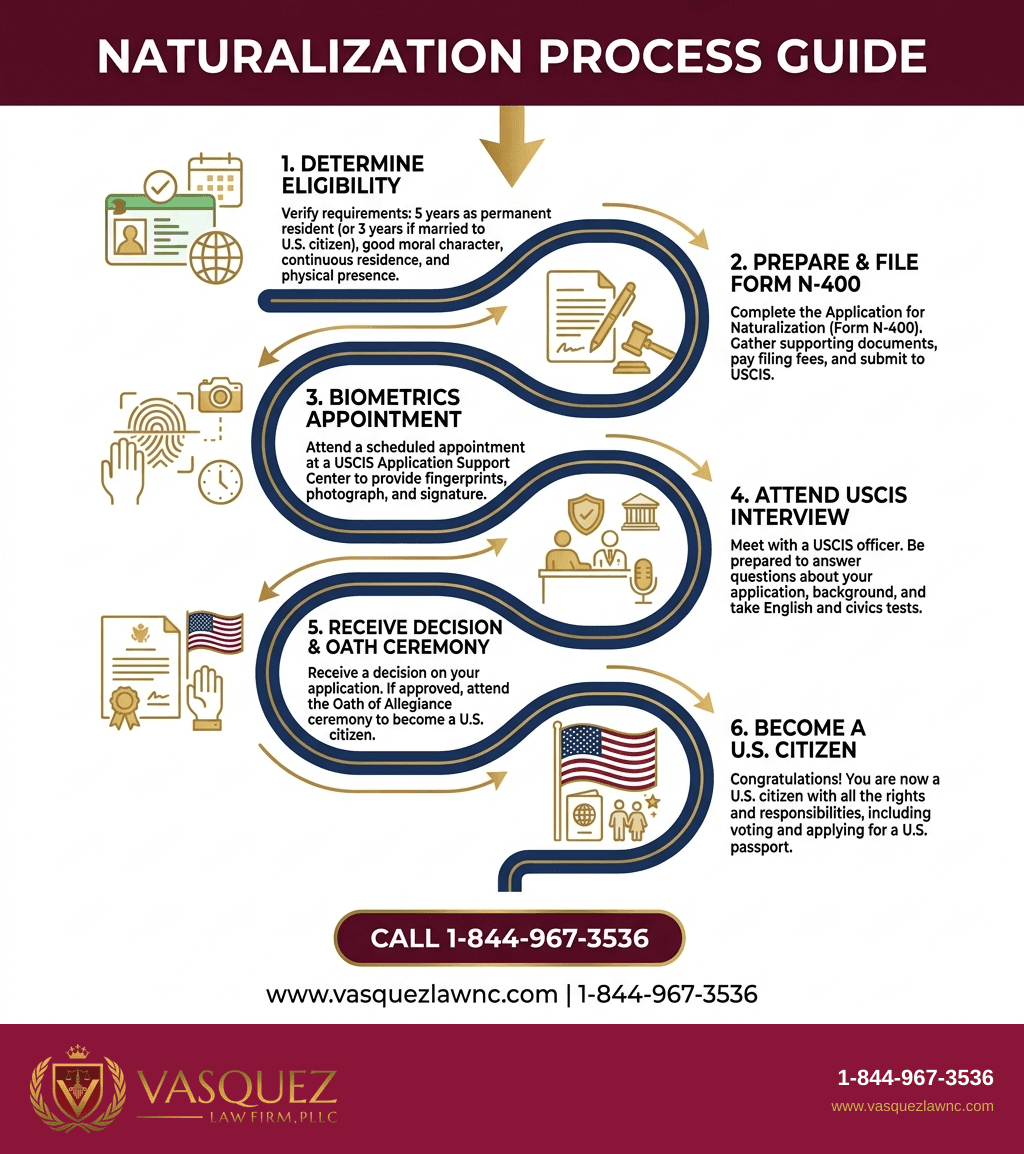
Step-by-Step Citizenship Process
- Check Your Eligibility: Ensure you meet key requirements such as five years (or three years if married to a U.S. citizen) of permanent residency and continuous physical presence in the U.S.
- Prepare Form N-400: Complete the Application for Naturalization carefully, including all necessary personal information.
- Submit the Application: File online or by mail to the appropriate USCIS office, such as Orlando or Raleigh field offices.
- Attend Biometrics Appointment: Provide fingerprints and photographs for background checks.
- Interview and Testing: Attend your USCIS interview, where you will answer questions and take the citizenship test, including English and civics sections.
- Receive Decision: USCIS will approve, continue, or deny your application.
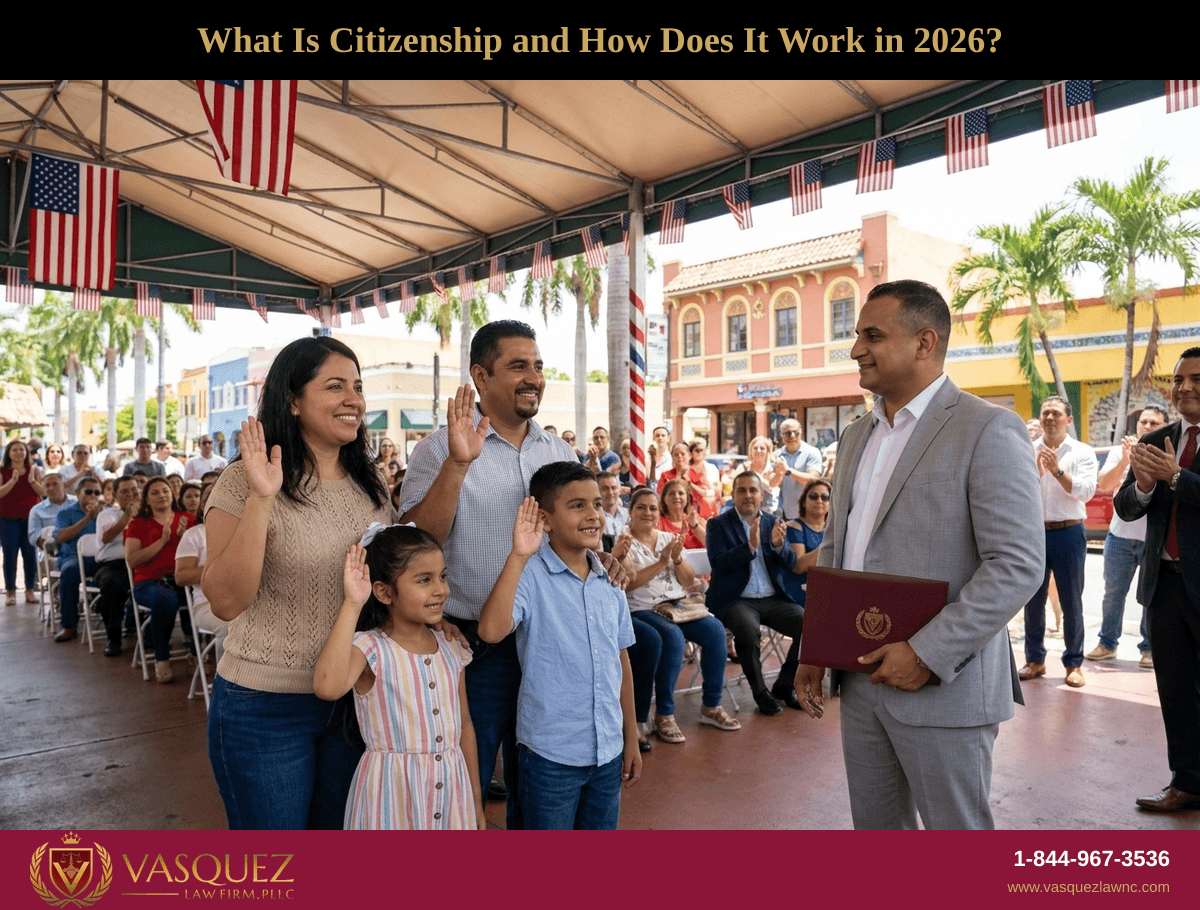
- Take the Oath of Allegiance: Once approved, attend a naturalization ceremony to officially become a U.S. citizen.
Attorney Vasquez has assisted many clients through each of these steps, ensuring proper preparation and representation.
Documents and Evidence Checklist
- Permanent Resident Card (Green Card)
- Passport(s) or travel documents
- Evidence of residency (leases, bills)
- Marriage certificate (if applying based on marriage)
- Tax returns or W-2 forms
- Documentation of selective service registration (for males 18-26)
- Proof of identity (state or driver’s license)
- Any court or police records (for disclosure)
- Two passport-style photos (if required)
- Completed Form N-400 application
Having all documents ready before filing speeds up your case and avoids delays.
Timeline and What to Expect
- Months 1-2: Gather documents and prepare Form N-400.
- Month 3: Submit your application to USCIS.
- Months 4-5: USCIS schedules your biometrics appointment.
- Months 6-10: USCIS schedules your naturalization interview and citizenship test.
- Month 11-14: If approved, attend your oath ceremony and receive your citizenship certificate.
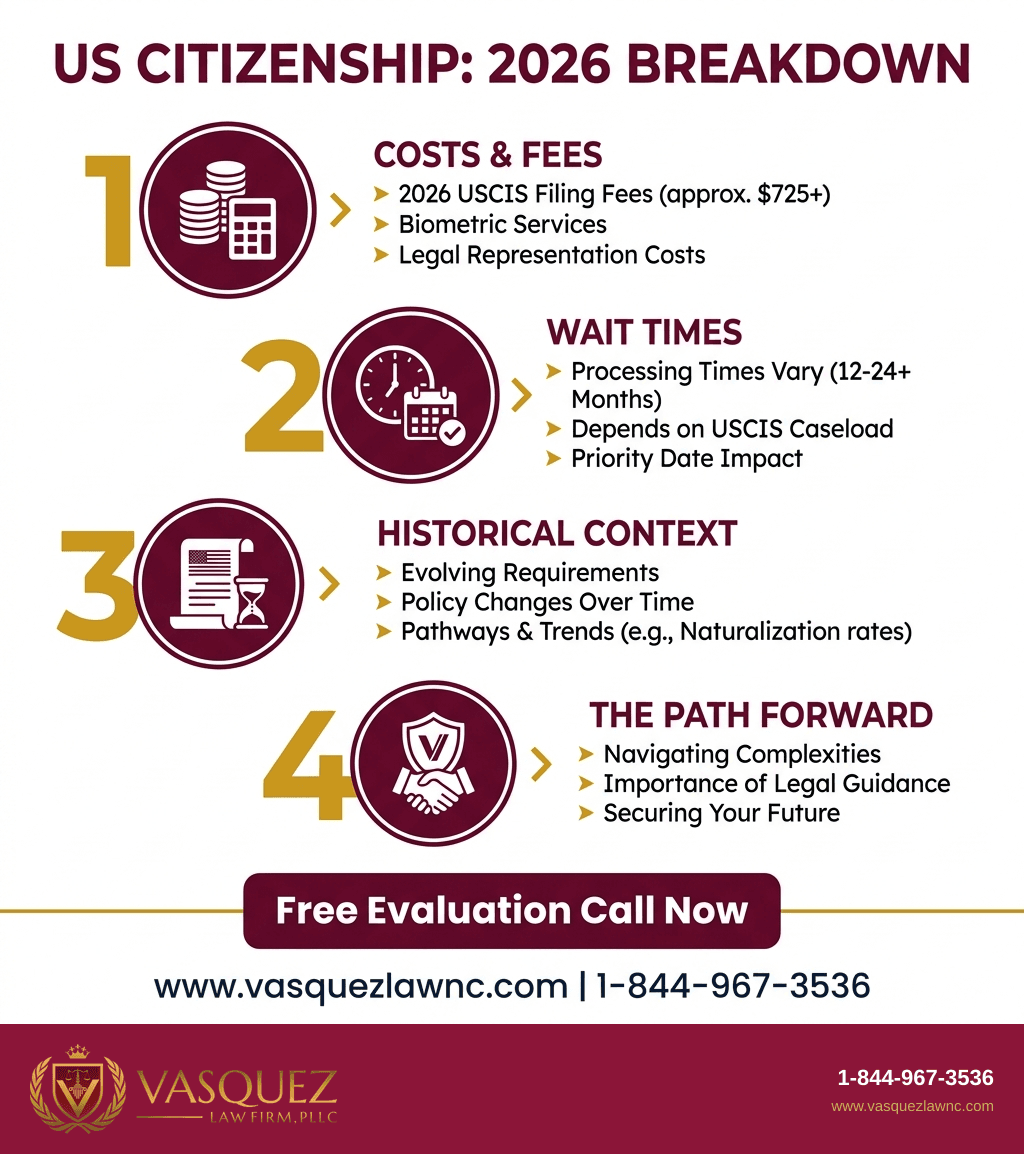
Processing times vary by USCIS field office. According to USCIS processing times, applicants in Orlando and Raleigh can expect a range of 8 to 14 months in 2026.
Costs and Fees
- Application Fee: Currently $640 for Form N-400.
- Biometrics Fee: $85, included for most applicants.
- Legal Fees: Varies; Vasquez Law Firm offers transparent pricing based on case complexity.
- Additional Costs: Document translations, travel to interviews, and test materials.
Fee waivers may be available for low-income applicants. Early legal consultation can identify saving options.
Common Mistakes to Avoid
- Submitting incomplete or incorrect Form N-400. Fix: Review carefully or have an attorney help.
- Failing to disclose past arrests or legal issues. Fix: Always be truthful and provide supporting documents.
- Missing biometrics or interview appointments. Fix: Mark dates and attend on time.
- Not preparing properly for the citizenship test. Fix: Use USCIS study materials and practice tests.
- Failing to meet continuous residence or physical presence requirements. Fix: Track your time abroad.
- Ignoring requests for additional evidence from USCIS. Fix: Respond promptly with complete info.
- Using outdated forms or filing at wrong locations. Fix: Check USCIS website regularly before filing.
If you only remember one thing: Preparing carefully and getting legal help can prevent delays and denials.
Jurisdiction Notes: NC, FL, and Nationwide
North Carolina Notes
USCIS has offices in Raleigh that process citizenship applications. Applicants should ensure all residency proofs are from the Raleigh area when applicable. Local attorneys, including Vasquez Law Firm, assist with NC-specific considerations such as state ID requirements and local court record checks.
Florida Notes
Orlando is home to a busy USCIS field office. Florida applicants should prepare for potentially longer wait times due to volume but benefit from many community resources. Vasquez Law Firm’s Orlando team is familiar with local procedures to streamline applications.
Nationwide Concepts
The citizenship process follows federal law, so requirements and processes are mostly uniform nationwide. However, variations in local office processing times and interviews occur. Federal laws like INA § 316 and regulations at 8 C.F.R. Part 316 set the foundation.
When to Call a Lawyer Now
- You received a USCIS notice denying your application.
- You have a criminal record that may affect citizenship.
- You missed an interview or biometrics appointment.
- There are questions about your continuous residence or physical presence.
- You need help preparing for the citizenship test and interview.
- You face USCIS requests for additional evidence or information.
- You want to understand how recent DOJ citizenship revocation efforts may affect you.
- You want a trusted attorney with bilingual support in Raleigh or Orlando.
About Vasquez Law Firm
At Vasquez Law Firm, we combine compassion with aggressive representation. Our motto "Yo Peleo®" (I Fight) reflects our commitment to standing up for your rights.
- Bilingual Support: Se Habla Español — Spanish-speaking attorneys and staff available
- Service Areas: North Carolina, Florida, and nationwide immigration services
- Experience: Over 30 years helping clients navigate complex legal matters
- Results: Thousands of successful cases across multiple practice areas
Attorney Trust and Experience
William J. Vásquez is admitted to the North Carolina State Bar (2011) and to the U.S. Courts of Appeals for the 4th, 5th, and 11th Circuits. Florida-jurisdiction matters at the firm are handled by Florida Bar attorney Harold Estrada-Rodriguez (FL Bar No. 1041171). The firm has provided dedicated legal representation since 2011, with personalized attention to each client's case.
Don't wait to get the help you deserve. Call us now for immediate assistance.
Se Habla Español
Frequently Asked Questions
What are the requirements for U.S. citizenship?
To apply for U.S. citizenship, you must meet requirements such as being a lawful permanent resident for at least 5 years (or 3 years if married to a U.S. citizen), being physically present in the U.S., demonstrating good moral character, passing English and civics tests, and showing attachment to the U.S. Constitution, as per INA § 316 and 8 C.F.R. § 316.2.
How long does the citizenship application process take?
As of 2026, the average processing time for Form N-400, the Application for Naturalization, ranges from 8 to 14 months according to USCIS processing times. Times vary by field office, case complexity, and applicant preparation.
What is the citizenship test?
The citizenship test includes an English test assessing reading, writing, and speaking skills, and a civics test covering U.S. history and government. Test questions are selected from a list of 100 civics questions provided by USCIS. Passing the test is required to demonstrate understanding as part of naturalization under 8 C.F.R. § 312.
Can dual citizenship affect my application?
The U.S. recognizes dual citizenship, meaning you can retain your native citizenship while becoming a U.S. citizen. However, it is important to fully disclose any dual nationality during the application process. Failure to do so can lead to complications or denial.
What happens if my citizenship application is denied?
If USCIS denies your citizenship application, you can receive a written notice outlining reasons. You may appeal the decision or request a hearing before an immigration judge through the EOIR, depending on your specific circumstances. Acting quickly and consulting an attorney is key.
How do I apply for citizenship in Orlando, FL or Raleigh, NC?
You apply by submitting Form N-400 online or by mail to USCIS. Local USCIS field offices in Orlando, FL and Raleigh, NC handle interviews and biometrics appointments. It is wise to seek legal assistance in these areas to navigate local procedures effectively.
What is the history of citizenship laws in the U.S.?
U.S. citizenship law evolved from the 14th Amendment (1868), granting citizenship to all born or naturalized in the U.S. Immigration and Nationality Act of 1952 consolidated many rules. Changes continue affecting eligibility, rights, and penalties, highlighting the importance of current legal guidance.
Can I lose my citizenship once naturalized?
Naturalized citizens can lose citizenship if they obtained it fraudulently or committed acts against the U.S. such as serious crimes or terrorism, under INA § 340 and related laws. However, revocation is rare and requires legal due process.
Sources and References
- U.S. Citizenship and Immigration Services
- Executive Office for Immigration Review
- Legal Information Institute
Take the first step toward justice today. Our team is standing by to help.
Start Your Free Evaluation Now
Call us: 1-844-967-3536
Se Habla Español - Estamos aquí para ayudarle.

William Vasquez
Founder & CEO, Vasquez Law Firm, PLLC
William Vasquez is the founder and CEO of Vasquez Law Firm, PLLC, a results-driven firm specializing in immigration, criminal defense, personal injury, and workers' compensation. A U.S. Air Force veteran and recipient of the Joint Service Achievement Medal, William is dedicated to fiercely fighting for his clients' rights.
Related Legal Services
Need legal help? Learn more about how our immigration attorneys can help, or contact us for a free evaluation.
You can also visit our NC immigration team for more information.