How New Asylum Approval Rules Affect You in 2026
Understand asylum approvals and new rules in 2026. Learn who qualifies and how to apply. Contact Vasquez Law Firm for a free consultation today.
Published on March 3, 2026
Talk to an immigration attorney
Free call. A clear plan for your case.
Free & confidential · Se habla espanol · 24/7
Have questions? Talk to an attorney - free evaluation.
Call 1-844-967-3536Worried how the latest immigration news affects you?
Schedule a confidential case review with an immigration attorney - know exactly where you stand.
How New Asylum Approval Rules Affect You in 2026
Navigating the U.S. asylum process can be incredibly complex, especially with recent changes impacting asylum approvals. If you are seeking safety and protection in the United States, understanding the current landscape and how new rules might affect your case is crucial. Asylum offers a pathway to legal status for individuals who fear persecution in their home country. Our goal is to provide clear, actionable information to help you understand what to expect in 2026 and how to best prepare your application.
Need help with your asylum case? Our experienced immigration attorneys are ready to fight for you. Se Habla Español.
Schedule Your Free Case Evaluation
Or call us now: 1-844-967-3536
Quick Answer
Asylum approvals grant protection to individuals fearing persecution in their home country. In 2026, eligibility largely depends on demonstrating a well-founded fear based on race, religion, nationality, political opinion, or membership in a particular social group. The process involves filing Form I-589, an interview, and potentially a hearing before an immigration judge.
- Eligibility requires a well-founded fear of persecution.
- The process includes filing Form I-589 within one year of arrival.
- Interviews are conducted by USCIS asylum officers.
- Immigration court hearings may be necessary for defensive asylum.
- Legal representation significantly increases approval chances.
- New rules in 2026 impact eligibility and procedural requirements.
Understanding Asylum Approvals in 2026
Asylum approvals are a lifeline for many, offering refuge from persecution. The United States provides asylum to individuals who meet the legal definition of a refugee, as outlined in the Immigration and Nationality Act (INA). This protection is granted to those who have suffered past persecution or have a well-founded fear of future persecution in their home country. Understanding these criteria is the first step toward a successful asylum claim.
In 2026, the criteria for asylum remain stringent. You must demonstrate that the persecution is or would be based on one of five protected grounds: race, religion, nationality, political opinion, or membership in a particular social group. Recent policy changes and court decisions continue to shape how these grounds are interpreted and applied. For instance, some interpretations have narrowed what constitutes a “particular social group,” making it even more critical to present a well-documented case.
The distinction between affirmative and defensive asylum is also important. Affirmative asylum is sought proactively by individuals not currently in removal proceedings, typically by filing an application with USCIS. Defensive asylum, on the other hand, is requested by individuals already facing deportation in immigration court, often as a defense against removal. Both paths lead to the same goal: asylum approvals, but they involve different procedural steps and timelines. Each approach requires a deep understanding of immigration law and strategy.
Who Qualifies for Asylum in the United States?
To qualify for asylum in the United States, you must meet specific legal requirements. The core of an asylum claim revolves around demonstrating a well-founded fear of persecution. This fear must be objectively reasonable and subjectively genuine. It is not enough to simply feel unsafe; you must provide credible evidence and testimony to support your claim. This often involves detailed accounts of past incidents, country conditions reports, and expert testimony.
The five protected grounds are central to any asylum application. Persecution based on race, religion, or nationality often involves direct discrimination, violence, or threats from government actors or groups the government is unwilling or unable to control. Political opinion can include actual opinions you hold or imputed opinions that others believe you hold. Membership in a particular social group is a more complex category, often involving shared immutable characteristics or a common past experience. Examples might include sexual orientation, gender identity, or family ties to a persecuted individual.
Additionally, you generally must apply for asylum within one year of your last arrival in the United States. There are, however, narrow exceptions to this one-year filing deadline for changed circumstances or extraordinary circumstances. These exceptions are difficult to prove and require substantial evidence. Missing this deadline without a valid exception can significantly jeopardize your chances of receiving asylum approvals. Therefore, prompt action is essential for anyone considering an asylum claim in Charlotte, North Carolina, or anywhere in the U.S.
Affirmative vs. Defensive Asylum
Understanding the two primary pathways to asylum, affirmative and defensive, is crucial. Affirmative asylum is for individuals who are not currently in removal proceedings. They voluntarily apply for asylum with U.S. Citizenship and Immigration Services (USCIS) by filing Form I-589. This process typically involves an interview with an asylum officer. If the asylum officer does not grant asylum, the case is usually referred to an immigration judge for defensive asylum proceedings.
Defensive asylum, conversely, is sought by individuals who are already in removal proceedings before an immigration judge. They present their asylum claim as a defense against deportation. This often occurs after an individual has been apprehended by immigration authorities, such as ICE, or if their affirmative asylum application was not approved by USCIS. The standards for proving eligibility are the same for both affirmative and defensive asylum, but the procedural aspects and the specific court where the claim is heard differ significantly. Both paths can lead to asylum approvals, but the defensive route can be more adversarial.
Step-by-Step: The U.S. Asylum Process in 2026
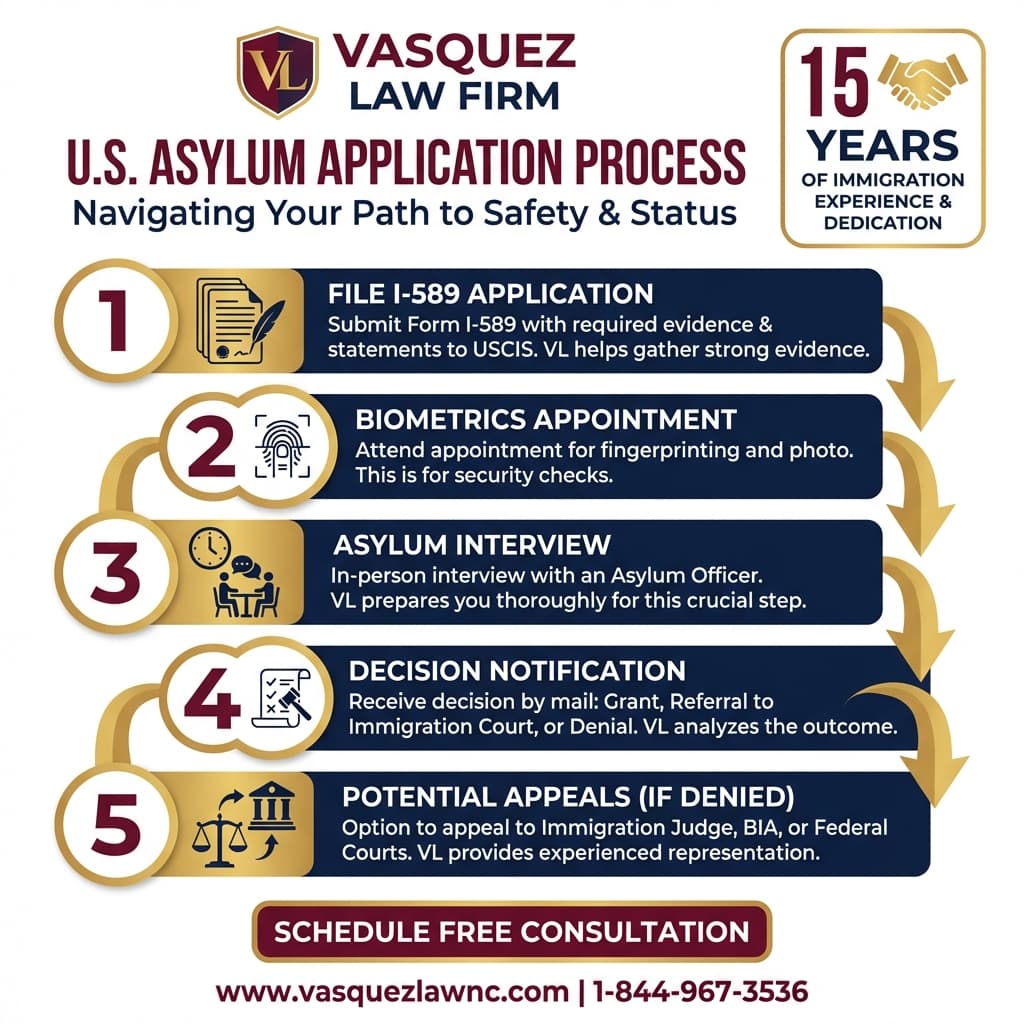
The U.S. asylum process, while complex, follows a structured series of steps designed to evaluate each claim thoroughly. Being prepared for each stage can significantly improve your chances of achieving asylum approvals. From initial filing to potential appeals, every step requires careful attention to detail and adherence to strict deadlines.
- Filing Form I-589: The first critical step is to submit Form I-589, Application for Asylum and for Withholding of Removal, to USCIS. This form must be filed within one year of your last arrival in the U.S., unless you qualify for an exception. Accurate and complete information is paramount.
- Biometrics Appointment: After filing, you will receive a notice for a biometrics appointment. This involves taking your fingerprints, photograph, and signature for background and security checks.
- Asylum Interview: If you filed an affirmative asylum application, you will attend an interview with an asylum officer. This is your opportunity to explain your fear of persecution and provide details about your claim. An attorney can attend with you.
- Decision from USCIS: Following the interview, the asylum officer will make a decision. If approved, you will be granted asylum. If not, your case may be referred to an immigration judge for removal proceedings, where you can pursue defensive asylum.
- Immigration Court Hearing (if applicable): For defensive asylum cases, you will attend hearings before an immigration judge. This is a formal court process where you present your case, call witnesses, and cross-examine government witnesses.
- Judge's Decision: The immigration judge will issue a decision. If asylum is granted, you can then apply for a Green Card after one year. If denied, you may have options to appeal the decision to the Board of Immigration Appeals (BIA) and potentially to federal court.
Essential Documents for Your Asylum Application
A strong asylum application relies heavily on compelling evidence and thorough documentation. Gathering the right documents can make a significant difference in demonstrating your eligibility for asylum approvals. The more credible and specific your evidence, the stronger your case will be. Begin collecting these materials as early as possible.
- Form I-589: The completed and signed application for asylum and withholding of removal.
- Identity Documents: Passport, birth certificate, national identity card, or any other proof of identity and nationality.
- Evidence of Persecution: Police reports, medical records, court documents, news articles, affidavits from witnesses, or letters from human rights organizations detailing the persecution you faced or fear.
- Country Conditions Reports: Official reports from organizations like the U.S. Department of State, Amnesty International, or Human Rights Watch, describing the general human rights situation in your home country.
- Personal Statements: A detailed written statement in your own words explaining your experiences, fears, and why you believe you qualify for asylum.
- Photos and Videos: Any visual evidence supporting your claim, such as photos of injuries, destroyed property, or public demonstrations.
- Witness Testimonies: Sworn statements or live testimony from individuals who can corroborate your story.
- Marriage Certificates/Birth Certificates: If applying with family members, documents proving your relationship.
Timeline: What to Expect for Asylum Approvals
The timeline for asylum approvals can vary significantly, depending on whether you file affirmatively or defensively, the caseload of USCIS and immigration courts, and the complexity of your case. While some cases are resolved relatively quickly, others can take many years. Patience and persistence are key, but also being proactive in following up with your attorney and the authorities.
- Initial Filing (Form I-589): Must be within one year of arrival, or meet an exception.
- Biometrics Appointment: Typically 3-8 weeks after filing Form I-589.
- Asylum Interview Scheduling (Affirmative): Can range from a few months to several years, depending on the asylum office's backlog. USCIS aims to prioritize newer filings under its "last in, first out" policy, but backlogs persist.
- Decision After Interview: Usually within 2 weeks to 2 months after the interview for affirmative cases.
- Referral to Immigration Court (if denied affirmatively): Within a few weeks of the USCIS decision.
- Immigration Court Hearings (Defensive): The first master calendar hearing can be months after referral. Individual hearings (merits hearings) can be scheduled years later, especially in busy courts in North Carolina or Florida.
- Decision by Immigration Judge: Typically issued at the end of the individual hearing or shortly thereafter.
- Appeals (if necessary): Appeals to the Board of Immigration Appeals (BIA) can take 1-2 years. Federal court appeals can take even longer.
- Adjustment of Status to Green Card: One year after asylum approval, you become eligible to apply for lawful permanent residency (Green Card).
Costs and Fees: What Impacts the Price of an Asylum Case
Understanding the financial aspects of pursuing asylum is important for planning. While there is no filing fee for Form I-589 itself, various other costs can arise throughout the process. These costs primarily relate to legal representation, document preparation, and other necessary expenses. Investing in experienced legal counsel can be invaluable, though it represents a significant portion of the overall expense.
Key factors impacting the cost of an asylum case include:
- Attorney Fees: This is often the largest expense. Fees can vary based on the attorney's experience, the complexity of your case, and whether you are pursuing affirmative or defensive asylum. Defensive cases in immigration court generally involve more hearings and thus higher fees.
- Translation Services: If your documents are not in English, certified translations will be required, incurring costs per page or per document.
- Expert Witness Fees: In some cases, expert witnesses (e.g., country conditions experts, psychologists) may be needed to strengthen your claim, adding to the expense.
- Document Gathering: Obtaining official records, police reports, or medical records from your home country can involve fees and logistical challenges.
- Travel Expenses: Attending interviews or court hearings, especially if they are far from your home in Charlotte or other areas, can incur travel and accommodation costs.
- Appeal Costs: If an appeal is necessary, additional legal fees and filing fees for the Board of Immigration Appeals or federal courts will apply.
Common Mistakes and How to Avoid Them in Asylum Cases
The asylum process is fraught with potential pitfalls that can jeopardize even strong cases. Avoiding common mistakes is as crucial as presenting strong evidence. Many individuals, especially those without legal representation, inadvertently make errors that lead to delays or denials of asylum approvals. Being aware of these traps can help you navigate the process more effectively.
- Missing the One-Year Filing Deadline: Failing to file Form I-589 within one year of arrival without a valid exception is a frequent reason for denial. File promptly or seek immediate legal advice if past the deadline.
- Inconsistent Testimony: Providing conflicting information during different stages of the process (e.g., at the border, with USCIS, in court) can severely damage your credibility. Always be truthful and consistent.
- Lack of Corroborating Evidence: Relying solely on your testimony without supporting documents (medical records, police reports, country conditions) weakens your claim. Gather all possible evidence.
- Insufficient Detail in Personal Statement: A vague or brief personal statement fails to convey the gravity of your fear. Provide specific dates, locations, and detailed accounts of events.
- Not Disclosing All Grounds for Persecution: Failing to mention all relevant protected grounds (race, religion, etc.) can lead to a weaker case. Include all applicable reasons for your fear.
- Failing to Update Contact Information: Moving without notifying USCIS or the immigration court can result in missed notices, interviews, or court dates, leading to a denial in absentia.
- Not Seeking Legal Counsel: Navigating complex immigration law without an experienced attorney significantly reduces your chances of asylum approvals. Legal guidance is invaluable.
- Underestimating the Importance of Credibility: Even minor inconsistencies can lead to a finding of lack of credibility. Be honest and prepared to explain any discrepancies.
If you only remember one thing: Seek legal advice from an experienced immigration attorney as early as possible. Their guidance can help you avoid critical mistakes and build the strongest possible case for asylum approvals.
North Carolina, Florida, and Nationwide Asylum Notes
While asylum law is federal, applying nationwide, the practical aspects of the process can vary by location. The specific USCIS asylum office or immigration court handling your case in North Carolina, Florida, or other states can influence timelines and procedural nuances. Understanding these localized differences can be beneficial.
North Carolina Asylum Notes
In North Carolina, asylum seekers typically fall under the jurisdiction of the USCIS asylum office in Arlington, Virginia. Cases referred to immigration court are heard at the Charlotte Immigration Court. The Charlotte area, with its growing immigrant population, sees a significant number of asylum claims. Local non-profits and legal aid organizations, alongside private firms like Vasquez Law Firm, provide crucial support. The court's docket can be crowded, affecting hearing schedules and the overall timeline for asylum approvals. It is vital to have local representation that understands the specific practices of the Charlotte Immigration Court.
Florida Asylum Notes
Florida is a major hub for immigration, including a large volume of asylum applications. The state has multiple USCIS asylum offices, including Miami and Orlando, and several immigration courts in cities like Miami, Orlando, and Pompano Beach. Due to its coastal location and proximity to various countries, Florida often processes a high number of affirmative and defensive asylum cases. The sheer volume can lead to longer processing times and complex dockets. Our firm serves clients across Florida, understanding the unique challenges and opportunities within the state's immigration system, helping them pursue asylum approvals.
Nationwide Asylum Concepts
Asylum law itself is federal, governed by the Immigration and Nationality Act (INA) and regulations found in the Code of Federal Regulations (CFR). This means the core eligibility requirements for asylum approvals are consistent across the United States. However, the interpretation and application of these laws can vary among different immigration judges and asylum officers. Furthermore, nationwide policies set by the Department of Homeland Security (DHS) and the Executive Office for Immigration Review (EOIR) can impact the entire system, from expedited removal procedures to detention policies. Staying informed about these nationwide developments is essential for anyone seeking asylum, regardless of their specific location.
When to Call a Lawyer Now for Asylum Approvals
The decision to seek legal counsel is often the most critical step in an asylum case. Given the complexity and high stakes involved, having an experienced immigration attorney on your side can significantly improve your chances of success. Do not hesitate to contact a lawyer if any of these situations apply to you:
- You have recently arrived in the U.S. and believe you qualify for asylum.
- You are approaching the one-year filing deadline for Form I-589.
- You have received a Notice to Appear (NTA) in immigration court.
- Your affirmative asylum application was denied by USCIS.
- You are in immigration detention and fear persecution if returned to your home country.
- You have experienced past persecution or fear future persecution based on a protected ground.
- You are unsure whether you meet the eligibility criteria for asylum.
- You need help gathering evidence or preparing your personal statement.
- You require representation at an asylum interview or immigration court hearing.
- You have a prior deportation order or other immigration complications.
About Vasquez Law Firm
At Vasquez Law Firm, we combine compassion with aggressive representation. Our motto "Yo Peleo" (I Fight) reflects our commitment to standing up for your rights. We understand the immense fear and uncertainty that come with seeking asylum, and we are dedicated to providing personalized, effective legal strategies for our clients. Whether you are in Charlotte, across North Carolina, Florida, or anywhere nationwide, our team is prepared to guide you through every step of the immigration process.
- Bilingual Support: Se Habla Español - our team is fully bilingual and ready to communicate in your preferred language.
- Service Areas: We proudly serve clients in North Carolina and Florida for immigration matters, and offer nationwide immigration services.
- Experience: With over 15 years of dedicated legal experience, Attorney Vasquez has a proven track record of helping clients navigate complex legal challenges.
- Results: We are committed to achieving the best possible outcomes, fighting tirelessly for our clients' rights and futures.
Attorney Trust and Experience
Attorney Vasquez holds a Juris Doctor degree and is admitted to practice in both the North Carolina State Bar and Florida Bar. With over 15 years of dedicated legal experience, he has built a reputation for providing personalized attention and achieving favorable outcomes for his clients. His deep understanding of immigration law, including the intricacies of asylum approvals, makes him a trusted advocate for those in need of protection. He and his team are ready to put their experience to work for you, ensuring your voice is heard and your rights are protected.
Don't face your legal challenges alone. Our team is here to help you every step of the way.
Call today: 1-844-967-3536 | Se Habla Español
Frequently Asked Questions
What is the difference between asylum and refugee status?
Asylum and refugee status both offer protection to individuals fleeing persecution. The key difference is location. Refugee status is sought by individuals outside the U.S. who apply for protection from abroad. Asylum is for individuals already in the United States or at a port of entry who then seek protection. Both require demonstrating a well-founded fear of persecution based on specific grounds.
How long does it take to get asylum approvals in 2026?
The processing time for asylum approvals varies significantly. Affirmative asylum cases can take anywhere from several months to several years, depending on the USCIS asylum office backlog. Defensive asylum cases in immigration court can also extend for years due to crowded dockets and the complexity of court proceedings. Legal representation can help streamline the process and address delays.
Can I work while my asylum application is pending?
Yes, you can apply for work authorization (an Employment Authorization Document or EAD) if your asylum application has been pending for at least 150 days and no delays are attributable to you. You must file Form I-765, Application for Employment Authorization. Once approved, the EAD allows you to legally work in the United States while awaiting a decision on your asylum case.
What happens if my asylum application is denied?
If your affirmative asylum application is denied by USCIS, your case is typically referred to an immigration judge for defensive asylum proceedings. If an immigration judge denies your defensive asylum claim, you usually have the right to appeal the decision to the Board of Immigration Appeals (BIA) and, in some cases, to a federal circuit court. It is crucial to consult an attorney immediately after a denial.
Can my family members be included in my asylum application?
Yes, your spouse and unmarried children under 21 years of age who are physically present in the United States may be included in your asylum application at the time of filing or at any point before a final decision is made. If you are granted asylum, you can later file a Form I-730, Refugee/Asylee Relative Petition, for eligible family members who were not included.
Do I need a lawyer to apply for asylum?
While not legally required, having an experienced immigration lawyer significantly increases your chances of successful asylum approvals. An attorney can help you gather evidence, prepare your testimony, navigate complex legal requirements, represent you at interviews or hearings, and avoid common mistakes that could lead to denial. The process is highly complex and legal guidance is invaluable.
What are the chances of asylum approvals in 2026?
The chances of asylum approvals depend heavily on the specifics of your case, the strength of your evidence, the credibility of your testimony, and current immigration policies. While statistics fluctuate, having a well-prepared application and experienced legal representation significantly improves your odds. Recent policy changes in 2026 emphasize the importance of meeting stringent eligibility criteria. An attorney can assess your individual case.
What is a well-founded fear of persecution?
A well-founded fear of persecution means you have a reasonable possibility of being persecuted if you return to your home country. This fear must be objectively reasonable, meaning a reasonable person in your circumstances would also fear persecution, and subjectively genuine, meaning you genuinely fear it. It must also be based on one of the five protected grounds: race, religion, nationality, political opinion, or particular social group.
Can I travel outside the U.S. after being granted asylum?
Yes, once you are granted asylum, you can apply for a refugee travel document (Form I-131, Application for Travel Document). This document allows you to travel outside the United States and return. However, you should not travel to the country from which you sought asylum, as this could lead to the termination of your asylum status, as it might indicate you no longer fear persecution there.
How do new rules in 2026 affect asylum seekers?
New rules in 2026 have introduced stricter eligibility criteria, particularly regarding what constitutes a "particular social group" and the types of persecution considered. There's also an increased emphasis on the one-year filing deadline and the credibility of testimony. These changes underscore the need for meticulous application preparation and strong legal advocacy. An attorney can help you navigate these evolving requirements.
Sources and References
- U.S. Citizenship and Immigration Services (USCIS) - Asylum
- Executive Office for Immigration Review (EOIR) - Asylum Statistics
- 8 U.S. Code § 1158 - Asylum
Need immigration help? Our immigration attorneys can review your case.
Ready to take the next step? Contact Vasquez Law Firm today for a free, confidential consultation. We're committed to fighting for your rights and achieving the best possible outcome for your case.
Start Your Free Case Evaluation Now
Call us: 1-844-967-3536
Se Habla Español - Estamos aquí para ayudarle.


William Vasquez
Founder & CEO, Vasquez Law Firm, PLLC
William Vasquez is the founder and CEO of Vasquez Law Firm, PLLC, a results-driven firm specializing in immigration, criminal defense, personal injury, and workers' compensation. A U.S. Air Force veteran and recipient of the Joint Service Achievement Medal, William is dedicated to fiercely fighting for his clients' rights.
Related Legal Services
Need legal help? Learn more about immigration lawyers in North Carolina, or contact us for a free evaluation.
You can also visit statewide immigration legal services for more information.