What USCIS Means for Your Immigration Case in 2026
Wondering what USCIS means for your immigration case in 2026? Learn key steps, processing times, and how to protect your rights. Contact us for help.
Published on May 16, 2026
Talk to an immigration attorney
Free call. A clear plan for your case.
Free & confidential · Se habla espanol · 24/7
Have questions? Talk to an attorney - free evaluation.
Call 1-844-967-3536Free Tool
Check Your USCIS Case Status Now
Enter your receipt number - get the official USCIS status in English or Spanish. No registration.
What USCIS Means for Your Immigration Case in 2026
USCIS, the United States Citizenship and Immigration Services, plays a critical role in managing immigration cases in 2026. Whether applying for a visa, green card, or citizenship in Raleigh, NC, or Orlando, FL, understanding USCIS processes and requirements can help you navigate your case confidently. This article explains what USCIS means, outlines key steps and timelines, and offers tips to avoid common mistakes when dealing with your immigration matters in 2026.
Need help with your case? Our experienced attorneys are ready to fight for you. Se Habla Español.
Or call us now: 1-844-967-3536
Quick Answer
USCIS is the federal agency that oversees immigration applications in the United States. They process cases such as visa petitions, green card applications, work permits, and citizenship requests. Understanding USCIS means knowing key steps like filing forms, attending interviews, and tracking your case status online or by phone.
- USCIS manages immigration benefits applications.
- Applicants can create a USCIS account to track their case.
- Typical processes include biometrics and interviews.
- Processing times vary by application type and location.
- Errors or missing info can delay your case.
- Consulting an immigration lawyer can help protect your rights.
Understanding USCIS and Its Role
Imagine applying for your green card from Raleigh, NC, or your visa renewal in Orlando, FL. USCIS, or United States Citizenship and Immigration Services, is the federal agency responsible for processing these applications across the country. Established under the Department of Homeland Security, USCIS handles millions of immigration benefits requests each year. These include family-based petitions, work and student visas, humanitarian relief, and naturalization.
What does USCIS mean for your immigration case? It means that every step, from submitting forms to checking your USCIS account online, is governed by their regulations and procedures. For example, you will likely need to file Form I-485 (Application to Register Permanent Residence or Adjust Status) or Form I-130 (Petition for Alien Relative). USCIS uses these forms to establish eligibility and admissibility under federal statutes like 8 U.S.C. § 1255 governing adjustment of status.
Key USCIS Functions
- Receipt and review of immigration applications and petitions.
- Biometrics collection for background and security checks.
- Scheduling interviews at local field offices, such as those in Raleigh or Orlando.
- Decision issuance, including approval, denial, or requests for more evidence.
- Providing electronic case tracking with USCIS online accounts.
How USCIS Interacts with Other Agencies
While USCIS manages immigration benefits, enforcement is handled by agencies like ICE (Immigration and Customs Enforcement). If your USCIS case faces complications or you encounter removal proceedings, cases are reviewed by the Executive Office for Immigration Review (EOIR). Understanding this separation of duties helps clarify what to expect with your immigration case status and hearings.
Learn more about our immigration services and how we assist with USCIS cases in Raleigh, NC, and Orlando, FL.
Key Steps to Take with USCIS
Many applicants wave their forms through without fully understanding the process—a mistake that can cause costly delays. Here are the essential steps when dealing with USCIS:
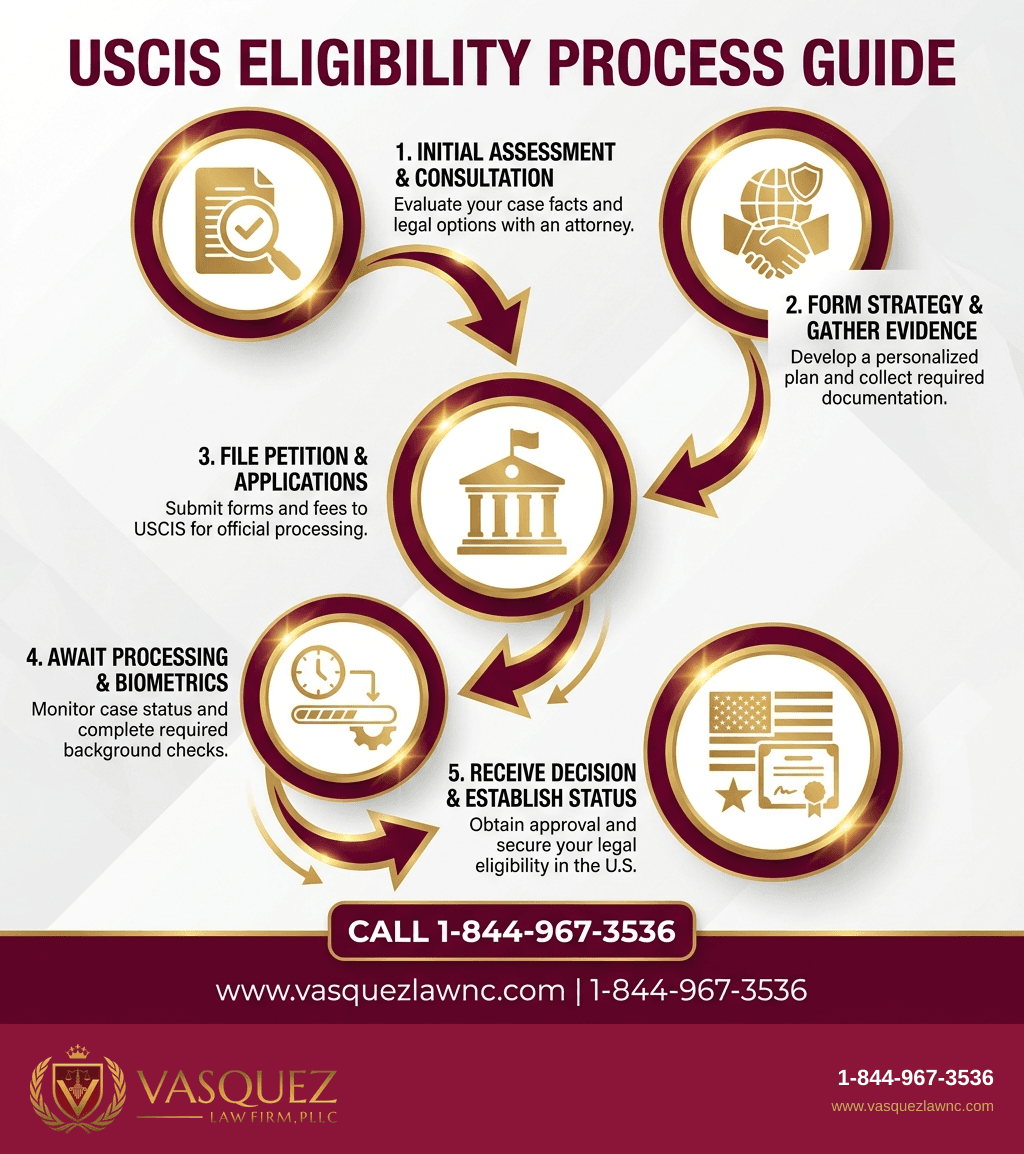
1. Gather Required Documents
Before filing, collect all supporting documents, such as birth certificates, marriage certificates, passport copies, and proof of lawful status. USCIS requires complete evidence to process applications smoothly.
2. Complete and Submit the Correct Form
USCIS offers dozens of forms like I-485 for adjustment of status or N-400 for naturalization. Filing the proper form correctly, including paying the required fee, is critical. Fees and forms are updated regularly—check the USCIS website for 2026 requirements.
3. Create a USCIS Online Account
Creating a USCIS account allows you to track your case status, receive notices, and respond to requests electronically. Keep your login info secure and check your account frequently for updates.
4. Attend Biometrics Appointment
USCIS schedules a biometrics appointment to collect fingerprints, photograph, and signature. This is mandatory for most benefit applications and triggers background checks.
5. Prepare for Your USCIS Interview
Depending on your application, USCIS may require an in-person interview. Prepare by reviewing your submitted forms and gathering originals of your documents. Our immigration attorneys can help you practice and prepare.
6. Respond Promptly to Requests for Evidence (RFEs)
USCIS often issues RFEs when more documentation is needed. Respond quickly and thoroughly within deadlines to avoid denials.
7. Receive Decision and Next Steps
After review, USCIS will approve, deny, or schedule removal proceedings. If denied, options may include appeal, motion to reopen, or new filing. Understanding your USCIS case status helps you take the correct action.
Don't wait to get the help you deserve. Call us now for immediate assistance.
Se Habla Español
Common Mistakes to Avoid When Dealing with USCIS
Errors in your USCIS case can cause processing delays or denials. Here are common mistakes applicants make and how to avoid them.
- Incomplete Forms: Leaving fields blank or mistakes in names, birthdates, or addresses. Fix: Double-check all entries and use consistent names as on official documents.
- Missing Documents: Forgetting to include mandatory evidence like proof of marriage or financial support. Fix: Use USCIS checklists and attorney review to ensure completeness.
- Not Updating USCIS: Failing to report address changes promptly, risking lost notices. Fix: Submit Form AR-11 or update your USCIS online account.
- Ignoring Biometrics Appointments: Missing fingerprint or photo sessions can halt your case. Fix: Prioritize attending all appointments and notify USCIS if rescheduling is needed.
- Late Responses to RFEs: Missing deadlines to provide requested evidence leads to automatic denial. Fix: Respond as soon as possible with help from an attorney.
- Failing to Attend Interviews: Not showing up results in case closure. Fix: Attend all scheduled interviews or request rescheduling immediately if there is a conflict.
If you only remember one thing: meticulous preparation and prompt responses are key to a smooth USCIS process. Our skilled immigration lawyers help prevent these mistakes in Raleigh and Orlando.
Timeline and What to Expect from USCIS
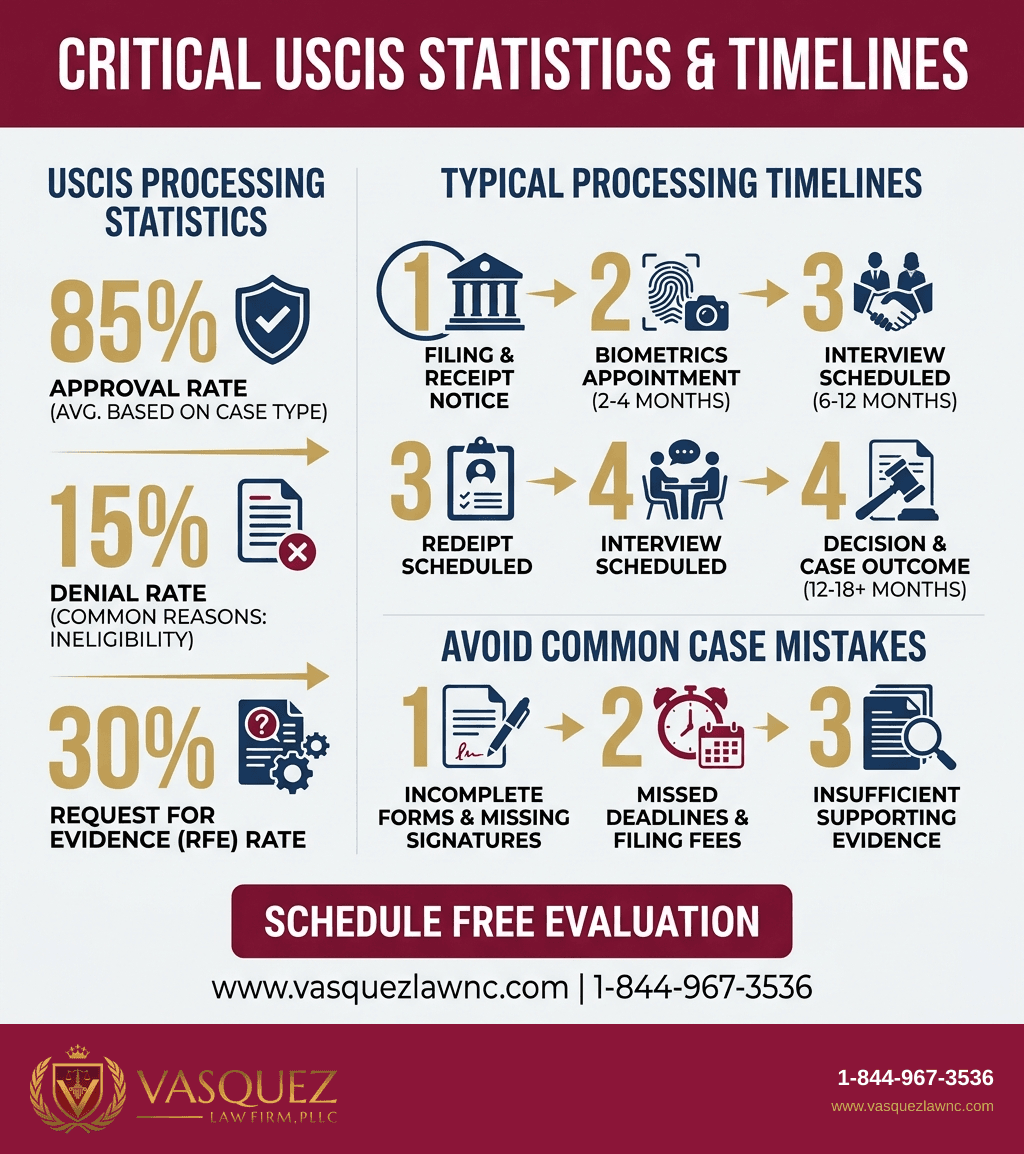
Knowing the typical timeline for your USCIS case can ease anxiety. Here is what applicants commonly experience:
- Application Submission: Day 0 is when USCIS receives your petition or form.
- Receipt Notice: Usually within 2-4 weeks, USCIS issues Form I-797 acknowledging receipt.
- Biometrics Appointment: Scheduled typically 4-8 weeks after receipt, varies by field office.
- Case Processing: Background and security checks conducted during this period.
- Interview Scheduling: May occur 3-12 months post-filing depending on case type and backlog.
- Final Decision: Applicants are notified of approval or denial within weeks after the interview.
For specific forms, the USCIS Processing Times website lists current expected durations, updated regularly. For example, I-485 cases processed in Raleigh field office average 10-14 months in 2026.
Frequently Asked Questions about USCIS
What does USCIS mean?
USCIS stands for United States Citizenship and Immigration Services. It is the government agency responsible for administering immigration and naturalization benefits in the U.S., including visa petitions, green cards, and citizenship applications.
How can I check my USCIS case status?
You can check your case status online by entering your receipt number at the official USCIS website. Creating a USCIS online account also allows notifications and document submissions.
What if I marry a U.S. citizen and then divorce before my green card is approved?
Divorce can complicate your application since many cases rely on marriage validity. Special legal provisions exist, but contacting an attorney to protect your status is crucial.
Is ICE deporting Green Card holders?
Generally, lawful permanent residents (Green Card holders) have protections, but certain criminal convictions can trigger removal proceedings by ICE. Knowing your rights is important.
Do naturalized citizens have to carry proof of citizenship?
Naturalized U.S. citizens receive a Certificate of Naturalization as proof. While not required to carry at all times, carrying it helps prove your citizenship if needed.
What is a Request for Evidence (RFE)?
An RFE is a notice from USCIS asking for additional documents or information to continue processing your application. Responding fully and timely is critical to avoid denial.
What are USCIS biometrics appointments?
Biometrics appointments collect fingerprints, photos, and signatures for background checks. They are required for most immigration forms and scheduled at local application support centers.
How do I update my address with USCIS?
You must notify USCIS within 10 days of moving by submitting Form AR-11 online or by mail. Failing to update your address can cause delays or missed notices.
About Vasquez Law Firm
At Vasquez Law Firm, we combine compassion with aggressive representation. Our motto "Yo Peleo®" (I Fight) reflects our commitment to standing up for your rights.
- Bilingual Support: Se Habla Español — Spanish-speaking attorneys and staff available
- Service Areas: North Carolina, Florida, and nationwide immigration services
- Experience: Over 30 years helping clients navigate complex legal matters
- Results: Thousands of successful cases across multiple practice areas
Attorney Trust and Experience
William J. Vásquez is admitted to the North Carolina State Bar (2011) and to the U.S. Courts of Appeals for the 4th, 5th, 6th, and 11th Circuits. Florida-jurisdiction matters at the firm are handled by Florida Bar attorney Alekssandra Lopez. The firm has provided dedicated legal representation since 2011, with personalized attention to each client's case.
Take the first step toward justice today. Our team is standing by to help.
Start Your Free Evaluation Now
Call us: 1-844-967-3536
Se Habla Español - Estamos aquí para ayudarle.
Sources and References

William Vasquez
Founder & CEO, Vasquez Law Firm, PLLC
William Vasquez is the founder and CEO of Vasquez Law Firm, PLLC, a results-driven firm specializing in immigration, criminal defense, personal injury, and workers' compensation. A U.S. Air Force veteran and recipient of the Joint Service Achievement Medal, William is dedicated to fiercely fighting for his clients' rights.
Related Legal Services
Need legal help? Learn more about speak with an immigration lawyer, or contact us for a free evaluation.
You can also visit our North Carolina immigration practice for more information.