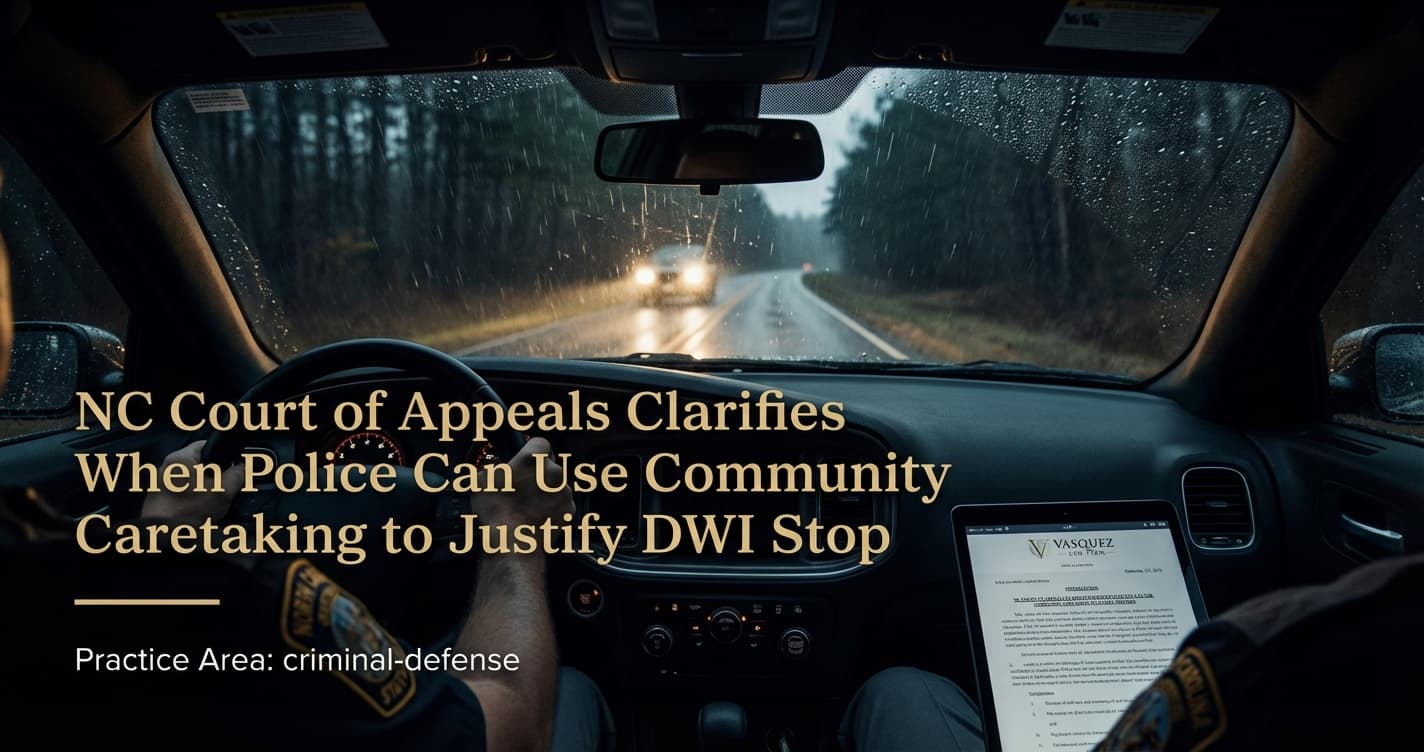
NC Supreme Court Reviews Police Stops for Minor Weaving Under DUI Laws
The NC Supreme Court will review whether police can stop drivers for minor weaving under DUI laws, which could impact how DWI cases are handled in North Carolina. Understand your rights and the implications of this ruling with Vasquez Law Firm.
Published on December 20, 2025· Updated March 3, 2026
Protect your record and your freedom
Free, confidential review. 24/7.
Free & confidential · Se habla espanol · 24/7
Have questions? Talk to an attorney - free evaluation.
Call 1-844-967-3536Protect Your Record and Your Freedom
A confidential case review - available 24/7 for emergencies.
NC Supreme Court Reviews Police Stops for Minor Weaving Under DUI Laws
The North Carolina Supreme Court’s decision to review the legality of police stops for minor weaving may impact countless drivers across the state. This case raises vital questions about the thresholds for reasonable suspicion and the rights of individuals accused of Driving While Impaired (DWI). For clients of Vasquez Law Firm, understanding the implications of this ruling is crucial in navigating the complexities of DUI laws in North Carolina.
ICE encounter or deportation risk?
Time-sensitive cases need quick action. We answer 24/7 for emergency immigration matters. Free 15-min call.
Overview of the Legal Issue
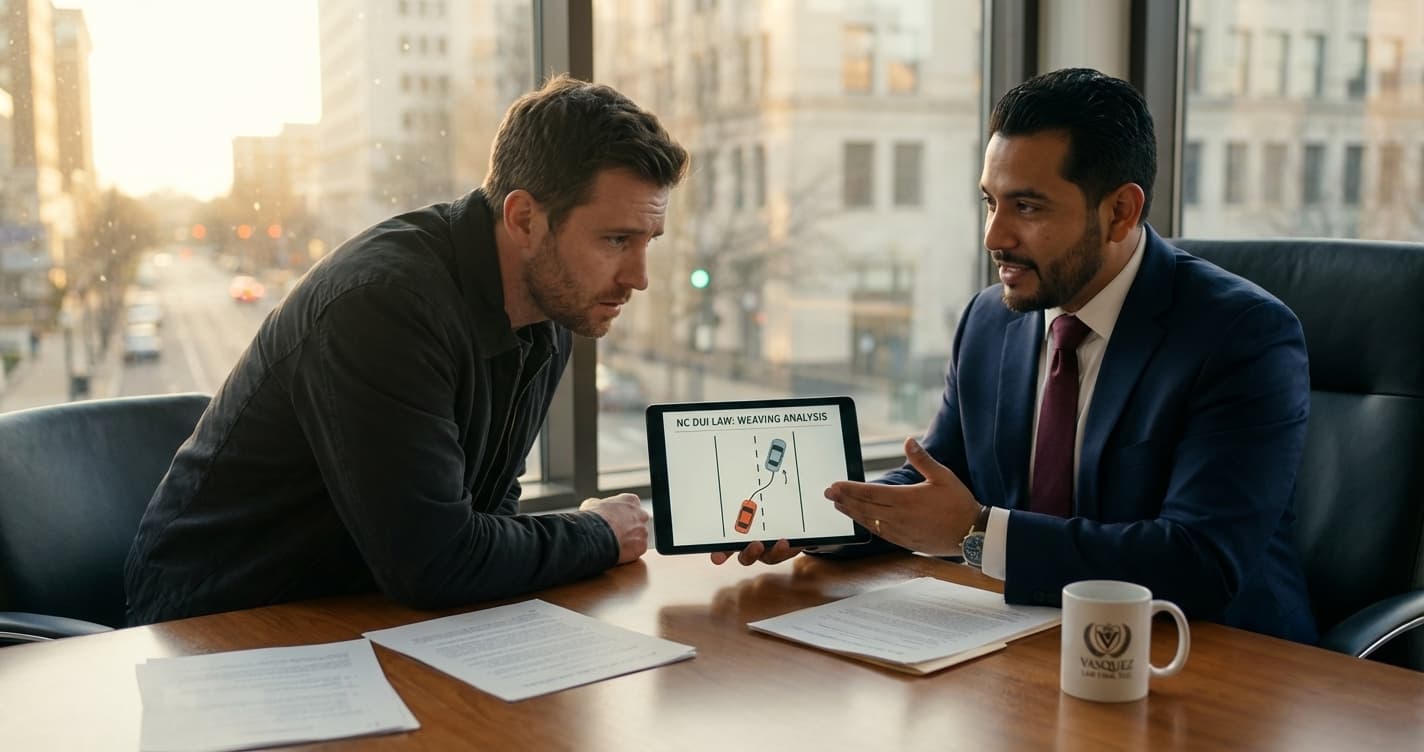
In a recent ruling, the North Carolina Court of Appeals upheld a DWI conviction primarily based on the defendant's minor weaving within their lane and the context of late-night driving. This decision has sparked debate about what constitutes reasonable suspicion for police to initiate a traffic stop. The Supreme Court's review will clarify how minor driving infractions, like brief lane weaving, can lead to DWI charges.
At the heart of this legal battle is the balance between public safety and individual rights. If the Supreme Court rules that minor weaving does not provide adequate grounds for a stop, it could significantly impact how law enforcement approaches suspected DUI cases. Conversely, a ruling affirming the earlier decision may empower officers to act on less definitive evidence, potentially leading to more unjust arrests.
Client Rights and Options
Understanding your rights on the road is essential, especially in light of this ongoing case. If you are pulled over under suspicion of DUI, here are some rights and options to consider:
- Right to Remain Silent: You have the right to not answer questions that may incriminate you. Politely inform the officer that you wish to exercise this right.
- Right to an Attorney: You have the right to request legal counsel. If you are arrested, contact a lawyer immediately.
- Field Sobriety Tests: You may refuse to take field sobriety tests, but doing so may lead to automatic license suspension.
- Breathalyzer Tests: Under North Carolina law, refusing a breath test may result in harsher penalties, so consider your options carefully.
It is vital that you document everything that happens during the stop. If you believe the stop was unjust, gather details such as the officer's name, badge number, and any dashcam footage available.
Step-by-Step Process After a DUI Stop
If you find yourself pulled over on suspicion of DUI, follow these steps:
- Stay Calm: Pull over safely and remain calm. Keep your hands visible on the steering wheel.
- Be Respectful: Interact politely with the officer, even if you disagree with their reasons for stopping you.
- Gather Evidence: If possible, record the interaction or take notes about the circumstances surrounding the stop.
- Contact Vasquez Law Firm: Reach out for a free case evaluation. We can help you navigate the complex legal landscape.
Common Mistakes to Avoid
In DUI cases, avoiding common pitfalls can significantly influence your outcomes. Here are mistakes to steer clear of:
- Admitting Guilt: Never confess to drinking or being impaired; this may be used against you in court.
- Ignoring Legal Help: Many people underestimate the importance of legal counsel, which can be crucial in defending against DUI charges.
- Failing to Document: Not keeping track of the details of the stop can weaken your case.
How Vasquez Law Firm Can Help
At Vasquez Law Firm, our experienced team understands the intricacies of DUI laws in North Carolina. We are committed to protecting the rights of our clients, ensuring that they receive fair treatment under the law. Our bilingual services ensure that we can support both English and Spanish-speaking clients throughout their legal journey.
We will thoroughly investigate the circumstances surrounding your stop, assess the legality of the police action, and build a robust defense strategy tailored to your case. Our goal is to provide you with the best possible outcome, whether that means negotiating a plea deal or fighting for your rights in court.
Contact Us for a Free Case Evaluation
If you face DUI charges or have questions about your rights during a traffic stop, do not hesitate to reach out. Contact Vasquez Law Firm today at (phone) for a free case evaluation. Let us help you navigate the complexities of your case with confidence. Se Habla Español.
FAQ Section
- What constitutes reasonable suspicion for a DUI stop?
Reasonable suspicion may include erratic driving patterns, such as weaving within the lane, but the specifics can vary based on the case. - Can I refuse a field sobriety test in North Carolina?
You can refuse a field sobriety test, but it may result in license suspension or other penalties. Always consult with an attorney before making decisions. - What should I do if I am arrested for DUI?
Remain calm, exercise your right to remain silent, and contact a lawyer as soon as possible to discuss your case.
North Carolina Traffic Law: Your Rights and Responsibilities
North Carolina has one of the more complex traffic law systems in the southeastern United States, with a structured sentencing grid for traffic violations, a license points system, and both civil and criminal consequences for certain traffic offenses. Understanding your rights and responsibilities is essential for every NC driver.
The NC Points System for Traffic Violations
How Serious Are My Charges?
Find out what you're facing and your options
Question 1 / 3
What are you charged with?
North Carolina uses a driver's license points system to track traffic violations. Points accumulate based on convictions, not citations, and remain on your record for three years. Key point values:
- Speeding 10 mph or less over the limit: 2 points
- Speeding more than 10 mph over the limit: 3 points
- Reckless driving: 4 points
- Hit and run: 4 points
- Aggressive driving: 5 points
- Passing a stopped school bus: 5 points
- DWI: 12 points (with immediate revocation)
Accumulating 12 points in a 3-year period results in license suspension. At 8 points after reinstatement, another suspension occurs. The accumulation of points also typically triggers insurance surcharges through North Carolina's Safe Driver Incentive Plan (SDIP).
Traffic Violations That Can Affect Your Insurance
North Carolina's SDIP assigns points for insurance purposes (separate from the DMV points above). Moving violations, including speeding, reckless driving, and DWI, trigger SDIP points that increase your insurance premiums. A single serious violation can increase your premiums by 25-80% for 3 years. Multiple violations can result in being placed in the high-risk pool with dramatically higher rates.
Keep Reading
When a Traffic Ticket Becomes a Criminal Matter
Most traffic violations in North Carolina are infractions—civil matters that cannot result in jail time. However, several traffic offenses are criminal misdemeanors or felonies:
- Reckless driving (G.S. 20-140): Class 2 misdemeanor; up to 60 days jail for first offense
- DWI (G.S. 20-138.1): Class 1 misdemeanor with possible jail time depending on sentencing level
- Speeding to elude arrest (G.S. 20-141.5): Misdemeanor (first offense) or felony (if serious aggravating factors exist)
- Hit and run with injury or death (G.S. 20-166): Felony
- Driving while license revoked for impaired driving (G.S. 20-28(a1)): Class 1 misdemeanor
Options for Handling a Traffic Ticket in NC
When you receive a traffic citation in North Carolina, you have several options:
- Pay the ticket (plead responsible): Convenient but results in a conviction, DMV points, and SDIP insurance points
- Request a prayer for judgment continued (PJC): If granted, the conviction is entered but judgment (and thus points) is withheld. Limited to one per household per 3 years for insurance purposes.
- Attend traffic school: Completing an approved driver improvement clinic reduces your DMV point total by 3 points (once every 5 years)
- Contest the ticket in court: Hire an attorney to appear in traffic court on your behalf and potentially have the charge reduced, dismissed, or resolved in a way that avoids points and insurance impact
The Value of Hiring a Traffic Attorney in North Carolina
Traffic attorneys provide value that far exceeds their fees in many cases. An experienced traffic attorney can:
- Negotiate with the prosecutor to reduce charges to a lesser offense or non-moving violation
- Appear in court on your behalf, saving you time off work
- Identify procedural defenses, calibration issues with radar equipment, or other technical defects in the prosecution's case
- Advise you on whether a PJC is appropriate and whether you or a family member have already used one
- Navigate CDL-specific issues that could affect your commercial driving career
For many violations, particularly speeding 15+ mph over the limit and reckless driving, the multi-year insurance premium increases far exceed the cost of hiring an attorney. Consulting with a traffic attorney before deciding how to handle a citation is almost always worthwhile.
Frequently Asked Questions About NC Traffic Violations
Can out-of-state drivers get NC traffic tickets on their record?
Yes. Under the Driver License Compact (which most states participate in), traffic convictions in North Carolina will be reported to your home state's DMV and can appear on your home state driving record. The home state then applies its own rules regarding points and insurance implications.
Will a minor traffic conviction affect my immigration status?
Some traffic violations—particularly those that involve elements of dishonesty (like leaving the scene of an accident) or rise to misdemeanor or felony level—can have immigration consequences for non-citizens. Reckless driving and DWI convictions, in particular, should be evaluated by both a criminal defense attorney and an immigration attorney if the driver is a non-citizen.
How long do I have to respond to a traffic ticket in NC?
Your citation will specify the date you must either appear in court or otherwise respond (typically by paying online or requesting a continuance). Failure to respond by that date results in a Failure to Appear (FTA) charge and can result in license revocation. Contact an attorney before the citation's due date to understand your options.
Vasquez Law Firm: Traffic Defense Throughout North Carolina
Vasquez Law Firm's traffic defense attorneys represent clients throughout North Carolina, from Charlotte and Raleigh to Smithfield and beyond. We understand NC traffic law and the local courts where your case will be heard. Contact us for a free case evaluation about your traffic citation. Se Habla Español.
Need immigration help? Our immigration attorneys can review your case.
Related Topics

William Vasquez
Founder & CEO, Vasquez Law Firm, PLLC
William Vasquez is the founder and CEO of Vasquez Law Firm, PLLC, a results-driven firm specializing in immigration, criminal defense, personal injury, and workers' compensation. A U.S. Air Force veteran and recipient of the Joint Service Achievement Medal, William is dedicated to fiercely fighting for his clients' rights.
Related Legal Services
Need legal help? Learn more about our criminal defense legal services, or contact us for a free evaluation.
You can also visit North Carolina criminal defense firm for more information.