How a Criminal Defense Lawyer in NC Can Protect Your Rights and Travel Plans
Need a criminal defense lawyer NC? Learn how pending charges can impact travel, court, and outcomes. Call 1-844-967-3536 for help.
Published on December 20, 2025
Have questions? Talk to an attorney - free evaluation.
Call 1-844-967-3536Protect Your Record and Your Freedom
A confidential case review - available 24/7 for emergencies.
How a Criminal Defense Lawyer in NC Can Protect Your Rights and Travel Plans
If you are searching for a criminal defense lawyer NC, you may be dealing with more than court dates. A pending charge can affect your job, your driver’s license, and even your ability to travel. Recent news about passport renewal during a criminal case highlights a common fear: “Will this case stop me from living my life?” This guide explains how criminal charges work in North Carolina, what restrictions courts can place on you, and how the right defense strategy can protect your record and your future.
Need legal help?
Immigration in NC and FL. Personal injury and workers compensation across NC. Criminal defense in Johnston and Harnett counties, and traffic tickets in 10 NC counties. Tell us your county and we will tell you exactly what we can do.
Worried about an arrest, warrant, or upcoming court date? Talk with our team today. Call 1-844-967-3536 or request help online. Se Habla Español.
What This News Means for Charlotte Residents Facing Charges
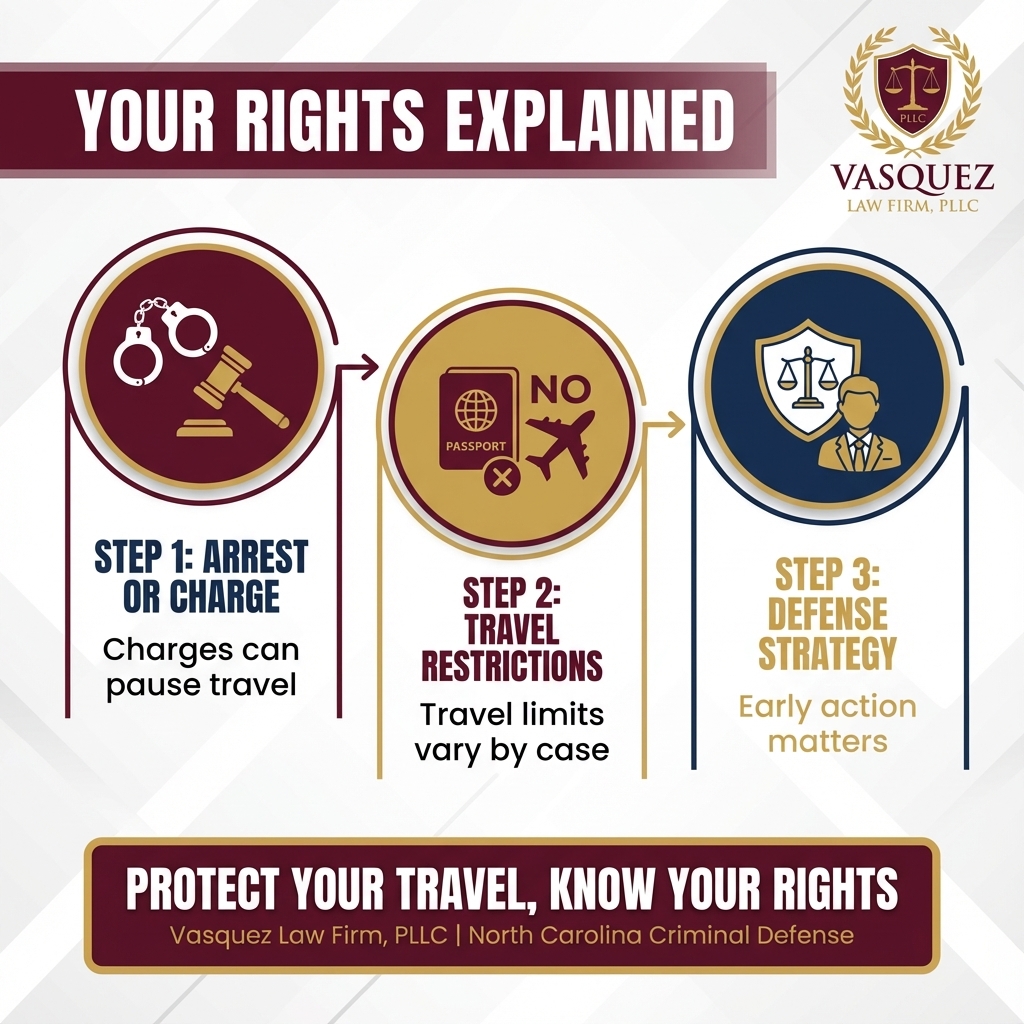
Why passport and travel issues come up during criminal cases
A recent legal update discussed whether a passport renewal can be denied just because a criminal case is pending—especially when a trial court has allowed renewal. You can read the update here: passport renewal and pending criminal case news report.
That article is not a North Carolina case. Still, the real-life concern is the same for many people: when your criminal case is open, courts and agencies may set limits that affect travel and other parts of daily life.
The North Carolina reality: courts can restrict your movement
In North Carolina, a judge can impose conditions of release (often called “bond conditions”). Depending on the charges, a judge may require you to:
- Stay within North Carolina or the U.S.
- Give up your passport (in some cases).
- Avoid certain places or people.
- Check in with pretrial services.
For many people in charlotte, this becomes urgent when work requires travel, family emergencies arise, or immigration status is involved.
Why this should push you to act early
If you wait until the last minute, you may miss a chance to request a bond modification, correct mistakes in court paperwork, or present proof that you are not a flight risk. A criminal defense lawyer NC can step in early to ask for reasonable conditions and to build a defense plan that supports your long-term goals.
How Criminal Charges Work in North Carolina (Plain-English Overview)
Key stages: from arrest to resolution
Most North Carolina criminal cases follow a predictable path, even though every case is unique. Here is a simple roadmap:
- Investigation or arrest (sometimes with a warrant, sometimes without).
- First appearance and setting conditions of release.
- District Court dates (misdemeanors and felonies before indictment).
- Grand jury/indictment for most felonies.
- Superior Court for felony cases (and some appeals).
- Outcome: dismissal, plea, trial, or alternative resolution.
For court logistics and official information, the North Carolina Judicial Branch has court location details and resources.
Misdemeanor vs. felony: why the label matters
In North Carolina, misdemeanors generally carry less exposure than felonies. But “misdemeanor” does not mean “minor.” A conviction can still lead to:
- Jail time
- Probation and fees
- A permanent criminal record
- Problems with housing, school, and professional licenses
Felony cases can bring higher prison exposure and longer-term consequences, including loss of firearm rights and more severe employment barriers.
Bond conditions and travel limits (what judges look at)
North Carolina law allows courts to set conditions of pretrial release to assure appearance and protect public safety. Examples can include secured bonds, curfews, no-contact orders, and location restrictions.
A key statute is N.C. Gen. Stat. § 15A-534, which covers pretrial release conditions. If travel matters to your job or family, your lawyer may be able to request a modification with supporting documents.
When You Need a Criminal Defense Lawyer in NC (and What to Bring)

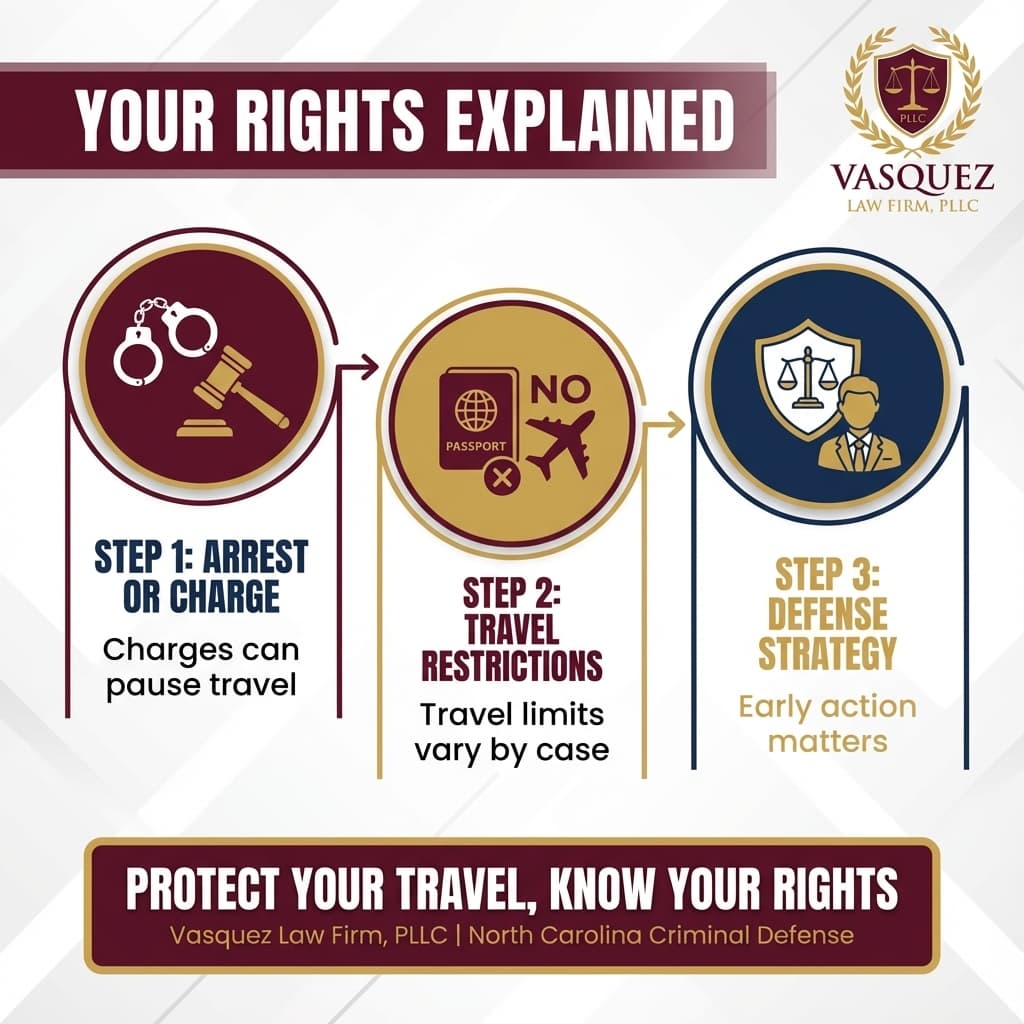
Situations where delay can hurt you
People often call a lawyer only after they “get a court date.” In reality, some of the most important decisions happen right after the incident. Consider calling a criminal defense lawyer NC as soon as you face any of the following:
- You were arrested or questioned by police.
- You have a warrant or you think one may be issued.
- You received a citation for DWI, assault, shoplifting, or drug possession.
- You are under a protective order or no-contact order.
- You need to travel for work and worry about bond restrictions.
What to gather for your first meeting
You do not need to “prove your case” on day one. But the right documents help your lawyer move faster. Bring what you have, such as:
- Charging documents (citation, warrant, criminal summons)
- Bond paperwork and conditions of release
- Any court notices
- Names of witnesses and screenshots/photos
- Proof of work travel needs (flight itinerary, employer letter)
Questions to ask before you hire anyone
Not all defense approaches are the same. Asking clear questions can help you choose the right fit:
- How often do you handle cases like mine in this county?
- What are realistic best- and worst-case outcomes?
- What defenses apply (constitutional issues, lack of proof, mistaken identity)?
- Will you seek dismissal, reduction, or a trial strategy?
Common Defense Strategies in NC Criminal Cases
Challenging the State’s evidence (the most common path)
North Carolina prosecutors must prove every element of a charge beyond a reasonable doubt. Strong defense work often focuses on evidence problems such as:
- Unreliable witness identification
- Contradictory statements
- Missing body cam or surveillance footage
- Chain-of-custody issues for drugs or weapons
Constitutional defenses: illegal stops, searches, and statements
Many cases turn on whether police followed constitutional rules. If law enforcement lacked reasonable suspicion for a stop, probable cause for an arrest, or a valid basis for a search, key evidence may be suppressed.
That can change everything in cases involving:
- DWI and traffic stops
- Drug possession and drug trafficking investigations
- Gun charges
Negotiated outcomes and alternatives (when appropriate)
Not every case should go to trial. Sometimes the best result is a dismissal after compliance, a reduction to a lesser offense, or a structured outcome that protects your record as much as possible.
Your lawyer may explore options like:
- Deferred prosecution (when available)
- Conditional discharge for certain drug offenses (when eligible)
- Restitution agreements in some property cases
- Expunction eligibility after certain dismissals (where allowed)
Need a plan, not just a court date? Call 1-844-967-3536 to talk through next steps with a defense team that knows North Carolina courts. Se Habla Español.
Charlotte Courts, Local Considerations, and What to Expect
Where cases are handled in the Charlotte area
Many cases for charlotte residents are handled through the Mecklenburg County court system, with District Court typically addressing misdemeanors and Superior Court handling felonies after indictment. Knowing local calendars, courtroom procedures, and common bond conditions can make a real difference in how smoothly your case moves.
Local factors that can affect your case
Even with the same charge, outcomes can vary based on practical issues such as:
- Whether the alleged victim supports prosecution
- Your record (or lack of one)
- Whether there were injuries or property damage
- Whether the case involves alcohol, drugs, or firearms
If you are serving charlotte area obligations—work in Uptown, family responsibilities, or school—your lawyer can present those stability factors when advocating for reasonable bond terms.
How Serious Are My Charges?
Find out what you're facing and your options
Question 1 / 3
What are you charged with?
Keep Reading

Nearby communities we commonly serve
Criminal charges do not follow city limits. A criminal defense lawyer NC may help clients across the region, including Matthews, Mint Hill, Huntersville, Cornelius, Pineville, Concord, and Gastonia.
How Vasquez Law Firm, PLLC Builds a Defense That Fits Your Life
Experience and credentials that matter in court
Vasquez Law Firm, PLLC focuses on criminal defense and helps clients make smart choices when the stakes are high. Attorney Vasquez, JD has 15 years of experience and is admitted to the North Carolina State Bar and the Florida Bar.
Learn more about our team here: Attorney Vasquez.
A practical, client-centered approach
When you hire a defense lawyer, you deserve clear answers. We focus on:
- Fast action on bond issues, warrants, and no-contact orders
- Evidence review to identify weaknesses in the State’s case
- Communication so you know what is happening and why
- Respect for your family and your reputation
What we handle (and how to get started)
If you need help now, start with our Criminal Defense services page, then contact us to discuss your situation. We regularly assist clients facing allegations such as:
- DWI / DUI
- Drug charges (possession, paraphernalia, intent)
- Assault and domestic violence-related allegations
- Theft and fraud charges
- Probation violations
For many families in charlotte, the biggest relief comes from having a clear plan and a lawyer who can speak directly to the court on your behalf.
Frequently Asked Questions (Criminal Defense in NC)
1) Can I leave North Carolina while my case is pending?
Sometimes, yes—but it depends on your bond conditions. Some people are released on written promise or unsecured bond with minimal restrictions. Others may have conditions that limit travel or require permission. A criminal defense lawyer NC can review your release order and, if needed, request a modification under North Carolina pretrial release rules.
2) Do I have to tell my employer about my charges?
There is no one-size-fits-all answer. Some jobs require disclosure due to licensing, security clearance, or driving duties. Others do not. Before you disclose, it helps to talk with counsel about what will show up on background checks and how your case may resolve.
3) What happens if I miss court in Mecklenburg County?
Missing court can lead to an order for arrest and additional charges in some situations. It can also cause bond consequences. If you missed a date, contact a lawyer immediately to address the problem before it escalates.
4) Can charges be dismissed if the alleged victim “drops” them?
In North Carolina, the State (prosecutor) controls the case—not the alleged victim. Even if a complaining witness wants to withdraw, the prosecutor may continue if they believe they can prove the charge. However, changes in cooperation can strongly affect negotiations and trial strategy.
5) Will a misdemeanor conviction affect my immigration status?
It can. Some misdemeanors can still trigger immigration consequences depending on the offense and the specific status involved. If immigration is a concern, tell your attorney right away so your defense strategy considers those risks. Se Habla Español—we can explain options clearly in Spanish or English.
6) How much does a criminal defense lawyer cost in NC?
Fees vary based on the charge level, complexity, county, and whether the case is likely to go to trial. A consultation is the best way to get a clear estimate and understand what is included (court appearances, motions, negotiations, and trial prep).
Get a defense strategy built for your case. If you are facing charges in North Carolina, call 1-844-967-3536 or request a free consultation today. Se Habla Español.
Disclaimer: This article is for general information only and is not legal advice. Reading this does not create an attorney-client relationship. Every case depends on specific facts.

William Vasquez
Founder & CEO, Vasquez Law Firm, PLLC
William Vasquez is the founder and CEO of Vasquez Law Firm, PLLC, a results-driven firm specializing in immigration, criminal defense, personal injury, and workers' compensation. A U.S. Air Force veteran and recipient of the Joint Service Achievement Medal, William is dedicated to fiercely fighting for his clients' rights.
Related Legal Services
Need legal help? Learn more about criminal defense lawyers in North Carolina, or contact us for a free evaluation.
You can also visit Smithfield criminal defense attorneys for more information.