H-1B Specialty Occupation and Consular Processing Updates for 2026
The 2026 H-1B specialty occupation requirements maintain the focus on jobs requiring specialized knowledge and a bachelor’s degree or higher. Employers must file petitions with USCIS, and applicants outside the U.S. generally undergo consular processing for visa issuance. This article explains the updated rules affecting Raleigh, NC and Orlando, FL applicants, outlines the legal framework, and provides practical steps for filing and consular processing in 2026.
Published on May 27, 2026
Talk to an immigration attorney
Free call. A clear plan for your case.
Free & confidential · Se habla espanol · 24/7
Have questions? Talk to an attorney - free evaluation.
Call 1-844-967-3536Worried how the latest immigration news affects you?
Schedule a confidential case review with an immigration attorney - know exactly where you stand.
This article provides general legal information, not individualized legal advice. Reading does not create an attorney-client relationship. For advice specific to your situation, contact Vasquez Law Firm.
What are the H-1B specialty occupation requirements for 2026 applicants?
Need a Work Visa or Permit?
H-1B, TN, L-1, and more. We help workers and employers navigate the visa process.
H-1B specialty occupation requirements for 2026 applicants continue to focus on positions that require theoretical and practical application of specialized knowledge, typically necessitating at least a bachelor’s degree or its equivalent. Employers must file petitions demonstrating the job qualifies as a specialty occupation and that the beneficiary meets educational and professional criteria.
The H-1B visa classification is designed for foreign workers in specialty occupations that require specialized knowledge and a minimum of a bachelor’s degree or higher. The 2026 requirements maintain the core criteria that the job must be in a specialty occupation and that the applicant’s education and experience align with the position. Employers must submit Form I-129, Petition for a Nonimmigrant Worker, to USCIS to establish eligibility.
According to the USCIS guidance on working in the United States, "a common way to work temporarily in the United States as a nonimmigrant is for a prospective employer to file a petition with USCIS on your behalf." This applies directly to H-1B petitions, where the employer acts as the petitioner and the prospective employee as the beneficiary.
The specialty occupation must require the application of a body of highly specialized knowledge and the attainment of a bachelor’s or higher degree in the specific specialty (or its equivalent). The beneficiary must have completed the required degree or possess equivalent experience and credentials. The 2026 process emphasizes careful documentation of the job duties and educational requirements to meet USCIS standards.
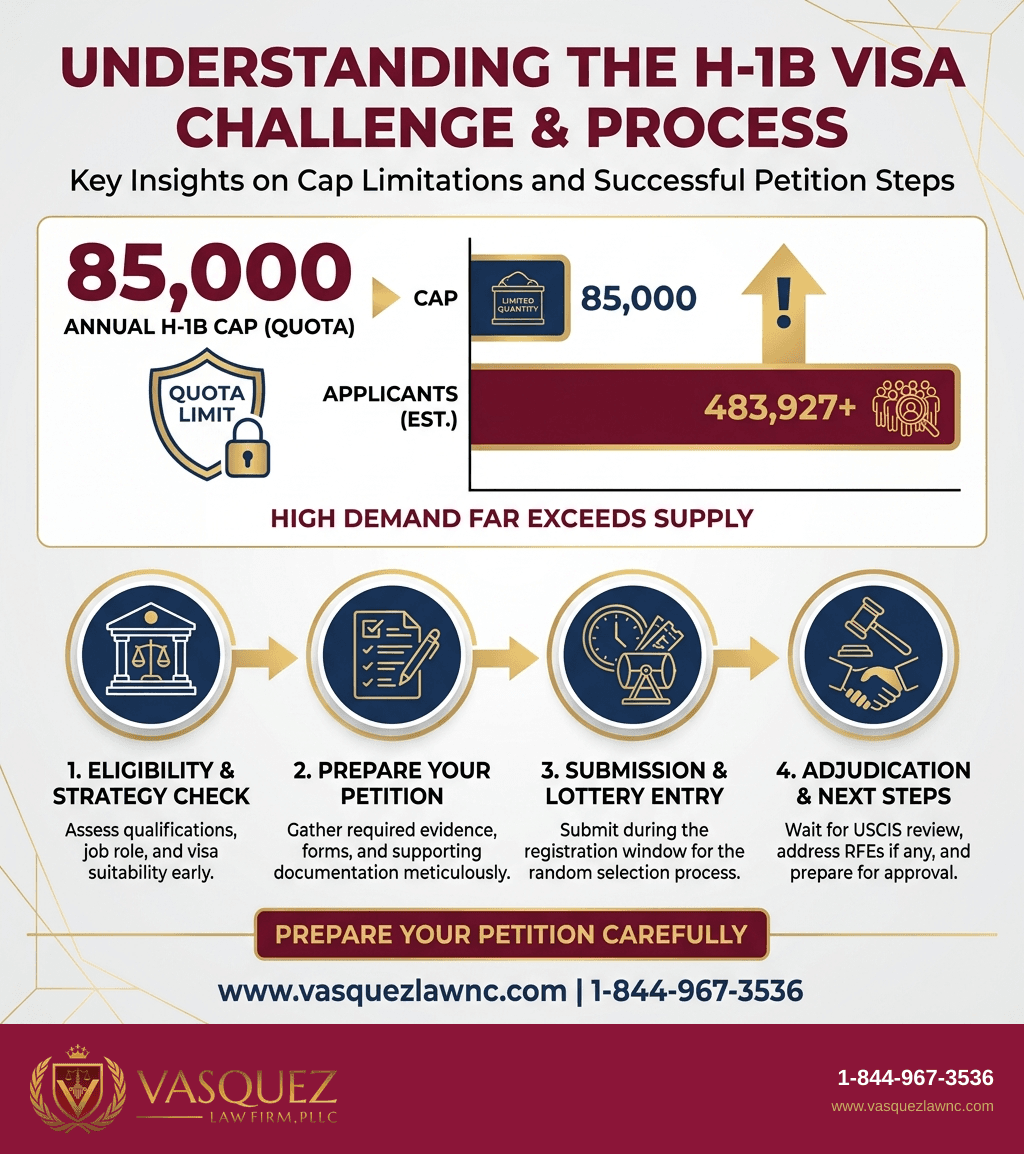
Employers should also be aware of the annual H-1B cap and lottery system, which remains in effect unless exempted. The cap limits the number of new H-1B visas issued each fiscal year, making timely and accurate petition filing critical.
Who is affected by the 2026 H-1B specialty occupation and consular processing rules?
The 2026 H-1B specialty occupation and consular processing rules affect prospective foreign workers seeking temporary employment in specialty occupations, U.S. employers sponsoring such workers, and applicants residing outside or inside the United States, including those in Raleigh, NC and Orlando, FL.
Specifically, foreign nationals with specialized skills, education, or experience who want to work in the United States under an H-1B visa are directly impacted. Employers in Raleigh, NC and Orlando, FL who regularly sponsor H-1B workers must comply with updated procedural and evidentiary requirements. Additionally, applicants who are outside the U.S. and require consular processing to obtain their H-1B visa must follow the Department of State’s visa application procedures after USCIS approves the petition.
According to USCIS, "if you live outside the United States and want to work here, you generally must apply for a visa from the U.S. Department of State (DOS), unless a visa is not required for people from your country of nationality." This means that most H-1B applicants abroad must undergo consular processing at a U.S. embassy or consulate.
In Raleigh, NC and Orlando, FL, where our offices are located, the demand for H-1B workers in technology, healthcare, engineering, and education sectors remains strong. Employers and applicants in these regions must be prepared for the procedural steps involved in both USCIS petition approval and consular visa issuance.
Furthermore, applicants currently in lawful nonimmigrant status without employment authorization may seek a change of status to H-1B or adjust status if eligible, impacting residents in Raleigh and Orlando. The rules also affect family members accompanying H-1B workers who may apply for dependent visas.
What does the law say about H-1B specialty occupation requirements and consular processing?
The legal framework for H-1B specialty occupation visas is primarily established under 8 U.S.C. § 1184(c), which governs the admission of nonimmigrant workers, including H-1B classifications. This statute sets forth the requirements for specialty occupations, including the necessity of a U.S. employer petition and evidence of the beneficiary’s qualifications.
Under 8 U.S.C. § 1184(c), an H-1B petition must demonstrate that the job qualifies as a specialty occupation and that the foreign worker meets the educational and professional standards. The statute also authorizes USCIS to adjudicate petitions and impose conditions on the employment authorization.
Consular processing is governed by regulations under 22 CFR Part 41, which outline visa issuance procedures by the Department of State. Applicants outside the U.S. must apply for their visa at a U.S. embassy or consulate after USCIS approves the H-1B petition. The consular officer reviews the application, conducts an interview, and issues the visa if eligibility is confirmed.
The USCIS policy page explains:
"In many cases, USCIS must approve your petition before you are eligible to apply to DOS for a visa or seek admission at a port of entry." (Source: USCIS, https://www.uscis.gov/working-in-the-united-states)
This highlights the two-step process: petition approval by USCIS and visa issuance by DOS through consular processing.
Additionally, adjustment of status within the U.S. for eligible applicants is governed by 8 U.S.C. § 1255, allowing certain individuals to become lawful permanent residents without leaving the country. However, many H-1B applicants outside the U.S. must complete consular processing to obtain their visa and enter the United States.
What should you do to apply for an H-1B specialty occupation visa and complete consular processing in 2026?
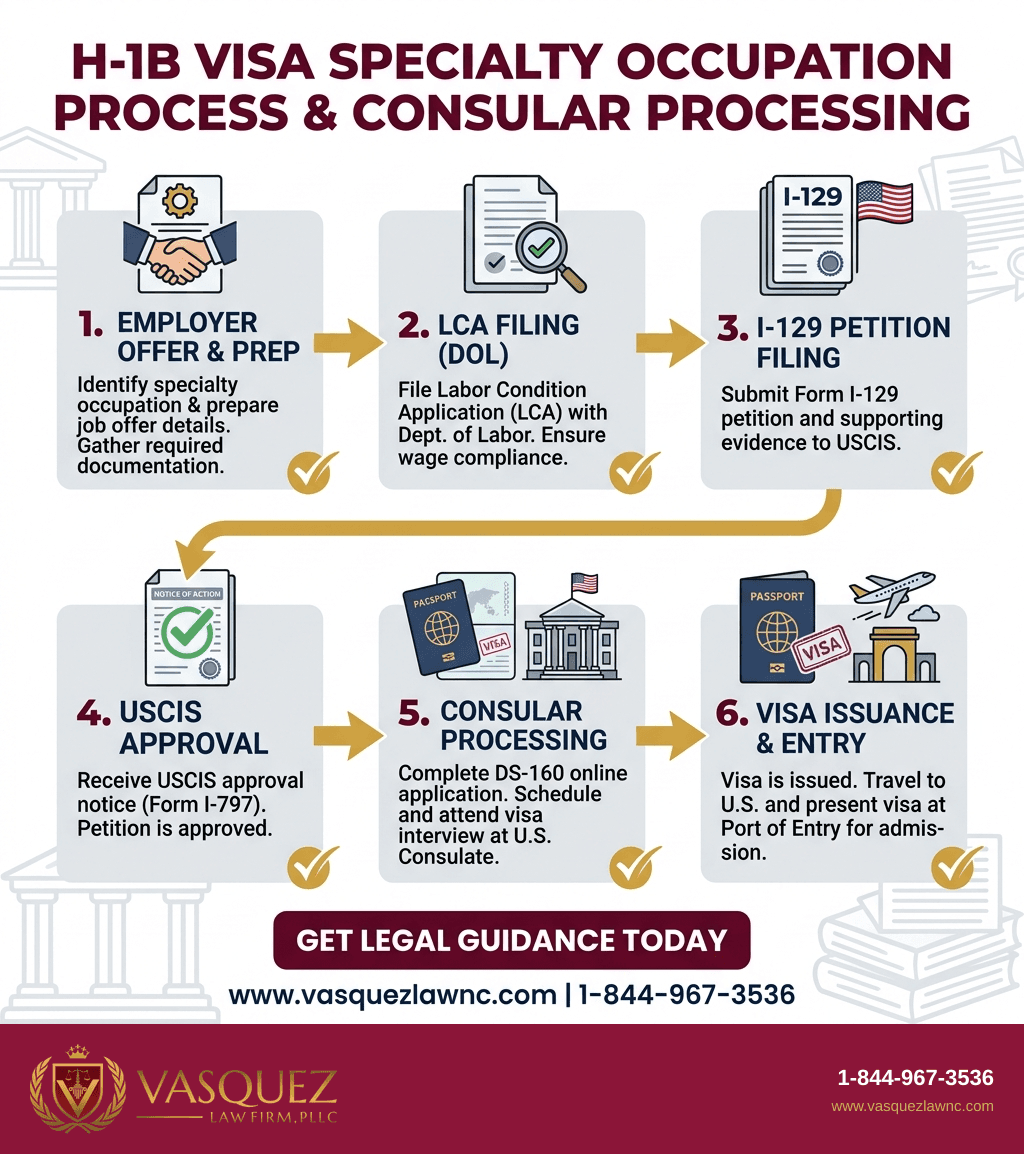
To apply for an H-1B specialty occupation visa in 2026, start by securing a job offer from a U.S. employer willing to file a petition on your behalf. The employer must submit Form I-129 to USCIS with supporting evidence that the position qualifies as a specialty occupation and that you meet the educational and experience requirements.
At our Raleigh, NC and Orlando, FL offices, we typically see that the most common mistake is incomplete documentation of the specialty occupation criteria and beneficiary qualifications, which can lead to delays or denials. Ensuring detailed job descriptions, educational credentials, and proof of employer-employee relationship is critical.
Once USCIS approves the petition, if you are outside the United States, you must apply for an H-1B visa at a U.S. embassy or consulate through consular processing. This involves completing Form DS-160, paying visa fees, scheduling and attending a visa interview, and presenting required documents such as the approved petition, passport, and educational certificates.
If you are inside the United States in a lawful nonimmigrant status without employment authorization, you may apply for a change of status to H-1B or an adjustment of status if eligible. USCIS allows concurrent filing of Form I-129 and Form I-485 in certain cases, but eligibility depends on visa availability and individual circumstances.
The following table summarizes the key steps for H-1B applicants inside and outside the U.S. in 2026:
| Applicant Location | Key Steps | Relevant Forms | Processing Agency |
|---|---|---|---|
| Outside the U.S. | Employer files Form I-129; USCIS approval; apply for visa at U.S. consulate; attend interview; enter U.S. | I-129, DS-160 | USCIS, DOS |
| Inside the U.S. | Employer files Form I-129 for change of status; if eligible, file Form I-485 for adjustment of status | I-129, I-485 (if applicable) | USCIS |
What's Your Immigration Situation?
Answer 3 questions - we'll tell you your options
Question 1 / 3
What best describes your situation?
Keep Reading
Applicants should maintain lawful status throughout the process and comply with all conditions of their employment authorization. Failure to do so can result in removal or denial of re-entry, as noted by USCIS:
"You must comply with all conditions of your employment authorization and the terms of your admission to this country. If you violate any of the conditions, you could be removed from or denied re-entry into the United States." (Source: USCIS, https://www.uscis.gov/working-in-the-united-states)
For residents of Raleigh, NC and Orlando, FL, coordinating with experienced immigration counsel can help avoid common pitfalls and streamline petition preparation and consular processing.
What happens next with H-1B specialty occupation petitions and consular processing for 2026 applicants?
Following USCIS petition approval, applicants outside the U.S. must proceed with consular processing through the Department of State. Visa appointments, interviews, and issuance depend on embassy schedules and individual circumstances. Delays may occur due to administrative processing or security clearances.
USCIS continues to update policies and procedures to improve adjudication efficiency and transparency. Applicants and employers should monitor official USCIS and DOS websites for announcements affecting H-1B processing timelines and requirements.
Employers and applicants should also prepare for the annual H-1B cap season, which typically begins in April for the following fiscal year. Meeting filing deadlines and submitting complete petitions remains crucial.
The USCIS guidance page states:
"Before entering the United States, you must present yourself to a U.S. Customs and Border Protection (CBP) officer and receive permission to enter the United States and engage in your proposed activity." (Source: USCIS, https://www.uscis.gov/working-in-the-united-states)
This final admission step is essential for lawful entry and employment under H-1B status. Applicants should be prepared with all documentation at the port of entry.
For Raleigh, NC and Orlando, FL applicants, working closely with legal counsel throughout the petition and consular process can help address issues promptly and improve chances of timely approval and entry.
This article provides general legal information, not individualized legal advice. Reading does not create an attorney-client relationship. For advice specific to your situation, contact Vasquez Law Firm.
Reviewed by William Vasquez, Founder & CEO, Vasquez Law Firm, PLLC.
Need immigration help? Our immigration attorneys can review your case.
Related Topics
William Vasquez
Founder & CEO, Vasquez Law Firm, PLLC
William Vasquez is the founder and CEO of Vasquez Law Firm, PLLC, a results-driven firm specializing in immigration, criminal defense, personal injury, and workers' compensation. A U.S. Air Force veteran and recipient of the Joint Service Achievement Medal, William is dedicated to fiercely fighting for his clients' rights.
Related Legal Services
Need legal help? Learn more about NC immigration legal team, or contact us for a free evaluation.
You can also visit statewide immigration legal services for more information.