Mayor says ICE operations in Columbus won't turn city into 'vehicle of fear' - The Columbus Dispatch | Know Your Rights
Mayor says ICE operations in Columbus won't turn city into 'vehicle of fear' - The Columbus Dispatch: learn ICE powers & your rights. Call 1-844-967-3536.
Published on January 14, 2026· Updated February 11, 2026
Talk to an immigration attorney
Free call. A clear plan for your case.
Free & confidential · Se habla espanol · 24/7

Have questions? Talk to an attorney - free evaluation.
Call 1-844-967-3536Worried how the latest immigration news affects you?
Schedule a confidential case review with an immigration attorney - know exactly where you stand.
Mayor says ICE operations in Columbus won't turn city into 'vehicle of fear' - The Columbus Dispatch | Know Your Rights
When headlines say Mayor says ICE operations in Columbus won't turn city into 'vehicle of fear' - The Columbus Dispatch, many immigrants and mixed-status families ask the same question: What can ICE actually do, and what rights do we have if agents show up? This guide breaks down ICE authority, limits on force, what “operations” can look like in real life, and practical steps to protect your family—especially if you are seeking or maintaining lawful status.
Worried About Immigration Policy Changes?
New policies can affect your case. Get current legal advice from an experienced immigration attorney.
Serving orlando residents and families across Central Florida, Vasquez Law Firm, PLLC focuses on immigration law and proactive planning so a scary moment does not become a life-changing crisis.
Worried about ICE contact or an immigration case? Talk with our team before it becomes urgent. Request a confidential consultation or call 1-844-967-3536. Se Habla Español.
What This News Means for Immigrant Communities (and Why It Matters in orlando)
Why a mayor’s comments can still affect real enforcement
Statements like Mayor says ICE operations in Columbus won't turn city into 'vehicle of fear' - The Columbus Dispatch can ease anxiety, but they do not change federal enforcement authority. ICE (Immigration and Customs Enforcement) is a federal agency, and its enforcement priorities can shift with policy changes, leadership, and resource allocation.
Even in cities that emphasize community trust, ICE may still conduct targeted arrests, workplace actions, or detention transfers through jail systems.
Columbus headlines, Central Florida questions
Although the headline is about Ohio, the underlying concerns are the same in orlando: Will people avoid reporting crime? Will families skip school meetings or medical care? Will a traffic stop lead to immigration consequences?
Those fears can be reduced with accurate legal information and a plan. In many cases, what you do before contact with immigration authorities matters as much as what you do during it.
The source people are sharing right now
Many readers are also circulating explainers about ICE authority and use of force, including this news item: an explainer on what ICE is and what powers agents have. Knowing the basics helps you make safer decisions under pressure.
What ICE Is, What It Does, and Who It Targets
ICE’s two main branches: ERO and HSI
ICE generally operates through two key components:
- ERO (Enforcement and Removal Operations): arrests, detention, and deportation (removal) cases.
- HSI (Homeland Security Investigations): investigations involving cross-border crime, trafficking, document fraud, and more.
In everyday community encounters, most people mean ERO activity when they talk about “ICE operations.”
How people come to ICE’s attention
People often assume ICE only shows up after a serious criminal conviction. In reality, ICE contact can begin in several ways, including:
- Prior immigration orders (old removal orders, missed court hearings)
- Pending criminal charges or jail bookings
- Workplace verification issues (I-9 audits)
- Tips, investigations, or identity/document questions
- Prior immigration filings that reveal address/employment history
This is why the reassurance implied by Mayor says ICE operations in Columbus won't turn city into 'vehicle of fear' - The Columbus Dispatch may feel comforting, yet still leaves families asking what to do if agents appear at home or work.
Why your immigration status changes the legal options
Your best response depends on your status and history. A U.S. citizen, a lawful permanent resident, a DACA recipient, an asylum applicant, and an undocumented person with a prior removal order each face different risks and defenses.
Checking case posture with counsel is often the safest first step—especially if you have missed court in the past or moved without updating addresses.
What Powers ICE Agents Have (and Limits on Force)
Arrest authority and questioning
Under federal law, ICE officers have authority to arrest certain noncitizens in specific circumstances, including when there is reason to believe a person is in the U.S. in violation of immigration law and may escape before a warrant can be obtained. (See legal citations below.)
Practically, ICE may ask questions about your identity, where you were born, or your immigration status. You generally have the right to remain silent. You can ask to speak with a lawyer.
Warrants, home entry, and the key difference between “ICE warrants” and judge-signed warrants
One of the most important concepts for families is the difference between:
- An administrative ICE warrant (often on Form I-200 or I-205), and
- A judicial warrant signed by a judge.
An administrative warrant is not the same as a judge-signed warrant for entering a home. In many scenarios, you can refuse entry unless agents present a judicial warrant. Ask them to slide it under the door or hold it up to a window.
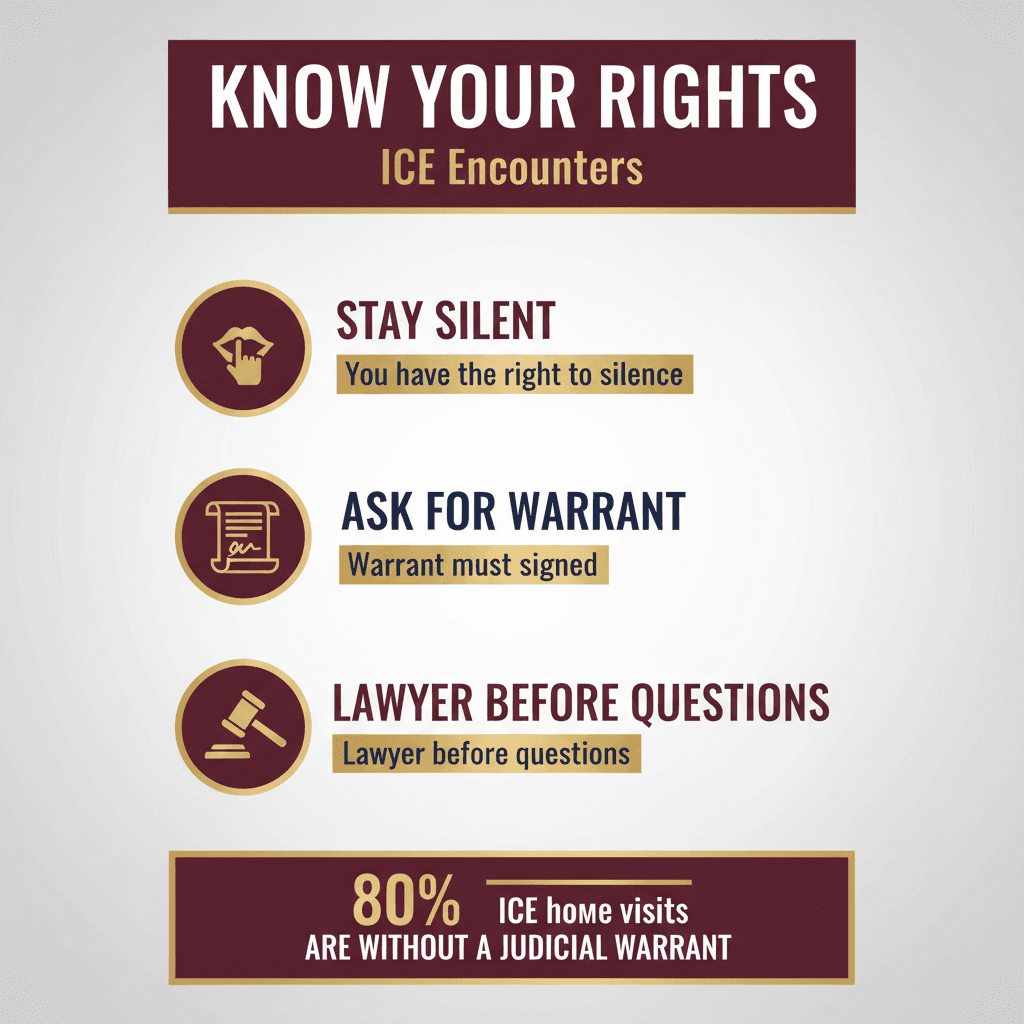
Because the law is fact-specific, speak with counsel about your situation before making decisions that could escalate risk.
Use of force: what “reasonable” can mean in practice
Federal regulations and agency policies address when force may be used and the type of force allowed. The legal standard often revolves around what is “reasonable” under the circumstances, which is heavily fact-dependent.
If you believe force was excessive, document everything you can safely document: names, badge numbers, witnesses, and medical records. Do not physically resist.
Your Rights During an ICE Encounter (Practical Steps)
If ICE comes to your home
If agents come to your door, your goal is to reduce risk and avoid giving up rights by mistake. Consider these steps:
- Stay calm and keep the door closed.
- Ask, “Do you have a warrant signed by a judge?”
- Do not open the door unless a judicial warrant is shown.
- Do not lie or present false documents. That can create criminal exposure.
- State clearly: “I choose to remain silent. I want to speak to a lawyer.”
Many families reading Mayor says ICE operations in Columbus won't turn city into 'vehicle of fear' - The Columbus Dispatch want reassurance. The best reassurance is knowing your options and having an attorney’s phone number ready.
If you are stopped in public or at work
Public encounters move quickly. If approached:
- Ask if you are free to leave. If yes, walk away calmly.
- If not, say you will remain silent and want an attorney.
- Do not consent to searches of your phone, car, or belongings.
- Do not sign anything you do not understand.
Workplace situations can involve employers, HR, security, and audits. If you are worried about I-9 issues or status, get legal advice proactively.
What documents to carry (and what not to carry)
Document choices should be tailored to your status. As general guidance:
- If you have lawful status, carry proof (e.g., green card, work permit).
- If you do not have status, avoid carrying foreign passports if you fear they will be taken.
- Carry an attorney contact card and emergency family contact info.
For official immigration forms and case tools, review resources from U.S. Citizenship and Immigration Services (USCIS).
Need a plan before anything happens? Call 1-844-967-3536 to discuss options with an immigration attorney. You can also message us privately here. Se Habla Español.
If ICE Detains Someone: What Happens Next
Detainers, jail transfers, and why timing matters
Detention sometimes starts after an arrest by local law enforcement, followed by an ICE “detainer” request. Policies vary by jurisdiction, and outcomes depend on charges, release decisions, and cooperation practices.
If your loved one is booked, time is critical. Getting the A-number, confirming detention location, and assessing bond eligibility can change the case path.
Immigration court, EOIR, and removal defense
Removal cases are handled through the immigration court system under the Executive Office for Immigration Review. You can learn more at EOIR (U.S. Department of Justice).
Depending on the case, legal strategies may include:
- Bond requests (where eligible)
- Motions to reopen (especially for missed hearings)
- Asylum, withholding of removal, or Convention Against Torture claims
- Cancellation of removal (if eligible)
- Adjustment of status through family or other qualifying pathways
Why you should not sign papers without counsel
Some detained individuals are pressured to accept quick removal or sign documents they do not understand. Signing can waive rights. Always request time to speak with counsel.
For visa categories and lawful entry options, see U.S. visa information from the Department of State.
How Vasquez Law Firm, PLLC Helps Families Facing ICE Concerns
Experience, credentials, and client-ready communication
Vasquez Law Firm, PLLC is led by Attorney Vasquez, JD, with 15 years of experience in immigration law and bar admissions with the North Carolina State Bar and the Florida Bar. We focus on clear advice and practical next steps—because in an emergency, confusion is the enemy.
We also know language access matters: Se Habla Español.
Immigration services that can reduce ICE-related risk
What's Your Immigration Situation?
Answer 3 questions - we'll tell you your options
Question 1 / 3
What best describes your situation?
Keep Reading

Legal solutions depend on facts, but common strategies include:
- Evaluating eligibility for family-based adjustment, consular processing, or waivers
- Reviewing prior removal orders and exploring motions to reopen
- Preparing for immigration court and bond hearings
- Helping lawful residents protect status after arrests (crimmigration screening)
- Preparing emergency family plans and documentation checklists
Learn more about our Immigration Law services and how we support clients step-by-step.
Serving orlando residents with local awareness
We routinely assist clients who live and work across orlando and nearby areas like Kissimmee, Winter Park, Sanford, and Lake Nona. We also understand how stressful it can feel to navigate a federal system while managing everyday life—school, work, and family responsibilities.
When appropriate, we coordinate documentation and planning with local realities in mind, including travel routes, work schedules, and court appearances. Many families also recognize landmarks like the Orange County Courthouse downtown as a reminder that legal problems can move fast—so planning early matters.
Frequently Asked Questions About ICE Operations and Your Rights
1) Can ICE enter my home without a judge-signed warrant?
Often, ICE needs consent or a judicial warrant to enter a home. ICE may present an administrative warrant, which is different from a judge-signed warrant. Because small details matter, get legal advice for your specific situation.
2) Should I open the door if ICE knocks?
You can speak through the door and ask what they want. If they do not have a judge-signed warrant, you generally can refuse entry. Stay calm, do not lie, and do not physically resist.
3) What if ICE stops me in public in orlando?
You can ask if you are free to leave. If you are detained, you can remain silent and ask for a lawyer. Do not sign documents you do not understand. If you fear arrest is likely, speak with counsel ahead of time to plan.
4) Can ICE use force during an arrest?
ICE officers can use force in certain circumstances, but it must be legally justified and reasonable under the circumstances. If you believe force was excessive, prioritize safety, seek medical care, and document details for your attorney.
5) Does a city mayor’s statement stop ICE?
No. Local leaders can influence local policing policies and community messaging, but ICE is a federal agency. That is why headlines like Mayor says ICE operations in Columbus won't turn city into 'vehicle of fear' - The Columbus Dispatch may not change what happens in an individual case.
6) What is the first thing my family should do if someone is detained?
Gather the person’s full name, date of birth, and A-number (if any). Confirm where they are held and do not wait to consult counsel. Fast action can help preserve bond options, reopen old cases, or stop a mistake from becoming permanent.
Key Takeaways and Next Steps (A Calm Plan Beats Panic)
Three things to remember from this headline
Even if a city promises it will not become a “vehicle of fear,” families should focus on what they can control. Here are the most important points:
- Know the difference between administrative ICE paperwork and a judge-signed warrant.
- Use your rights calmly: remain silent, request counsel, and do not sign unknown documents.
- Get ahead of risk by reviewing your status, past court dates, and eligibility for relief.
Why planning works—especially for mixed-status families
Planning reduces fear because it replaces uncertainty with steps. For many readers, Mayor says ICE operations in Columbus won't turn city into 'vehicle of fear' - The Columbus Dispatch is a reminder to prepare:
- Create an emergency contact list and childcare plan.
- Keep copies of key documents in a safe place.
- Schedule a legal checkup to review options and risks.
When to talk to an immigration attorney
Consider speaking with counsel if you have:
- A prior removal order or missed immigration court date
- Any arrest history (even dismissed charges)
- Pending asylum, family petitions, or work permit renewals
- Concerns about workplace verification or identity issues
In our experience serving orlando families, early legal advice often creates options that do not exist later.
Ready for real answers—not rumors? Contact Vasquez Law Firm, PLLC today. Call 1-844-967-3536 or schedule a confidential consultation. Se Habla Español.
Attorney advertising. This article is general information and not legal advice. Every case depends on specific facts and changing law.
Keyword note: This article discusses the concerns raised by Mayor says ICE operations in Columbus won't turn city into 'vehicle of fear' - The Columbus Dispatch and explains practical rights-based steps that may apply nationwide, including for families in orlando.

William Vasquez
Founder & CEO, Vasquez Law Firm, PLLC
William Vasquez is the founder and CEO of Vasquez Law Firm, PLLC, a results-driven firm specializing in immigration, criminal defense, personal injury, and workers' compensation. A U.S. Air Force veteran and recipient of the Joint Service Achievement Medal, William is dedicated to fiercely fighting for his clients' rights.
Related Legal Services
Need legal help? Learn more about NC immigration legal team, or contact us for a free evaluation.
You can also visit statewide immigration legal services for more information.