Can Remote Employees File Workers Comp Claims in 2026
Understanding workers' comp for remote work in North Carolina is crucial in 2026. Learn your rights and how to file a claim. Contact Vasquez Law Firm for a free consultation.
Published on February 18, 2026
Hurt on the job?
Free review of your workers' comp claim.
Free & confidential · Se habla espanol · 24/7
Have questions? Talk to an attorney - free evaluation.
Call 1-844-967-3536Hurt on the Job? Claim What You Are Owed
A review of your workers' comp claim - we handle the fight.
Can Remote Employees File Workers Comp Claims in 2026
The landscape of employment has significantly shifted, with remote work becoming a permanent fixture for many companies in 2026. This evolution brings new questions, especially concerning workers' comp remote work claims. If you're a remote employee in North Carolina and suffer a work-related injury or illness while working from home, understanding your rights and the complexities of filing a workers' compensation claim is essential. The line between personal and professional can blur, making it challenging to prove that an injury occurred in the course and scope of employment. This guide will clarify how workers' compensation applies to remote workers in NC, providing critical information to protect your interests.
Need help with your workers' comp remote work case? Our experienced attorneys are ready to fight for you. Se Habla Español.
Schedule Your Free Case Evaluation
Or call us now: 1-844-967-3536
Quick Answer: Workers' Comp Remote Work in NC
Yes, remote employees in North Carolina are generally covered by workers' compensation for injuries sustained while performing job-related duties from home, as of 2026. The key is establishing a direct link between the injury and your employment responsibilities. This includes injuries occurring during specific work tasks or activities that benefit your employer, even if they happen within your home environment.
- Injuries must occur during work-related activities.
- The home must be considered a secondary workplace.
- Proving the injury's work-relatedness is crucial.
- Immediate reporting to your employer is mandatory.
- Seeking medical attention promptly is vital for your claim.
Understanding Remote Work and Workers' Compensation in NC
North Carolina's workers' compensation system is designed to provide benefits to employees who suffer injuries or illnesses arising out of and in the course of their employment. For traditional workplaces, this concept is relatively straightforward. However, with the rise of workers' comp remote work, the interpretation becomes more nuanced. The central challenge for remote employees is demonstrating that their injury meets these criteria when their home doubles as their office.
The North Carolina Industrial Commission (NCIC) generally recognizes that if an employee is injured while performing duties for their employer, regardless of location, it can be a compensable claim. This means that if you're working from your home in Smithfield, for example, and you trip over an office cable while getting up to answer a work call, that injury could potentially be covered. The critical factor is whether the activity you were performing at the time of injury was directly related to your job responsibilities or for the benefit of your employer.
For a remote workers' comp claim to be successful, there must be a clear causal connection between the employment and the injury. This often involves examining the specific task being performed, the location within the home, and the employer's expectations for the remote work arrangement. An experienced attorney can help navigate these complexities, ensuring your claim is presented effectively. Remember, simply being at home when an injury occurs is not enough; it must be tied to your work duties.
Establishing 'Course and Scope of Employment' for Remote Workers
The phrase "arising out of and in the course of employment" is the cornerstone of any North Carolina workers' compensation claim, and it's particularly important for workers' comp remote work cases. "In the course of employment" generally means the injury occurred while the employee was performing work tasks. "Arising out of employment" means there's a causal connection between the work and the injury. For remote employees, this often involves proving that the home environment, at the time of injury, was functioning as an extension of the employer's workplace.
Consider the "personal comfort doctrine," which often applies to traditional workplaces. This doctrine allows for coverage of injuries sustained during brief deviations for personal comfort, such as getting a drink of water or using the restroom. This can extend to remote workers, meaning an injury sustained while walking to the kitchen for a glass of water during work hours could potentially be covered, provided it's a reasonable and necessary activity within the scope of your work duties. However, if you are injured while performing a purely personal task, like cooking a family meal, that would likely not be covered.
Employers often have specific remote work policies in place that can influence a claim. These policies might define working hours, designated workspaces, and acceptable activities. While these policies are important, they do not automatically dictate compensability. A skilled workers' compensation attorney will analyze all relevant factors, including the nature of your job, your employer's expectations, and the specific circumstances of your injury, to build a strong case for your workers' comp remote work claim. Understanding your rights under NC workers' compensation laws is crucial.
The Going and Coming Rule and Remote Work
Traditionally, the "going and coming rule" states that injuries sustained while commuting to and from a fixed workplace are not covered by workers' compensation. For remote employees, this rule is generally less relevant because their workplace is their home. However, exceptions can arise if a remote employee is required to travel to a client site, a company meeting, or another location for work-related purposes. In such instances, injuries sustained during that travel could be covered.
For example, if your employer requires you to drive from your home in Smithfield to a regional office for a mandatory team meeting, and you are involved in a car accident on the way, that injury would likely fall within the course and scope of your employment. The key is whether the travel was an integral part of your job duties or specifically requested by your employer. Attorney Vasquez and the team at Vasquez Law Firm understand these nuances and can help you determine if your travel-related injury qualifies for workers' comp remote work benefits.
Step-by-Step: Filing a Remote Workers' Comp Claim in NC
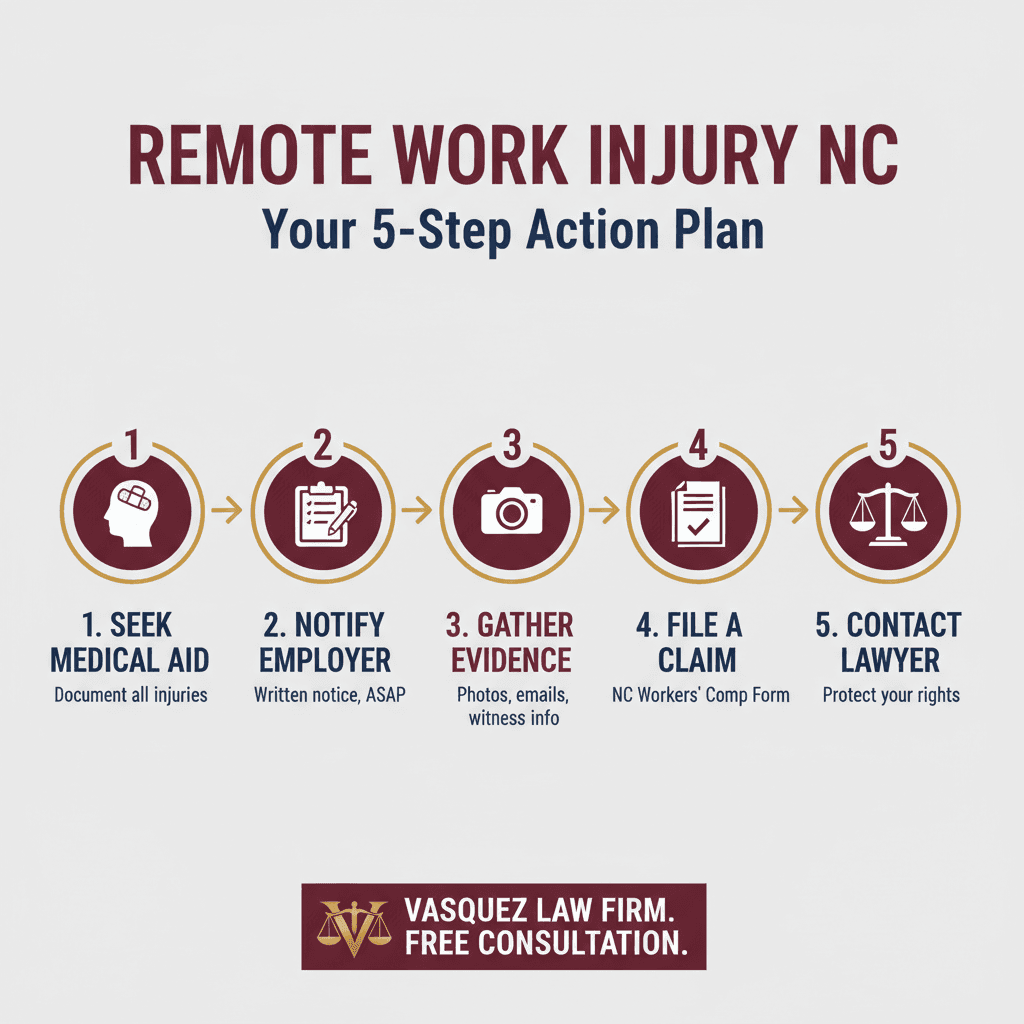
If you've suffered a work-related injury while working remotely in North Carolina, taking the correct steps immediately is vital to protect your right to workers' comp remote work benefits. Following these steps can help ensure your claim proceeds smoothly.
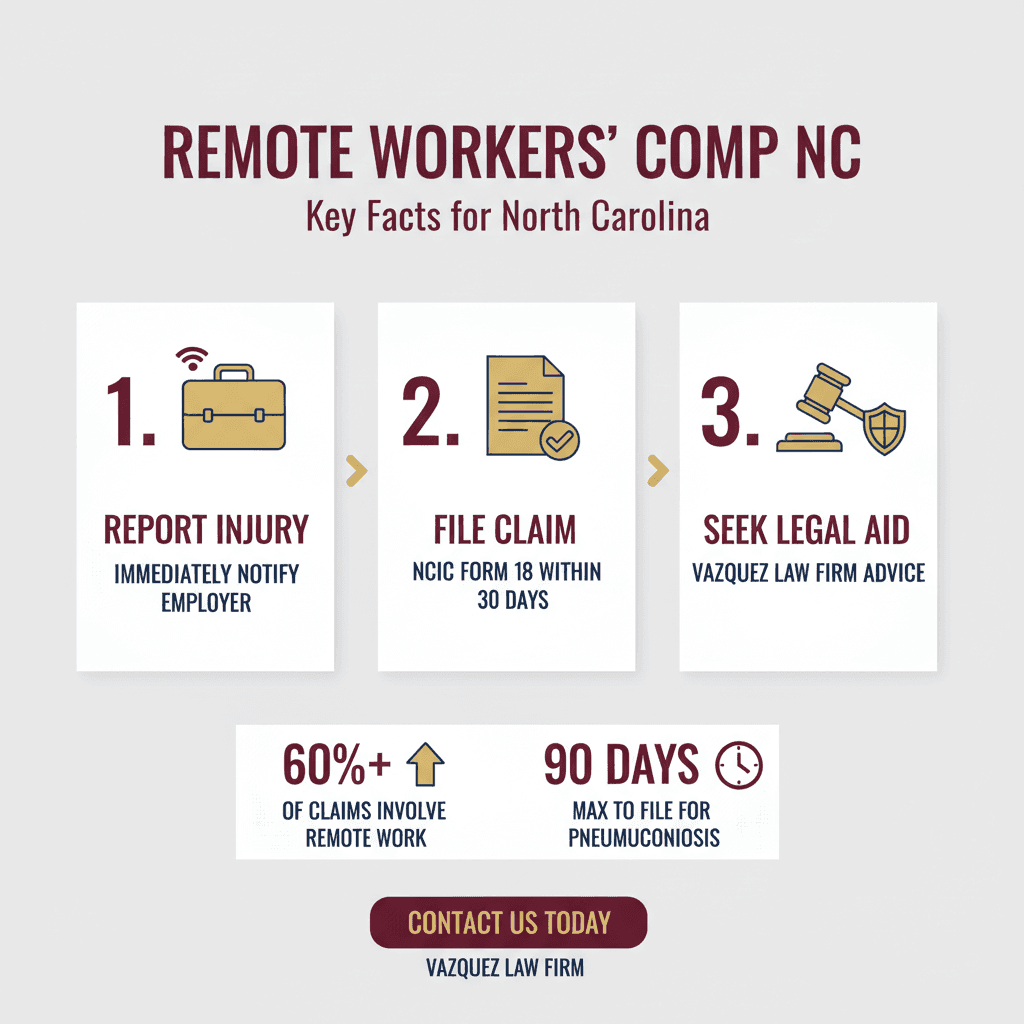
- Report the Injury Immediately: Notify your employer in writing as soon as possible, ideally within 30 days of the injury or diagnosis of an occupational disease. Include the date, time, location (your home address), and a brief description of how the injury occurred. Failure to report promptly can jeopardize your claim.
- Seek Medical Attention: Get immediate medical treatment for your injury. Be clear with medical providers that your injury is work-related and explain how it happened. Keep detailed records of all medical appointments, diagnoses, treatments, and prescriptions.
- Document Everything: Maintain a comprehensive record of all communications with your employer, doctors, and the insurance company. Take photos of the injury, the area where it occurred, and any equipment involved. Keep a journal of your symptoms, pain levels, and how the injury impacts your daily life.
- File Form 18 with the NC Industrial Commission: This is the official notice of accident to the Industrial Commission. You can file this yourself, but it's often best to have an attorney assist you to ensure all necessary information is included and correctly submitted. This form must typically be filed within two years of the injury.
- Consult with a Workers' Compensation Attorney: Navigating a workers' comp remote work claim can be challenging, especially when dealing with insurance companies. An experienced attorney can ensure your rights are protected, help gather evidence, handle communications, and represent you throughout the process.
Evidence Checklist for Remote Work Injuries
Gathering the right evidence is crucial for a successful workers' comp remote work claim. The more documentation you have, the stronger your case will be. Here's a checklist of items that can support your claim:
- Written Report of Injury: Your formal notification to your employer, detailing the incident.
- Medical Records: All documentation from doctors, specialists, physical therapists, including diagnoses, treatment plans, prescriptions, and any work restrictions.
- Witness Statements: If anyone witnessed the incident or can attest to your work activities (e.g., a family member present in the home, a colleague you were on a call with).
- Photos/Videos: Images of the injury, the specific area in your home where it occurred, and any equipment involved.
- Remote Work Agreement: Any formal document outlining your remote work arrangement, work hours, and designated workspace.
- Communication Logs: Emails, chat messages, or other communications with your employer discussing your work duties, the injury, or the remote work setup.
- Job Description: A copy of your official job description outlining your responsibilities.
- Time Sheets/Work Logs: Proof that you were on the clock and performing work duties at the time of the injury.
- Employer's Policies: Any company policies related to remote work, safety, or incident reporting.
The team at Vasquez Law Firm can help you identify and gather all necessary evidence to support your workers' comp remote work claim.
Don't face your legal challenges alone. Our team is here to help you every step of the way.
Call today: 1-844-967-3536 | Se Habla Español
Common Mistakes and How to Avoid Them
Navigating a workers' comp remote work claim can be complex, and certain missteps can significantly jeopardize your chances of receiving benefits. Avoiding these common mistakes is crucial:
- Delaying Injury Reporting: Waiting too long to report your injury to your employer can lead to denial. Report it in writing immediately.
- Not Seeking Prompt Medical Care: Gaps in medical treatment or delaying care can make it harder to prove the injury's severity and work-relatedness. See a doctor right away.
- Failing to Document Everything: Lack of documentation (photos, communication, medical records) weakens your claim. Keep meticulous records.
- Misrepresenting the Injury: Be honest and consistent in your accounts of how the injury occurred. Inconsistencies can be used against you.
- Ignoring Doctor's Orders: Failing to follow prescribed treatments or work restrictions can lead to a reduction or termination of benefits. Adhere strictly to medical advice.
- Communicating Without Legal Counsel: Insurance companies may try to minimize your claim. Avoid giving recorded statements or signing documents without consulting an attorney.
- Not Understanding Your Rights: Many remote workers are unaware of their eligibility for workers' comp. Educate yourself or seek legal guidance.
- Failing to File Form 18: This official form is crucial for notifying the NC Industrial Commission. Missing the deadline can result in your claim being barred.
If you only remember one thing: Always report your injury to your employer immediately and seek legal counsel from a dedicated workers' compensation attorney to protect your rights.
North Carolina Specific Considerations for Remote Work Injuries
North Carolina law, specifically the North Carolina Workers' Compensation Act (N.C. Gen. Stat. § 97), governs all workers' compensation claims within the state. While the principles generally apply to workers' comp remote work, the application can be more challenging. The NC Industrial Commission (NCIC) is the state agency responsible for administering these laws and adjudicating disputes.
In NC, the burden of proof is on the injured employee to show that the injury arose out of and in the course of employment. For remote workers, this often means demonstrating that the home environment, at the specific time of injury, was directly serving as the employer's workplace. For example, if you are injured while performing a task that would typically be done in a traditional office setting, such as retrieving files from a home office cabinet, your claim would likely be stronger than if you were injured doing a personal chore.
Attorney Vasquez and the Vasquez Law Firm are deeply familiar with North Carolina workers' compensation laws and how they apply to the evolving landscape of remote work. We can help you navigate the specific requirements and challenges of filing a claim in NC, ensuring you meet all deadlines and present a compelling case to the NCIC. Our experience in Smithfield and across North Carolina means we understand the local nuances that can impact your case.
For more detailed information on specific topics related to workers' compensation in North Carolina, consider reading our other articles like Employer Choice of Doctors in NC Workers' Comp or NC Workers' Compensation Reforms.
When to Call a Workers' Comp Attorney Now
Dealing with a work-related injury, especially one sustained while working remotely, can be overwhelming. Knowing when to seek legal help from an experienced workers' comp attorney is crucial. You should contact Vasquez Law Firm immediately if any of the following apply:
- Your employer denies your workers' comp remote work claim.
- The insurance company is delaying or denying medical treatment.
- You receive an offer for a settlement that seems too low.
- Your employer is pressuring you to return to work before you are medically cleared.
- You are unsure if your remote injury qualifies for workers' compensation.
- You are struggling to gather the necessary evidence to support your claim.
- Your employer or the insurance company is disputing the extent of your injuries.
- You fear retaliation from your employer for filing a claim.
- You have questions about your rights or the claims process in North Carolina.
Don't hesitate to reach out. The sooner you speak with an attorney, the better your chances of a successful outcome.
About Vasquez Law Firm
At Vasquez Law Firm, we combine compassion with aggressive representation. Our motto "Yo Peleo" (I Fight) reflects our commitment to standing up for your rights. We understand the unique challenges faced by injured workers, especially those navigating workers' comp remote work claims, and we are dedicated to providing personalized and effective legal solutions.
- Bilingual Support: Se Habla Español - our team is fully bilingual and ready to assist clients in their preferred language.
- Service Areas: We proudly serve clients across North Carolina, including Smithfield, and handle nationwide immigration services.
- Experience: With over 15 years of dedicated legal experience, Attorney Vasquez has a proven track record of success in workers' compensation and other practice areas.
- Results: We have successfully helped thousands of clients secure the compensation and justice they deserve, fighting tirelessly for favorable outcomes.
Attorney Trust and Experience
Attorney Vasquez holds a Juris Doctor degree and is admitted to practice in both the North Carolina State Bar and Florida Bar. With over 15 years of dedicated legal experience, he has built a reputation for providing personalized attention and achieving favorable outcomes for his clients. His deep understanding of workers' compensation law, combined with a compassionate approach, ensures that every client receives the highest level of advocacy. He is committed to fighting for the rights of injured workers, including those dealing with complex workers' comp remote work cases, ensuring they receive fair treatment and just compensation.
Frequently Asked Questions About Workers' Comp Remote Work
Is a remote employee covered by workers' compensation in North Carolina?
Yes, a remote employee in North Carolina is generally covered by workers' compensation if their injury arises out of and in the course of their employment. This means the injury must occur while performing job-related duties or activities that benefit the employer, even if working from home. Proving the direct link between work and injury is the most critical aspect of these claims.
What if I get hurt during a break while working from home?
Injuries during short, reasonable breaks for personal comfort, like getting a drink or using the restroom, may be covered under the "personal comfort doctrine." However, if the break involves purely personal activities unrelated to work, like extensive meal preparation or household chores, coverage is less likely. Each case depends on its specific facts and the nature of the activity.
How do I report a remote work injury to my employer in NC?
You must report your injury to your employer in writing as soon as possible, ideally within 30 days. Include the date, time, location (your home), and a detailed description of how the injury occurred. Keep a copy of your report. Prompt notification is crucial for a valid workers' comp remote work claim in North Carolina.
What kind of evidence do I need for a remote workers' comp claim?
Essential evidence includes medical records, your formal injury report, photos of the injury and incident location, any remote work agreements, job descriptions, and communication logs with your employer. Witness statements, if available, can also be helpful. Comprehensive documentation strengthens your workers' comp remote work case significantly.
Can my employer deny my workers' comp remote work claim?
Yes, employers or their insurance carriers can deny a claim, especially if they dispute that the injury arose out of or in the course of employment. Common reasons for denial include insufficient evidence, late reporting, or the injury occurring during purely personal activities. An attorney can help appeal a denied workers' comp remote work claim.
Do I need a specific workspace at home for my injury to be covered?
While having a designated home office can strengthen your claim by clearly defining your workspace, it's not strictly required. The key is whether you were performing work-related duties at the time of injury, regardless of the specific room. However, an injury in a non-work area like a bedroom might be harder to prove as work-related.
What if my remote work injury is an occupational disease?
Occupational diseases, such as carpal tunnel syndrome from extensive computer use, can also be covered for remote workers. You must prove the disease was caused by conditions specific to your employment and not from ordinary life. Report symptoms as soon as they manifest and link them to your work activities for a workers' comp remote work claim.
How long do I have to file a workers' comp claim in NC for a remote injury?
In North Carolina, you generally have two years from the date of the injury to file a Form 18 (Notice of Accident) with the NC Industrial Commission. For occupational diseases, the timeline can be more complex, often two years from the date of diagnosis or when you were informed of the connection to your work. Prompt action is always best.
Can I get a remote job while on workers' comp?
Being on workers' comp for one employer does not automatically prevent you from taking a remote job with a *different* employer, especially if your current claim involves restrictions that a remote job accommodates. However, it's crucial to discuss this with your workers' comp attorney and potentially your doctor, as it could impact your existing benefits or return-to-work status. Transparency is key.
What if my employer doesn't have workers' comp insurance?
Most North Carolina employers with three or more employees are required to carry workers' compensation insurance. If your employer doesn't have coverage, you may still be able to file a claim directly with the NC Industrial Commission, or pursue a civil lawsuit. This situation is complex and absolutely requires immediate legal counsel to protect your rights.
Sources and References
- North Carolina Industrial Commission (NCIC)
- North Carolina Workers' Compensation Act (N.C. Gen. Stat. § 97)
Hurt at work? Our workers' compensation attorneys can review your claim.
Ready to take the next step? Contact Vasquez Law Firm today for a free, confidential consultation. We're committed to fighting for your rights and achieving the best possible outcome for your workers' comp remote work case.
Start Your Free Case Evaluation Now
Call us: 1-844-967-3536
Se Habla Español - Estamos aquí para ayudarle.

William Vasquez
Founder & CEO, Vasquez Law Firm, PLLC
William Vasquez is the founder and CEO of Vasquez Law Firm, PLLC, a results-driven firm specializing in immigration, criminal defense, personal injury, and workers' compensation. A U.S. Air Force veteran and recipient of the Joint Service Achievement Medal, William is dedicated to fiercely fighting for his clients' rights.
Related Legal Services
Need legal help? Learn more about our workers compensation legal services, or contact us for a free evaluation.
You can also visit North Carolina workers compensation lawyers for more information.