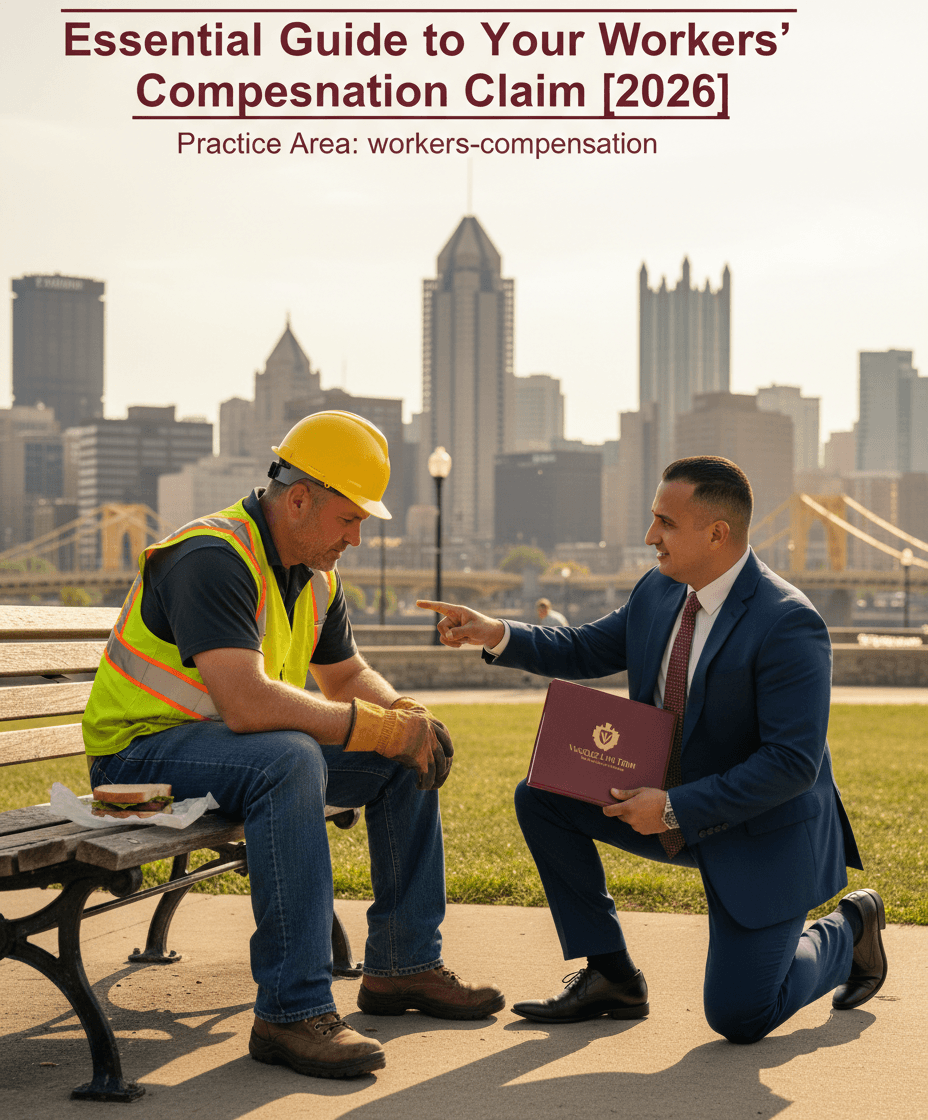
Can You Get Workers Comp If You Were Injured During Horseplay in 2026
Injured due to horseplay at work? Understand workers' compensation horseplay rules in North Carolina for 2026. Contact Vasquez Law Firm for a free consultation.
Published on February 18, 2026

Have questions? Talk to an attorney - free evaluation.
Call 1-844-967-3536Hurt on the Job? Claim What You Are Owed
A review of your workers' comp claim - we handle the fight.
Can You Get Workers Comp If You Were Injured During Horseplay in 2026
Navigating a workers' compensation claim can be complex, especially when the injury involves workplace horseplay. Many employees wonder if an injury sustained during what might be considered 'horseplay' is compensable under North Carolina law. As of 2026, understanding the nuances of the "horseplay rule" is crucial for anyone seeking benefits. This comprehensive guide from Vasquez Law Firm will clarify how workers' compensation horseplay incidents are typically handled, what factors influence a claim's success, and how an experienced attorney can advocate for your rights. Don't let uncertainty prevent you from seeking the compensation you may deserve.
Need help with your workers' compensation horseplay case? Our experienced attorneys are ready to fight for you. Se Habla Español.
Schedule Your Free Consultation
Or call us now: 1-844-967-3536
Quick Answer: Workers' Compensation Horseplay
In North Carolina, injuries from workplace horseplay are generally not covered by workers' compensation if the injured employee was the instigator or a willing participant. However, there are exceptions, such as when the horseplay was a common workplace occurrence known to the employer, or if the injured party was an unwilling victim. Each case depends on specific facts and the degree of deviation from work duties.
- Injured worker's role (instigator, participant, victim) is key.
- Employer's knowledge of or tolerance for horseplay matters.
- Deviation from work duties impacts compensability.
- Legal guidance is often essential for successful claims.
- North Carolina law has specific interpretations of the "horseplay rule."
Understanding the "Horseplay Rule" in Workers' Compensation
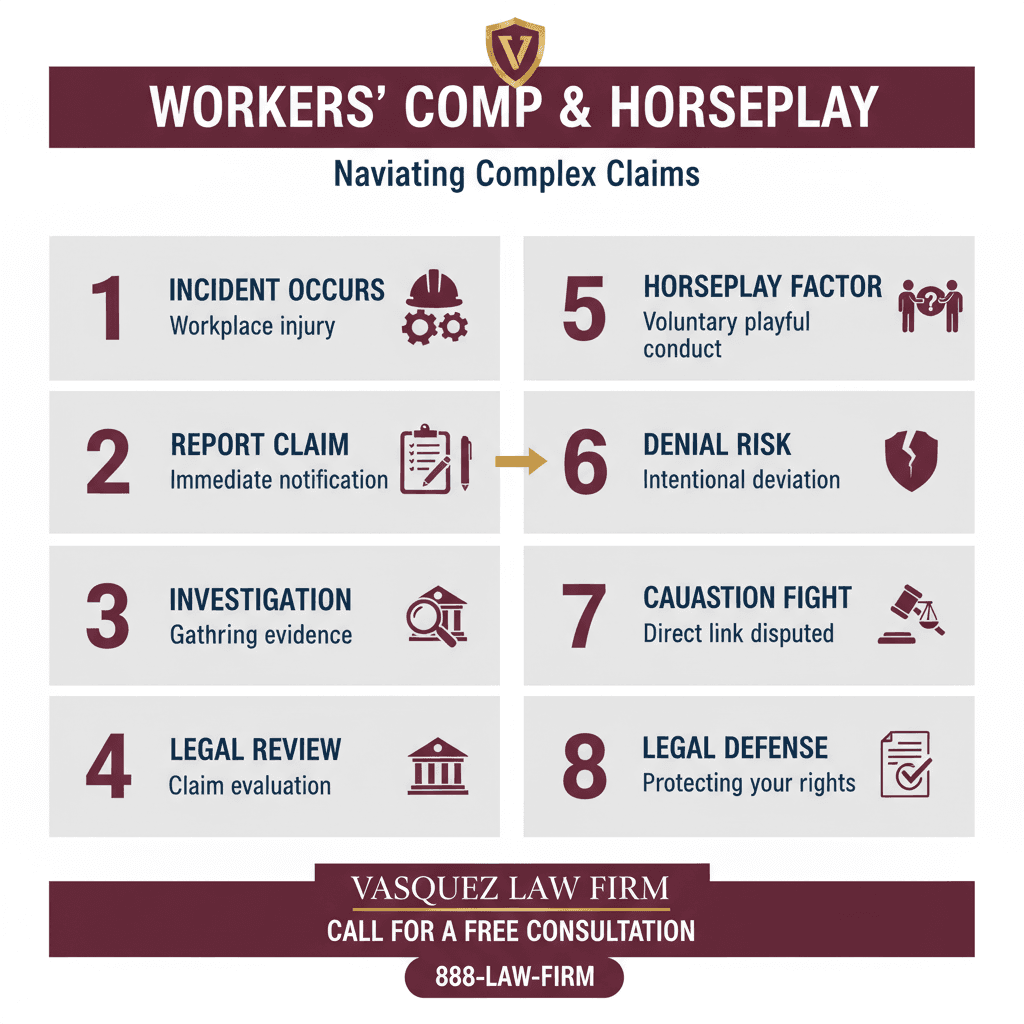
The "horseplay rule" is a critical concept in North Carolina workers' compensation law. It addresses injuries that occur when an employee is engaged in playful, careless, or reckless behavior rather than performing their assigned job duties. Generally, if an injury arises solely from an employee's voluntary participation in horseplay, it may not be considered compensable. This rule aims to distinguish between injuries arising out of and in the course of employment and those resulting from purely personal activities.
However, the application of this rule is not always straightforward. Courts and the North Carolina Industrial Commission (NCIC) often examine several factors to determine if an injury related to workers' compensation horseplay should still be covered. These factors include the extent of the deviation from work, whether the employer knew about or tolerated the horseplay, and the role of the injured employee in the incident. For instance, an injury sustained by an innocent bystander might be treated differently than one involving an active participant.
The core principle is whether the activity, despite being horseplay, can still be considered an incident of employment. If the horseplay has become a regular, accepted, or even condoned part of the workplace environment, a claim might have a stronger chance of success. This is a complex area of law where the specific facts of your case, including the employer's policies and past actions, will be heavily scrutinized. Consulting with a knowledgeable attorney is essential to understand how these rules apply to your unique situation and to build a strong argument for your claim.
Factors Affecting Compensability of Horseplay Injuries
When an injury involves workers' compensation horseplay, several key factors determine whether the claim will be compensable under North Carolina law. These factors are often evaluated by the North Carolina Industrial Commission to decide if the injury arose "out of and in the course of employment." Understanding these elements is crucial for anyone involved in such a claim.
Employee's Role in the Horseplay Incident
The role of the injured employee is paramount. Were they the instigator, an active participant, or an innocent victim? If the employee initiated the horseplay or willingly joined in, their chances of receiving benefits might be significantly reduced. However, if the employee was merely an unwilling bystander who was injured due to someone else's horseplay, the claim has a much higher likelihood of being approved. This distinction is often a primary point of contention in these cases.
Employer's Knowledge and Tolerance of Horseplay
The employer's awareness and attitude toward horseplay in the workplace also play a significant role. If the employer knew that horseplay was a common occurrence and did nothing to stop it, or even implicitly tolerated it, an argument can be made that the horseplay had become a condition of employment. Conversely, if the employer had strict policies against horseplay and actively enforced them, it becomes harder to link the injury to the workplace environment.
Deviation from Employment Duties
The degree to which the horseplay deviated from the employee's regular job duties is another critical consideration. A minor, momentary deviation might be viewed differently than a prolonged period of engaging in non-work related activities. The more significant the deviation, the less likely the injury will be considered to have occurred "in the course of employment." The NC Industrial Commission evaluates whether the activity was a slight departure or a complete abandonment of work responsibilities. For more details on how claims are processed, you can refer to our guide on NC workers' compensation claims.
Types of Horseplay and Their Impact on Claims
Not all instances of workers' compensation horseplay are treated equally. The specific nature of the playful activity can significantly influence a workers' compensation claim. Differentiating between various types of horseplay helps clarify how an injury might be viewed by the North Carolina Industrial Commission and insurance carriers. Understanding these distinctions is vital for both employees and employers.
Minor, Spontaneous Horseplay
This category includes brief, unplanned acts of playfulness that are relatively harmless and do not significantly disrupt work. An example might be a quick, playful shove or a lighthearted prank that goes awry. If an injury occurs during minor, spontaneous horseplay, particularly if the injured party was not the instigator, there might still be a chance for a compensable claim. The argument often hinges on whether such a minor deviation from duties should entirely negate coverage, especially if it's a common, albeit discouraged, workplace behavior.
Frequent or Tolerated Horseplay
When horseplay becomes a regular, almost ingrained part of the workplace culture, and management is aware of it but fails to take corrective action, it falls into this category. In such scenarios, an injury resulting from this type of workers' compensation horseplay may be more likely to be covered. The legal reasoning is that the employer's inaction effectively makes the horseplay an accepted, albeit unofficial, condition of employment. This is a strong argument for compensability, as it suggests the employer implicitly permitted the activity.
Malicious or Intentional Acts
This type of incident goes beyond simple horseplay and borders on intentional assault or harmful behavior. While workers' compensation generally covers injuries, it typically does not cover injuries caused by intentional acts of a co-worker if the act was purely personal and not work-related. However, if the intentional act arose from workplace dynamics or was an escalation of prior horseplay, the lines can blur. These cases are particularly complex and require careful legal analysis to determine if they fall within the scope of workers' compensation or if other legal avenues, such as a personal injury claim, might be more appropriate. For more insight into related legal areas, consider reviewing information on personal injury claims.
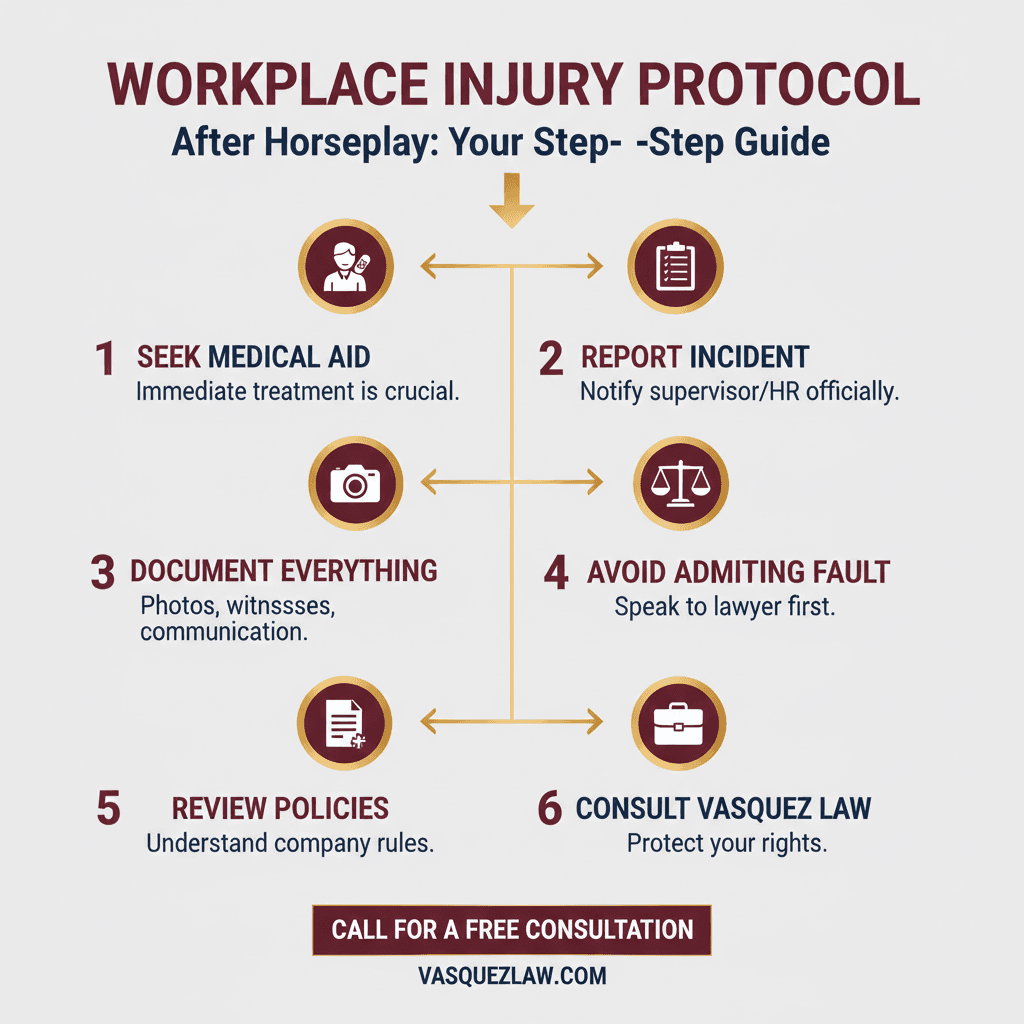
Steps to Take After a Horseplay-Related Injury in North Carolina
If you've been injured at work, especially in an incident involving workers' compensation horseplay, knowing the correct steps to take immediately can significantly impact your claim's success. North Carolina law has specific requirements for reporting workplace injuries, and failing to follow them can jeopardize your ability to receive benefits. Acting promptly and methodically is crucial.
- Report the Injury Immediately: Notify your employer or supervisor of the injury as soon as possible, preferably in writing. North Carolina law generally requires notification within 30 days. Be clear about how and when the injury occurred, including any details about horseplay.
- Seek Medical Attention: Even if the injury seems minor, get it checked by a doctor. Make sure to inform the medical professional that your injury is work-related and explain the circumstances fully. Follow all recommended treatments and keep detailed records of all medical visits, diagnoses, and treatments.
- Document Everything: Keep a personal log of the incident, including dates, times, names of witnesses, and what was said. Take photos of the injury and the scene if possible. Document any communication with your employer, HR, or the insurance company.
- Do Not Admit Fault or Minimize Injury: Be truthful about what happened, but avoid admitting fault for the horseplay. Do not downplay your symptoms or suggest that your injury is not serious. These statements can be used against you later.
- Consult with a Workers' Compensation Attorney: Given the complexities of workers' compensation horseplay claims, it is highly advisable to speak with an experienced North Carolina workers' compensation lawyer. An attorney can help you understand your rights, navigate the reporting process, gather necessary evidence, and represent you if your claim is disputed or denied.
Common Mistakes and How to Avoid Them in Horseplay Claims
Navigating a workers' compensation claim, especially one involving workers' compensation horseplay, is fraught with potential pitfalls. Making certain mistakes can severely weaken your claim or even lead to its denial. Being aware of these common errors and actively working to avoid them is paramount for protecting your rights and securing the benefits you deserve.
- Failing to Report the Injury Promptly: Delaying notification to your employer can raise doubts about the injury's legitimacy or its connection to the workplace. Report the injury to your supervisor or HR department in writing as soon as possible, ideally within 24-48 hours, but no later than 30 days as required by North Carolina law (N.C. Gen. Stat. § 97-22).
- Not Seeking Immediate Medical Attention: Gaps between the injury and your first medical visit can be used by the insurance company to argue that your injury wasn't severe or wasn't caused by the workplace incident. See a doctor promptly and follow all their recommendations.
- Minimizing the Incident or Your Injuries: Avoid telling co-workers or supervisors that you're "fine" or that it was "just a little horseplay." Be honest about your pain and symptoms. Downplaying the situation can undermine your claim later on.
- Admitting Fault for the Horseplay: While honesty is important, do not take full blame for the horseplay. Focus on the facts of what happened, not on assigning fault. Let the investigation determine liability.
- Not Documenting Everything: Failing to keep records of medical appointments, communications with your employer, and witness statements can leave you without crucial evidence. Maintain a detailed log.
- Speaking to the Insurance Adjuster Without Legal Counsel: Insurance adjusters represent the insurance company's interests, not yours. They may try to get you to make statements that could harm your claim. It's best to have an attorney communicate with them on your behalf.
- Returning to Work Against Medical Advice: If your doctor has placed you on light duty or restricted your work, follow those instructions. Returning to full duty too soon can aggravate your injury and complicate your claim.
- Not Consulting a Workers' Compensation Attorney: Horseplay claims are complex. Attempting to handle it alone against experienced insurance adjusters and defense lawyers is a common mistake. An attorney can protect your rights and maximize your chances of success.
If you only remember one thing: Report your injury immediately and seek legal counsel promptly. These two actions are the most critical steps to protect your workers' compensation horseplay claim.
North Carolina Workers' Compensation Laws and Horseplay
In North Carolina, the Workers' Compensation Act governs how workplace injuries are handled. For an injury to be compensable, it must arise "out of and in the course of employment." This two-part test is central to any claim, especially those involving workers' compensation horseplay. The "out of employment" requirement means there must be a causal connection between the employment and the injury, while "in the course of employment" refers to the time, place, and circumstances of the injury.
NC Specific Interpretations of the Horseplay Rule
The North Carolina Industrial Commission (NCIC) and state courts have developed specific interpretations regarding horseplay. Generally, if an employee is injured while engaged in horseplay, they may be denied benefits if they were the instigator or a willing participant. However, North Carolina recognizes exceptions, such as the "innocent victim" rule, where a non-participating employee injured by others' horseplay may still receive benefits. Furthermore, if horseplay has become a known and tolerated part of the workplace culture, the employer's implicit consent can sometimes lead to compensability. This is why the specifics of your workplace environment, including any employer policies or lack thereof, are so vital. For more detailed information on NC laws, visit the NC Industrial Commission website.
Distinguishing Horseplay from Work-Related Activities
A key challenge in these cases is distinguishing whether the activity that led to the injury was truly horseplay or a momentary, minor deviation from work that still falls within the scope of employment. North Carolina courts often look at the extent of the deviation, its nature, and its relationship to the employment. A brief, thoughtless act might be treated differently than a prolonged, intentional abandonment of duties. This distinction is often subtle and requires a thorough understanding of case law and the specific facts. Attorney Vasquez has over 15 years of experience handling these nuanced cases across North Carolina, including in Orlando and statewide, ensuring clients receive comprehensive representation.
Don't face your legal challenges alone. Our team is here to help you every step of the way.
Call today: 1-844-967-3536 | Se Habla Español
When to Call a Lawyer Now for Horseplay Injuries
Dealing with a workers' compensation claim, especially one involving workers' compensation horseplay, can be overwhelming. The insurance company and your employer may try to minimize your injury or deny your claim based on the circumstances. Knowing when to seek legal counsel from Vasquez Law Firm is crucial to protect your rights and ensure you receive fair compensation.
- Your Claim Was Denied: If your workers' compensation claim has been denied, particularly with horseplay cited as the reason, you need legal help immediately to appeal the decision.
- You Are Unsure About Reporting: If you're hesitant to report the injury due to the horseplay aspect, an attorney can advise you on the best way to proceed without jeopardizing your claim.
- The Insurance Company is Questioning Your Story: If adjusters are expressing skepticism or trying to get you to admit fault, it's a sign they're building a case against you. Stop communicating with them and contact a lawyer.
- You Feel Pressured by Your Employer: If your employer is pressuring you to not file a claim, return to work before you're ready, or change your story, legal intervention is necessary.
- You Have Serious Injuries: For significant injuries requiring extensive medical treatment or resulting in long-term disability, the stakes are high, and professional legal representation is invaluable.
- You Are Offered a Settlement: Never accept a settlement offer without having an attorney review it. You could be giving up valuable rights and future benefits.
- You Were an Innocent Bystander: If you were injured by others' horseplay but were not participating, an attorney can help you prove your status as an innocent victim and secure benefits.
- You Believe Horseplay Was Tolerated: If horseplay was a common and known occurrence in your workplace, an attorney can help establish that the employer implicitly condoned the activity.
About Vasquez Law Firm
At Vasquez Law Firm, we combine compassion with aggressive representation. Our motto "Yo Peleo" (I Fight) reflects our commitment to standing up for your rights. We understand the physical, emotional, and financial toll a workplace injury can take, especially when navigating complex issues like workers' compensation horseplay. Our dedicated legal team is here to provide personalized attention and strategic advocacy.
- Bilingual Support: Se Habla Español - our team is fully bilingual, ensuring clear communication and understanding for all our clients.
- Service Areas: We proudly serve clients throughout North Carolina, including Orlando, and offer nationwide immigration services. Our focus for workers' compensation is exclusively within North Carolina.
- Experience: With over 15 years helping clients navigate complex legal matters, Attorney Vasquez brings a wealth of knowledge and a proven track record to every case.
- Results: We have secured thousands of successful outcomes across multiple practice areas, demonstrating our commitment to achieving the best possible results for those we represent.
Attorney Trust and Experience
Attorney Vasquez holds a Juris Doctor degree and is admitted to practice in both the North Carolina State Bar and Florida Bar. With over 15 years of dedicated legal experience, he has built a reputation for providing personalized attention and achieving favorable outcomes for his clients. His deep understanding of North Carolina workers' compensation law, including the intricacies of the "horseplay rule," ensures that your case is handled with the expertise it deserves. Learn more about Attorney Vasquez and his commitment to justice.
Frequently Asked Questions About Workers' Compensation Horseplay
Is horseplay considered an OSHA recordable?
OSHA requires recording injuries and illnesses that are work-related, new cases, and meet certain severity criteria. While horseplay itself isn't directly recordable, any resulting injury that meets OSHA's recordability criteria and occurs in the work environment generally must be recorded. The question of whether the injury is compensable for workers' compensation is separate from OSHA's record-keeping rules. Always consult OSHA guidelines for specific recordability criteria as of 2026.
What is the horseplay rule in North Carolina workers' compensation?
In North Carolina, the "horseplay rule" dictates that an injury sustained during horseplay is typically not compensable if the injured employee was the instigator or a willing participant. However, exceptions exist, such as when the employer tolerated regular horseplay, or if the injured party was an unwilling victim. The NC Industrial Commission evaluates each case based on the specific facts, including the employer's knowledge and the degree of deviation from work duties. This rule is often a point of complex legal argument.
Will workers' compensation always cover an injury resulting from horseplay?
False. Workers' compensation does not always cover injuries resulting from horseplay. Coverage largely depends on the specifics of the incident and the relevant state's laws. In North Carolina, if you initiated the horseplay or were a willing participant, your claim might be denied. However, if you were an innocent victim or if the horseplay was a regular, tolerated part of the workplace, your claim might still be compensable. It is critical to consult an attorney to assess your specific situation.
What should I not say to a workers' comp doctor regarding horseplay?
When speaking to a workers' comp doctor, focus on accurately describing your injury and symptoms. Avoid admitting fault for the horseplay or minimizing the severity of your pain. Do not speculate about the cause beyond the facts. Stick to how you feel and what hurts. The doctor's role is to assess your medical condition, not to determine liability for the incident. Any statements minimizing your injury or admitting fault could negatively impact your claim's approval. Be truthful, but cautious.
Can I still get workers' compensation if I was a victim of horseplay, not a participant?
Yes, if you were an innocent victim of horseplay and not a willing participant, you generally have a stronger chance of receiving workers' compensation benefits in North Carolina. The law often distinguishes between those who instigate or actively join in horseplay and those who are simply injured by others' actions while performing their duties or being present in the workplace. Proving your status as an innocent victim is crucial and often requires legal assistance to present a compelling case.
Does an employer's tolerance of horseplay impact a workers' comp claim?
Absolutely. If an employer was aware of ongoing horseplay in the workplace and did not take reasonable steps to stop it, their tolerance can significantly strengthen a workers' compensation claim for an injury resulting from that horseplay. This is because the employer's inaction can be interpreted as implicitly condoning the activity, making it a de facto condition of employment. Documenting instances of tolerated horseplay and reporting them is vital for your claim.
What evidence is important for a workers' compensation horseplay claim?
Key evidence for a workers' compensation horseplay claim includes immediate incident reports, witness statements, medical records detailing your injury, and any documentation of the workplace environment, such as safety policies or records of prior horseplay incidents. Photos or videos of the incident location or your injuries can also be valuable. An attorney can help you gather and present this evidence effectively to support your claim and counter any arguments from the insurance company.
How long do I have to file a workers' compensation claim in NC after a horseplay injury?
In North Carolina, you typically have two years from the date of the injury to file a formal claim with the North Carolina Industrial Commission (N.C. Gen. Stat. § 97-24). However, you must first report the injury to your employer within 30 days. It is always best to report and file your claim as soon as possible to avoid any statutory limitations or challenges regarding the timeliness of your claim. Delays can complicate your case significantly.
Can I be fired for an injury sustained during horseplay at work?
North Carolina is an at-will employment state, meaning employers can generally terminate employees for any non-discriminatory reason. However, it is illegal to fire an employee in retaliation for filing a workers' compensation claim. If your injury was due to horseplay and you file a claim, and then are fired, it could potentially be considered wrongful termination if it was retaliatory. This is a complex area, and immediate legal advice is recommended if you believe you were unjustly terminated. Understanding employer choices can be helpful.
What if my employer denies my horseplay workers' compensation claim?
If your employer or their insurance company denies your workers' compensation horseplay claim, you have the right to appeal the decision. This typically involves requesting a hearing with the North Carolina Industrial Commission. An attorney can represent you throughout the appeals process, gather additional evidence, interview witnesses, and present your case to an administrative law judge. Do not give up if your claim is initially denied; legal assistance can significantly improve your chances of overturning the denial.
Sources and References
- North Carolina Industrial Commission (NCIC)
- Legal Information Institute, Cornell Law School - Workers' Compensation
- Occupational Safety and Health Administration (OSHA) - Recordkeeping
Ready to take the next step? Contact Vasquez Law Firm today for a free, confidential consultation. We're committed to fighting for your rights and achieving the best possible outcome for your workers' compensation horseplay case.
Start Your Free Consultation Now
Call us: 1-844-967-3536
Se Habla Español - Estamos aquí para ayudarle.


William Vasquez
Founder & CEO, Vasquez Law Firm, PLLC
William Vasquez is the founder and CEO of Vasquez Law Firm, PLLC, a results-driven firm specializing in immigration, criminal defense, personal injury, and workers' compensation. A U.S. Air Force veteran and recipient of the Joint Service Achievement Medal, William is dedicated to fiercely fighting for his clients' rights.
Related Legal Services
Need legal help? Learn more about our workers comp law practice, or contact us for a free evaluation.
You can also visit North Carolina workers compensation lawyers for more information.