How NC Courts Decide Spousal Support in a Divorce
Understanding spousal support in North Carolina is complex. Get a complete guide for 2026 and learn your rights. Contact Vasquez Law Firm for a free consultation.
Published on February 27, 2026
Have questions? Talk to an attorney - free evaluation.
Call 1-844-967-3536How NC Courts Decide Spousal Support in a Divorce
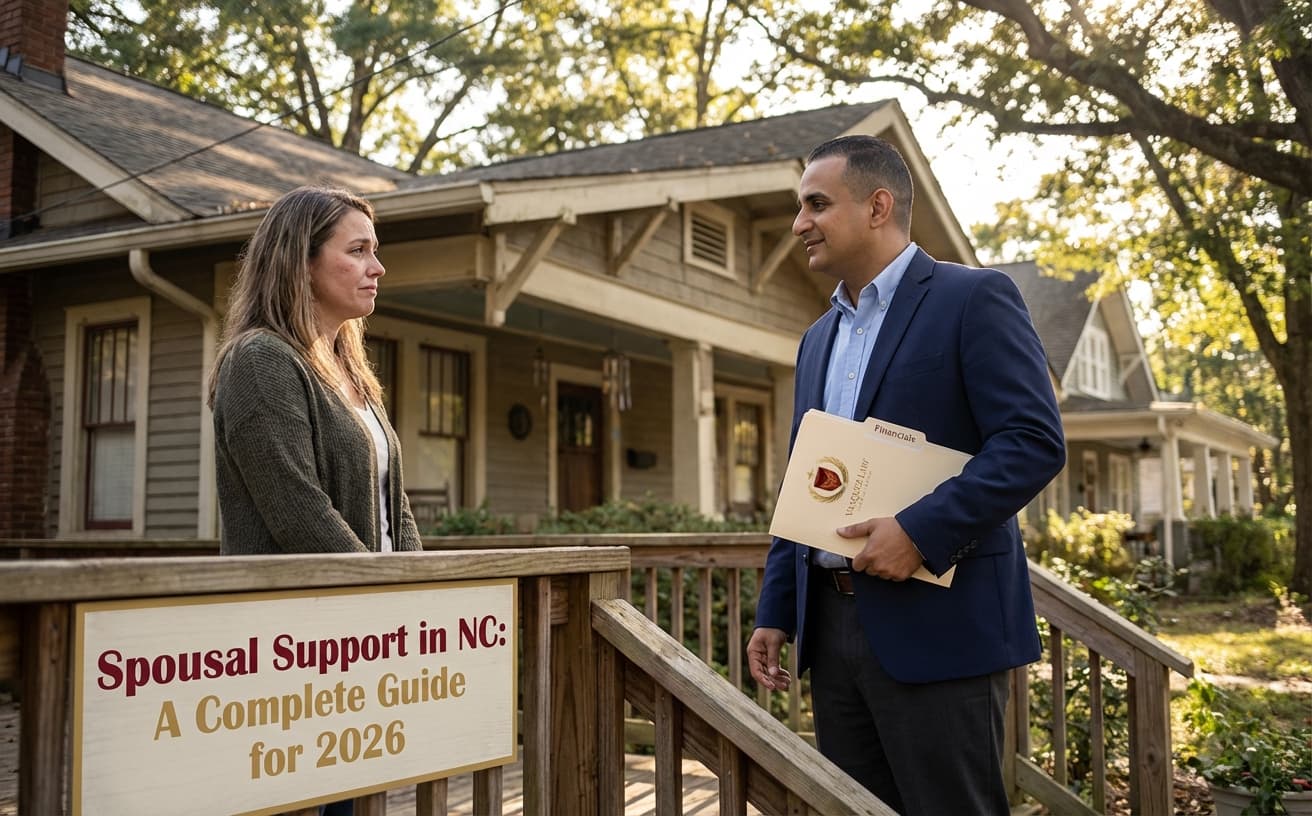
Navigating the complexities of spousal support in North Carolina can be overwhelming, especially during an already challenging time like separation or divorce. Spousal support, often referred to as alimony, is a payment made by one spouse to the other after separation or divorce. The purpose of spousal support is to provide financial assistance to a dependent spouse, helping them maintain a standard of living similar to what they enjoyed during the marriage. This comprehensive guide for 2026 will help you understand the factors involved, the legal process in North Carolina, and how to protect your financial future. Whether you are seeking support or may be ordered to pay it, knowing your rights and obligations is crucial.
Need help with your spousal support case? Our experienced attorneys are ready to fight for you. Se Habla Español.
Schedule Your Free Consultation
Or call us now: 1-844-967-3536
Quick Answer
In North Carolina, spousal support, or alimony, is determined by a judge based on specific factors outlined in N.C. Gen. Stat. § 50-16.3A. The court assesses whether one spouse is a "dependent spouse" and the other an "supporting spouse." Key considerations include the income and expenses of each party, their accustomed standard of living, duration of the marriage, and contributions to the marriage.
- Spousal support is not automatic and must be requested.
- Adultery by the dependent spouse can bar support, while adultery by the supporting spouse can compel it.
- The amount and duration of support are highly individualized.
- Mediation is often required before a court hearing.
Understanding Spousal Support in North Carolina
Spousal support in North Carolina is a complex area of family law designed to address financial imbalances that may arise after a marriage ends. Unlike child support, there is no fixed formula or calculator for spousal support. Instead, judges in Raleigh and across North Carolina have significant discretion to determine if support is appropriate, how much it should be, and for how long it should last. This makes every spousal support case unique, emphasizing the need for experienced legal guidance.
The primary goal of spousal support is to prevent a dependent spouse from suffering undue economic hardship following a divorce. This doesn't necessarily mean equalizing incomes, but rather ensuring the dependent spouse can meet their reasonable needs and maintain a lifestyle that is not drastically inferior to the marital standard. The court must first identify who is the "dependent spouse" and who is the "supporting spouse." A dependent spouse is one who is actually substantially dependent on the other spouse for maintenance and support, or is substantially in need of maintenance and support from the other spouse.
Several factors play a crucial role in the court's decision-making process for spousal support. These include the income, earning capacity, and financial obligations of both parties, as well as the length of the marriage. The court will also consider the age and physical and mental health of both spouses, their education, and the extent to which one spouse contributed to the other's education or career. It is important to remember that fault, such as marital misconduct, can also significantly impact a spousal support award in North Carolina.
For more information on general family law matters, you can explore our family law services. Understanding these foundational principles is essential before you even begin the process of seeking or defending against a spousal support claim.
Key Factors Determining Spousal Support in NC
North Carolina General Statute § 50-16.3A outlines 16 specific factors a judge must consider when determining the amount, duration, and method of payment for spousal support. These factors are not exhaustive, and the court can consider any other factor it deems relevant to achieve a just outcome. It's not about one factor outweighing another; rather, it's about a holistic assessment of the marital circumstances. Understanding these factors is critical for anyone involved in a spousal support dispute.
Some of the most significant factors include:
- Marital Misconduct: This is a powerful factor in North Carolina. If the dependent spouse engaged in illicit sexual behavior (adultery) before or on the date of separation, they are barred from receiving spousal support. Conversely, if the supporting spouse engaged in such behavior, the court must order spousal support. If both engaged in it, the court has discretion.
- Relative Earning Capacities: The court will examine each spouse's present and future ability to earn income, considering education, training, and employment opportunities.
- Ages and Physical/Mental Health: The age and health of each spouse can impact their ability to work and their financial needs.
- Sources of Income: This includes not only salaries but also dividends, pensions, and other benefits.
- Duration of the Marriage: Generally, longer marriages may result in longer periods of spousal support.
- Standard of Living: The court aims to ensure the dependent spouse can maintain the standard of living enjoyed during the marriage, to the extent possible.
- Contributions to Education/Career: If one spouse sacrificed their career or education to support the other's advancement, this is a significant consideration.
- Financial Needs and Obligations: The court examines the reasonable needs of both spouses and their financial responsibilities.
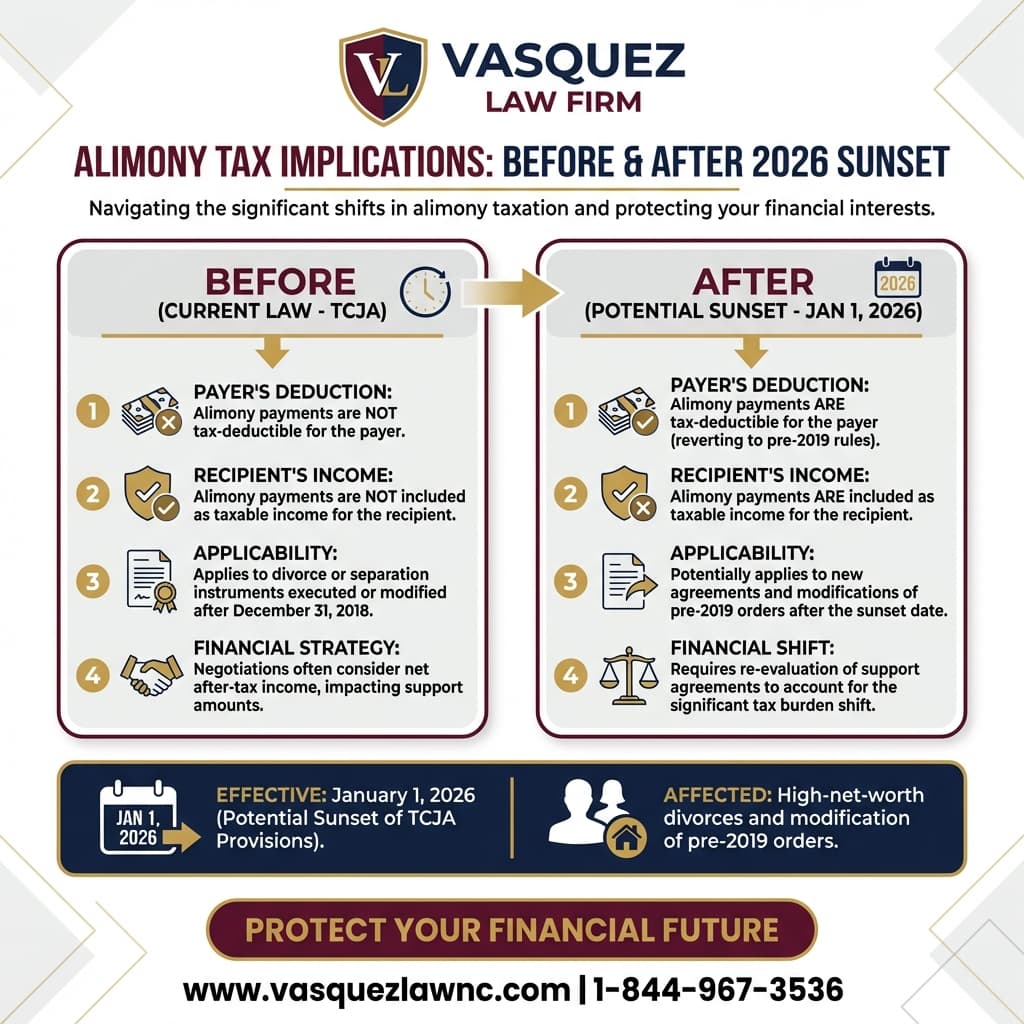
It's important to note that the court may also consider the tax implications of spousal support payments, which changed significantly after the 2017 Tax Cuts and Jobs Act. As of 2026, spousal support payments are generally no longer tax-deductible for the payer nor taxable income for the recipient under federal law for divorce agreements executed after December 31, 2018. However, North Carolina state tax laws may differ, so professional tax advice is always recommended.
Marital Misconduct and Spousal Support
The role of marital misconduct in North Carolina spousal support cases cannot be overstated. Unlike many other states, NC law explicitly mandates how illicit sexual behavior affects alimony. If the dependent spouse committed adultery, they are legally barred from receiving spousal support. This is a strict rule with very few exceptions. However, if the supporting spouse engaged in adultery, the court is obligated to award spousal support to the dependent spouse. This specific statutory provision makes it crucial to understand the details of marital conduct leading up to separation. For an in-depth look at related topics, consider reading our article on alienation of affections, which is another area where marital misconduct plays a significant role in NC family law.
The Spousal Support Process in NC: What to Expect
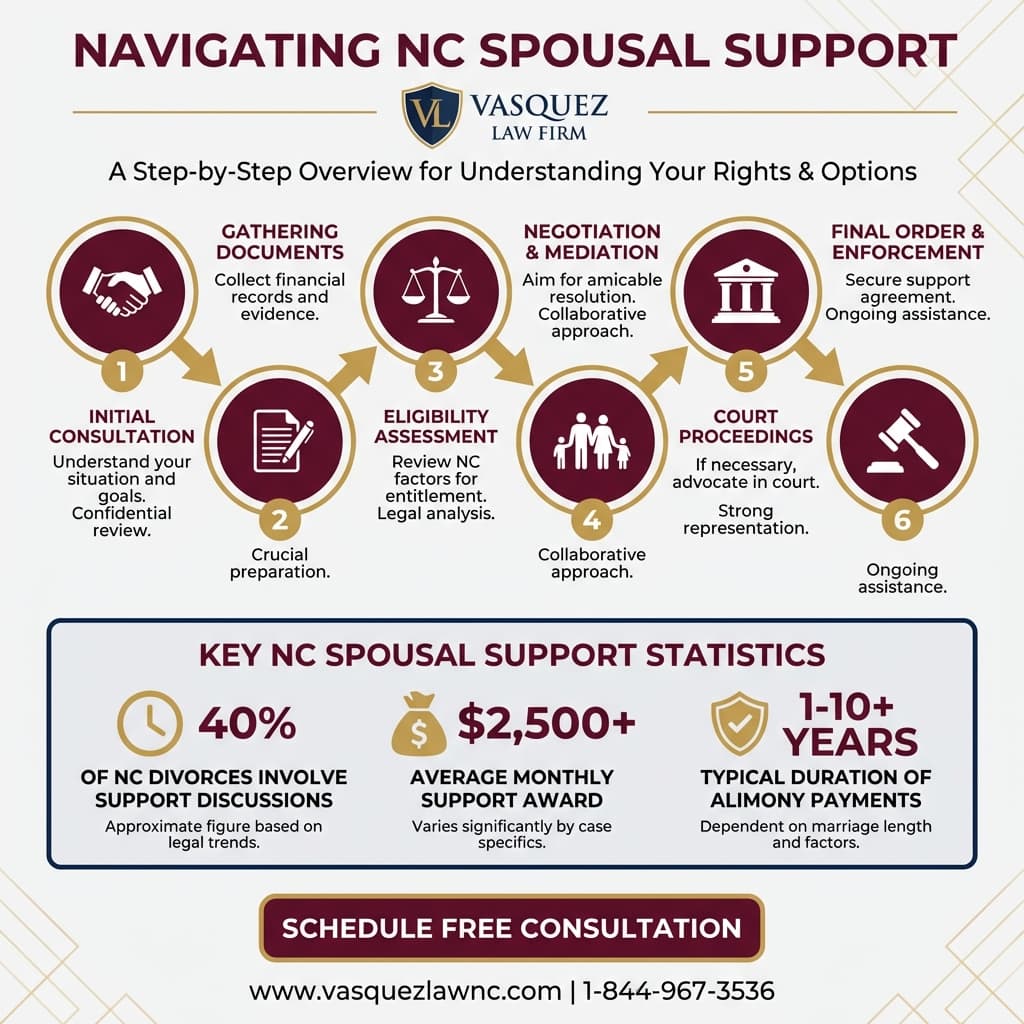
The process of obtaining or defending against a spousal support order in North Carolina typically begins with the filing of a complaint for divorce or a separate action for post-separation support and alimony. It is not an automatic process; one spouse must actively request it from the court. Understanding each step can help manage expectations and prepare effectively for legal proceedings in Raleigh or elsewhere in the state.
- Filing the Complaint: One spouse files a complaint with the court, requesting post-separation support (temporary) and/or alimony (long-term). This complaint must clearly state the grounds for support and demonstrate that one party is a dependent spouse and the other is a supporting spouse.
- Discovery: Both parties will exchange financial information, including income statements, tax returns, bank records, and expense lists. This phase is critical for the court to accurately assess each spouse's financial situation.
- Mediation: In most North Carolina counties, including Wake County (where Raleigh is located), mediation is a mandatory step before a final court hearing. A neutral third-party mediator helps spouses try to reach a mutually agreeable settlement for spousal support and other divorce-related issues.
- Temporary Orders (Post-Separation Support): If spouses cannot agree, a judge may issue a temporary order for post-separation support. This is designed to provide financial relief to the dependent spouse while the divorce case is pending. These orders are usually issued after a hearing where the judge reviews preliminary financial information.
- Trial and Final Order (Alimony): If mediation fails and no agreement is reached, the case proceeds to trial. A judge will hear evidence, consider all 16 statutory factors, and issue a final order for alimony, specifying the amount, duration, and payment method.
- Enforcement and Modification: Once a spousal support order is in place, it is legally binding. If a supporting spouse fails to pay, the dependent spouse can seek enforcement through the court. Similarly, if there is a substantial change in circumstances (e.g., job loss, remarriage), either party may petition the court for a modification of the order.
This process can be lengthy and emotionally taxing. Having a dedicated family law attorney from Vasquez Law Firm can make a significant difference in navigating these steps, advocating for your best interests, and ensuring all legal requirements are met. We also have experience with complex marital funds distribution, which often goes hand-in-hand with spousal support cases.
Spousal Support Calculator Myths
One common misconception is the existence of a "spousal support calculator" for North Carolina. Unlike child support, which uses a specific guideline formula, spousal support in NC is not determined by a calculator. The court's discretion, based on the 16 statutory factors, means that every case is unique. While some online tools may offer estimations, these are not legally binding and cannot predict a court's decision. Relying on such calculators can lead to unrealistic expectations and hinder effective negotiation. Always consult with a legal professional to understand your specific situation regarding spousal support.
Don't face your legal challenges alone. Our team is here to help you every step of the way.
Call today: 1-844-967-3536 | Se Habla Español
Duration and Modification of Spousal Support
The duration of spousal support in North Carolina is not fixed and varies greatly depending on the circumstances of the marriage and the financial needs of the dependent spouse. Unlike some states that set statutory limits, NC law allows judges considerable flexibility. Support can be awarded for a specific period, or indefinitely, though indefinite awards are less common and typically reserved for long-term marriages where one spouse has limited earning capacity due to age, health, or other factors. The court considers the same 16 factors when determining duration as it does for the amount.
Spousal support orders are not necessarily set in stone forever. They can be modified or terminated under certain conditions. A significant change in circumstances for either the dependent or supporting spouse can trigger a review by the court. Common reasons for modification or termination include:
- Remarriage of the Dependent Spouse: In North Carolina, spousal support automatically terminates upon the dependent spouse's remarriage.
- Cohabitation: If the dependent spouse cohabits with another person in a romantic relationship, spousal support may be terminated. Cohabitation is defined by statute and requires a detailed factual analysis.
- Death of Either Spouse: Spousal support obligations generally cease upon the death of either the supporting or dependent spouse.
- Substantial Change in Income: A significant increase in the dependent spouse's income or a substantial decrease in the supporting spouse's income (e.g., job loss, disability) could warrant a modification.
- Retirement: While retirement alone isn't always a basis for modification, if it's a bona fide retirement at a reasonable age, it may be considered a substantial change in circumstances.
It is crucial to understand that any modification to a spousal support order must be approved by the court. You cannot simply stop paying or reduce payments without a court order, as this could lead to serious legal consequences, including being held in contempt of court. If you believe your circumstances warrant a change in spousal support, it is vital to consult with a family law attorney promptly. For general information on divorce law changes, you may find our article on divorce law changes in 2026 helpful.
Common Mistakes in Spousal Support Cases and How to Avoid Them
Spousal support cases are fraught with potential pitfalls that can significantly impact the outcome. Avoiding these common mistakes requires careful planning, thorough documentation, and experienced legal representation. Being aware of these errors can save you time, money, and emotional distress.
- Failing to Request Spousal Support: Support is not automatic. If you are a dependent spouse, you must specifically request post-separation support and/or alimony in your divorce complaint or a separate action. Missing this step can permanently waive your right to support.
- Hiding Assets or Income: Attempting to conceal financial resources will almost always backfire. Courts have broad powers to compel disclosure, and dishonesty can result in severe penalties, including sanctions or an unfavorable ruling.
- Not Documenting Marital Misconduct: If marital misconduct is a factor, gather concrete evidence. Hearsay or unsubstantiated accusations are rarely enough. Keep records, messages, and witness statements if available and legally obtained.
- Failing to Understand Your Financials: Both parties must have a clear and accurate picture of their income, expenses, assets, and debts. Underestimating your needs or overstating your ability to pay can weaken your case.
- Making Verbal Agreements: Never rely on verbal agreements for spousal support. All agreements must be in writing, signed by both parties, and ideally incorporated into a court order to be legally enforceable.
- Delaying Legal Action: There are statutes of limitations for certain family law actions. Delaying can result in losing rights or making your case more difficult to prove due to lost evidence or fading memories.
- Representing Yourself: Spousal support law is highly complex. Attempting to navigate it without legal counsel often leads to missed deadlines, improper filings, and unfavorable outcomes.
If you only remember one thing: Always seek legal counsel from an experienced family law attorney when dealing with spousal support. The nuances of North Carolina law and the discretion of the courts make professional guidance indispensable.
When to Call a Lawyer Now About Spousal Support
The decision to seek legal counsel is critical in spousal support matters. Certain situations warrant immediate attention from an experienced family law attorney to protect your rights and ensure the best possible outcome. Delaying can have significant and irreversible consequences.
- You are considering separation or divorce: It's best to understand your potential rights and obligations regarding spousal support before you separate.
- Your spouse has filed for divorce: You need to respond appropriately and timely to protect your interests, especially if spousal support is requested.
- You believe you are a dependent spouse: If you are financially reliant on your spouse and anticipate a divorce, you need to understand your eligibility for support.
- You have been accused of marital misconduct: Allegations of adultery can drastically impact spousal support, making legal defense essential.
- Your financial situation has significantly changed: Whether you are paying or receiving support, a major change (job loss, disability, inheritance) may warrant a modification.
- Your spouse is failing to make court-ordered payments: You need legal assistance to enforce the order and collect overdue support.
- You suspect your spouse is hiding assets or income: An attorney can help uncover hidden financials through the discovery process.
- You've received a proposed spousal support agreement: Never sign anything without a lawyer reviewing it to ensure it's fair and protects your long-term interests.
Contact Vasquez Law Firm today for a confidential discussion about your spousal support concerns. Our team, led by Attorney Vasquez, is ready to provide the aggressive and compassionate representation you deserve. We serve clients throughout North Carolina, including Raleigh, and can help you navigate the complexities of family law.
About Vasquez Law Firm
At Vasquez Law Firm, we combine compassion with aggressive representation. Our motto "Yo Peleo" (I Fight) reflects our commitment to standing up for your rights. We understand that family law matters, including spousal support, are deeply personal and often emotionally charged. Our team is dedicated to providing personalized attention and unwavering advocacy for each client in North Carolina.
- Bilingual Support: Se Habla Español - our team is fully bilingual, ensuring clear communication and understanding for all our clients.
- Service Areas: We primarily serve clients in North Carolina for family law matters, including Raleigh, Wake County, and surrounding areas. Our immigration services extend nationwide.
- Experience: With over 15 years of dedicated legal experience, we have a proven track record of helping clients navigate complex legal matters and achieve favorable outcomes.
- Results: We pride ourselves on securing positive results for thousands of clients across multiple practice areas, from family law to immigration and personal injury.
Attorney Trust and Experience
Attorney Vasquez holds a Juris Doctor degree and is admitted to practice in the North Carolina State Bar. With over 15 years of dedicated legal experience, he has built a reputation for providing personalized attention and achieving favorable outcomes for his clients. His deep understanding of North Carolina family law, coupled with a compassionate approach, makes him a trusted advocate for those facing challenging legal situations. He is committed to fighting for your rights, embodying the "Yo Peleo" spirit in every case.
Ready to take the next step? Contact Vasquez Law Firm today for a free, confidential consultation. We're committed to fighting for your rights and achieving the best possible outcome for your case.
Start Your Free Consultation Now
Call us: 1-844-967-3536
Se Habla Español - Estamos aquí para ayudarle.
Frequently Asked Questions
Do I have to support my wife after divorce in North Carolina?
Not necessarily. In North Carolina, a spouse is only obligated to pay spousal support (alimony) if they are deemed the "supporting spouse" and the other is the "dependent spouse" by the court. The court considers many factors, including income, earning capacity, and marital misconduct. An order for support is not automatic and must be specifically requested and granted by a judge based on statutory guidelines.
What is the average monthly alimony payment in NC?
There is no specific "average" monthly alimony payment in North Carolina because there is no statutory formula or calculator for spousal support. Each case is decided individually based on 16 statutory factors, including the parties' incomes, expenses, standard of living, and duration of the marriage. Payments can range from a few hundred dollars to several thousand, depending entirely on the unique circumstances of the divorcing couple.
What makes a person have to pay spousal support in NC?
A person is ordered to pay spousal support in North Carolina if they are identified as the "supporting spouse" and the other party is the "dependent spouse." This determination is made by a judge after considering factors such as relative incomes, earning capacities, financial needs, and marital misconduct. If the supporting spouse engaged in illicit sexual behavior, the court must order support.
How long does spousal support last in North Carolina?
The duration of spousal support in North Carolina is decided by the court and is not fixed by statute. It can be for a specific, limited period or, in rarer cases, for an indefinite term, often until a specific event like remarriage or cohabitation occurs. The judge considers the same 16 statutory factors that determine the amount of support when deciding its duration. There is no standard length.
Can spousal support be modified in NC?
Yes, spousal support orders in North Carolina can be modified if there is a substantial change in circumstances impacting either the dependent or supporting spouse. Common reasons for modification include significant changes in income, job loss, disability, or the dependent spouse's cohabitation with a new partner. Any modification must be approved by the court, and you cannot unilaterally stop or change payments.
Does adultery affect spousal support in North Carolina?
Yes, adultery significantly impacts spousal support in North Carolina. If the dependent spouse engaged in adultery before or on the date of separation, they are legally barred from receiving support. Conversely, if the supporting spouse committed adultery, the court is legally required to award spousal support to the dependent spouse. If both engaged in adultery, the court has discretion.
What is the difference between post-separation support and alimony in NC?
Post-separation support (PSS) is temporary financial assistance awarded to a dependent spouse during the period between separation and the final divorce judgment. Alimony is the long-term, permanent financial support awarded after the divorce. PSS is designed to meet immediate needs, while alimony aims to help the dependent spouse maintain a reasonable standard of living post-divorce. Both are determined by similar factors.
Are spousal support payments taxable in 2026?
For divorce or separation agreements executed after December 31, 2018, spousal support payments are generally no longer tax-deductible for the payer nor taxable income for the recipient under federal law. However, North Carolina state tax laws may differ, and it's essential to consult with a tax professional or attorney to understand the specific tax implications for your situation as of 2026.
Can I get spousal support if I have a short marriage in NC?
While the duration of the marriage is one of the 16 factors a North Carolina court considers, a short marriage does not automatically preclude spousal support. The court will weigh all factors, including the relative incomes, earning capacities, and financial needs of both spouses. However, support awards in shorter marriages are typically for shorter durations and smaller amounts compared to long-term marriages.
What if my spouse refuses to pay court-ordered spousal support?
If your spouse refuses to pay court-ordered spousal support in North Carolina, you can file a motion with the court to enforce the order. The court can hold the non-paying spouse in contempt, which may result in penalties like fines, wage garnishment, seizure of assets, or even jail time until the payments are made. It's crucial to seek legal assistance to initiate enforcement proceedings.
Sources and References


William Vasquez
Founder & CEO, Vasquez Law Firm, PLLC
William Vasquez is the founder and CEO of Vasquez Law Firm, PLLC, a results-driven firm specializing in immigration, criminal defense, family law, personal injury, and workers' compensation. A U.S. Air Force veteran and recipient of the Joint Service Achievement Medal, William is dedicated to fiercely fighting for his clients' rights.