Know Your Rights Under Immigration Detention Policy in 2026
Understand the immigration detention policy in 2026, your rights, and how long ICE can hold you. Contact Vasquez Law Firm for a free consultation today.
Published on February 19, 2026
Talk to an immigration attorney
Free call. A clear plan for your case.
Free & confidential · Se habla espanol · 24/7

Have questions? Talk to an attorney - free evaluation.
Call 1-844-967-3536Worried how the latest immigration news affects you?
Schedule a confidential case review with an immigration attorney - know exactly where you stand.
Know Your Rights Under Immigration Detention Policy in 2026
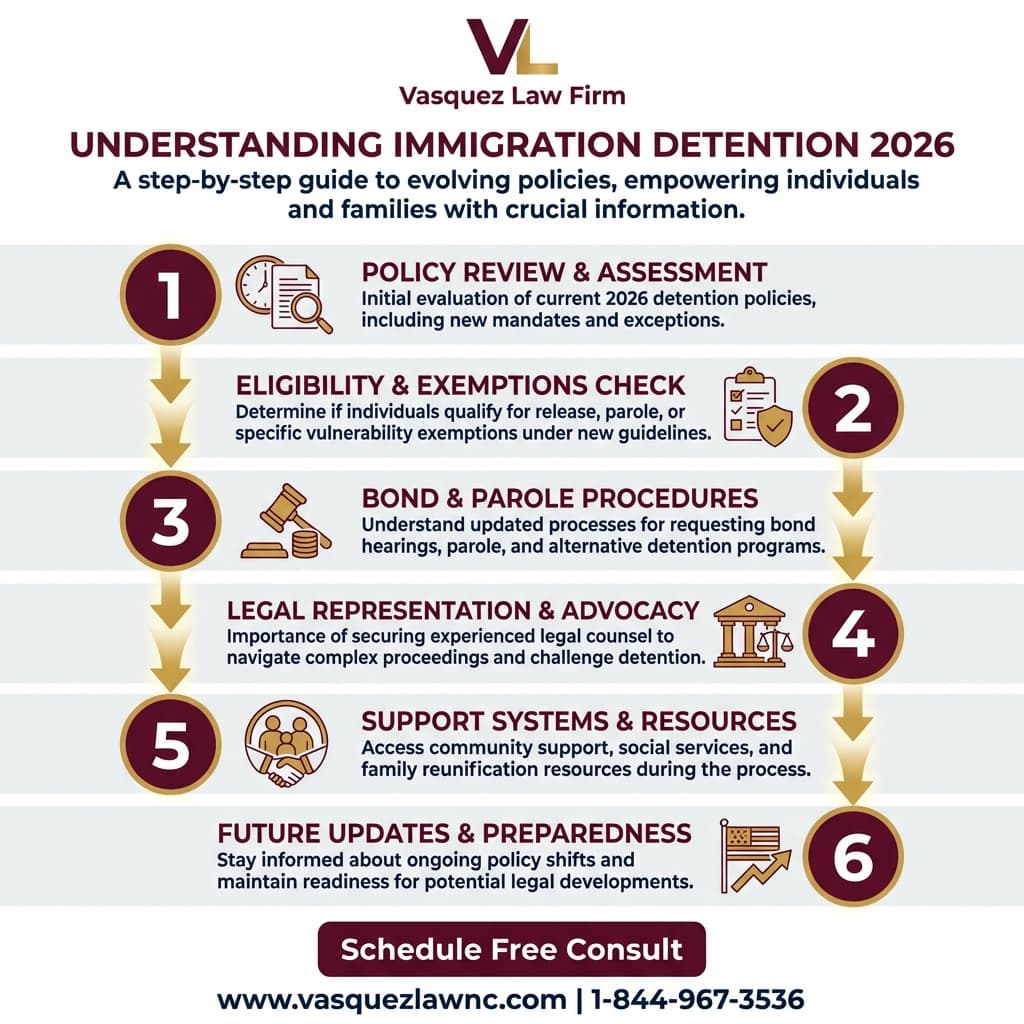
Navigating the complexities of immigration detention policy can be daunting, especially when a loved one is detained. Understanding the legal framework, your rights, and the typical procedures involved is crucial. As of 2026, immigration detention policies continue to evolve, impacting thousands of individuals and families across the United States, including those in North Carolina and Florida. This comprehensive guide will explain the key aspects of immigration detention, what to expect, and how to protect your rights.
Need help with your case? Our experienced attorneys are ready to fight for you. Se Habla Español.
Schedule Your Free Case Evaluation
Or call us now: 1-844-967-3536
Quick Answer
Immigration detention policy outlines the rules for holding non-citizens during immigration proceedings. In 2026, policies continue to emphasize enforcement, with mandatory detention for certain offenses. Detainees generally have rights to legal representation, communication, and a bond hearing, though these vary.
- Mandatory detention applies to specific criminal and immigration violations.
- The length of detention varies greatly, often depending on case complexity.
- Detainees have due process rights, including the right to a hearing.
- Access to legal counsel is critical for navigating the detention process.
- Bond hearings are possible for some, but not all, detained immigrants.
Understanding Immigration Detention Policy in 2026
Immigration detention policy refers to the set of laws, regulations, and guidelines that govern the apprehension and holding of non-citizens by U.S. immigration authorities, primarily Immigration and Customs Enforcement (ICE). These policies dictate who can be detained, for how long, and under what conditions. The legal framework is complex, drawing from the Immigration and Nationality Act (INA), federal regulations, and court decisions. In 2026, the overall policy direction continues to reflect a strong emphasis on border security and interior enforcement, leading to significant numbers of individuals being held in various detention facilities.
The primary purpose of immigration detention is to ensure that non-citizens appear for their immigration court hearings and to facilitate their removal from the U.S. if ordered. It also serves to protect public safety by detaining individuals deemed a flight risk or a danger to the community. The application of immigration detention policy can vary based on an individual's immigration history, criminal record, and the specific circumstances of their apprehension. Understanding these nuances is essential for anyone facing detention or assisting a detained family member.
Mandatory vs. Discretionary Detention
A critical distinction in immigration detention policy is between mandatory and discretionary detention. Mandatory detention applies to non-citizens who have committed certain criminal offenses, such as aggravated felonies or drug offenses, or those who are considered inadmissible or deportable on specific grounds. For these individuals, ICE generally has no discretion to release them, and an immigration judge cannot grant bond. This is codified in sections of the INA, such as 8 U.S.C. § 1226(c).
Discretionary detention, on the other hand, applies to non-citizens who do not fall under mandatory detention categories. For these individuals, an immigration judge or ICE may have the authority to release them on bond or on their own recognizance, provided they are not deemed a flight risk or a danger. The determination often involves considering factors like community ties, employment history, family responsibilities, and past court appearances. Navigating this distinction is a key aspect of challenging an immigration hold, and an experienced attorney can help determine if a bond hearing is possible.
How Long Can ICE Hold Someone? Understanding Detention Timelines
The question of "how long can ICE hold you before deportation" is one of the most common and critical concerns for detained immigrants and their families. Unfortunately, there is no single, simple answer, as the length of immigration detention can vary significantly based on individual circumstances, the complexity of the case, and current legal precedents. While some individuals may be detained for only a few days or weeks, others can remain in detention for months or even years, especially if their case involves appeals or complex legal issues.
For individuals subject to mandatory detention, they will typically remain in custody until their immigration proceedings are complete, including any appeals. This can be a lengthy process. For those in discretionary detention, the length often depends on the outcome of bond hearings or the resolution of their underlying immigration case. Recent court rulings, such as the 2020 Supreme Court decision in DHS v. Thuraissigiam, have impacted the scope of judicial review for certain detention cases, making it even more vital to have skilled legal representation to advocate for timely release.
Post-Order Detention and Expedited Removal
Even after an order of removal has been issued, an individual may remain in ICE custody. This "post-order detention" period is generally limited by statute, with ICE typically having 90 days to effectuate removal (8 U.S.C. § 1231(a)(1)(A)). If removal cannot be carried out within this 90-day period, the individual may be released under supervision, unless they are deemed a flight risk or a danger to the community. However, there are exceptions, particularly for individuals from countries that refuse to accept their nationals.
Another factor impacting detention timelines is expedited removal, a process that allows immigration officers to quickly remove certain non-citizens without a hearing before an immigration judge. This applies primarily to individuals apprehended at the border or ports of entry who are deemed inadmissible and cannot establish a credible fear of persecution. While intended to be swift, individuals subject to expedited removal can still be detained for periods while their initial claims are processed. USCIS provides detailed information on these procedures.
What Rights Do Immigrants Have During Detention?
Even while in immigration detention, non-citizens retain certain fundamental rights under U.S. law and the Constitution. Understanding these rights is paramount for anyone navigating the detention system. These rights are not always automatically afforded or easily exercised, which is why legal representation is so vital. Detained individuals have the right to communicate with family members, legal counsel, and consular officials. They also have the right to be informed of the charges against them and the opportunity to present their case in immigration court.
Key rights include the right to a bond hearing, if eligible, to seek release from custody. They also have the right to challenge their detention through various legal avenues, such as a petition for a writ of habeas corpus. Access to medical care, although often criticized for its quality, is also a right. However, the conditions of detention and access to resources can vary significantly between facilities, making it challenging for individuals to fully exercise these rights without legal assistance. Attorney Vasquez and his team are dedicated to ensuring these rights are upheld for clients in Smithfield, across North Carolina, and Florida.
Access to Legal Counsel
One of the most critical rights for a detained immigrant is the right to legal representation. While the U.S. government does not provide appointed counsel for immigration cases, as it does in criminal cases, individuals have the right to obtain legal representation at their own expense. A skilled immigration attorney can significantly impact the outcome of a detention case, from advocating for bond to challenging the grounds of detention or deportation. They can help gather evidence, prepare for hearings, and navigate the complex legal procedures.
Attorneys can communicate directly with ICE and the Executive Office for Immigration Review (EOIR), ensuring that all necessary paperwork is filed correctly and on time. This is especially important for those facing deportation, where a strong defense can be the difference between remaining in the U.S. and being removed. The support of an attorney is invaluable in ensuring that an individual's voice is heard and their rights are protected throughout the detention process.
Challenging Detention and Seeking Release
If you or a loved one is in immigration detention, there are several legal avenues to challenge the detention and seek release. The most common method is through a bond hearing before an immigration judge. During this hearing, the judge evaluates whether the individual is a flight risk or a danger to the community. The attorney presents arguments and evidence to demonstrate that the individual should be released on bond, highlighting factors such as strong community ties, employment, and family responsibilities. The judge then sets a bond amount or denies bond.
For those not eligible for a bond hearing, or if bond is denied, other options may exist. These include requesting a custody redetermination from ICE, or, in certain circumstances, filing a petition for a writ of habeas corpus in federal court. A habeas petition argues that the detention is unlawful and seeks a court order for release. These are complex legal maneuvers that require the expertise of an experienced immigration attorney. The Vasquez Law Firm has a proven track record of fighting for the release of detained immigrants.
Immigration Detainer and the 48-Hour Rule
The "immigration detainer 48 hour rule" often refers to the period state and local law enforcement agencies typically hold an individual for ICE after they would otherwise be released from local custody. An immigration detainer is a request from ICE to a law enforcement agency to maintain custody of a non-citizen for up to 48 hours (excluding weekends and holidays) after their release date, to allow ICE to take them into federal custody. This policy has been a subject of legal debate and varying local policies.
While ICE issues detainers, state and local agencies are not legally mandated to honor them. Many jurisdictions, including some in North Carolina and Florida, have adopted policies limiting their cooperation with ICE detainers, particularly if the detainer is not accompanied by a judicial warrant. Understanding the local policies regarding detainers is critical, as it can impact whether an individual is transferred to ICE custody or released. An attorney can help determine the implications of a detainer and advise on the best course of action.
Don't face your legal challenges alone. Our team is here to help you every step of the way.
Call today: 1-844-967-3536 | Se Habla Español
Common Mistakes and How to Avoid Them
Navigating immigration detention can be a stressful and confusing experience, leading individuals and their families to make common mistakes that can jeopardize their case. Awareness and proactive measures are key to avoiding these pitfalls. One significant mistake is failing to seek legal counsel promptly. The immigration system is highly complex, and delays in obtaining legal representation can result in missed deadlines, inadequate preparation, or lost opportunities for release. Early intervention by an attorney can make a substantial difference.
- Not understanding your rights: Many detained individuals are unaware of their rights to silence, legal counsel, or bond hearings. This can lead to self-incrimination or missed opportunities. Always assert your right to speak with an attorney before answering questions.
- Signing documents without understanding them: Do not sign any document presented by immigration officials unless you fully understand its contents and implications, preferably after consulting with an attorney. Some documents could waive crucial rights.
- Providing false information: Any false statements or documents provided to immigration authorities can have severe consequences, including charges of fraud and immediate deportation. Always be truthful and provide accurate information, guided by your attorney.
- Missing court dates or deadlines: Failing to appear for an immigration court hearing can result in an order of removal in absentia (in your absence), making it much harder to reopen your case. Keep track of all dates and deadlines.
- Not communicating with family/attorney: Isolation can make the detention experience worse. Make every effort to communicate with your family and attorney to ensure they are aware of your situation and can assist effectively.
- Failing to gather necessary documents: Supporting documents like birth certificates, marriage licenses, proof of residence, or criminal records are often crucial for your case. Start gathering these as soon as possible with legal guidance.
- Believing misinformation: There is a lot of misinformation regarding immigration law and detention policies. Rely only on trusted legal professionals for accurate advice.
If you only remember one thing: Always assert your right to speak with an attorney before making any statements or signing any documents, and contact legal counsel as soon as possible.
Immigration Detention Policy: NC, FL, and Nationwide Notes
Immigration detention policy is primarily federal, meaning the core laws and regulations originate from the U.S. government and apply nationwide. Agencies like ICE and the Executive Office for Immigration Review (EOIR) operate under these federal mandates. However, the practical application and local impact of these policies can vary significantly from state to state and even county to county, particularly concerning cooperation between federal immigration authorities and local law enforcement. This variation affects individuals in North Carolina, Florida, and across the nation.
North Carolina Notes
In North Carolina, the implementation of immigration detention policy often involves complex interactions between ICE and local sheriffs' offices. While some counties in North Carolina may have 287(g) agreements (allowing local law enforcement to perform certain immigration enforcement functions, as seen in other states), others may have policies limiting their cooperation with ICE detainers. For instance, the city of Smithfield, like many communities, is impacted by these statewide and local decisions. Understanding these local nuances is crucial for individuals detained in North Carolina. Our firm, serving clients in Smithfield and throughout NC, is well-versed in these local operational differences.
Florida Notes
Florida has historically had a more robust stance on cooperating with federal immigration enforcement. While there are ongoing legal and policy debates, many local jurisdictions in Florida actively work with ICE, including honoring detainers. This means that individuals arrested for state crimes in Florida may have a higher likelihood of being transferred to ICE custody upon release, even for minor offenses. The Vasquez Law Firm assists clients throughout Florida, helping them navigate these often challenging local detention landscapes and advocating for their rights.
Nationwide Concepts (General Only, Rules Vary)
Across the nation, the overarching immigration detention policy is set by federal law and executive actions. However, the exact experience of detention can vary greatly depending on the specific facility, the immigration court jurisdiction, and local political climates. For example, the number of beds available for detention, the speed of court proceedings, and the availability of legal aid resources can differ significantly by region. It is essential to remember that while federal law provides a baseline, local practices and court interpretations can create distinct challenges and opportunities for detained individuals across the U.S. This is why specialized legal counsel for immigration law is so critical.
When to Call a Lawyer Now for Immigration Detention Policy Issues
The moment you or a loved one faces immigration detention, time becomes a critical factor. Delaying legal consultation can severely impact the outcome of a case. You should call an experienced immigration lawyer immediately if any of the following situations arise, particularly concerning immigration detention policy:
- You or a family member has been arrested by ICE or local law enforcement and is facing immigration detention.
- An immigration detainer has been issued against you, and you are currently in local custody.
- You have received a Notice to Appear (NTA) in immigration court while in detention.
- You believe you are eligible for bond but have been denied a bond hearing or had an excessively high bond set.
- You are concerned about the conditions of detention or access to necessary medical care.
- You have been ordered removed but believe you have grounds for an appeal or other relief (e.g., asylum appeal).
- You are a U.S. citizen or legal resident and your family member is detained.
- You have a credible fear of persecution or torture and need to assert your right to seek asylum.
- You are unsure about your legal options or the next steps in an immigration detention case.
About Vasquez Law Firm
At Vasquez Law Firm, we combine compassion with aggressive representation. Our motto "Yo Peleo" (I Fight) reflects our commitment to standing up for your rights. We understand the fear and uncertainty that comes with immigration detention, and we are dedicated to providing relentless advocacy for our clients in North Carolina, Florida, and nationwide.
- Bilingual Support: Se Habla Español - our team is fully bilingual, ensuring clear communication and understanding throughout your legal journey.
- Service Areas: We proudly serve clients facing immigration challenges in North Carolina, Florida, and offer nationwide immigration services.
- Experience: With over 15 years of dedicated experience, Attorney Vasquez has a deep understanding of complex immigration law and detention policies.
- Results: We have a strong track record of achieving favorable outcomes for thousands of clients across various practice areas, fighting tirelessly for justice.
Attorney Trust and Experience
Attorney Vasquez holds a Juris Doctor degree and is admitted to practice in both the North Carolina State Bar and Florida Bar. With over 15 years of dedicated legal experience, he has built a reputation for providing personalized attention and achieving favorable outcomes for his clients. His commitment to the immigrant community is unwavering, and he brings an urgent mindset to every case, fighting for the best possible resolution.
Don't face your legal challenges alone. Our team is here to help you every step of the way.
Call today: 1-844-967-3536 | Se Habla Español
Frequently Asked Questions
How long can someone be held in immigration detention?
The length of immigration detention varies greatly. It can range from a few days to several months or even years, depending on factors like the individual's immigration status, criminal history, the complexity of their case, and whether they are eligible for bond. There isn't a fixed maximum period for all detention cases, especially if an individual is deemed a flight risk or a danger to the community, or if their case is undergoing appeals. Legal counsel can help expedite the process.
What is the law of immigration detention?
The law governing immigration detention is primarily found in the Immigration and Nationality Act (INA), specifically sections 8 U.S.C. § 1225 and § 1226. These statutes outline who can be detained, for what reasons, and under what conditions. Federal regulations (Title 8 of the Code of Federal Regulations) and numerous court decisions further interpret and shape these laws. Policies are constantly evolving, requiring up-to-date legal knowledge to navigate effectively.
What rights do immigrants have during detention?
Detained immigrants retain several fundamental rights, including the right to due process, the right to communicate with family and legal counsel, and the right to a bond hearing (if eligible). They also have the right to challenge their detention and removal proceedings in immigration court. While these rights exist, accessing and exercising them can be challenging within the detention system, emphasizing the importance of legal representation.
Who is subject to mandatory detention in 2026?
As of 2026, individuals subject to mandatory detention typically include non-citizens convicted of certain criminal offenses, such as aggravated felonies, drug offenses, or certain crimes involving moral turpitude. Also, individuals deemed inadmissible or deportable on specific grounds, often related to security concerns or past immigration violations, may be subject to mandatory detention. An attorney can determine if your specific situation falls under these categories.
What is an immigration detainer and how does the 48-hour rule work?
An immigration detainer is a request from ICE to state or local law enforcement to hold a non-citizen for up to 48 hours (excluding weekends and holidays) after they would otherwise be released, to allow ICE to take them into federal custody. The "48-hour rule" refers to this requested holding period. However, state and local agencies are not legally required to honor these detainers, and many jurisdictions have policies limiting their cooperation, especially without a judicial warrant.
Can a detained immigrant get released on bond?
Yes, many detained immigrants can be released on bond, but not all. Eligibility for bond depends on whether the individual is subject to mandatory detention or discretionary detention. If an individual is not subject to mandatory detention, an immigration judge may grant bond after assessing factors like flight risk and danger to the community. An attorney can represent you in a bond hearing to argue for your release.
What is the purpose of immigration detention centers?
The purpose of immigration detention centers is to hold non-citizens while their immigration cases are pending, to ensure their appearance at hearings, and to facilitate their eventual removal from the U.S. if ordered. They also serve to detain individuals who are deemed a flight risk or a danger to public safety. These facilities are distinct from criminal jails, though some immigrants are held in local jails under contract with ICE.
What should I do if a family member is in ICE custody?
If a family member is in ICE custody, first try to locate them using the ICE Detainee Locator. Next, contact an experienced immigration attorney immediately. Do not attempt to represent them yourself or sign any documents without legal advice. An attorney can help understand the charges, explore options for release, and ensure their rights are protected during this critical time. Vasquez Law Firm can help.
Are there alternatives to immigration detention?
Yes, there are alternatives to immigration detention, primarily for individuals who are not considered flight risks or dangers to the community. These alternatives include release on bond, electronic monitoring, or participation in programs that require regular check-ins with ICE. The availability and suitability of alternatives depend on individual circumstances and ICE's discretion. An attorney can advocate for the least restrictive alternatives for their clients.
How does immigration detention policy affect asylum seekers?
Immigration detention policy significantly impacts asylum seekers. Those who express a credible fear of persecution or torture upon apprehension are often detained while their fear claim is evaluated. If a credible fear is established, they may be released on parole or bond, though this is not guaranteed. Asylum seekers often face prolonged detention, and policies surrounding their release are subject to frequent changes, making legal assistance crucial for navigating these complex processes.
Sources and References
- U.S. Citizenship and Immigration Services (USCIS)
- Executive Office for Immigration Review (EOIR)
- 8 U.S. Code § 1226 - Apprehension and detention of aliens
- 8 C.F.R. Part 241 - Orders of Removal
Ready to take the next step? Contact Vasquez Law Firm today for a free, confidential consultation. We're committed to fighting for your rights and achieving the best possible outcome for your case.
Start Your Free Case Evaluation Now
Call us: 1-844-967-3536
Se Habla Español - Estamos aquí para ayudarle.


William Vasquez
Founder & CEO, Vasquez Law Firm, PLLC
William Vasquez is the founder and CEO of Vasquez Law Firm, PLLC, a results-driven firm specializing in immigration, criminal defense, personal injury, and workers' compensation. A U.S. Air Force veteran and recipient of the Joint Service Achievement Medal, William is dedicated to fiercely fighting for his clients' rights.
Related Legal Services
Need legal help? Learn more about learn about our immigration practice, or contact us for a free evaluation.
You can also visit immigration attorneys across North Carolina for more information.