What You Need to Know About DWI Checkpoints in NC and Your Rights in 2026
DWI checkpoints in NC raise important questions about your legal rights. This guide covers checkpoint procedures, constitutional protections, and expert defense.
Published on December 22, 2025· Updated February 9, 2026
Have questions? Talk to an attorney - free evaluation.
Call 1-844-967-3536Fight Your Ticket, Protect Your License
A free review that can keep points off your record.
What You Need to Know About DWI Checkpoints in NC and Your Rights in 2026
Understanding DWI Checkpoints in North Carolina
Facing a DUI/DWI charge in NC?
Every DUI case is different. We've handled hundreds in North Carolina. 15-min call to walk through your specifics — no fee.
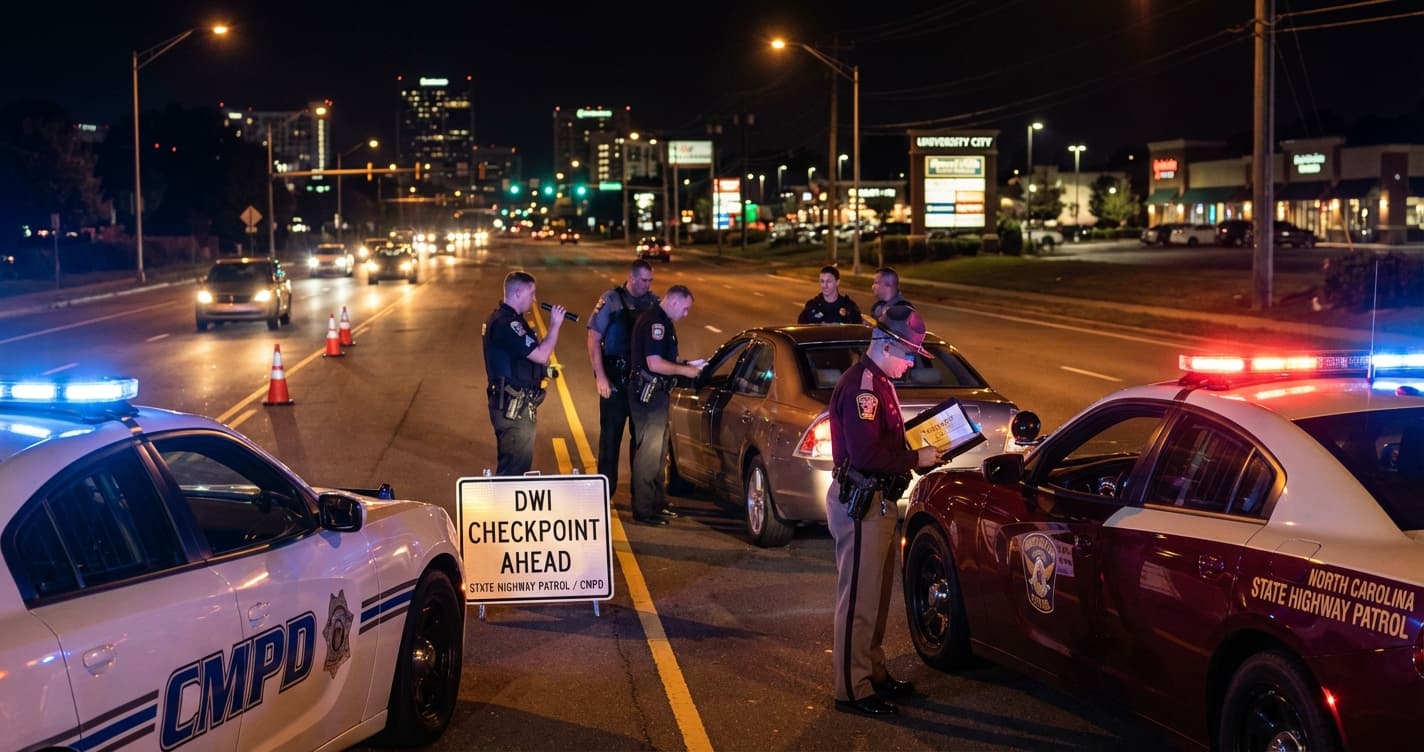
Driving While Impaired (DWI) checkpoints are a common law enforcement strategy used across North Carolina to deter and apprehend impaired drivers. In Charlotte, particularly around University City, the Charlotte-Mecklenburg Police Department (CMPD) frequently establishes DWI checkpoints to monitor and enforce impaired driving NC law. These checkpoints involve stopping vehicles at predetermined locations to check for signs of intoxication.
DWI checkpoints, also called sobriety checkpoints, are legal in North Carolina but must follow strict guidelines to protect constitutional rights. The Fourth Amendment protects against unreasonable searches and seizures, so law enforcement must adhere to procedural rules to ensure checkpoint stops are lawful.
When stopped at a drunk driving checkpoint NC, drivers may be asked to provide identification and submit to field sobriety or breathalyzer tests if officers suspect impairment. Understanding your DWI checkpoint NC rights is crucial to avoid self-incrimination or procedural missteps that could impact your case.
Have you been stopped at a DWI checkpoint in Charlotte or University City? Contact a skilled DWI defense attorney NC at Vasquez Law Firm for a free consultation today.
Phone: 1-844-967-3536 | Se Habla Espanol
Legal Foundations of DWI Checkpoints NC
DWI checkpoints in North Carolina are authorized under state law but must comply with both North Carolina statutes and federal constitutional protections. The North Carolina General Assembly has not passed specific statutes governing sobriety checkpoints, but the practice is regulated through case law and policies established by the NC General Assembly.
The U.S. Supreme Court, in Michigan Dept. of State Police v. Sitz, 496 U.S. 444 (1990), upheld the constitutionality of sobriety checkpoints, provided they are conducted under guidelines designed to minimize intrusion and protect individual rights. In North Carolina, the NC Department of Public Safety and local law enforcement agencies such as CMPD must follow policies to ensure checkpoints are legal and non-discriminatory.
Checkpoint locations, timing, and officer conduct must be predetermined and publicly available, and vehicle stops should be brief and minimally intrusive. If checkpoints violate procedural requirements, any evidence obtained may be suppressed in court.
Your Rights at a DWI Checkpoint NC
Knowing your checkpoint legal rights can help you navigate a DWI checkpoint without unintentionally harming your defense. First, police may stop your vehicle briefly, but they must have a neutral method of selecting vehicles, such as stopping every third or fourth car. Arbitrary stops based on race, ethnicity, or other discriminatory factors are illegal.
You have the right to remain silent beyond providing your driver’s license, vehicle registration, and proof of insurance. Refusing to answer questions about alcohol consumption is within your rights, but refusing to provide identification or driving documents may lead to citations or arrest.
Under North Carolina law, if officers suspect impairment, they can request you to perform standardized field sobriety tests or submit to a breathalyzer. You have the right to refuse some tests, but refusal can result in license suspension under the state’s Implied Consent Law, codified in N.C. Gen. Stat. § 20-16.2.
Field Sobriety Tests and Breathalyzers
Standardized field sobriety tests include the walk-and-turn, one-leg stand, and horizontal gaze nystagmus. These tests are voluntary but refusing them may lead to further suspicion and arrest. Breathalyzer tests are governed by the implied consent statute; refusal can lead to administrative penalties even if you are not criminally charged.
Right to Legal Counsel
If you are arrested at a checkpoint, you have the right to contact a lawyer before answering any questions. Early consultation with a DWI defense attorney NC can protect your rights and help build a strong defense.
Are you facing charges after a DWI checkpoint stop in University City? Schedule your free consultation with Vasquez Law Firm today!
Call 1-844-967-3536 | Se Habla Espanol
CMPD DWI Enforcement and Checkpoints in University City
The Charlotte-Mecklenburg Police Department has a dedicated focus on combating impaired driving through frequent CMPD DWI enforcement operations, including sobriety checkpoints in University City and surrounding neighborhoods. These checkpoints are part of a strategic effort to reduce alcohol-related crashes and fatalities.
CMPD typically announces checkpoint locations in advance as part of community safety initiatives. Officers at these checkpoints are trained to identify signs of impairment and follow procedural requirements to ensure stops are lawful.
The department also uses data-driven approaches, analyzing crash statistics and DUI arrest data to select checkpoint sites where impaired driving is most prevalent. Collaboration with the North Carolina Department of Transportation enhances enforcement efforts through public awareness campaigns and impaired driving prevention programs.
What to Expect at a CMPD Checkpoint
When approaching a CMPD DUI checkpoint in University City, expect to slow down and stop as directed. Officers will ask for license and registration and may conduct a brief visual inspection of drivers for signs of impairment. If suspicion arises, you may be asked to step out of your vehicle and perform sobriety tests.
Legal Challenges to CMPD Checkpoints
Should I Fight My Traffic Ticket?
Find out if it's worth fighting
Question 1 / 3
What were you cited for?
Some defendants challenge the legality of checkpoint stops based on improper setup, lack of neutrality, or failure to follow established policies. A knowledgeable DWI defense attorney NC can investigate whether CMPD checkpoint procedures were properly followed.
Common Legal Defenses for DWI Checkpoint Stops NC
Facing charges after a DWI checkpoint stop does not mean a conviction is inevitable. Experienced attorneys at Vasquez Law Firm use various legal defenses to protect clients’ rights and seek dismissal or reduction of charges.
Common defenses include:
- Illegality of the checkpoint: If the checkpoint was not conducted in compliance with constitutional or state guidelines, evidence may be suppressed.
- Improper vehicle selection: Stops must use a neutral formula. If selection was arbitrary or discriminatory, the stop may be invalid.
- Violation of procedural protocols: Failure to notify the public, improper officer conduct, or extended detention beyond what is reasonable can be challenged.
- Faulty breathalyzer or test administration: Breath tests must be performed using properly maintained equipment and calibrated devices.
- Lack of probable cause: Arrests require reasonable suspicion or probable cause, which can be contested if unsupported by facts.
Keep Reading
Each case is unique, and building an effective defense requires timely legal intervention.
Understanding Impaired Driving NC Law
North Carolina’s impaired driving laws are strict and include criminal penalties for operating a vehicle under the influence of alcohol or drugs. The legal blood alcohol content (BAC) limit is 0.08% for drivers over 21, per N.C. Gen. Stat. § 20-138.1.
Penalties for DWI in North Carolina can include fines, license suspension, community service, and jail time. Repeat offenders or those with high BAC levels face enhanced penalties.
Additionally, the Implied Consent Law means that by driving in North Carolina, drivers consent to chemical testing if suspected of impairment. Refusal to submit to testing results in automatic license suspension and can be used against you in court.
It is crucial to consult with a DWI defense attorney NC immediately if you are charged with impaired driving to understand your options and protect your rights.
Tips for Drivers Approaching DWI Checkpoints in NC
To protect your rights and safety when approaching a DWI checkpoint NC, consider the following tips:
- Stay calm and comply with officers’ instructions.
- Provide requested documents such as your driver’s license and registration.
- Do not volunteer information about alcohol consumption.
- Politely decline field sobriety tests if you choose, but understand the potential consequences.
- Do not attempt to evade or avoid the checkpoint, as this may lead to additional charges.
- Contact a qualified attorney promptly if you are arrested or charged.
Need help after a DWI checkpoint stop in Charlotte or University City? Contact Vasquez Law Firm for expert legal representation.
Get in touch today or call 1-844-967-3536 for a free consultation. Se Habla Espanol.
Frequently Asked Questions about DWI Checkpoints NC
What are my rights if stopped at a DWI checkpoint in North Carolina?
You have the right to remain silent except for providing your driver’s license, registration, and proof of insurance. Officers must use neutral criteria to stop vehicles. You can refuse field sobriety tests but may face consequences such as license suspension.
Are DWI checkpoints legal in North Carolina?
Yes, DWI checkpoints are legal if conducted in compliance with constitutional guidelines and procedural rules. Law enforcement must follow policies that protect drivers’ Fourth Amendment rights.
Can I be arrested without probable cause at a checkpoint?
No. While police may stop your vehicle briefly, an arrest requires probable cause based on observed impairment or failed tests.
What should I do if I am asked to perform a field sobriety test?
You may politely refuse the test, but refusal can be used as evidence against you and may result in license suspension under North Carolina’s Implied Consent Law.
Can I challenge the legality of a DWI checkpoint stop?
Yes. If the checkpoint did not follow required procedures or was discriminatory, a defense attorney can file motions to suppress evidence obtained during the stop.
What penalties can I face for a DWI conviction in North Carolina?
Penalties include fines, jail time, license suspension, community service, and mandatory alcohol education. Penalties increase for repeat offenses or high BAC levels.
How can a DWI defense attorney help me after a checkpoint stop?
An experienced attorney can review the legality of the stop, challenge evidence, negotiate with prosecutors, and protect your rights throughout the legal process.
Where can I find information about upcoming DWI checkpoints in Charlotte?
CMPD and local news outlets sometimes announce checkpoint locations in advance. You can also check official websites like CMPD or community safety pages.
Is it legal to avoid a DWI checkpoint?
Attempting to evade or avoid a checkpoint may raise suspicion and could lead to additional charges. It is safest to comply with checkpoint procedures.
Disclaimer
This blog post is for informational purposes only and does not constitute legal advice. Laws and procedures may change over time and vary by jurisdiction. For personalized legal advice regarding your situation, contact a licensed attorney at Vasquez Law Firm.
Related Topics
William Vasquez
Founder & CEO, Vasquez Law Firm, PLLC
William Vasquez is the founder and CEO of Vasquez Law Firm, PLLC, a results-driven firm specializing in immigration, criminal defense, family law, personal injury, and workers' compensation. A U.S. Air Force veteran and recipient of the Joint Service Achievement Medal, William is dedicated to fiercely fighting for his clients' rights.
Related Legal Services
Need legal help? Learn more about speak with a traffic violation lawyer, or contact us for a free evaluation.
You can also visit traffic attorneys serving all of North Carolina for more information.


