What Is Chain Migration and How It Impacts Immigration in 2026
Learn what chain migration means in 2026. Discover how it affects your immigration case. Contact Vasquez Law Firm for a free consultation.
Published on March 13, 2026
Talk to an immigration attorney
Free call. A clear plan for your case.
Free & confidential · Se habla espanol · 24/7
Have questions? Talk to an attorney - free evaluation.
Call 1-844-967-3536Worried how the latest immigration news affects you?
Schedule a confidential case review with an immigration attorney - know exactly where you stand.
USCIS Case Status
Check your USCIS case status
Enter your receipt number and get the official status. Free, no registration.
What Is Chain Migration and How It Impacts Immigration in 2026
Chain migration plays a key role in family-based immigration, allowing relatives of U.S. citizens or legal permanent residents to apply for visas. In 2026, understanding how chain migration works is crucial for immigrants in Raleigh and beyond. This guide explains chain migration’s legal basics, the federal process, timelines, costs, and when to contact an immigration attorney. Vasquez Law Firm offers bilingual support and experienced representation for clients navigating this complex system across North Carolina and Florida.
Need help with your case? Our experienced attorneys are ready to fight for you. Se Habla Español.
Schedule Your Free Case Evaluation
Or call us now: 1-844-967-3536
Quick Answer
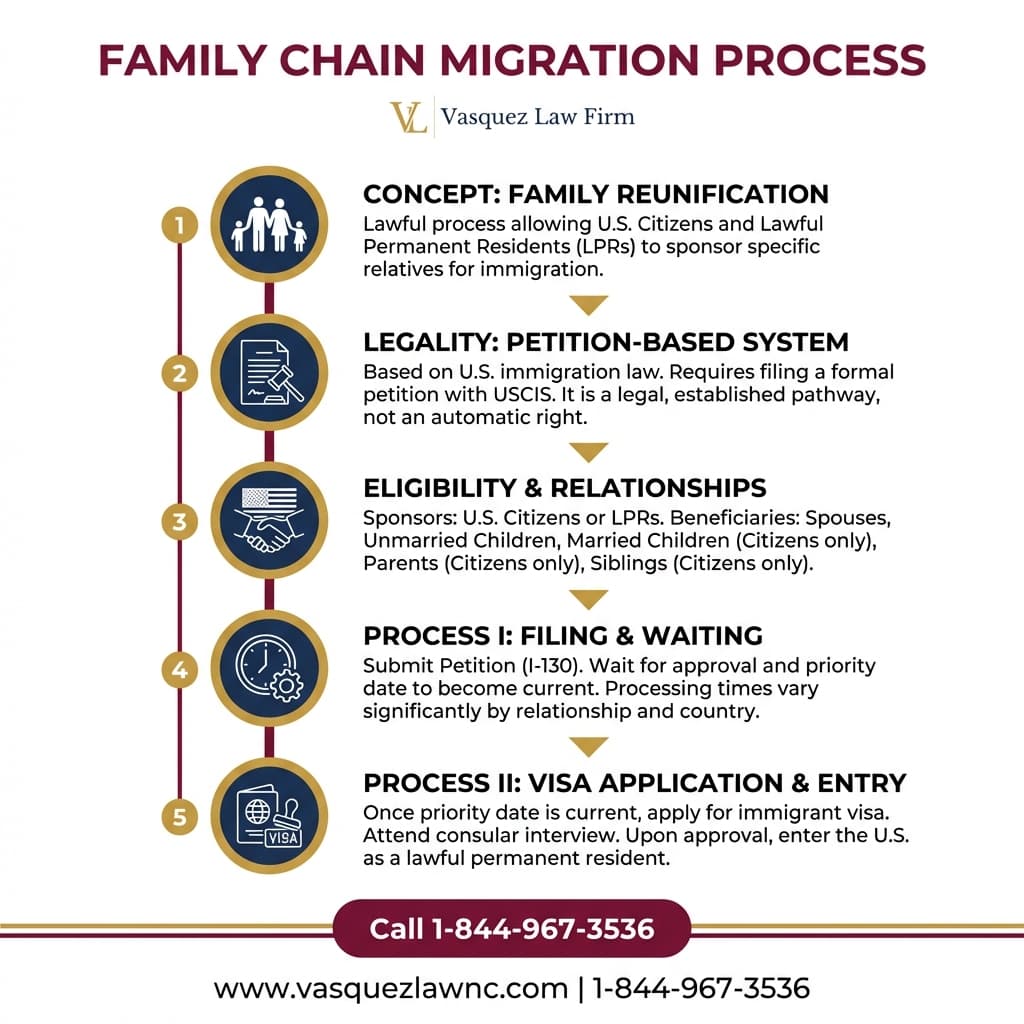
Chain migration is a family reunification process where U.S. citizens or lawful permanent residents sponsor eligible relatives to immigrate. It involves filing petitions, waiting through processing and visa availability, then final entry into the United States.
- U.S. citizens can petition spouses, children, parents, and siblings
- Legal permanent residents petition spouses and unmarried children
- The process requires USCIS petition approval and visa number availability
- Delays may occur due to quotas and background checks
- Legal assistance helps navigate these steps
What Is Chain Migration?
Imagine a U.S. citizen named Maria who decides to bring her mother and siblings to join her in Raleigh, North Carolina. Through chain migration, she can sponsor these family members to apply for immigrant visas. This system lets immigrants reunite families by allowing qualified relatives to follow an initial sponsor to the United States.
Chain migration is officially recognized by U.S. immigration law. It occurs when U.S. citizens or lawful permanent residents file petitions to sponsor specific relatives. The process is governed by federal statutes and regulations. It includes categories such as immediate relatives and family preference groups, each with its own rules and visa limitations.
In 2026, chain migration continues to be a vital pathway for immigrants seeking to build or reunite their families legally. Understanding its mechanics helps applicants make informed decisions and anticipate challenges.
Chain Migration Simple Definition
Chain migration can be simply defined as: the process by which U.S. citizens and green card holders sponsor family members for immigration, creating a chain of migrants based on family connections.
Chain Migration Example
A common example of chain migration is when a U.S. citizen sponsors a spouse, who after obtaining permanent residency, sponsors their children. This chain effect expands the family’s ability to live together in the U.S.
Is Chain Migration Legal?
Chain migration is legal under current U.S. immigration statutes. Challenges or proposals seeking to restrict chain migration have not abolished it. Legal experts advise clients to stay informed of any changes impacting this process. Vasquez Law Firm monitors reforms affecting immigration rights.
Step-by-Step: How Chain Migration Works
Consider Carlos, a lawful permanent resident living in Florida, who wants to bring his unmarried daughter from Mexico. Here is a step-by-step outline of what happens next:
- Filing the Petition: Carlos files Form I-130, Petition for Alien Relative, with USCIS to start the process.
- USCIS Reviews the Petition: USCIS verifies the relationship and checks documentation.
- Approval and Priority Date: Once approved, the petition receives a priority date which determines visa queue position.
- Visa Availability: The Department of State publishes monthly visa bulletins showing visa availability for family preference categories.
- Consular Processing: When a visa number is current, the beneficiary applies for an immigrant visa at a U.S. consulate abroad.
- Entry and Adjustment: The family member enters the U.S. and becomes a lawful permanent resident.
Filing Form I-130 Correctly
Accuracy in Form I-130 is critical. Petitions require clear proof such as birth certificates and marriage documents. Mistakes can delay approvals or cause denials.
Visa Bulletin Monitoring
Applicants regularly check the Department of State visa bulletin to track when their visa category is current, especially for preference categories that often have long waits.
Consular Interview Preparation
The immigrant visa interview tests eligibility and background. Preparation includes gathering all documents and anticipating questions. Vasquez Law Firm coaches clients for success.
Documents Needed for Family-Based Immigration
Sponsors and beneficiaries must prepare various documents. An incomplete or incorrect submission often leads to processing delays. Key required documents include:
- Proof of U.S. citizenship or permanent residency of the sponsor (passport, birth certificate, green card)
- Evidence of family relationship (marriage certificate, birth certificates, adoption papers)
- Completed Form I-130 and supporting affidavits or declarations
- Financial support evidence, including Form I-864, Affidavit of Support
- Photographs and identification for all parties
- Police certificates and medical examination reports for beneficiary
Gathering these documents requires attention to detail. Missing or inconsistent paperwork raises red flags at USCIS or consulates.
Affidavit of Support Importance
The sponsor must prove they can financially support the immigrant. Filling Form I-864 correctly prevents application refusals.
Supporting Evidence Tips
Providing additional proof like photos, communication records, and joint finances can strengthen relationship claims, especially for spouses.
Common Documentation Pitfalls
Submitting unofficial translations, expired IDs, or incomplete forms are common pitfalls to avoid.
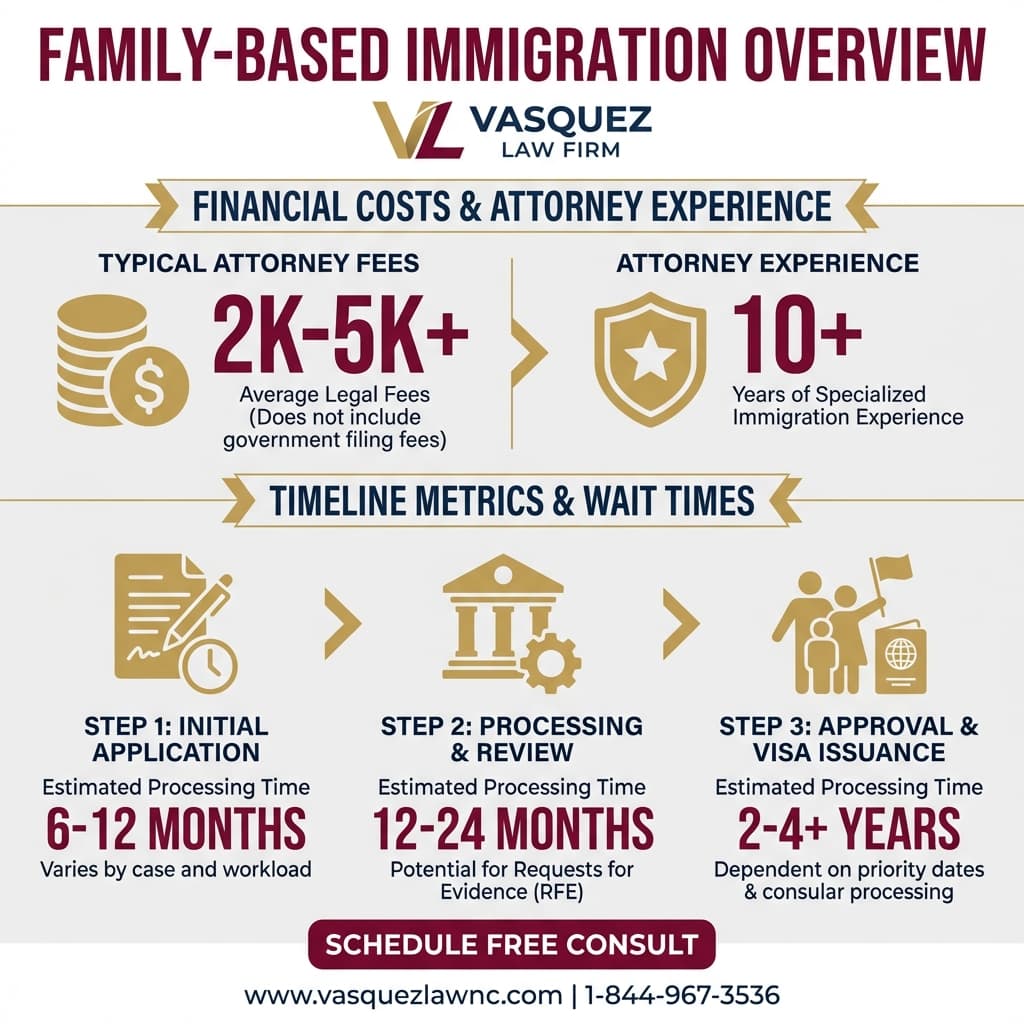
Timeline: What to Expect During the Process
Chain migration timelines depend on category and country of origin. For example:
- Immediate relatives (spouses, parents, children under 21) often experience shorter waits, some within 12 months
- Family preference categories including siblings or adult children can wait several years, sometimes more than a decade
- USCIS processing phases also vary based on caseload and petition complexity
Applicants should expect waiting periods that include: petition approval, visa number availability, consular interview scheduling, and final processing.
Timeline Checklist for Applicants
- Filing and USCIS petition processing: 6-12 months
- Waiting for priority date to become current: months to years
- Consular interview and visa issuance: 1-3 months after priority date
- Entry into the U.S. and green card receipt: 2-4 weeks afterward
Tips for Managing the Timeline
Regularly check USCIS and Department of State websites to track status. Promptly respond to requests for evidence or interviews.
Causes of Delays
Backlogs, security checks, incomplete paperwork, or changes in immigration law can extend timelines.
Costs and Fees: What Impacts the Price
Chain migration cases incur several fees. Examples:
- Form I-130 filing fee: as of 2026, $535
- Visa application fees at consulates: between $230-$325
- Medical examination, document translation, and travel expenses
- Attorney fees, varying by case complexity
Unexpected charges can arise if applications are denied or require appeals.
Fee Waivers and Financial Help
Applicants with low income may qualify for fee waivers on some forms. Vasquez Law Firm helps clients explore these options.
Planning for Additional Costs
Consider costs of gathering evidence, expert evaluations, and possible delays when budgeting for your immigration case.
Common Mistakes to Avoid in Chain Migration
- Submitting incomplete or inaccurate petitions—always double-check forms.
- Failing to include required supporting documents—missing evidence delays processing.
- Ignoring priority dates and visa bulletin updates—don’t miss your window to apply.
- Not responding timely to Requests for Evidence (RFE)—unanswered RFEs often lead to denials.
- Misunderstanding eligibility criteria—consult a lawyer to verify qualifications.
- Skipping authorized attorney assistance—legal help reduces errors and helps appeals.
- Assuming immediate family petitions are processed instantly—expect and plan for wait times.
- Not preparing for consular interviews—practice and bring all documents.
If you only remember one thing: Accurate, complete paperwork combined with professional legal guidance greatly improves success chances.
NC and FL Jurisdiction Notes
Chain migration immigration petitions follow federal law overseen by USCIS and the Department of State. However, case handling can vary in Raleigh, North Carolina, or Florida due to local offices and field resources.
North Carolina Notes
USCIS has local offices in Charlotte and Raleigh areas providing application support. Vasquez Law Firm serves clients statewide with personalized case management. North Carolina immigrant communities benefit from bilingual legal assistance.
Florida Notes
Florida features high immigration volumes with multiple USCIS field offices. Delays may occur due to heavy caseloads. Legal representation familiar with Florida’s diverse immigrant populations is important.
Nationwide Concepts (General Only, Rules Vary)
Family-based immigration falls under federal jurisdiction regardless of state. National visa quotas and policy changes affect all applicants. Check USCIS.gov and travel.state.gov for updates.
When to Call a Lawyer Immediately
- Receiving a Request for Evidence from USCIS or the consulate
- Facing a denial or Notice of Intent to Deny your petition
- Complex family situations such as past deportations or criminal history
- Confusion about eligibility or paperwork requirements
- Long delays with unclear status updates
- Preparing for consular interviews or adjustments of status
- Issues with affidavit of support or financial concerns
- Changing immigration laws or policy affecting your category
About Vasquez Law Firm
At Vasquez Law Firm, we combine compassion with aggressive representation. Our motto "Yo Peleo" (I Fight) reflects our commitment to standing up for your rights.
- Bilingual Support: Se Habla Español - our team is fully bilingual
- Service Areas: North Carolina, Florida, and nationwide immigration services
- Experience: Over 15 years helping clients navigate complex legal matters
- Results: Thousands of successful cases across multiple practice areas
Attorney Trust and Experience
Attorney Vasquez holds a Juris Doctor degree and is admitted to practice in both the North Carolina State Bar and Florida Bar. With over 15 years of dedicated legal experience, he has built a reputation for providing personalized attention and achieving favorable outcomes for his clients.
Don't wait to get the help you deserve. Call us now for immediate assistance.
Se Habla Español
Frequently Asked Questions
What is meant by chain migration?
Chain migration refers to when U.S. citizens or lawful permanent residents sponsor certain family members to immigrate. This family-based immigration process is designed to reunite relatives legally.
Is chain migration legal in the US?
Yes. Chain migration is recognized in U.S. immigration law allowing family members to petition for one another. Changes in law may affect details, but it remains legal in 2026.
What are the main family categories in chain migration?
They include immediate relatives like spouses and minor children and family preference categories like adult children and siblings. Each has different visa waiting times.
How long does the chain migration process usually take?
It varies; immediate relatives may wait under a year, while other categories can take years due to visa limits and backlogs.
Can chain migration be denied or delayed?
Yes. Reasons include paperwork errors, lack of proof, or security issues. Timely legal advice helps avoid problems.
Does chain migration apply differently in North Carolina and Florida?
Federal law governs chain migration for all states, but local USCIS offices and resources vary. Vasquez Law Firm supports clients in both regions.
What documents are needed for a family-based immigration petition?
Proof of citizenship, relationship evidence, Form I-130, affidavits of support, and other supporting papers are essential for a complete application.
How can Vasquez Law Firm help with chain migration cases?
We assist with petition preparation, evidence gathering, legal strategy, and representation throughout all immigration process stages.
Sources and References
- USCIS family immigration guidelines
- U.S. Department of State family immigration
- Executive Office for Immigration Review
- 8 U.S.C. § 1154 - Petition for Immigrant Visa
- 8 C.F.R. § 204.1 - Filing Petition for Relatives
Need immigration help? Our immigration attorneys can review your case.
Take the first step toward justice today. Our team is standing by to help. Se Habla Español.
Start Your Free Case Evaluation Now
Call us: 1-844-967-3536
Se Habla Español - Estamos aquí para ayudarle.


William Vasquez
Founder & CEO, Vasquez Law Firm, PLLC
William Vasquez is the founder and CEO of Vasquez Law Firm, PLLC, a results-driven firm specializing in immigration, criminal defense, personal injury, and workers' compensation. A U.S. Air Force veteran and recipient of the Joint Service Achievement Medal, William is dedicated to fiercely fighting for his clients' rights.
Related Legal Services
Need legal help? Learn more about speak with an immigration lawyer, or contact us for a free evaluation.
You can also visit our North Carolina immigration practice for more information.
![Timeline: ASAP - Multiple Days Explained [2026]](/_next/image?url=https%3A%2F%2Fvuuyorlsmhunqektprqy.supabase.co%2Fstorage%2Fv1%2Fobject%2Fpublic%2Fblogs%2Fimmigration-header-1773407439444.png&w=1920&q=75)