What is DACA and How Does It Impact You in 2026?
Discover what DACA means in 2026, who is eligible, and how to renew your status. Contact Vasquez Law Firm for a free consultation today.
Published on March 25, 2026
Talk to an immigration attorney
Free call. A clear plan for your case.
Free & confidential · Se habla espanol · 24/7
Have questions? Talk to an attorney - free evaluation.
Call 1-844-967-3536Free Tool
Check Your USCIS Case Status Now
Enter your receipt number - get the official USCIS status in English or Spanish. No registration.
What is DACA and How Does It Impact You in 2026?
DACA stands for Deferred Action for Childhood Arrivals, a federal program that protects undocumented immigrants brought to the U.S. as children. In 2026, it remains a vital opportunity for Dreamers in Orlando and beyond to live and work without fear of deportation. This guide explains DACA's key rules, renewal process, eligibility, common mistakes, and recent legal updates, especially important for individuals in North Carolina and Florida. Contact Vasquez Law Firm for compassionate bilingual legal support to protect your rights in 2026.
Need help with your case? Our experienced attorneys are ready to fight for you. Se Habla Español.
Schedule Your Free Case Evaluation
Or call us now: 1-844-967-3536
Quick Answer
DACA shields eligible immigrant youth from deportation and allows work authorization under federal law. In 2026, it continues as a key program for Dreamers in Orlando and other parts of North Carolina and Florida.
- Temporary protection from deportation
- Renewable work permit
- Access to social security number
- No direct path to citizenship
- Eligibility requires strict criteria including age and residency
Understanding DACA and Its Importance
Imagine arriving in the United States as a child with your family, only to face the threat of deportation years later after building your life here. DACA, or Deferred Action for Childhood Arrivals, provides reprieve and work authorization to certain undocumented immigrants who arrived as minors. Introduced by the Obama administration in 2012, it does not grant legal immigration status but empowers recipients, often called Dreamers, to work legally and avoid removal from the country.
Despite ongoing legal battles, DACA continues to be active as of 2026, offering vital opportunities especially in cities with large immigrant populations like Orlando, Florida, and several regions in North Carolina. With over 600,000 recipients nationwide, the program has reshaped many lives.
An essential detail to understand is that DACA recipients must meet eligibility rules, including arriving in the U.S. before age 16 and having lived continuously in the country since June 2007. Valid renewals are required every two years to maintain status and work permits.
The benefits include temporary protection from deportation, the ability to work legally, and access to some state services, but it does not offer a direct route to lawfully permanent resident status or citizenship. For many, DACA is a bridge allowing them to pursue education and work opportunities safely.
You can read more about our immigration services that assist with DACA applications and renewals.
Step-by-Step: Applying for or Renewing DACA
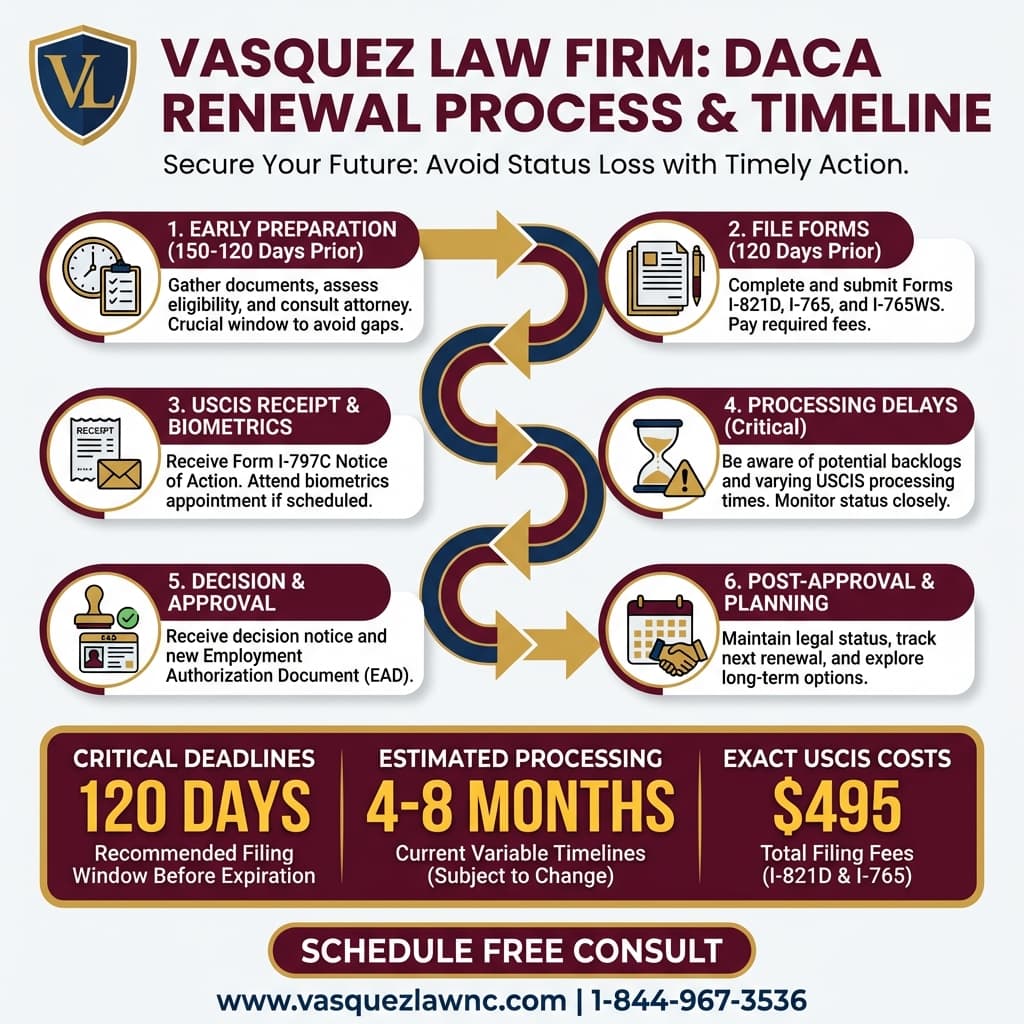
- Confirm Eligibility: Meet the age, residency, education, and criminal background requirements set by USCIS. Verify all criteria carefully before applying.
- Gather Documents: Collect proof of arrival, continuous residence, education or military service, and any other supporting paperwork like identification.
- Complete Forms: Prepare Forms I-821D (Consideration of Deferred Action), I-765 (Work Authorization), and I-765WS (Worksheet). Accuracy is crucial to avoid delays.
- Pay Fees: Include the current USCIS application fee, which is approximately $495 as of 2026, though fee waivers may apply in some cases.
- Submit Application: File the packet to the appropriate USCIS service center with all necessary documents and fees.
- Fingerprinting and Biometrics: Attend your appointment for biometrics to allow USCIS to conduct necessary background checks.
- USCIS Review: USCIS will adjudicate your application, which typically takes 4-6 months but can vary.
- Receive Decision: If approved, you’ll receive your deferred action status and work permit valid for two years, with eligibility for renewal.
- Renewal: Begin renewal applications 150-120 days before expiration to avoid gaps in protection.
Attorney Vasquez and our team specialize in guiding Dreamers through these steps, ensuring accuracy and timeliness. Contact us early, especially for renewals, to prevent lapses in status.
Common Mistakes to Avoid with DACA
- Missing Deadlines: Waiting too long to renew DACA can cause a lapse in status and employment authorization. Start renewals at least 4 months before expiration.
- Incomplete Forms: Errors or missing information can lead to delays or denials. Work with an attorney to double-check all paperwork.
- Lack of Supporting Evidence: Failure to provide clear proof of residency or education status undermines your application.
- Criminal History Issues: Not disclosing or misunderstanding how certain convictions affect eligibility can result in denial.
- Unauthorized Travel: Traveling abroad without advance parole approval risks losing DACA status.
- Not Maintaining Eligibility: Changes in education or military service status must be monitored to remain qualified.
- Not Responding to USCIS Requests: Ignoring Requests for Evidence (RFEs) or interview notifications delays processing.
If you only remember one thing: Accurate, timely filing with strong evidence and maintaining communication with USCIS are essential to protect your DACA status.
Timeline and What to Expect After Applying
- Weeks 1-2: USCIS receives and logs your application.
- Weeks 3-6: Biometrics appointment notice is sent; you attend fingerprinting.
- Months 2-5: USCIS reviews your case, conducts security and background checks.
- Month 5-6: Approval or denial notice is issued.
- Within 2 weeks of approval: Receive work permit card valid for two years.
- Renewals: Submit renewal application 4-5 months before expiry to avoid gaps.
Busy periods or USCIS backlogs can extend these time frames, so plan ahead. Our office closely monitors processing times and assists clients to meet deadlines.
Costs and Fees Related to DACA Applications
- USCIS Filing Fee: The current filing fee is $495 for DACA applications and renewals, covering biometric services.
- Attorney Fees: Legal assistance varies by provider; Vasquez Law Firm offers competitive rates and transparent pricing.
- Document Preparation Costs: Some applicants may pay for certified records or translations.
- Fee Waivers: USCIS may grant waivers for those who can prove financial hardship, but applications must include supporting documents.
- Add-ons: Expedited processing is generally not available; careful early application submission is best to avoid extra costs.
Call our office to discuss fee structures and possible financial assistance options.
North Carolina and Florida DACA Considerations
North Carolina Notes
North Carolina recognizes DACA work permits for employment and driver’s licenses, though policies may vary by DMV location. The state offers in-state tuition benefits in some universities to DACA recipients meeting residency requirements. Legal protections for DACA recipients in NC are generally aligned with federal rules, but local enforcement priorities may affect deportation risks.
Florida Notes
Florida allows DACA holders to obtain driver's licenses valid for the length of their work permit. Public university tuition rates do not uniformly apply to DACA recipients, and the state has seen political debates on immigration enforcement. For Dreamers in Orlando, awareness of local policies and avoiding interactions with ICE is critical.
Nationwide Concepts
DACA is a federal program, so USCIS policies apply across states. However, individual states vary in benefits like tuition and driver’s licenses. Dreamers should understand both federal protections and local laws in their state. Traveling internationally requires advance parole permission.
When to Call a Lawyer About Your DACA Case
- If your initial DACA application was denied
- If you receive a Request for Evidence (RFE) from USCIS
- Before submitting a renewal to avoid status gaps
- If you face criminal charges or have a criminal record
- If you plan to travel outside the U.S. and need advance parole
- If your DACA status is expiring soon and you need advice
- If you have concerns about ICE enforcement targeting you
- If you are confused about eligibility requirements
- If USCIS delays or refuses your employment authorization
- To explore options beyond DACA like green cards
About Vasquez Law Firm
At Vasquez Law Firm, we combine compassion with aggressive representation. Our motto "Yo Peleo" (I Fight) reflects our commitment to standing up for your rights.
- Bilingual Support: Se Habla Español - our team is fully bilingual
- Service Areas: North Carolina, Florida, and nationwide immigration services
- Experience: Over 15 years helping clients navigate complex legal matters
- Results: Thousands of successful cases across multiple practice areas
Attorney Trust and Experience
Attorney Vasquez holds a Juris Doctor degree and is admitted to practice in the North Carolina State Bar. With over 15 years of dedicated legal experience, he has built a reputation for providing personalized attention and achieving favorable outcomes for his clients.
Don't wait to get the help you deserve. Call us now for immediate assistance.
Se Habla Español
Frequently Asked Questions
What does DACA mean?
DACA stands for Deferred Action for Childhood Arrivals, allowing certain undocumented immigrants who came as children temporary relief from deportation and eligibility to work legally.
Is DACA now illegal?
As of 2026, courts have upheld DACA protections despite challenges. It remains a lawful program, but status depends on federal policies and ongoing legal decisions.
Who is eligible for DACA?
Eligibility requires arrival before age 16, continuous residence since June 2007, being under 31 in 2012, schooling or military service, and no serious crimes.
Can DACA recipients become U.S. citizens?
DACA does not provide a direct path to citizenship, but recipients may qualify for other immigration benefits enabling permanent residency and eventual citizenship.
What are the benefits of DACA?
DACA offers protection against deportation, work permits, social security access, and state benefits like driver’s licenses in some states.
How do I renew my DACA status?
Renew with Form I-821D, I-765, and evidence of continuous residence before expiration. Apply 4-5 months early.
What happens if my DACA application is denied?
You can appeal or submit motions. Legal help is crucial to explore options and avoid losing protections.
Can DACA recipients travel outside the U.S.?
Travel requires advance parole approval. Unauthorized travel may cause loss of DACA status.
Sources and References
- USCIS official guidelines
- Executive Office for Immigration Review
- U.S. Department of State visa information
Take the first step toward justice today. Our team is standing by to help. Se Habla Español.
Start Your Free Case Evaluation Now
Call us: 1-844-967-3536


William Vasquez
Founder & CEO, Vasquez Law Firm, PLLC
William Vasquez is the founder and CEO of Vasquez Law Firm, PLLC, a results-driven firm specializing in immigration, criminal defense, personal injury, and workers' compensation. A U.S. Air Force veteran and recipient of the Joint Service Achievement Medal, William is dedicated to fiercely fighting for his clients' rights.
Related Legal Services
Need legal help? Learn more about get immigration legal help today, or contact us for a free evaluation.
You can also visit NC immigration legal help for more information.