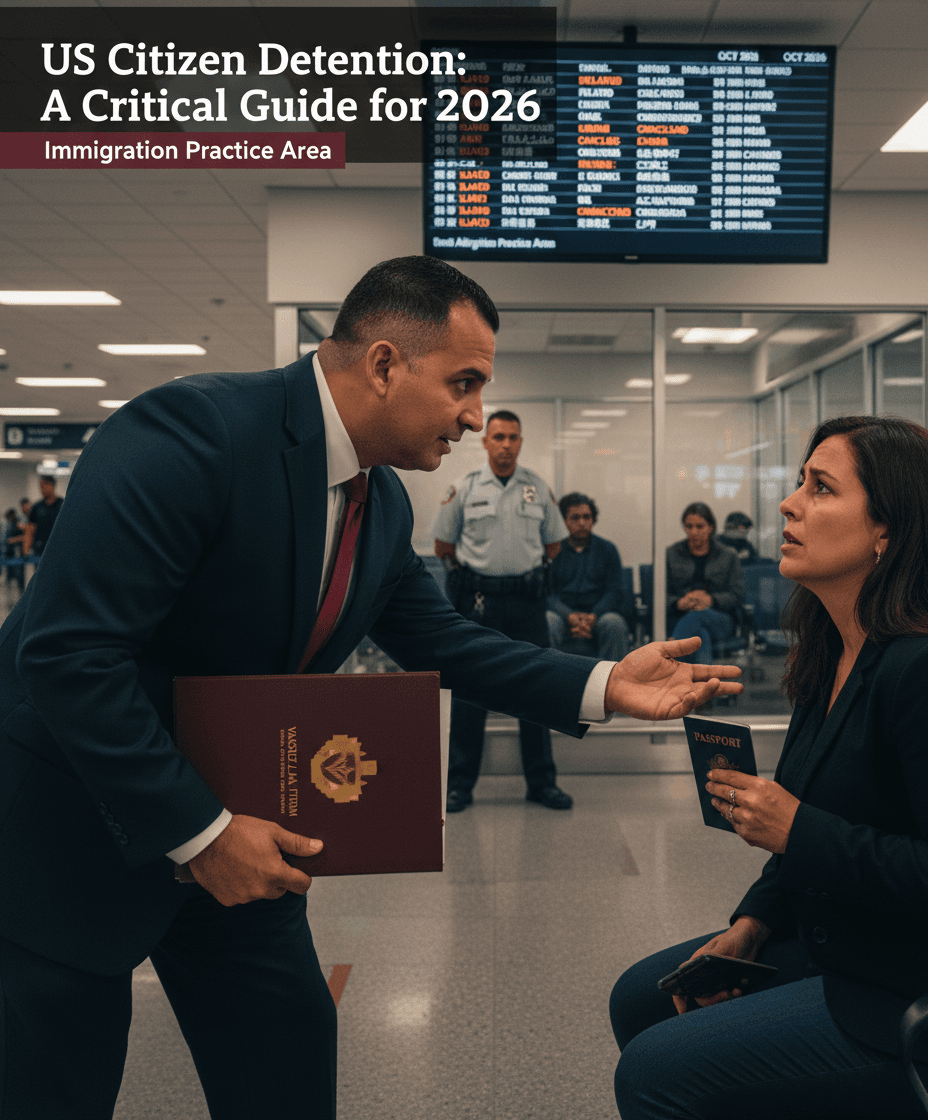
Can US Citizens Be Detained by Immigration in 2026
Understand your rights regarding US citizen detention by immigration agents in 2026. Learn how to protect yourself and get legal help. Contact Vasquez Law Firm for a free consultation.
Published on February 15, 2026
Have questions? Talk to an attorney - free evaluation.
Call 1-844-967-3536Worried how the latest immigration news affects you?
Get a free, confidential case review with an immigration attorney - know exactly where you stand.
Can US Citizens Be Detained by Immigration in 2026
The possibility of US citizen detention by immigration authorities like ICE is a serious concern for many, even those who believe their citizenship is clear. While federal law protects U.S. citizens from unlawful arrest and detention, instances of mistaken identity or aggressive enforcement can lead to stressful and confusing situations. Knowing your rights and the proper procedures is essential, especially in 2026, to navigate such encounters effectively and protect your freedom. This guide provides vital information for U.S. citizens in North Carolina, Florida, and across the nation.
Need help with your case? Our experienced attorneys are ready to fight for you. Se Habla Español.
Schedule Your Free Consultation
Or call us now: 1-844-967-3536
Quick Answer
While U.S. citizens cannot be lawfully detained by immigration authorities like ICE without a valid warrant or probable cause of a crime, mistaken identity or procedural errors can lead to temporary detention. If you are a U.S. citizen and detained by ICE, immediately assert your citizenship, remain silent, and request to speak with an attorney. Do not sign anything without legal counsel. Seek legal assistance promptly to challenge any unlawful detention.
- Assert your U.S. citizenship clearly and repeatedly.
- Do not answer questions about your immigration status.
- Demand to speak with an attorney immediately.
- Do not sign any documents without legal review.
- Contact family or an attorney as soon as possible.
Understanding US Citizen Detention by Immigration Agents
The concept of US citizen detention by immigration agencies such as Immigration and Customs Enforcement (ICE) might seem contradictory. However, reports show that individuals who are, in fact, U.S. citizens can be mistakenly or even unlawfully apprehended and held. This can happen due to various factors, including errors in databases, racial profiling, or an individual's inability to immediately prove their citizenship status. It's a critical issue that underscores the importance of understanding your rights.
In 2026, immigration enforcement remains a high-priority area for federal agencies. This heightened activity, while primarily targeting non-citizens, can unfortunately sweep up U.S. citizens in its net. The consequences of such a detention can be severe, leading to immense stress, prolonged separation from family, and potential violations of constitutional rights. Knowing the difference between lawful and unlawful detention is your first line of defense.
Many people wonder, "How long can ICE detain a U.S. citizen?" The answer is, legally, not at all, unless there is probable cause to believe they have committed a crime or a valid warrant for their arrest. Any detention of a U.S. citizen for immigration purposes without such legal justification is unlawful and must be challenged immediately. This is where experienced legal representation becomes absolutely vital.
Your Rights as a US Citizen if Detained by ICE
If you are a U.S. citizen and find yourself in a situation where you are being questioned or detained by ICE or any law enforcement agency regarding your immigration status, it's crucial to remember your constitutional rights. These rights are designed to protect you from unlawful detention and ensure due process. Asserting these rights calmly and clearly can significantly impact the outcome of your encounter. Here are the fundamental rights you should be aware of:
The Right to Remain Silent
You have the right to remain silent. You are not required to answer questions about your citizenship, where you were born, or how you entered the United States. Simply state, "I am a U.S. citizen, and I wish to remain silent." Do not engage in lengthy conversations or provide any information beyond asserting your citizenship. This right is enshrined in the Fifth Amendment of the U.S. Constitution.
The Right to an Attorney
You have the right to speak with an attorney. If detained, immediately and clearly state, "I want to speak with my attorney." Do not answer any further questions until your attorney is present. An attorney can help you navigate the complex legal landscape and ensure your rights are protected throughout the process. This is a critical safeguard against wrongful detention.
Do Not Sign Anything Without Legal Counsel
Immigration officers may present you with documents to sign. These documents could waive your rights or even admit to things that are not true. Never sign any papers without first consulting with an attorney. Signing documents without understanding their implications can have severe and long-lasting consequences for your case, making it harder to prove your U.S. citizen status.
How to Prove Your Citizenship and Avoid Detention
While you are not required to carry proof of U.S. citizenship at all times, having readily accessible documentation can help prevent or quickly resolve issues of mistaken identity. Proactive measures are the best defense against potential US citizen detention scenarios. It's always a good idea to know where your documents are and to inform family members of their location.
- U.S. Passport: This is the most definitive proof of U.S. citizenship.
- U.S. Birth Certificate: Accompanied by a government-issued photo ID (like a driver's license).
- Certificate of Naturalization: For naturalized citizens, this document proves your citizenship.
- Certificate of Citizenship: For those who derived or acquired citizenship through parents.
- Consular Report of Birth Abroad (CRBA): For U.S. citizens born outside the U.S. to U.S. citizen parents.
Keep copies of these documents in a safe place, and consider having a digital copy accessible to a trusted family member or your attorney. If questioned, you can state, "I am a U.S. citizen, and my proof is with my family/attorney. I want to speak with my attorney."
Steps to Take if a US Citizen is Detained by ICE
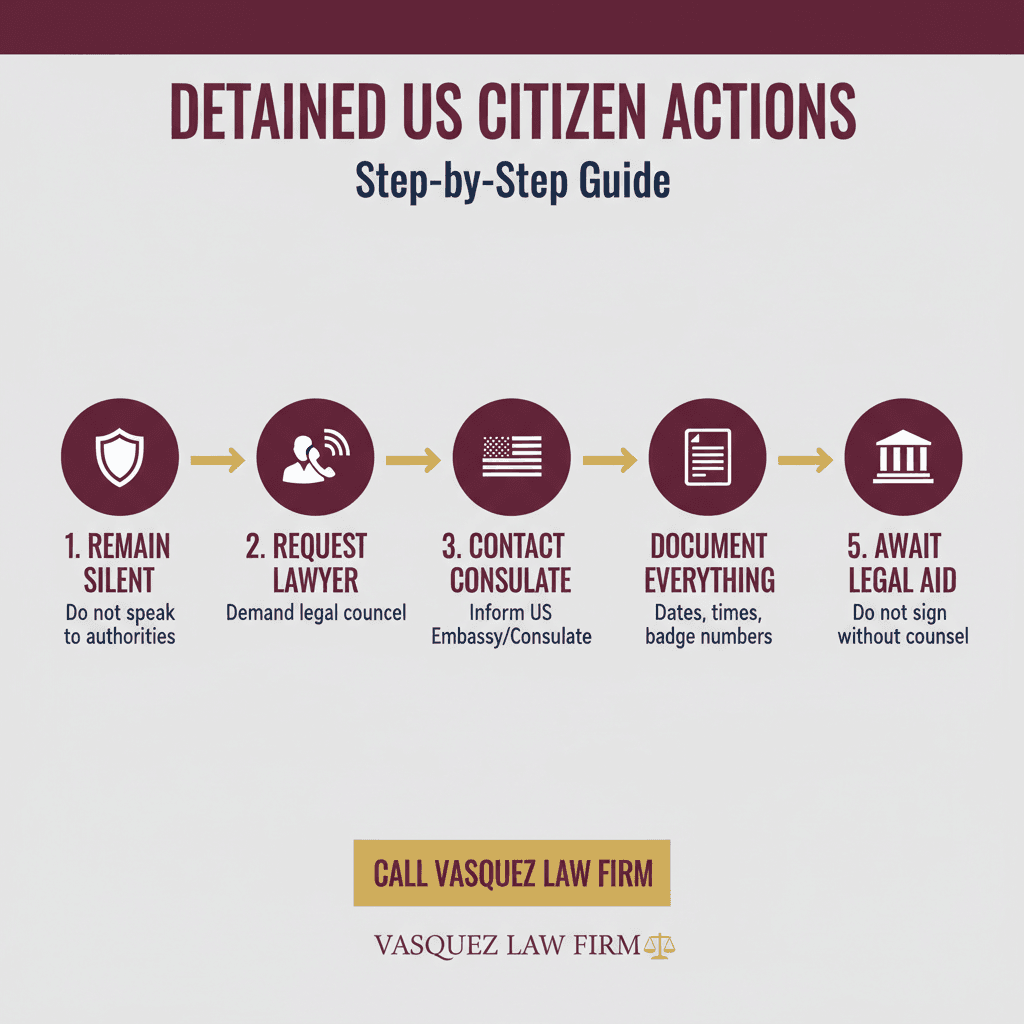
If you or a loved one who is a U.S. citizen is detained by ICE, quick and decisive action is paramount. The initial hours are critical for asserting rights and challenging the detention. Here's a step-by-step guide on what to do:
- Assert Citizenship and Remain Silent: As soon as an officer attempts to question or detain, clearly state, "I am a U.S. citizen. I do not consent to a search. I wish to remain silent and speak with my attorney."
- Do Not Provide False Information: Never lie about your citizenship or immigration status. This can create further legal problems.
- Request to See a Warrant: If officers claim to have a warrant, ask to see it. A valid warrant must be signed by a judge and specifically name the person or address. Note that administrative warrants from ICE are not the same as judicial warrants and may not authorize entry into a home without consent.
- Contact an Attorney Immediately: This is the most crucial step. Contact an immigration attorney who can intervene on your behalf. Vasquez Law Firm has extensive experience in challenging illegal detentions and asserting the rights of U.S. citizens.
- Document Everything: If possible, note down details like the time, date, location, names/badge numbers of officers, and what was said. This information will be vital for your attorney.
- Inform Family Members: Ensure your family is aware of your situation and knows how to contact your lawyer.
Prompt legal action can lead to a swift release, minimizing the emotional and practical toll of an unlawful US citizen detention. The longer an unlawful detention continues, the more difficult it can become to resolve.
Common Mistakes and How to Avoid Them
Navigating an encounter with immigration authorities can be intimidating, leading individuals to make mistakes that can complicate their situation. Avoiding these common pitfalls is essential for protecting your rights, especially if you are a U.S. citizen facing potential US citizen detention.
- Mistake 1: Arguing with Officers: Engaging in arguments or becoming confrontational can escalate the situation and may lead to additional charges, such as obstruction of justice. Always remain calm and respectful, but firm in asserting your rights.
- Mistake 2: Providing Extensive Information: Beyond stating your citizenship and requesting an attorney, do not volunteer personal information, travel history, or immigration status details of others. This information can be used against you or others.
- Mistake 3: Signing Documents Without Legal Review: Never sign anything presented by immigration officers, including voluntary departure forms or waivers of rights, without your attorney's review. These documents can have irreversible negative consequences.
- Mistake 4: Consenting to Searches: You have the right to refuse searches of your person, vehicle, or home unless officers have a warrant signed by a judge. Clearly state, "I do not consent to a search."
- Mistake 5: Not Asserting Citizenship: Some U.S. citizens, especially those from diverse backgrounds, might be hesitant to assert their citizenship. It is your right and crucial to state it clearly and repeatedly if questioned.
- Mistake 6: Delaying Legal Counsel: Waiting to contact an attorney can significantly prolong an unlawful detention. The sooner a lawyer intervenes, the better the chances of a quick resolution.
- Mistake 7: Failing to Document Details: Forgetting to note crucial details about the encounter, like badge numbers, time, and location, can hinder your attorney's ability to challenge the detention effectively.
If you only remember one thing: Assert your U.S. citizenship and immediately demand to speak with an attorney. Do not sign anything without legal counsel.
NC, FL, and Nationwide Immigration Notes
Immigration law in the United States is primarily federal, meaning the laws and regulations apply uniformly across all states, including North Carolina and Florida. Agencies like USCIS, ICE, and the Executive Office for Immigration Review (EOIR) operate under federal statutes such as the Immigration and Nationality Act (INA). However, the practical implications of immigration enforcement and detention can vary by location and local policies.
North Carolina Notes
In North Carolina, ICE maintains a significant presence, with various field offices and detention facilities. Local law enforcement agencies in some NC counties may cooperate with ICE through programs like 287(g) agreements, which deputize local officers to perform certain immigration enforcement functions. This can increase the risk of encounters that might lead to questioning or detention, even for U.S. citizens. Understanding these local dynamics is crucial for those in cities like Charlotte, Raleigh, or Greensboro.
Florida Notes
Florida, particularly Orlando, has a large immigrant population and is also a hub for immigration enforcement due to its geographical location and international travel. ICE operations are active throughout the state, and policies can be particularly stringent. State-level immigration laws, while generally preempted by federal law, can sometimes create additional layers of complexity or confusion, making legal guidance even more vital for residents in Miami, Orlando, or Tampa.
Nationwide Concepts (General Only, Rules Vary)
Across the nation, the principles of federal immigration law apply. However, the intensity and nature of enforcement can differ based on factors like border proximity, local political climate, and specific ICE operational priorities. The fundamental rights of U.S. citizens against unlawful US citizen detention remain constant, regardless of state. It's always advisable for U.S. citizens to carry some form of identification and be prepared to assert their rights, even when traveling nationally.
When to Call a Lawyer Now
The moment you suspect an issue related to immigration or potential US citizen detention, it's time to contact an attorney. Delays can severely jeopardize your rights and complicate your case. Do not wait for things to escalate. Here are critical triggers indicating you should call Vasquez Law Firm immediately:
- You are being questioned by ICE or other law enforcement about your citizenship or immigration status.
- You or a family member who is a U.S. citizen has been detained by immigration authorities.
- You are presented with any documents to sign by immigration officers.
- You believe your rights are being violated during an encounter with law enforcement.
- You are at an airport or border crossing and are being subjected to prolonged questioning about your citizenship.
- You have received a Notice to Appear (NTA) in immigration court, even if you believe you are a U.S. citizen.
- You are concerned about a family member's status or potential detention.
- You need assistance proving your U.S. citizenship to authorities.
Our firm, Vasquez Law Firm, offers compassionate yet aggressive representation. We understand the urgency and fear associated with these situations. Contact us immediately for a free consultation. Se Habla Español.
About Vasquez Law Firm
At Vasquez Law Firm, we combine compassion with aggressive representation. Our motto "Yo Peleo" (I Fight) reflects our commitment to standing up for your rights and protecting your future. We understand the profound impact that immigration and detention issues can have on individuals and families, and we are dedicated to providing personalized, effective legal solutions.
- Bilingual Support: Se Habla Español - our team is fully bilingual, ensuring clear communication and understanding throughout your legal journey.
- Service Areas: We proudly serve clients across North Carolina and Florida, offering comprehensive immigration services nationwide.
- Experience: With over 15 years of dedicated legal practice, Attorney Vasquez brings a wealth of knowledge and a proven track record to every case.
- Results: Our firm has successfully handled thousands of cases across multiple practice areas, including complex immigration matters, personal injury, and workers' compensation.
Attorney Trust and Experience
Attorney Vasquez holds a Juris Doctor degree and is admitted to practice in both the North Carolina State Bar and Florida Bar. With over 15 years of dedicated legal experience, he has built a reputation for providing personalized attention and achieving favorable outcomes for his clients. His veteran-founded leadership ensures a disciplined and strategic approach to every legal challenge, making Vasquez Law Firm a trusted advocate for your rights.
Don't face your legal challenges alone. Our team is here to help you every step of the way.
Call today: 1-844-967-3536 | Se Habla Español
Frequently Asked Questions
Can ICE detain a U.S. citizen for obstruction?
ICE primarily enforces immigration laws, but if an individual, even a U.S. citizen, interferes with an officer's lawful duties, they could potentially face criminal charges for obstruction. This is a criminal matter, not an immigration one. Such charges would fall under federal or state criminal law, leading to detention by relevant criminal justice authorities rather than for immigration purposes. Always assert your rights respectfully.
What happens if a U.S. citizen gets detained by ICE?
If a U.S. citizen is detained by ICE, they should immediately assert their citizenship, state their right to remain silent, and demand to speak with an attorney. An attorney can then intervene to prove citizenship and secure release. Any detention of a U.S. citizen for immigration purposes without a criminal warrant is unlawful and should be challenged vigorously. Document all details of the encounter.
Has any U.S. citizen ever been denaturalized?
Yes, U.S. citizens can be denaturalized, though it is rare and requires a complex legal process. Denaturalization typically occurs if the government can prove that citizenship was obtained fraudulently or through misrepresentation. This is a severe legal action, usually initiated by the Department of Justice, and requires a court order. It does not happen arbitrarily or without due process.
How many U.S. citizens have been detained by ICE in 2026?
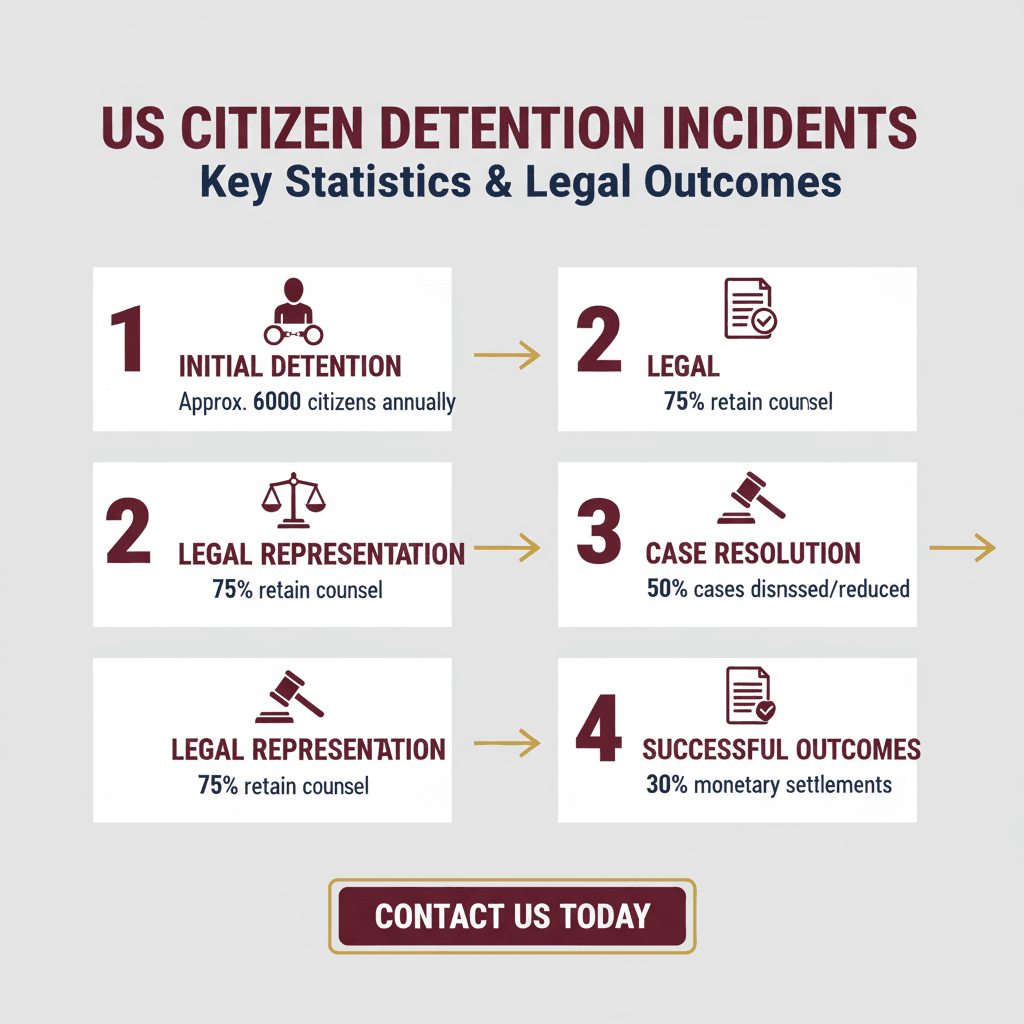
Precise, up-to-date statistics on the number of U.S. citizens mistakenly detained by ICE in 2026 are often difficult to obtain publicly and are subject to ongoing data collection and reporting. While ICE's mandate is to detain non-citizens, incidents of U.S. citizens being held due to errors or mistaken identity do occur. Advocacy groups and legal organizations often track and report on these cases.
What are the most common reasons for wrongful US citizen detention?
Wrongful US citizen detention often stems from database errors, name similarities, or reliance on outdated or incorrect information. Racial profiling and an individual's inability to immediately produce proof of citizenship can also contribute. Sometimes, aggressive enforcement tactics by immigration agents lead to detaining individuals whose citizenship status is not immediately clear, resulting in unlawful holds.
Can a U.S. citizen be detained at an airport by immigration?
Yes, U.S. citizens can be questioned and temporarily detained at airports by Customs and Border Protection (CBP) if there are doubts about their citizenship or if they are suspected of criminal activity. However, prolonged detention for immigration purposes of a confirmed U.S. citizen is unlawful. You have the right to assert your citizenship and request an attorney immediately if this occurs.
What documents should a U.S. citizen carry to avoid detention?
While not legally required to carry proof, having a U.S. passport, birth certificate with photo ID, Certificate of Naturalization, or Certificate of Citizenship can help prevent mistaken US citizen detention. Keep these documents in a safe, accessible place, and inform a trusted family member or attorney of their location for quick access if needed. Digital copies can also be helpful.
What is the process to challenge an unlawful US citizen detention?
Challenging an unlawful US citizen detention typically involves an immigration attorney filing a writ of habeas corpus in federal court. This legal action demands that the government justify the detention or release the individual. The attorney will present evidence of citizenship and argue for immediate release. Prompt legal action is crucial for a successful challenge and swift resolution.
Are there any differences in rights for naturalized vs. birthright citizens?
No, once a person becomes a naturalized U.S. citizen, they possess the exact same rights and responsibilities as a birthright citizen, with very few exceptions (e.g., eligibility for the presidency). Both are equally protected from unlawful US citizen detention by immigration authorities. The Fifth and Fourteenth Amendments guarantee equal protection and due process for all citizens.
Can a U.S. citizen be deported?
No, a U.S. citizen cannot be deported. Deportation is a process reserved for non-citizens who have violated immigration laws. If a U.S. citizen is mistakenly placed in deportation proceedings, it is a grave error that must be immediately challenged by proving their citizenship. The only way a U.S. citizen could lose their status is through denaturalization, which is a rare and distinct legal process.
Sources and References
- U.S. Citizenship and Immigration Services (USCIS)
- Executive Office for Immigration Review (EOIR)
- Fifth Amendment, U.S. Constitution (Cornell Law School)
Ready to take the next step? Contact Vasquez Law Firm today for a free, confidential consultation. We're committed to fighting for your rights and achieving the best possible outcome for your case.
Start Your Free Consultation Now
Call us: 1-844-967-3536
Se Habla Español - Estamos aquí para ayudarle.


William Vasquez
Founder & CEO, Vasquez Law Firm, PLLC
William Vasquez is the founder and CEO of Vasquez Law Firm, PLLC, a results-driven firm specializing in immigration, criminal defense, personal injury, and workers' compensation. A U.S. Air Force veteran and recipient of the Joint Service Achievement Medal, William is dedicated to fiercely fighting for his clients' rights.
Related Legal Services
Need legal help? Learn more about learn about our immigration practice, or contact us for a free evaluation.
You can also visit statewide immigration legal services for more information.