How a Shoplifting Arrest Can Affect Child Custody in NC
Discover the implications of a recent shoplifting arrest in NC that revealed a woman tied up in a suspect’s car. Learn about your rights in family law matters like divorce, child custody, and child support.
Published on December 15, 2025· Updated March 3, 2026
Have questions? Talk to an attorney - free evaluation.
Call 1-844-967-3536How a Shoplifting Arrest Can Affect Child Custody in NC
Understanding the Shocking News: A Woman Found Tied Up in a Suspect’s Car
Going Through a Divorce in NC?
NC requires 1 year of separation. We protect your assets, custody rights, and future.
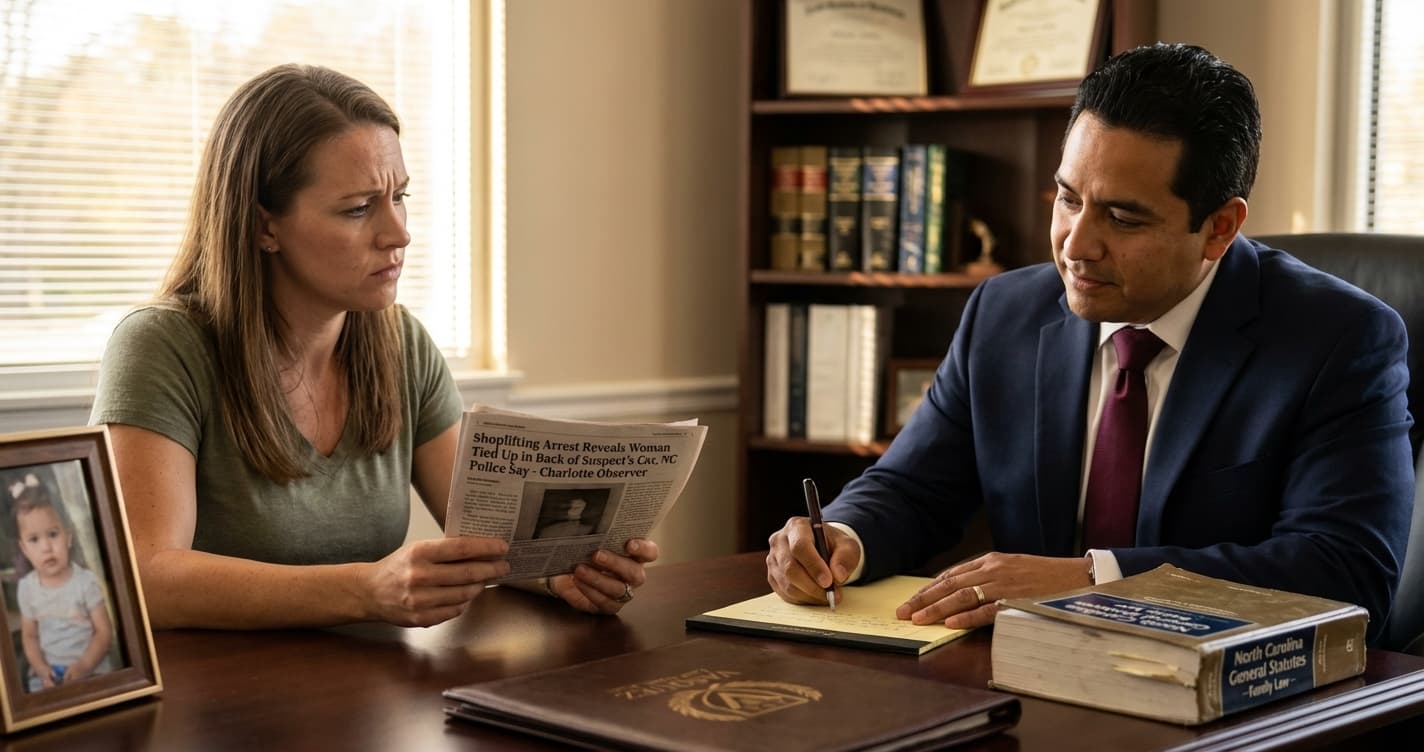
Recently, news broke from the Charlotte Observer about a shoplifting arrest in North Carolina that revealed a woman tied up in the back of a suspect's car. While this incident raises many questions about criminal law, it also sheds light on the potential implications for family law, particularly regarding divorce, child custody, and child support in our state.
Overview of the Legal Issue
Shoplifting is a serious offense in North Carolina, often leading to criminal charges that can have a cascading effect on an individual's personal life, including family dynamics. When criminal activities intersect with family law matters, such as divorce or child custody, the implications can be significant.
What This Means for Families in North Carolina
The incident at hand not only highlights the dangers of criminal behavior but also raises critical questions about the safety and well-being of children involved in such situations. If a parent is arrested or involved in criminal activity, it can impact their custodial rights, child support obligations, and overall family stability.
Client Rights and Options After an Arrest
If you or a loved one has been implicated in a criminal case, it is crucial to understand your legal rights and options. Here are some key points to consider:
- Right to Legal Representation: You are entitled to an attorney. Engaging a skilled divorce or family law lawyer can provide you with guidance tailored to your specific situation.
- Impact on Child Custody: If a parent is arrested, it can lead to immediate concerns about custody arrangements. The court will prioritize the child's welfare when making any custody decisions.
- Child Support Considerations: An arrest can affect a parent's ability to meet child support obligations, which may lead to modifications in existing agreements.
- Separation and Divorce: If the arrest leads to significant changes in the family dynamic, it may prompt discussions about separation or divorce.
Step-by-Step Process Following an Arrest
Here’s a general outline of the steps to take after an arrest that may impact family law matters:
- Contact a Lawyer: Seek legal counsel immediately to discuss the implications of the arrest.
- Assess Custody Arrangements: Evaluate your current custody situation and how it may be affected by the criminal charge.
- Gather Evidence: Collect any relevant documentation that can support your case, especially if custody is contested.
- Prepare for Court: Work with your attorney to prepare your defense and family law arguments, focusing on the best interests of your child.
- Consider Mediation: In some cases, mediation may be a viable option to resolve disputes amicably.
Common Mistakes to Avoid
In the wake of an arrest, individuals can make critical mistakes that may adversely affect their family law cases. Here are some common pitfalls to avoid:
- Ignoring Legal Counsel: Failing to seek professional legal help can lead to poor decision-making.
- Making Incriminating Statements: Avoid discussing the case with anyone except your attorney.
- Neglecting Custody Issues: Don’t assume that your custody rights will remain unchanged after an arrest; address these concerns with urgency.
- Overlooking Financial Obligations: Ensure that child support payments are maintained to avoid further complications.
How Vasquez Law Firm Can Help
At Vasquez Law Firm, we understand the challenges that arise when criminal charges intersect with family law. Our experienced attorneys are committed to providing personalized legal support to help you navigate these complex issues. We offer bilingual services, ensuring that all families in North Carolina can receive the guidance they need.
Whether you're facing a divorce, child custody dispute, or need assistance with child support modifications, we are here to help. Our firm prides itself on being a trusted authority in family law, and we are dedicated to advocating for your rights and the best interests of your children.
Frequently Asked Questions
What happens to child custody if a parent is arrested?
If a parent is arrested, the court will evaluate the situation to determine if the arrest affects the child's safety and well-being. Depending on the circumstances, custody arrangements may be modified.
Can an arrest impact child support payments?
An arrest can affect a parent's ability to meet child support obligations, which could lead to modifications in the support arrangement. It's crucial to address these issues with legal counsel.
What legal rights do I have during a criminal investigation?
You have the right to remain silent, the right to legal counsel, and the right to a fair trial. It's essential to seek legal representation to ensure your rights are protected.
Contact Us for a Free Consultation
What Are My Options in Family Court?
Answer 3 questions to understand your rights
Question 1 / 3
What family legal issue are you facing?
If you or someone you know is facing legal challenges related to family law or criminal charges in North Carolina, don’t hesitate to reach out. Contact Vasquez Law Firm today at (phone) for a free consultation. Our experienced attorneys are ready to assist you. Se Habla Español.
Divorce in North Carolina: Understanding Your Legal Rights
Divorce is never easy, but understanding your legal rights and the process can help you navigate this difficult time with greater confidence. North Carolina's divorce laws are designed to ensure fair and equitable outcomes, though the specific facts of your case will determine what "fair" looks like for you.
North Carolina Divorce Basics
Keep Reading
North Carolina requires a one-year separation period before granting an absolute divorce. During this period:
- You and your spouse must live in separate residences
- At least one of you must intend the separation to be permanent
- The separation need not be mutual—one spouse initiating it suffices
- Reconciliation resets the one-year clock
Related divorce matters—property division, alimony, child custody, and child support—are legally separate from the divorce itself and must be pursued separately (or agreed upon in a separation agreement before the divorce is finalized).
Division of Marital Property
North Carolina divides marital property under the equitable distribution standard, which means fair rather than necessarily equal. The court considers:
- Each spouse's income and earning capacity
- Duration of the marriage
- Contributions to the marital estate, including non-financial contributions
- Each spouse's economic circumstances following the divorce
- Custodial parent's need to use or own the family home
Child Custody and Support
North Carolina courts decide child custody based exclusively on the best interests of the child. Judges evaluate the quality of each parent's relationship with the child, each parent's ability to provide stability and meet the child's needs, the child's preferences (given appropriate weight based on maturity), and any history of domestic violence or substance abuse. Child support is calculated using NC's Child Support Guidelines, which consider each parent's income, number of children, and childcare and health insurance costs.
Alimony in North Carolina
Alimony is available to a dependent spouse—one who is substantially dependent on the supporting spouse for maintenance. Courts consider the marital standard of living, each spouse's income and assets, contributions to the marriage (including homemaking and child-rearing), and marital misconduct (which can bar alimony for a dependent spouse who committed adultery). Alimony can be permanent, term-limited, or rehabilitative.
Protecting Your Interests During Divorce
Taking proactive steps to protect yourself during divorce proceedings is critical:
- Consult with a family law attorney before taking any significant action
- Document all marital assets and debts with financial statements and account records
- Avoid major financial decisions during the divorce process without consulting your attorney
- Maintain detailed records of all communications with your spouse about property, children, and finances
- Be cautious about social media activity, which can be used as evidence in custody and property proceedings
Frequently Asked Questions About Divorce in NC
Can I speed up the divorce process in North Carolina?
The one-year separation requirement cannot be waived. However, once the year has passed, an uncontested divorce can proceed relatively quickly—sometimes in as little as 60-90 days after filing, depending on the court's schedule.
What is a Separation Agreement and do I need one?
A Separation Agreement is a legally binding contract between spouses that resolves all or some of the issues arising from the breakdown of the marriage. While not required, a well-drafted Separation Agreement can provide certainty, privacy, and efficiency compared to litigating all issues in court. An attorney can help draft an agreement that fully protects your rights and interests.
Vasquez Law Firm: Divorce and Family Law in North Carolina
Whether your divorce is straightforward or involves complex property, custody, or support disputes, Vasquez Law Firm's family law attorneys are here to guide you through every step. We serve clients throughout North Carolina including Raleigh, Charlotte, Smithfield, and Durham. Se Habla Español. Contact us for a free consultation.
Related Topics

William Vasquez
Founder & CEO, Vasquez Law Firm, PLLC
William Vasquez is the founder and CEO of Vasquez Law Firm, PLLC, a results-driven firm specializing in immigration, criminal defense, family law, personal injury, and workers' compensation. A U.S. Air Force veteran and recipient of the Joint Service Achievement Medal, William is dedicated to fiercely fighting for his clients' rights.