NC Workers' Compensation: What You Need to Know in 2026
Injured at work in North Carolina? Understand your workers' compensation rights and how to file a claim in 2026. Contact Vasquez Law Firm for a free consultation today.
Published on March 10, 2026

Have questions? Talk to an attorney - free evaluation.
Call 1-844-967-3536Hurt on the Job? Claim What You Are Owed
Free review of your workers' comp claim - we handle the fight.
NC Workers' Compensation: What You Need to Know in 2026
Suffering a workplace injury can turn your life upside down, impacting your health, finances, and future. In North Carolina, the workers' compensation system is designed to provide financial and medical benefits to employees injured on the job, regardless of fault. However, navigating this complex system, especially concerning specific injuries or claim denials, requires a clear understanding of your rights and the legal process. This guide provides essential information on workers' compensation in North Carolina as of 2026, helping you understand what steps to take to protect your claim and secure the benefits you deserve.
Need help with your workers' compensation case? Our experienced North Carolina attorneys are ready to fight for you. Se Habla Español.
Schedule Your Free Consultation
Or call us now: 1-844-967-3536
Quick Answer
If you're injured at work in North Carolina, workers' compensation provides medical care, wage replacement, and disability benefits. You must report the injury promptly to your employer and file a claim with the North Carolina Industrial Commission. Seeking legal guidance can significantly improve your chances of a successful claim.
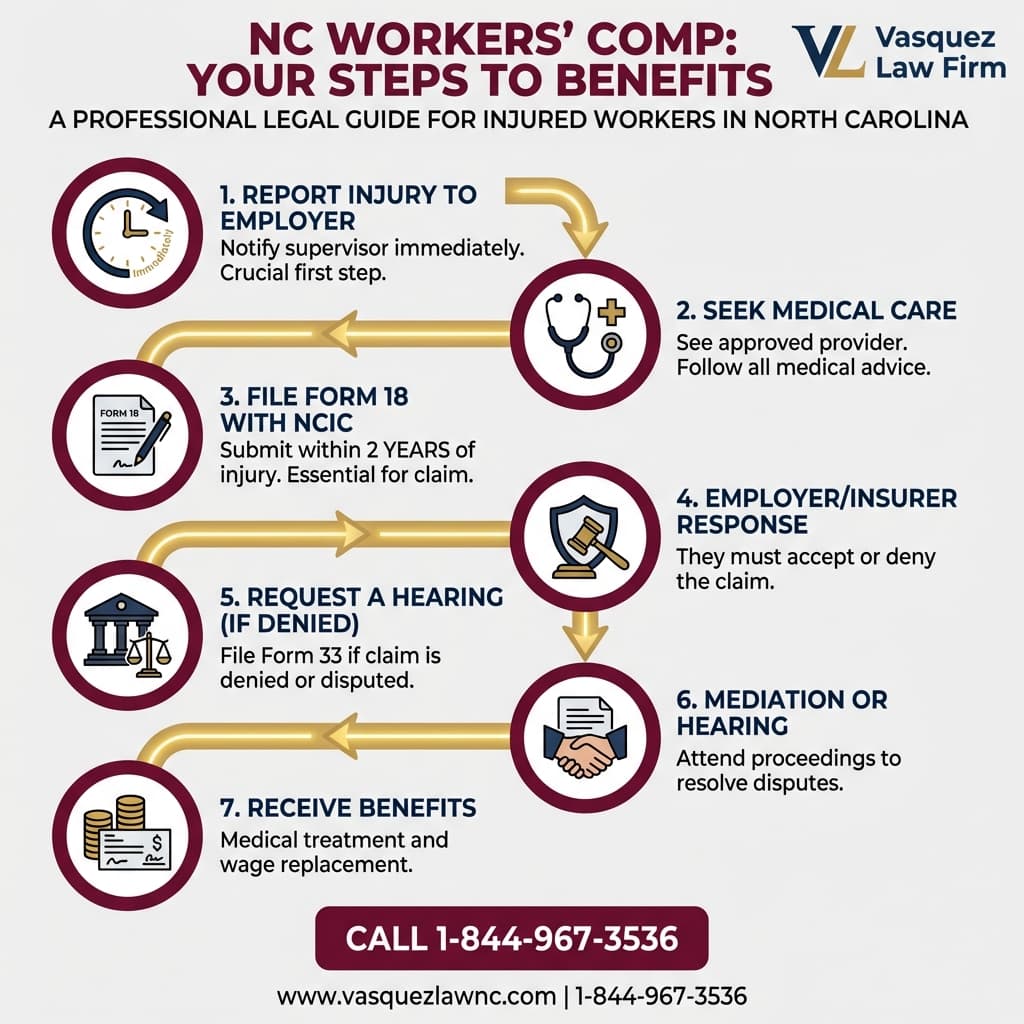
- Report your injury to your employer immediately.
- Seek medical attention for your injuries.
- File a Form 18 or Form 18B with the NC Industrial Commission.
- Keep detailed records of all medical treatments and communications.
- Consider consulting with a North Carolina workers' compensation lawyer.
Understanding NC Workers' Compensation: Your Rights in 2026
Imagine you're working a routine shift in Smithfield, North Carolina, when suddenly, a slip-and-fall accident leaves you with a serious back injury. What happens next? In North Carolina, the North Carolina Workers' Compensation Act provides a no-fault insurance system to cover medical expenses and lost wages for employees injured on the job. This means that you can receive benefits even if the accident was partially your fault, as long as it occurred within the scope of your employment.
As of 2026, understanding your rights under this Act is crucial. Many workers incorrectly assume their employer will automatically handle everything, but the burden often falls on the injured employee to navigate the initial steps. This includes timely reporting of the injury and understanding the types of benefits available, which typically cover medical treatment, temporary or permanent disability payments, and vocational rehabilitation services.
For example, if you suffer a repetitive stress injury over time, such as carpal tunnel syndrome from years of data entry, this can also qualify as a compensable injury under North Carolina law. The key is demonstrating that the injury arose out of and in the course of your employment. This legal standard is often a point of contention in workers' compensation claims, making it essential to gather all relevant evidence and documentation from the outset.
Step-by-step: What to do After a Workplace Injury in North Carolina
When an accident happens at work, taking immediate and precise action is critical to protecting your workers' compensation claim. For instance, if a construction worker in Smithfield falls from scaffolding and breaks a leg, the first priority is medical attention, followed swiftly by reporting the incident. Missing key steps can jeopardize your ability to receive benefits.
- Seek Immediate Medical Attention: Your health is paramount. Get emergency care if necessary, or see a doctor as soon as possible. Be clear that your injury is work-related.
- Report the Injury to Your Employer: Notify your employer in writing as soon as possible, but no later than 30 days after the accident or diagnosis of an occupational disease. This formal notice is a legal requirement under North Carolina General Statute § 97-22.
- File a Claim with the NC Industrial Commission: Complete and submit Form 18 (Notice of Accident to Employer and Claim of Employee) or Form 18B (Notice of Occupational Disease) to the NC Industrial Commission within two years of the injury or diagnosis. This is the official start of your claim.
- Follow Medical Advice: Attend all appointments, follow prescribed treatments, and do not miss physical therapy sessions. Your adherence to medical care can significantly impact your recovery and the perception of your claim.
- Document Everything: Keep detailed records of doctor visits, prescriptions, mileage to appointments, lost wages, and all communications with your employer and their insurance carrier.
- Consult a Workers' Compensation Lawyer: An experienced North Carolina workers' compensation attorney can guide you through the process, ensure deadlines are met, and advocate for your rights, especially if your claim is denied or disputed.
Essential Documents and Evidence for Your Claim
To build a strong workers' compensation claim in North Carolina, collecting and organizing specific documents is crucial. Consider a truck driver in Smithfield who suffered whiplash and a herniated disc after being rear-ended while on a delivery route. The success of their claim will heavily rely on the thoroughness of their documentation.
- Employer Incident Report: A copy of the formal report you submitted to your employer detailing the accident.
- Medical Records: All reports, diagnoses, treatment plans, prescriptions, and bills related to your work injury. This includes records from emergency rooms, specialists, and rehabilitation centers.
- Wage Statements: Pay stubs or other documentation proving your average weekly wage prior to the injury. This is essential for calculating lost wage benefits.
- Witness Statements: Contact information and written statements from anyone who witnessed your accident or can attest to your working conditions.
- Communication Logs: A detailed log of all conversations, emails, and letters exchanged with your employer, their insurance company, and medical providers.
- Travel Expenses: Receipts or mileage logs for travel to medical appointments.
- Photos or Videos: Any visual evidence of the accident scene, your injuries, or hazardous conditions at the workplace.
- Proof of Claim Filing: Confirmation that your Form 18 or Form 18B was successfully filed with the NC Industrial Commission.
Timeline: What to Expect in an NC Workers' Compensation Case
Understanding the typical timeline for a North Carolina workers' compensation claim can help manage expectations and ensure you meet critical deadlines. While every case is unique, a general sequence of events often unfolds, from injury to resolution. For example, a teacher in Smithfield who sustained a knee injury breaking up a fight might see their case progress through several distinct stages.
- Day 1-30: Injury and Reporting: You must report your injury to your employer within 30 days.
- Within 2 Years: Filing Your Claim: You have two years from the date of injury or diagnosis to file Form 18 or Form 18B with the NC Industrial Commission.
- Weeks 1-6: Initial Investigation and Decision: The employer's insurance carrier will investigate the claim. They typically have 14-30 days to accept or deny the claim after receiving notice.
- Ongoing: Medical Treatment and Temporary Benefits: If your claim is accepted, you will receive medical treatment and potentially temporary total disability benefits if you are out of work.
- Months 3-12+: Reaching Maximum Medical Improvement (MMI): Treatment continues until you reach MMI, meaning your condition has stabilized and no further significant improvement is expected.
- After MMI: Permanent Impairment Rating: Your doctor will assess any permanent impairment, which can lead to permanent partial disability benefits.
- Negotiation or Hearing: If benefits are disputed, you may enter into negotiations for a settlement or proceed to a hearing before the NC Industrial Commission. This phase can vary greatly in length, from a few months to over a year, depending on the complexity and willingness of both parties to settle.
Costs and Fees: What Impacts the Price of Legal Help
Many injured workers in North Carolina worry about the cost of hiring a workers' compensation attorney. For instance, a factory worker in Smithfield facing mounting medical bills and lost wages might feel hesitant to add legal fees to their financial stress. However, most workers' compensation lawyers, including Vasquez Law Firm, operate on a contingency fee basis.
This means you typically do not pay any upfront fees. Instead, your attorney's fees are a percentage of the benefits they recover for you, whether through a settlement or an award at a hearing. If your attorney doesn't recover benefits, you generally don't owe them a fee. This arrangement makes legal representation accessible to everyone, regardless of their current financial situation.
The specific percentage for contingency fees in North Carolina workers' compensation cases is regulated by the NC Industrial Commission and is usually capped at 25% of the total compensation recovered. Factors that can influence the overall cost of a claim, and thus the attorney's fee, include the complexity of the case, the amount of medical evidence required, the need for expert witness testimony, and whether the case proceeds to a formal hearing or mediation. These factors determine the amount of time and resources your attorney must invest.
Common Mistakes and How to Avoid Them in NC Workers' Comp Claims
Navigating a workers' compensation claim can be fraught with pitfalls. For example, a retail employee in Smithfield who delays reporting a recurring shoulder injury might find their claim denied due to late notice. Avoiding common errors is crucial for a successful outcome.
- Delaying Reporting Your Injury: Waiting too long can lead to denial, as it raises questions about the injury's origin. Report it immediately in writing.
- Not Seeking Medical Attention: Failing to see a doctor promptly can undermine your claim, suggesting the injury isn't serious or work-related. Always prioritize medical care.
- Failing to File a Formal Claim: Simply telling your employer is not enough. You must file Form 18 or Form 18B with the NC Industrial Commission within the two-year statute of limitations.
- Giving Recorded Statements Without Legal Counsel: Insurance adjusters may try to get you to say things that can be used against your claim. Never give a recorded statement without first consulting an attorney.
- Not Following Doctor's Orders: Deviating from prescribed treatment or missing appointments can be used by the insurance company to argue your injuries are not severe or that you are not cooperating with treatment.
- Returning to Work Too Soon or Against Medical Advice: This can exacerbate your injury and complicate your claim for lost wages or disability benefits. Follow your doctor's restrictions.
- Failing to Document Everything: Lack of detailed records for medical visits, communications, and expenses can weaken your case. Keep meticulous documentation.
- Accepting a Settlement Without Legal Review: Insurers often offer lowball settlements early on. An attorney can assess the true value of your claim and negotiate effectively.
If you only remember one thing: Report your injury in writing to your employer immediately and file your official claim with the NC Industrial Commission within two years. Then, seek legal advice from a North Carolina workers' compensation lawyer.
NC Notes: Specifics for North Carolina Claims
North Carolina's workers' compensation system, governed by the NC Industrial Commission, has specific rules that differ from other states. For instance, employees generally do not have the right to choose their own doctor initially; the employer or insurer designates the treating physician. Any change in medical provider usually requires approval from the employer, insurer, or the Industrial Commission. Furthermore, North Carolina law mandates that most employers with three or more employees carry workers' compensation insurance, with some exceptions for agricultural workers and domestic servants.
The state also has a specific definition for what constitutes an "injury by accident" or an "occupational disease." An injury by accident must be a specific traumatic incident, not merely the result of ordinary work activities. Occupational diseases, on the other hand, are diseases arising out of and in the course of employment that are characteristic of and peculiar to a particular trade, occupation, or employment. These distinctions are critical for establishing eligibility for workers' compensation benefits in North Carolina and often require careful legal interpretation.
When to Call a North Carolina Workers' Compensation Lawyer Now
While some straightforward workers' compensation claims may resolve without legal intervention, many situations warrant immediate legal counsel. For example, if you're a municipal worker in Smithfield and your workers' compensation claim is outright denied, or if the insurer is delaying medical approvals, it's time to speak with an attorney.
- Your workers' compensation claim has been denied.
- The insurance company is delaying or refusing medical treatment.
- You disagree with the doctor chosen by the insurance company or employer.
- Your employer is retaliating against you for filing a claim.
- You are unable to return to your previous job due to your injury.
- You have been offered a settlement, but you are unsure if it's fair.
- Your injuries are severe, leading to long-term disability or permanent impairment.
- You are facing a hearing or mediation with the NC Industrial Commission.
- You have a pre-existing condition that the insurer is using to deny your claim.
- You are confused by the paperwork or the legal process involved.
About Vasquez Law Firm
At Vasquez Law Firm, we combine compassion with aggressive representation. Our motto "Yo Peleo" (I Fight) reflects our commitment to standing up for your rights. We understand that a workplace injury can be a deeply personal and financially devastating experience, and our team is dedicated to providing personalized attention to every client.
- Bilingual Support: Se Habla Español - our team is fully bilingual and ready to assist clients in both English and Spanish, ensuring clear communication.
- Service Areas: We proudly serve clients throughout North Carolina, including Smithfield, and also provide immigration services across Florida and nationwide.
- Experience: Attorney Vasquez brings over 15 years of dedicated experience to complex legal matters, including workers' compensation, personal injury, and immigration law.
- Results: Our firm has a strong track record of achieving favorable outcomes, helping thousands of clients secure the compensation and justice they deserve.
Attorney Trust and Experience
Attorney Vasquez holds a Juris Doctor degree and is admitted to practice in both the North Carolina State Bar and Florida Bar. With over 15 years of dedicated legal experience, he has built a reputation for providing personalized attention and achieving favorable outcomes for his clients. He is committed to fighting tirelessly for the rights of injured workers, understanding the intricate details of North Carolina workers' compensation law to advocate effectively on your behalf.
Don't face your legal challenges alone. Our team is here to help you every step of the way, providing expert legal counsel and unwavering support.
Call today: 1-844-967-3536 | Se Habla Español
Frequently Asked Questions
What types of injuries are covered by NC workers' compensation?
North Carolina workers' compensation covers injuries sustained "by accident" arising out of and in the course of employment, as well as occupational diseases. This includes specific traumatic incidents, repetitive stress injuries, and illnesses directly caused or aggravated by work. Injuries that are self-inflicted or result from intoxication are typically not covered. It's crucial that your injury is clearly linked to your work duties.
How long do I have to report a workplace injury in North Carolina?
You must report your workplace injury to your employer in writing as soon as practicable, and no later than 30 days from the date of the accident or diagnosis of an occupational disease. Failure to provide timely notice can jeopardize your claim, potentially leading to a denial of benefits. Prompt reporting ensures your employer is aware and can take necessary steps.
Can I choose my own doctor for an NC workers' comp claim?
Generally, in North Carolina, the employer or their insurance carrier has the right to select the treating physician for your workers' compensation injury. If you wish to change doctors, you usually need to obtain approval from the employer, the insurer, or the NC Industrial Commission. Seeking unauthorized medical treatment may result in those costs not being covered by your claim.
What if my North Carolina workers' compensation claim is denied?
If your claim is denied, you have the right to appeal the decision by filing a request for a hearing with the NC Industrial Commission. It is highly recommended to seek legal counsel from a workers' compensation attorney at this stage. An attorney can help you understand the reasons for denial, gather additional evidence, and represent you effectively during the appeals process.
How are lost wages calculated in NC workers' compensation?
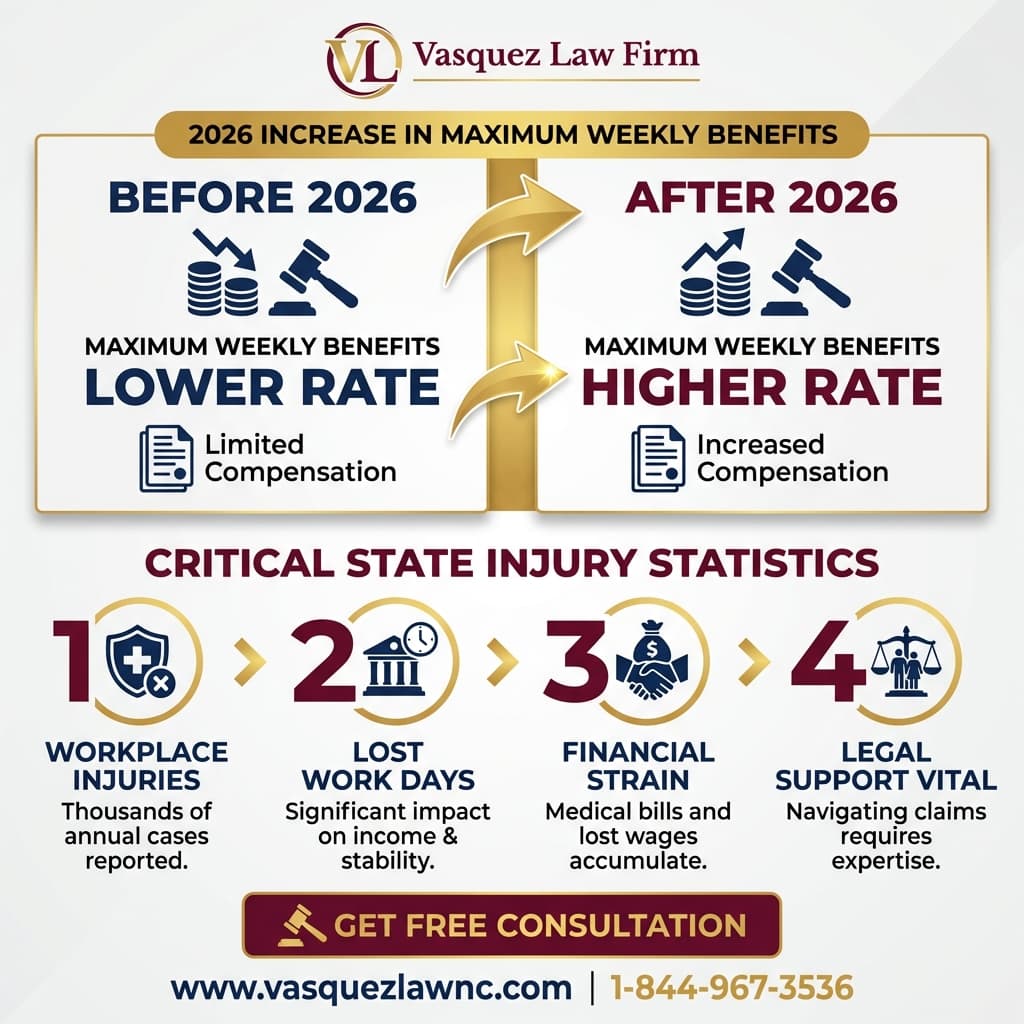
Temporary total disability (TTD) benefits in North Carolina are typically two-thirds of your average weekly wage, subject to a statewide maximum. This calculation is based on your earnings for the 52 weeks prior to your injury. These benefits are paid while you are temporarily unable to work due to your injury. Accurate wage documentation is essential for correct benefit calculation.
What is Maximum Medical Improvement (MMI) in NC workers' comp?
Maximum Medical Improvement (MMI) is the point at which your treating physician determines that your medical condition has stabilized and no further significant improvement is expected from treatment. Once you reach MMI, your doctor will assess any permanent impairment. This assessment is crucial for determining eligibility for permanent partial disability benefits.
Can I be fired for filing a workers' compensation claim in North Carolina?
North Carolina law prohibits employers from retaliating against an employee for filing a workers' compensation claim in good faith. If you believe you were terminated or faced adverse employment action because you filed a claim, you may have grounds for a wrongful termination lawsuit in addition to your workers' compensation case. Document any instances of retaliation carefully.
What is the role of the NC Industrial Commission?
The North Carolina Industrial Commission (NCIC) is the state agency responsible for administering the Workers' Compensation Act. It oversees claims, resolves disputes, approves settlements, and conducts hearings. The NCIC ensures that benefits are paid correctly and that both employers and employees adhere to the state's workers' compensation laws. They provide forms and procedural guidelines.
Are psychological injuries covered by NC workers' compensation?
Psychological injuries can be covered by North Carolina workers' compensation, but they are generally more challenging to prove than physical injuries. Typically, a psychological injury must be directly caused by a physical injury that arose out of and in the course of employment, or be the result of an unusual and extraordinary work event. Purely mental stress claims without a physical component are rarely compensable.
How long does a North Carolina workers' compensation case take?
The duration of a North Carolina workers' compensation case varies significantly based on factors like injury severity, claim acceptance, and dispute resolution. Straightforward claims might resolve in a few months, while complex cases involving denials, multiple hearings, or significant permanent disability can take over a year or even several years to reach a final resolution. Legal representation can help expedite the process.
Sources and References
- North Carolina Industrial Commission
- Cornell Law School - Workers' Compensation
- North Carolina General Statutes Chapter 97
Ready to take the next step? Contact Vasquez Law Firm today for a free, confidential consultation. We're committed to fighting for your rights and achieving the best possible outcome for your case.
Start Your Free Consultation Now
Call us: 1-844-967-3536
Se Habla Español - Estamos aquí para ayudarle.

William Vasquez
Founder & CEO, Vasquez Law Firm, PLLC
William Vasquez is the founder and CEO of Vasquez Law Firm, PLLC, a results-driven firm specializing in immigration, criminal defense, personal injury, and workers' compensation. A U.S. Air Force veteran and recipient of the Joint Service Achievement Medal, William is dedicated to fiercely fighting for his clients' rights.
Related Legal Services
Need legal help? Learn more about learn about workers compensation rights, or contact us for a free evaluation.
You can also visit statewide workers comp services for more information.