North Carolina Workers Compensation Payouts: What to Expect in 2026
Understand NC workers compensation payout calculations and your rights in 2026. Get a free consultation from Vasquez Law Firm.
Published on March 8, 2026
Hurt on the job?
Free review of your workers' comp claim.
Free & confidential · Se habla espanol · 24/7
Have questions? Talk to an attorney - free evaluation.
Call 1-844-967-3536Hurt on the Job? Claim What You Are Owed
A review of your workers' comp claim - we handle the fight.
North Carolina Workers Compensation Payouts: What to Expect in 2026
Navigating a workplace injury in North Carolina can be overwhelming, especially when trying to understand your potential workers compensation payout. Many injured workers wonder how much their claim is worth and what factors influence the final settlement amount. As of 2026, the North Carolina Workers' Compensation Act provides specific guidelines for calculating benefits, including temporary and permanent disability, medical expenses, and vocational rehabilitation. Understanding these components is crucial for protecting your rights and ensuring you receive fair compensation. Our dedicated team at Vasquez Law Firm is here to help you understand every aspect of your workers compensation payout, fighting aggressively for the benefits you deserve.
Need help with your workers compensation case? Our experienced North Carolina attorneys are ready to fight for you. Se Habla Español.
Schedule Your Free Case Evaluation
Or call us now: 1-844-967-3536
Quick Answer
A North Carolina workers compensation payout can cover medical expenses, lost wages (temporary or permanent disability), and vocational rehabilitation. The amount is calculated based on your average weekly wage and the severity of your injury, often involving an impairment rating. Settlements can be paid as a lump sum or structured payments, depending on the case and agreement.
- Medical treatment costs
- Lost wages (temporary total, temporary partial, permanent partial, permanent total disability)
- Vocational rehabilitation services
- Lump sum or structured settlement options
- Factors like average weekly wage and impairment rating
Understanding North Carolina Workers Compensation Payouts in 2026
In 2026, the North Carolina Industrial Commission (NCIC) oversees all workers' compensation claims, ensuring compliance with the state's Workers' Compensation Act. For instance, if a Smithfield construction worker suffers a back injury, their potential payout isn't just a random number; it's determined by specific legal frameworks. These frameworks consider factors like the nature and extent of the injury, the worker's average weekly wage prior to the injury, and whether the injury results in temporary or permanent disability.
The primary goal of a workers compensation payout is to make the injured worker whole again, as much as possible, by covering financial losses and medical costs. This includes not only direct medical treatment but also rehabilitation and, in some cases, compensation for permanent impairment. Understanding how these calculations are made is essential, as employers and their insurance carriers often try to minimize their financial liability.
The system distinguishes between various types of benefits. Temporary disability benefits, for example, replace a portion of lost wages while you are recovering. Permanent disability benefits, on the other hand, compensate for lasting impairments. Navigating these distinctions and ensuring proper classification is a critical step in securing a fair payout.
Types of Workers Compensation Benefits You Can Receive
When you file a workers' compensation claim in North Carolina, you might be eligible for several types of benefits, each designed to address different aspects of your injury and its impact. Imagine an office worker in Raleigh who develops carpal tunnel syndrome due to repetitive motion. Their benefits would likely include medical care, but also compensation for time missed from work.
Medical benefits cover all necessary and reasonable medical treatment related to the work injury. This can include doctor visits, surgeries, medications, physical therapy, and even mileage to and from appointments. There is generally no co-pay or deductible for approved medical care under workers' compensation in North Carolina.
Wage loss benefits, often called disability benefits, come in several forms:
- Temporary Total Disability (TTD): Paid when you are completely unable to work for a temporary period. In North Carolina, this is typically two-thirds of your average weekly wage, subject to a maximum weekly amount set by the NC Industrial Commission for 2026.
- Temporary Partial Disability (TPD): If you can return to work but earn less than before your injury, you may receive two-thirds of the difference between your pre-injury and post-injury wages, up to the maximum weekly rate.
- Permanent Partial Disability (PPD): This compensates you for the permanent impairment to a body part, even if you can return to your previous job. It's calculated based on a schedule of specific body parts and an impairment rating assigned by a doctor.
- Permanent Total Disability (PTD): Reserved for severe injuries that permanently prevent you from working in any capacity. These benefits are paid for life.
Additionally, vocational rehabilitation services may be available to help you return to work, which could include job placement assistance, training, or education. These benefits are crucial for long-term recovery and re-entry into the workforce after a significant injury.
Calculating Your Workers Compensation Payout: Factors and Formulas
Determining the exact value of a workers compensation payout involves several key calculations and considerations. For example, if a textile worker in Gastonia loses a finger in a machine accident, the payout for that specific injury is outlined in the North Carolina General Statutes. The primary factor in calculating wage loss benefits is your average weekly wage (AWW).
Your AWW is generally calculated by taking your total gross wages for the 52 weeks prior to your injury and dividing by 52. If you worked less than 52 weeks, or if your wages fluctuated significantly, other methods may be used to ensure a fair calculation. This AWW then forms the basis for your temporary total disability benefits, which are typically two-thirds of your AWW, up to the state's maximum weekly amount for 2026.
For permanent partial disability (PPD) benefits, the calculation is more complex. A doctor assigns an impairment rating, which is a percentage reflecting the permanent loss of use of a body part or function. This rating is then applied to a statutory number of weeks assigned to that specific body part by the North Carolina Industrial Commission. For example, the statute assigns a specific number of weeks for the loss of an arm, a leg, or a finger. The formula is: AWW x 2/3 x impairment rating percentage x statutory number of weeks.
It's important to note that the impairment rating payout calculator North Carolina uses is based on medical evidence and specific legal tables. Disagreements over impairment ratings are common and can significantly impact your potential workers compensation payout. This is where an experienced attorney can be invaluable, ensuring your rating accurately reflects your condition.
The Settlement Process and When to Expect an Offer
Many injured workers ask, "When will workers' comp offer a settlement?" The timing of a workers compensation settlement offer can vary widely depending on the complexity of your case and the severity of your injury. A Charlotte warehouse worker who suffers a minor sprain might receive an offer relatively quickly, while a worker with a traumatic brain injury could wait years.
Generally, a settlement offer may come once your medical treatment has stabilized, and your doctor has determined you've reached Maximum Medical Improvement (MMI). MMI means your condition is not expected to improve further, though you may still require ongoing care. At this point, your doctor can assign a permanent impairment rating, which is a key component in valuing your claim.
Settlements in North Carolina are typically formalized through a Full and Final Compromise Settlement Agreement, which must be approved by the NC Industrial Commission. This agreement usually closes out all future rights to benefits, including medical care, so it's a significant decision. Before signing any settlement, it is critical to understand what you are giving up and whether the offer truly reflects the full value of your claim.
Insurance companies are not always proactive in offering fair settlements. They often aim to settle for the lowest possible amount. Having a skilled attorney during this phase can level the playing field, ensuring that all your current and future needs, including potential future medical expenses and lost earning capacity, are factored into the negotiation for your workers compensation payout. Learn more about delays in workers' comp claims.
Don't face your legal challenges alone. Our team is here to help you every step of the way.
Call today: 1-844-967-3536 | Se Habla Español
Maximizing Your Workers Compensation Payout: Tips and Strategies
Securing the maximum possible workers compensation payout requires strategic action from the moment of injury. For instance, a construction worker in Fayetteville who properly documents their injury and seeks immediate medical attention is in a much stronger position than someone who delays reporting. Every step you take, or fail to take, can impact your claim's value.
Here are crucial tips to strengthen your case:
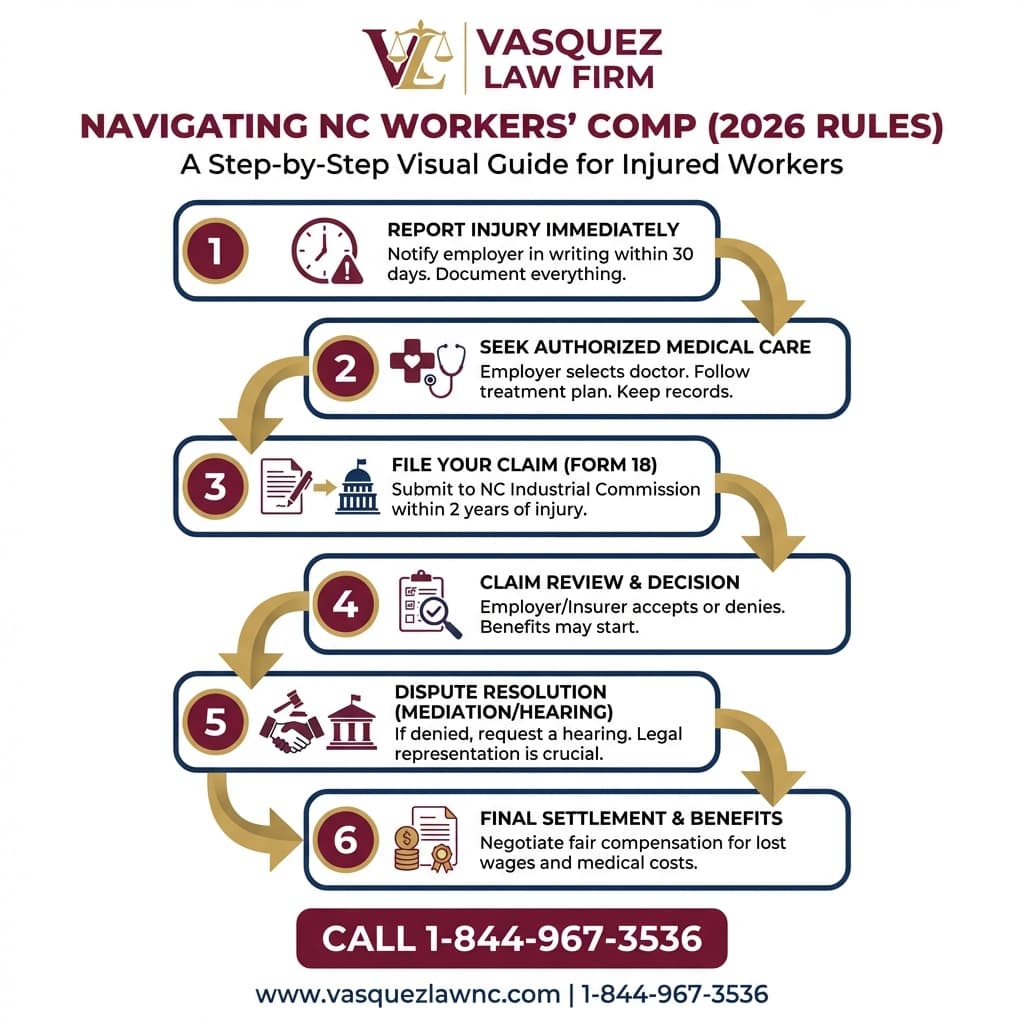
- Report Your Injury Immediately: North Carolina law requires you to notify your employer within 30 days of the accident or diagnosis. Delaying this can jeopardize your claim.
- Seek Prompt Medical Attention: Follow all doctor's orders and attend all appointments. Gaps in treatment can be used by the insurance company to argue your injury isn't serious or work-related.
- Document Everything: Keep detailed records of all medical appointments, mileage, lost wages, and communications with your employer or the insurance company. This documentation is vital evidence.
- Do Not Give Recorded Statements Without Legal Counsel: Insurance adjusters may try to get you to say things that could hurt your claim. Always consult with an attorney before providing any recorded statements.
- Understand Your Impairment Rating: If you receive a low impairment rating that doesn't reflect your true condition, an attorney can help you seek a second opinion or challenge the rating.
- Avoid Social Media Posts: Anything you post online, even personal photos, can be used by the insurance company to discredit your injury claims.
- Consult a Workers' Compensation Attorney: An attorney can guide you through the complex legal process, negotiate with the insurance company, and represent you before the NC Industrial Commission, significantly increasing your chances of a fair workers compensation payout.
Remember, the insurance company's goal is to minimize your payout. Your goal should be to protect your rights and secure the compensation you deserve. Consider how psychological injuries impact workers' comp.
Common Mistakes That Can Reduce Your Workers Compensation Payout
Even a minor misstep can significantly reduce the workers compensation payout you receive. A truck driver in Greensboro who misses a doctor's appointment might unknowingly weaken their claim. Avoiding these common errors is as important as taking the right steps.
- Failing to Report the Injury on Time: Waiting too long to inform your employer can lead to your claim being denied outright. Report it in writing as soon as possible.
- Not Seeking Medical Treatment Promptly: Delays create a perception that your injury is not serious or that it wasn't caused by your work.
- Failing to Follow Medical Advice: If you don't adhere to your doctor's treatment plan, the insurance company may argue you are not doing your part to recover, potentially reducing benefits.
- Giving a Recorded Statement Without an Attorney: Insurance adjusters are trained to ask leading questions that can be used against you. Always have legal representation before speaking to them.
- Returning to Work Too Soon or Against Doctor's Orders: This can exacerbate your injury and complicate your claim for lost wages or permanent disability.
- Failing to Disclose Pre-Existing Conditions: While a pre-existing condition doesn't automatically disqualify you, failing to disclose it can harm your credibility.
- Signing Documents Without Understanding Them: Never sign any settlement agreement or medical release forms without a thorough review by your attorney.
- Not Hiring an Attorney: Trying to navigate the complex North Carolina workers' compensation system alone often results in a significantly lower payout than with legal representation.
If you only remember one thing: Always prioritize your health and consult with an experienced North Carolina workers' compensation attorney as early as possible to protect your rights and maximize your workers compensation payout.
About Vasquez Law Firm
At Vasquez Law Firm, we combine compassion with aggressive representation. Our motto "Yo Peleo" (I Fight) reflects our commitment to standing up for your rights. We understand the physical, emotional, and financial toll a workplace injury can take on you and your family. That's why we dedicate ourselves to fighting tirelessly for the maximum workers compensation payout you deserve in North Carolina.
- Bilingual Support: Se Habla Español - our team is fully bilingual, ensuring clear communication and understanding throughout your legal journey.
- Service Areas: We proudly serve injured workers across North Carolina, including Smithfield, Raleigh, Charlotte, Fayetteville, and Greensboro.
- Experience: With over 15 years of dedicated legal experience, Attorney Vasquez has a proven track record of successfully handling complex workers' compensation claims.
- Results: We strive to achieve favorable outcomes for our clients, helping thousands recover the compensation they need to rebuild their lives.
Attorney Trust and Experience
Attorney Vasquez holds a Juris Doctor degree and is admitted to practice in the North Carolina State Bar. With over 15 years of dedicated legal experience, he has built a reputation for providing personalized attention and achieving favorable outcomes for his clients. His deep understanding of North Carolina workers' compensation law makes him a formidable advocate for injured workers. He is committed to fighting for your workers compensation payout, just as he would for his own family.
Don't face your legal challenges alone. Our team is here to help you every step of the way.
Call today: 1-844-967-3536 | Se Habla Español
Frequently Asked Questions
What's the most you can get from a workers' comp settlement in North Carolina?
The maximum workers compensation payout in North Carolina varies significantly based on factors like the severity of your injury, your average weekly wage, and the extent of your permanent disability. While there isn't a single cap, benefits for temporary total disability are capped weekly. Permanent total disability benefits can be paid for life. An attorney can help estimate your potential maximum payout.
How is an impairment rating payout calculated in North Carolina?
In North Carolina, an impairment rating payout is calculated by taking two-thirds of your average weekly wage, multiplying it by your assigned impairment rating percentage, and then multiplying that by the statutory number of weeks assigned to the specific body part. This calculation determines the value for permanent partial disability (PPD) benefits.
When will workers' comp offer a settlement for my injury?
Workers' compensation insurance companies typically offer a settlement once your medical treatment has stabilized, and you've reached Maximum Medical Improvement (MMI). At this point, a doctor can assign a permanent impairment rating, allowing for a more accurate valuation of your claim. This process can take months or even years, depending on the injury.
What factors affect the average workers' comp settlement for surgery?
The average workers' comp settlement for surgery in North Carolina is influenced by the cost of the surgery itself, the recovery time (impacting lost wages), the resulting permanent impairment rating, and any future medical needs. More complex surgeries or those leading to greater disability generally result in higher payouts.
Can I get a lump sum payment for my North Carolina workers' comp claim?
Yes, you can receive a lump sum payment for your North Carolina workers' compensation claim through a Full and Final Compromise Settlement Agreement. This agreement must be approved by the NC Industrial Commission. A lump sum typically closes out all future rights to benefits, including medical care, so careful consideration and legal advice are essential.
Does a workers' comp settlement chart exist for North Carolina?
While there isn't a simple "chart" that gives you a fixed settlement amount, the North Carolina Workers' Compensation Act does provide a schedule for permanent partial disability (PPD) benefits. This schedule assigns a specific number of weeks of compensation for the loss of use of various body parts, which is then used in a calculation involving your average weekly wage and impairment rating.
What is a workers' comp body part values list in North Carolina?
The NC Workers' Compensation Act includes a schedule that assigns a specific number of weeks of compensation for the loss or loss of use of various body parts (e.g., arm, hand, leg, foot, eye). This schedule, combined with your average weekly wage and impairment rating, helps determine the permanent partial disability workers compensation payout for that specific body part.
How long does it take to get a workers compensation payout after a settlement?
Once a Full and Final Compromise Settlement Agreement is approved by the North Carolina Industrial Commission, the payout typically occurs within 10 to 30 days. The insurance company has a legal obligation to issue the payment promptly after the agreement is officially ordered. Delays can occur if there are administrative issues or disputes.
What if my workers' comp claim is denied in North Carolina?
If your North Carolina workers' comp claim is denied, you have the right to appeal the decision with the NC Industrial Commission. This involves filing specific forms and potentially attending hearings. It is highly recommended to seek legal representation immediately after a denial, as an attorney can navigate the appeals process and fight for your rights.
Can I be fired for filing a workers' compensation claim in NC?
No, North Carolina law prohibits employers from firing or retaliating against an employee solely for filing a workers' compensation claim. If you believe you were fired or discriminated against because you filed a claim, you may have grounds for a separate wrongful termination lawsuit. Consult an attorney if you suspect retaliation.
Sources and References
- North Carolina Industrial Commission (NCIC)
- Cornell Law School - Workers' Compensation Overview
- North Carolina General Statutes Chapter 97 (Workers' Compensation Act)
Hurt at work? Our workers' compensation attorneys can review your claim.
Ready to take the next step? Contact Vasquez Law Firm today for a free, confidential consultation. We're committed to fighting for your rights and achieving the best possible outcome for your workers compensation payout case.
Start Your Free Case Evaluation Now
Call us: 1-844-967-3536
Se Habla Español - Estamos aquí para ayudarle.

William Vasquez
Founder & CEO, Vasquez Law Firm, PLLC
William Vasquez is the founder and CEO of Vasquez Law Firm, PLLC, a results-driven firm specializing in immigration, criminal defense, personal injury, and workers' compensation. A U.S. Air Force veteran and recipient of the Joint Service Achievement Medal, William is dedicated to fiercely fighting for his clients' rights.
Related Legal Services
Need legal help? Learn more about how our work injury attorneys can help, or contact us for a free evaluation.
You can also visit work injury attorneys serving all of North Carolina for more information.