Michigan Supreme Court Rulings: What They Mean in 2026
Discover how Michigan Supreme Court rulings affect cases in 2026. Learn key facts and protect your rights with Vasquez Law’s free consultation.
Published on May 19, 2026
Talk to an immigration attorney
Free call. A clear plan for your case.
Free & confidential · Se habla espanol · 24/7
Have questions? Talk to an attorney - free evaluation.
Call 1-844-967-3536Worried how the latest immigration news affects you?
Schedule a confidential case review with an immigration attorney - know exactly where you stand.
USCIS Case Status
Check your USCIS case status
Enter your receipt number and get the official status. Free, no registration.
Michigan Supreme Court Rulings: What They Mean in 2026
The Michigan Supreme Court plays a crucial role in determining legal outcomes that can have ripple effects beyond Michigan’s borders, including in Orlando, FL, and Raleigh, NC. In 2026, its decisions continue to affect policies ranging from courthouse procedures to immigration enforcement. This detailed guide explains the court's functions, justices, election process, and key rulings, focusing particularly on the recent restriction of ICE civil arrests at courthouses and their implications for residents who may face immigration challenges. Vasquez Law Firm’s immigration attorneys in Orlando and Raleigh provide trusted advice on how these rulings could affect you.
Need help navigating court-related immigration issues? Our experienced attorneys are ready to fight for you. Se Habla Español.
Or call us now: 1-844-967-3536
Quick Answer
The Michigan Supreme Court is the highest court in Michigan, overseeing important legal decisions, including the recent ruling limiting ICE civil arrests at courthouses. While this ruling applies to Michigan, similar legal principles can influence courthouse safety policies in Raleigh, NC, and Orlando, FL. Understanding the court, its justices, elections, and rulings helps individuals protect their rights in immigration and legal matters.
- Comprised of seven justices serving eight-year terms
- Handles appeals and issues binding opinions for Michigan law
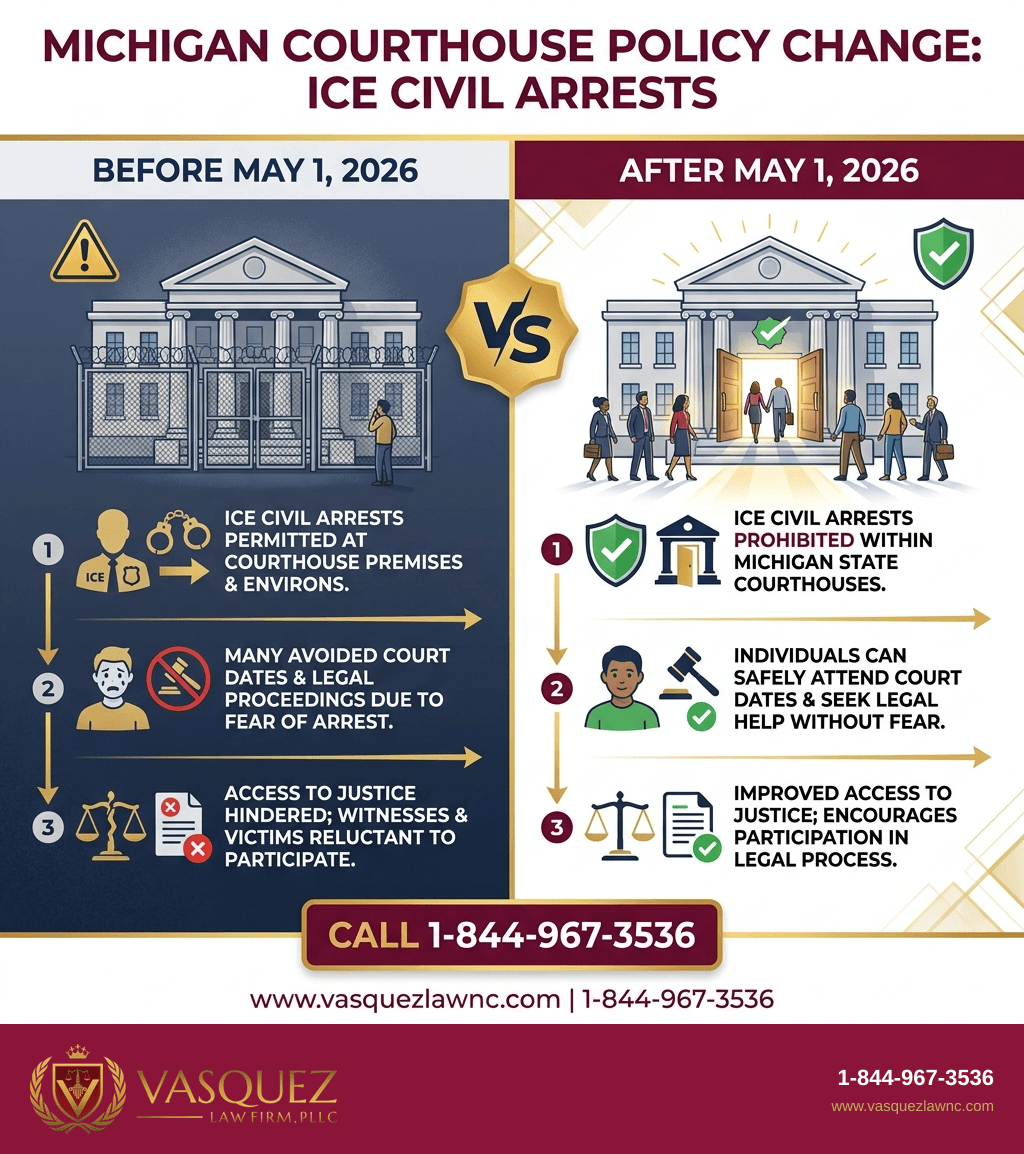
- Recent rulings restrict ICE civil arrests at courthouses
- Elections determine justices’ continuation on the bench
- Decisions can set precedent affecting immigration enforcement policies
Why Michigan Supreme Court's Role Matters to You
Imagine attending a court hearing in Michigan and fearing an ICE civil arrest. The Michigan Supreme Court has addressed this concern directly, restricting such arrests in courthouses to protect due process rights. Although this ruling is state-specific, federal immigration enforcement and court safety policies nationwide can be influenced by these decisions. For individuals in Orlando, FL, and Raleigh, NC, staying informed about such rulings is critical, especially if you or a family member may face immigration proceedings. Vasquez Law Firm’s immigration legal team regularly monitors these developments to better serve clients across states.
Step-by-step: Understanding the Michigan Supreme Court
- Composition and Justices: The court comprises seven justices elected to eight-year terms. As of 2026, the court includes the Chief Justice and six associate justices, each responsible for interpreting Michigan law.
- Election Process: Justices are selected through statewide elections, held every two years for staggered seats. Voters decide which candidates will serve or continue to serve on the court, shaping Michigan's judicial philosophy.
- Functions: The court reviews appeals from lower state courts, issues legal opinions impacting state law, and oversees administrative functions for Michigan’s judiciary.
- Recent Impactful Rulings: Notably, in 2026, the court ruled to restrict ICE civil arrests at courthouses, citing concerns over access to justice and constitutional rights.
- Accessing Court Services: Residents can follow the Michigan Supreme Court’s livestream sessions, access court opinions online, and contact the court via email for inquiries.
Michigan Supreme Court Justices in 2026
The court includes a diverse group of justices, with the Chief Justice leading administrative responsibilities. Their legal backgrounds range from prosecutors to civil litigators, balancing experience. Understanding each justice's perspective can illuminate how rulings might lean more liberal or conservative, affecting interpretation of laws related to immigration and civil rights.
The Election Cycle Explained
Every two years, Michigan voters decide on one or more Supreme Court seats. The elections are nonpartisan but often reflect broader political trends. Voters in Orlando and Raleigh who have Michigan ties or interests can follow these elections to anticipate shifts in legal precedents.
How to Contact the Michigan Supreme Court
The court maintains a public email system for inquiries and allows access to live hearings via a livestream. This transparency helps citizens stay informed about key decisions affecting legal rights.
Documents or Evidence Checklist for Related Immigration Cases
- Current Identification Documents (e.g., passport, state ID)
- Immigration Status Documentation (visas, DACA approval, work permits)
- Copies of Court Notices or Summons if applicable
- Correspondence from ICE or Immigration Courts
- Medical or Humanitarian Evidence supporting relief claims
- Records showing ties to the community (employment, family, education)
- Legal filings such as motions or appeals filed with court
Timeline: What to Expect with Cases Influenced by Michigan Supreme Court Rulings
- Initial Incident: ICE civil arrest attempt or court summons
- Legal Challenge: Filing of motions to restrict enforcement based on court rulings (0-3 months)
- Hearing or Appeal: Litigation based on Michigan Supreme Court precedents (3-9 months)
- Outcome Implementation: Enforcement agencies adjust procedures to comply with ruling (9-12 months)
- Ongoing Monitoring: Await further appeals or changes in related laws
Costs and Fees: What Impacts Legal Expenses
- Case Complexity: Cases involving immigration enforcement and constitutional rights require specialized expertise, impacting costs.
- Court Filings: Filing fees for motions, appeals, or other court documents vary by jurisdiction.
- Attorney Experience: Working with skilled immigration attorneys familiar with local and federal court rulings ensures better advocacy.
- Consultation Mode: Virtual consultations for business immigration cost less than in-person meetings.
- Additional Evidence Collection: Gathering medical or humanitarian evidence can add document preparation fees.
Common Mistakes and How to Avoid Them
- Missing Court Dates: Leads to default rulings. Always calendar deadlines immediately.
- Ignoring Recent Rulings: Not citing Michigan Supreme Court precedents may weaken defenses against ICE arrests.
- Incomplete Documentation: Failure to gather all supportive evidence delays or harms your case.
- Attempting Self-Representation: Immigration and constitutional law are complex. Legal advice is critical.
- Delaying Contact with Attorney: Early legal help improves outcomes.
- Not Understanding Election Impact: Changes in court composition affect ongoing and future cases.
- Miscommunication with Agencies: Maintain copies and records of all correspondence.
- Assuming Policies Are Nationwide: Michigan rulings may inspire other states but do not automatically apply in NC or FL.
If you only remember one thing: Staying informed about Michigan Supreme Court decisions and consulting with immigration attorneys is critical to protecting your rights.
NC, FL, and Nationwide Notes on Court Rulings and Immigration Enforcement
North Carolina Notes
While the Michigan Supreme Court ruling limits ICE civil arrests at Michigan courthouses, North Carolina courts have not adopted uniform policies yet. Local jurisdictions may vary. For people facing immigration enforcement in Raleigh or Johnston County, knowing current local rules, and obtaining legal advice from our immigration attorneys in North Carolina is essential.
Florida Notes
In Orlando, FL, courthouse policies regarding ICE arrests are different from Michigan’s but evolving. The Michigan Supreme Court’s decisions serve as persuasive authority for local advocacy to restrict arrests that interfere with court access. Vasquez Law Firm's immigration team in Orlando tracks these legal changes for Dreamers and other immigrants seeking protection.
Nationwide Concepts
Federal immigration enforcement generally preempts states, but court rulings such as Michigan’s can influence policies protecting individuals in courthouse settings. Individuals should understand federal statutes (e.g., 8 U.S.C. § 1226 and 8 C.F.R. § 236.1 on detention and arrest) and consult immigration counsel for guidance about their jurisdiction.
When to Call a Lawyer Now
- You receive notice of a court hearing involving immigration enforcement.
- An ICE civil arrest occurs or is threatened at a courthouse.
- You miss or risk missing a court date related to immigration or criminal proceedings.
- You have questions about how Michigan Supreme Court rulings might affect your immigration case.
- Law enforcement contacts you about possible detainment or deportation.
- You face charges that could lead to removal from the U.S.
- You want to understand your rights under recent court rulings before attending court.
- You need help obtaining or renewing immigration benefits impacted by court decisions.
About Vasquez Law Firm
At Vasquez Law Firm, we combine compassion with aggressive representation. Our motto "Yo Peleo®" (I Fight) reflects our commitment to standing up for your rights.
- Bilingual Support: Se Habla Español — Spanish-speaking attorneys and staff available
- Service Areas: North Carolina, Florida, and nationwide immigration services
- Experience: Over 30 years helping clients navigate complex legal matters
- Results: Thousands of successful cases across multiple practice areas
Attorney Trust and Experience
William J. Vásquez is admitted to the North Carolina State Bar (2011) and to the U.S. Courts of Appeals for the 4th, 5th, 6th, and 11th Circuits. Florida-jurisdiction matters at the firm are handled by Florida Bar attorney Alekssandra Lopez. The firm has provided dedicated legal representation since 2011, with personalized attention to each client's case.
Don't wait to get the help you deserve. Call us now for immediate assistance.
Se Habla Español
Frequently Asked Questions
Who is on the Michigan Supreme Court in 2026?
The Michigan Supreme Court consists of seven justices, including the Chief Justice. They are elected to eight-year terms in statewide elections. The current roster reflects a range of legal backgrounds, balancing perspectives for diverse rulings.
Is the Michigan Supreme Court considered liberal or conservative in 2026?
The Michigan Supreme Court shows a mix of judicial philosophies. Some justices lean liberal, emphasizing civil rights and due process, while others hold conservative views prioritizing law enforcement authority. This balance affects rulings like those limiting ICE arrests at courthouses.
What was the significance of the Michigan Supreme Court ruling on ICE civil arrests?
The court’s 2026 decision restricted ICE civil arrests at courthouses to protect individuals’ right to access justice without fear of enforcement actions at legal proceedings. This ruling aligns with constitutional protections and can influence similar policies nationwide.
How can Michigan Supreme Court rulings affect immigration cases in Orlando and Raleigh?
While not binding outside Michigan, these rulings serve as persuasive precedent. They raise awareness and may inspire local courts to implement similar safeguards for immigrant rights in Orlando, FL, and Raleigh, NC.
What is the Michigan Supreme Court election process?
Justices are elected statewide every two years in nonpartisan elections. Voters choose to retain or replace justices, which can shift the court’s ideological balance and impact future decisions.
How can I watch Michigan Supreme Court proceedings?
The Michigan Supreme Court offers a livestream of hearings accessible to the public online, providing transparency and real-time access to legal proceedings for interested parties anywhere, including in Orlando and NC.
How do I contact the Michigan Supreme Court by email?
The court provides a public email contact for inquiries regarding court procedures, opinions, or clerkship opportunities. This system supports transparency and public engagement with Michigan’s highest court.
What is a Michigan Supreme Court clerkship?
A clerkship is a prestigious legal assistantship under a Supreme Court justice. Clerks help research, draft opinions, and manage case materials, gaining valuable insight into appellate law and judicial reasoning.
Sources and References
- U.S. Citizenship and Immigration Services
- Executive Office for Immigration Review
- Legal Information Institute
Take the first step toward justice today. Our team is standing by to help.
Start Your Free Evaluation Now
Call us: 1-844-967-3536
Se Habla Español - Estamos aquí para ayudarle.



William Vasquez
Founder & CEO, Vasquez Law Firm, PLLC
William Vasquez is the founder and CEO of Vasquez Law Firm, PLLC, a results-driven firm specializing in immigration, criminal defense, personal injury, and workers' compensation. A U.S. Air Force veteran and recipient of the Joint Service Achievement Medal, William is dedicated to fiercely fighting for his clients' rights.
Related Legal Services
Need legal help? Learn more about get immigration legal help today, or contact us for a free evaluation.
You can also visit our North Carolina immigration practice for more information.