What the Immigration Registry Update Means for You in 2026
Understand the potential impact of an Immigration Registry update in 2026 on your path to a Green Card. Contact Vasquez Law for a free consultation.
Published on March 1, 2026· Updated March 1, 2026
Talk to an immigration attorney
Free call. A clear plan for your case.
Free & confidential · Se habla espanol · 24/7

Have questions? Talk to an attorney - free evaluation.
Call 1-844-967-3536Worried how the latest immigration news affects you?
Schedule a confidential case review with an immigration attorney - know exactly where you stand.
What the Immigration Registry Update Means for You in 2026
The concept of an Immigration Registry update can offer a beacon of hope for many long-term residents in the United States, including those in North Carolina and Florida. This often-discussed legislative change would potentially allow certain undocumented immigrants to adjust their status to lawful permanent residency, commonly known as getting a Green Card, without leaving the country. As of 2026, discussions around updating the registry provision, which has existed in U.S. immigration law for decades, continue to evolve. Understanding the current requirements, potential changes, and how a Vasquez Law Firm attorney can assist you is crucial for anyone hoping to benefit from such an update.
Need help understanding potential changes to the Immigration Registry? Our experienced attorneys are ready to fight for you. Se Habla Español.
Schedule Your Free Case Evaluation
Or call us now: 1-844-967-3536
Quick Answer
An Immigration Registry update refers to a potential change in U.S. immigration law that would adjust the eligibility date for certain long-term residents to apply for lawful permanent residency (Green Card) through the registry provision. This could open new pathways for individuals who have lived in the U.S. for many years without legal status. Eligibility typically hinges on continuous physical presence and good moral character.
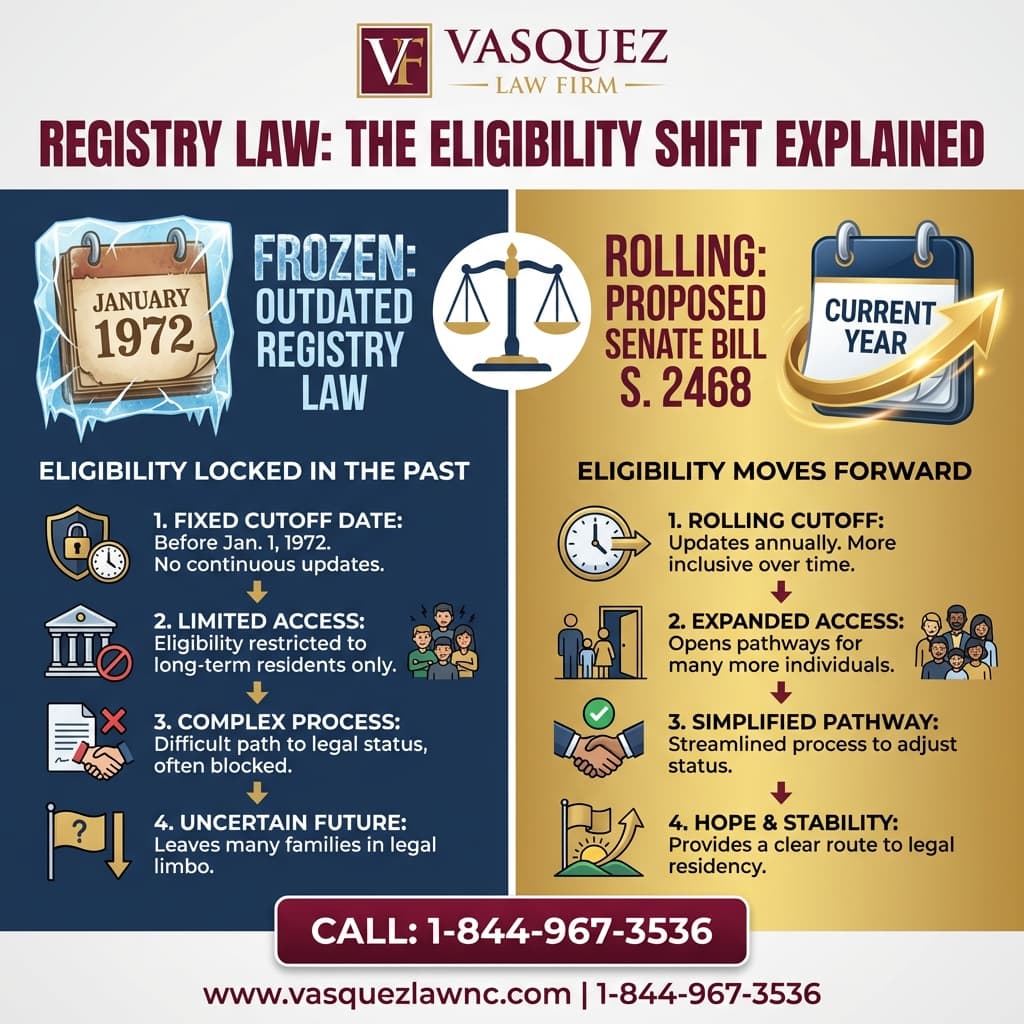
- Registry allows certain individuals to adjust status if they entered before a specific date.
- The current date is January 1, 1972, making it largely inaccessible.
- An update would push this date forward, potentially benefiting millions.
- Eligibility often requires proving continuous U.S. residence and good moral character.
- This process differs from asylum or other Green Card pathways.
Understanding the Immigration Registry and Its Current Status
The Immigration Registry is a provision within the U.S. Immigration and Nationality Act (INA) that allows certain non-citizens to apply for lawful permanent resident status. This is possible even if they initially entered the country without inspection or overstayed a visa. The key requirement for registry is that the individual must have resided continuously in the United States since a specified date and meet other criteria, such as good moral character. Currently, this crucial date is set at January 1, 1972, as outlined in 8 U.S.C. § 1259.
Because the registry date has not been updated in over 50 years, this provision is largely unavailable to most modern immigrants. An Immigration Registry update would involve Congress passing new legislation to advance this date. For example, if the date were moved to 2000 or 2001, it could potentially allow millions of individuals who have lived in the U.S. for decades to adjust their status. This would offer a significant pathway to legal residency for those who have built lives and contributed to communities in places like Smithfield, North Carolina, and across Florida, but currently lack a legal avenue.
The political landscape surrounding immigration reform is complex, and proposals for an Immigration Registry update often face considerable debate. However, advocates continue to push for this change, highlighting the humanitarian and economic benefits of integrating long-term residents into the legal framework. Staying informed about legislative developments is key, as any update would have profound implications for families nationwide.
Potential Impact of an Immigration Registry Update in 2026
Should Congress pass an Immigration Registry update, the ripple effects would be substantial for individuals, families, and communities. For those who meet the new eligibility criteria, it would provide a long-awaited opportunity to obtain a Green Card, offering stability, protection from deportation, and access to a wider range of employment and educational opportunities. This change would reduce the fear and uncertainty that often accompany undocumented status, allowing individuals to fully participate in society.
Economically, an update could lead to increased tax contributions, higher wages, and greater consumer spending. Many long-term residents already contribute significantly to the U.S. economy, and legal status would only enhance their ability to do so. Socially, it could lead to stronger, more integrated communities, reducing the strain on social services by allowing more people to access formal support systems. The Vasquez Law Firm understands the immense relief and opportunity such an update could bring to our clients in North Carolina, Florida, and beyond.
For individuals, the most immediate impact would be the ability to apply for lawful permanent residency without the need to return to their home country, which can be a significant barrier due to the 3-year or 10-year bars to re-entry. This would simplify the process and make it more accessible. However, it's crucial to note that even with an update, applicants would still need to meet specific requirements, including demonstrating good moral character and passing background checks. Navigating these requirements effectively would necessitate experienced legal guidance.
Eligibility Criteria and How to Prepare for Registry Changes
While the exact criteria for an Immigration Registry update would depend on the specific legislation passed, historical patterns and current registry law (8 C.F.R. § 249.2) suggest several key requirements. The most critical would be a new continuous physical presence date. For example, if the date were moved to January 1, 2001, applicants would need to prove they have lived in the U.S. continuously since that time. Other common requirements include:
- Good Moral Character: Applicants must demonstrate they have not committed certain crimes or engaged in activities that would deem them ineligible.
- Admissibility: While registry can waive some grounds of inadmissibility, others, especially those related to serious criminal offenses or national security, may still apply.
- No Disqualifying Factors: Certain actions, like involvement in persecution or terrorism, would automatically disqualify an applicant.
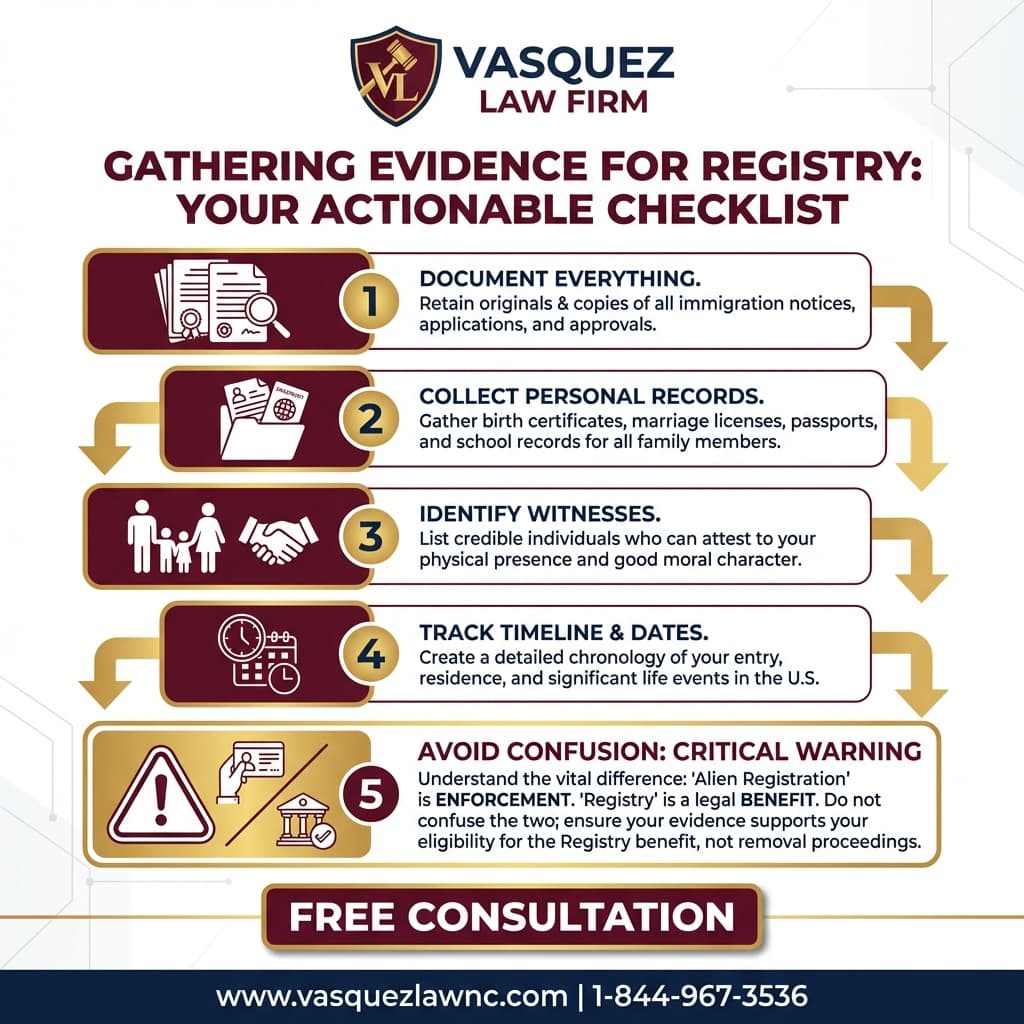
Preparing for a potential registry update means gathering comprehensive documentation now. This includes proof of continuous residence in the U.S., such as utility bills, tax records, school records, employment history, medical records, and affidavits from credible witnesses. It also involves ensuring you have a clean criminal record and addressing any past immigration violations that might impact your eligibility. Proactive preparation can significantly strengthen your case once an Immigration Registry update becomes law.
It is important to consult with an immigration attorney to understand what documents are most vital and how to present them effectively. An attorney can help you identify potential issues and strategize on how to overcome them. Vasquez Law Firm is ready to assist individuals in Smithfield, NC, Florida, and across the nation in preparing for any future changes to immigration law.
Step-by-step: What to Expect with a Registry Application
If an Immigration Registry update is enacted, the application process would likely involve several key steps. While specific forms and procedures might be introduced or modified by USCIS, the general framework would probably mirror existing adjustment of status applications. Here’s a general overview of what to expect:
- Consultation and Eligibility Assessment: The first step is to consult with an experienced immigration attorney to determine if you meet the new eligibility criteria. An attorney can review your history, identify potential challenges, and advise on the best course of action.
- Gathering Documentation: You will need to collect extensive documentation to prove continuous physical presence, good moral character, and other eligibility factors. This includes personal identification, birth certificates, marriage certificates, and financial records.
- Filing Form I-485, Application to Register Permanent Residence or Adjust Status: This is the primary form for adjusting status. It would be filed with U.S. Citizenship and Immigration Services (USCIS), along with supporting documents and applicable fees.
- Biometrics Appointment: After filing, you would receive a notice to attend a biometrics appointment, where your fingerprints, photograph, and signature are collected for background checks.
- Interview: USCIS typically schedules an interview at a local office. During the interview, an immigration officer will review your application and documents, and ask questions about your eligibility.
- Decision: Following the interview, USCIS will issue a decision. If approved, you will receive your Green Card, granting you lawful permanent residency.
Each step requires careful attention to detail and adherence to strict deadlines. Working with a knowledgeable legal team like Vasquez Law Firm can help ensure your application is complete and accurate, minimizing delays and increasing your chances of success.
Don't face complex immigration procedures alone. Our team is here to help you every step of the way.
Call today: 1-844-967-3536 | Se Habla Español
Essential Documents Checklist for a Registry Application
Preparing for an Immigration Registry update means having all your paperwork in order. The more thoroughly you prepare, the smoother the application process will likely be. Here’s a checklist of documents you should start gathering:
- Proof of Identity and Nationality: Birth certificate, passport, national identity card.
- Proof of Entry and Continuous Presence: Entry stamps, I-94 records, utility bills, rental agreements, tax returns, employment records (pay stubs, W-2s), school records, medical records, bank statements.
- Affidavits: Sworn statements from credible witnesses (friends, family, employers, religious leaders) attesting to your continuous residence and good moral character.
- Criminal Records: Certified copies of any arrest records, court dispositions, or police clearances, even for minor offenses.
- Immigration Records: Copies of any past immigration applications, notices, or orders from USCIS or the Executive Office for Immigration Review (EOIR).
- Marriage Certificates and Divorce Decrees: If applicable, for you and your spouse.
- Birth Certificates of Children: If applicable.
- Photographs: Passport-style photos meeting USCIS specifications.
- Medical Examination Report: Form I-693, completed by a USCIS-approved civil surgeon.
- Form G-325R, Biographic Information (Registration): This form, or its equivalent, provides essential personal details.
Organizing these documents can be overwhelming, but it's a critical step. An attorney can help you identify any missing pieces and ensure everything is properly submitted. For individuals in Smithfield, NC, and throughout Florida, Vasquez Law Firm offers comprehensive support in preparing these vital applications.
Common Mistakes and How to Avoid Them
The Immigration Registry update, while a potential opportunity, will also come with strict requirements. Mistakes in the application process can lead to delays, denials, or even trigger adverse immigration consequences. Here are common pitfalls to avoid:
- Failing to Prove Continuous Presence: Many applicants underestimate the amount of evidence needed. Keep every record that shows your presence in the U.S.
- Misrepresenting Facts: Any false statements or omissions can lead to a denial and accusations of fraud, with severe penalties. Always be truthful and provide accurate information.
- Ignoring Criminal History: Even minor arrests or convictions must be disclosed and properly addressed. Failure to do so can be a major disqualifier.
- Missing Deadlines or Incomplete Applications: USCIS has strict filing deadlines and requirements. An incomplete application will likely be rejected.
- Not Seeking Legal Counsel: Navigating complex immigration laws without an attorney is risky. An attorney can spot potential issues and guide you.
- Leaving the U.S. After Filing: Depending on your specific situation, leaving the U.S. after filing for adjustment of status can abandon your application. Consult your attorney before any travel plans.
- Not Understanding Admissibility Issues: Certain past immigration violations or criminal issues can make you inadmissible. An attorney can assess these and determine if waivers are available.
If you only remember one thing: Do not attempt to navigate an Immigration Registry update application without consulting an experienced immigration attorney. Their expertise is invaluable in avoiding critical errors.
NC, FL, and Nationwide Immigration Registry Considerations
While an Immigration Registry update would be a federal law, its practical implications would be felt nationwide, including in North Carolina and Florida. Immigration law is primarily federal, meaning the rules for registry eligibility and application would be uniform across all states. However, the local USCIS field offices in places like Smithfield, NC, and across Florida, would be responsible for processing these applications and conducting interviews.
North Carolina Considerations
For individuals residing in North Carolina, an Immigration Registry update would provide a critical pathway to legal status. Many long-term residents in communities throughout North Carolina could benefit, allowing them to fully integrate into the state's economy and social fabric. Vasquez Law Firm, with its office in Smithfield, NC, is well-positioned to assist clients throughout the state with registry applications, offering personalized guidance and strong advocacy.
Florida Considerations
Similarly, Florida, with its large immigrant population, would see a significant impact from an Immigration Registry update. Many individuals who have contributed to Florida's vibrant culture and economy for years could finally secure their legal status. Our firm extends its immigration services to clients across Florida, providing the same dedicated and bilingual support to ensure their applications are handled with the utmost care and precision.
Nationwide Concepts (General only, rules vary)
The core principles of an Immigration Registry update would apply uniformly across the United States. Eligibility dates, good moral character assessments, and the overall application process would be standardized by USCIS. However, local resources, processing times, and community support networks might vary. It's crucial for applicants nationwide to understand that while the law is federal, local legal counsel can provide invaluable assistance in navigating the specific nuances of their jurisdiction.
When to Call an Immigration Lawyer Now
Even before an Immigration Registry update officially passes, there are compelling reasons to consult with an immigration attorney from Vasquez Law Firm. Proactive legal advice can make a significant difference in your future. Consider calling us if:
- You have lived in the U.S. for many years without legal status and believe you might benefit from an update.
- You have questions about your eligibility for existing immigration benefits.
- You have a past criminal record, even minor offenses, that could impact your eligibility.
- You have previously been in deportation or removal proceedings.
- You are unsure what documents to gather to prove continuous residence or good moral character.
- You want to understand the current legislative landscape and how it might affect you.
- You need assistance evaluating your immigration history for any potential issues.
- You are concerned about potential fraud or scams related to immigration services.
Speaking with a knowledgeable attorney now can help you prepare for future opportunities and protect yourself from potential pitfalls.
About Vasquez Law Firm
At Vasquez Law Firm, we combine compassion with aggressive representation. Our motto "Yo Peleo" (I Fight) reflects our commitment to standing up for your rights. We understand the challenges and hopes that come with navigating the U.S. immigration system, especially concerning potential changes like an Immigration Registry update.
- Bilingual Support: Se Habla Español - our team is fully bilingual, ensuring clear communication and understanding.
- Service Areas: We proudly serve clients across North Carolina, Florida, and provide comprehensive immigration services nationwide.
- Experience: With over 15 years of dedicated legal experience, we have a proven track record of helping clients achieve their immigration goals.
- Results: Our firm is committed to achieving the best possible outcomes, fighting tirelessly for the rights and futures of those we represent.
Attorney Trust and Experience
Attorney Vasquez holds a Juris Doctor degree and is admitted to practice in both the North Carolina State Bar and Florida Bar. With over 15 years of dedicated legal experience, he has built a reputation for providing personalized attention and achieving favorable outcomes for his clients. He is deeply committed to the immigrant community and works diligently to ensure every client receives the highest level of legal representation.
Frequently Asked Questions
What is the new immigration registration rule?
As of 2026, there is no new immigration registration rule. The existing registry law allows individuals who entered the U.S. before January 1, 1972, to adjust their status. Discussions are ongoing in Congress to update this date, which would create a new pathway for many long-term residents to apply for Green Cards. Any new rule would require legislative action.
Is the U.S. suspending immigrant visas?
No, the U.S. is not currently suspending immigrant visas as of 2026. While there have been temporary suspensions or restrictions on certain visa categories in the past, these measures are not currently in effect. Immigrant visa processing continues through U.S. embassies and consulates worldwide, though processing times can vary due to various factors.
Who is eligible for the immigration registry?
Under the current law, eligibility for the immigration registry is limited to individuals who can prove continuous residence in the U.S. since before January 1, 1972, meet good moral character requirements, and are not inadmissible under specific grounds. A legislative update would advance this date, broadening eligibility to include more recent long-term residents.
Did Biden pass a new immigration law?
President Biden has not passed a new comprehensive immigration law as of 2026 that would update the registry provision. While his administration has implemented various policy changes and executive actions related to immigration, major legislative reforms, such as an Immigration Registry update, require congressional approval. Discussions continue in Congress regarding these potential changes.
What is the difference between registry and asylum?
Registry is a pathway to a Green Card for long-term U.S. residents who meet specific continuous presence and good moral character criteria. Asylum, conversely, is for individuals who fear persecution in their home country. While both can lead to legal status, their eligibility requirements and underlying legal bases are distinct. An Immigration Registry update would not affect asylum claims.
How long does a registry application take?
The processing time for a registry application, especially if the law were updated, would depend on USCIS caseloads, the complexity of the individual case, and whether an interview is required. Typically, adjustment of status applications can take anywhere from several months to a few years. Proactive preparation and complete documentation can help expedite the process.
Can I apply for registry if I have a deportation order?
Applying for registry if you have a deportation or removal order can be very complex. While some grounds of inadmissibility can be waived, a final order of removal might present a significant challenge. It is absolutely critical to consult with an experienced immigration attorney immediately to understand your options and the potential risks involved.
What proof of continuous residence do I need?
To prove continuous residence, you will need a substantial amount of documentation. This includes utility bills, rental agreements, tax returns, employment records (pay stubs, W-2s), school records, medical records, bank statements, and affidavits from credible witnesses. The more evidence you can provide, the stronger your claim will be for an Immigration Registry update.
Will an Immigration Registry update help Dreamers?
An Immigration Registry update could potentially help many Dreamers, depending on the specific eligibility date set by Congress. If the date is advanced to cover those who arrived as children and have lived in the U.S. for a significant period, it could offer a path to permanent residency. However, specific legislation targeting Dreamers (like the DREAM Act) often addresses their unique circumstances more directly.
What is Form G-325R, Biographic Information (Registration)?
Form G-325R, Biographic Information (Registration), is a form that was historically used to collect essential personal and biographic data for immigration purposes, including registry applications. While it's been largely replaced by other forms like Form I-485, Part 2 (Applicant Information), the concept of providing detailed biographic information remains crucial for any immigration registry update or application.
Sources and References
- U.S. Citizenship and Immigration Services (USCIS)
- 8 U.S.C. § 1259 - Adjustment of status of nonimmigrant to that of person admitted for permanent residence
- Executive Office for Immigration Review (EOIR)
Ready to take the next step? Contact Vasquez Law Firm today for a free, confidential consultation. We're committed to fighting for your rights and achieving the best possible outcome for your case.
Start Your Free Case Evaluation Now
Call us: 1-844-967-3536
Se Habla Español - Estamos aquí para ayudarle.


William Vasquez
Founder & CEO, Vasquez Law Firm, PLLC
William Vasquez is the founder and CEO of Vasquez Law Firm, PLLC, a results-driven firm specializing in immigration, criminal defense, personal injury, and workers' compensation. A U.S. Air Force veteran and recipient of the Joint Service Achievement Medal, William is dedicated to fiercely fighting for his clients' rights.
Related Legal Services
Need legal help? Learn more about get immigration legal help today, or contact us for a free evaluation.
You can also visit North Carolina immigration law firm for more information.