Child Custody Transfer: What to Expect in NC in 2026
Considering a child custody transfer in North Carolina? Learn the legal process, common challenges, and how Vasquez Law Firm can help you protect your child's best interests. Contact us for a free consultation today.
Vasquez Law Firm
Published on March 9, 2026

Have questions? Talk to an attorney — free evaluation.
Call 1-844-967-3536Child Custody Transfer: What to Expect in NC in 2026
Navigating a child custody transfer in North Carolina can feel overwhelming, especially when circumstances change significantly for you or your co-parent. Whether it involves a parent relocating, a change in living conditions, or concerns about a child's well-being, understanding the legal process is crucial. In 2026, North Carolina courts prioritize the child's best interests above all else, making every step of a custody modification or transfer a detailed and often complex legal endeavor. Vasquez Law Firm is here to guide you through this process.
Need help with your child custody transfer case? Our experienced attorneys are ready to fight for you. Se Habla Español.
Family law issue in NC?
Divorce, custody, and DV cases need fast strategy. 15-min call — confidential — to walk through your situation.
Schedule Your Free Consultation
Or call us now: 1-844-967-3536
Quick Answer
A child custody transfer in North Carolina typically requires filing a motion to modify an existing custody order with the court. The parent seeking the transfer must demonstrate a substantial change in circumstances affecting the child's welfare since the last order. The court will then evaluate if the proposed transfer is in the child's best interests, considering factors like stability, safety, and parental fitness.
- File a Motion to Modify Custody with the court.
- Prove a substantial change in circumstances has occurred.
- Demonstrate the transfer serves the child's best interests.
- Attend mediation or court hearings.
- Obtain a new court order reflecting the child custody transfer.
Understanding Child Custody Transfer in North Carolina
Imagine a scenario where a parent receives a job offer requiring relocation across state lines, or a child expresses a strong desire to live primarily with the other parent due to changing family dynamics. These situations often trigger the need for a child custody transfer, which legally means modifying an existing custody order. In North Carolina, modifying a custody order is not a simple process and requires judicial oversight to ensure the child's welfare remains the top priority, as outlined in N.C. Gen. Stat. § 50-13.7.
The court will not grant a modification lightly. A parent seeking a custody transfer must first prove that there has been a significant and material change in circumstances since the date of the last custody order. This change must be substantial enough to warrant a re-evaluation of the child's living arrangements. Without demonstrating this crucial first step, the court will not even consider whether a modification is in the child's best interests.
Once a substantial change is established, the court then proceeds to the second step: determining if the proposed child custody transfer is in the child's best interests. This involves a comprehensive review of various factors, including the child's physical and emotional needs, the stability of each parent's home, and the child's wishes if they are mature enough to express them. Understanding these two critical hurdles is fundamental for anyone considering a custody transfer in Raleigh or anywhere in North Carolina.
Proving a Substantial Change in Circumstances
A parent recently lost their job and can no longer afford the current living arrangements, impacting the child's stability. Another common situation involves one parent developing a serious health issue that affects their ability to care for the child. These are examples of the types of significant life events that North Carolina courts recognize as a substantial change in circumstances, a prerequisite for any child custody transfer.
The change must have occurred since the date of the last custody order and must affect the child's welfare. Simply wanting a change or believing the child would be better off with you is not enough. You must present concrete evidence that the existing order is no longer appropriate given the new reality. This could include changes in a parent's employment, health, marital status, or even a child's educational needs.
Documentation is key when attempting to prove a substantial change. Keep records of new addresses, job changes, medical reports, or school records that highlight the shift in circumstances. A skilled family law attorney can help you gather and present this evidence effectively to the court, strengthening your case for a child custody transfer.
Determining the Child's Best Interests
Once a substantial change in circumstances has been proven, the court's focus shifts entirely to the child's best interests, which is the paramount consideration in any child custody transfer case in North Carolina. For instance, if a child is thriving in their current school and community, a court might be hesitant to approve a transfer that disrupts this stability, even if a parent has a valid reason for relocation. The court evaluates all aspects of the child's life.
North Carolina courts consider a wide range of factors when determining what is in a child's best interest. These include the child's physical and emotional health, safety, welfare, and developmental needs. The court also looks at the stability of the home environment each parent can provide, the child's relationship with each parent, and any history of domestic violence or substance abuse.
The child's preference may also be considered, particularly if the child is older and can articulate their reasons maturely. However, the child's wishes are just one factor among many and are not determinative. The court ultimately makes the decision based on a holistic view of what will promote the child's overall well-being and development. This comprehensive approach ensures that any child custody transfer genuinely benefits the child.
The Legal Process for Child Custody Transfer
If you believe a child custody transfer is necessary, the first formal step is to file a Motion to Modify Custody with the appropriate North Carolina court. This initiates the legal process and formally requests the court to review your existing custody order. Neglecting this step and unilaterally changing custody arrangements can lead to serious legal consequences, including accusations of contempt of court.
After filing, both parents may be required to attend mediation to try and reach an agreement outside of court. Mediation offers an opportunity to resolve differences amicably and craft a new parenting plan that works for everyone. If an agreement is reached, it can be submitted to the court for approval, which then becomes a new court order for the child custody transfer.
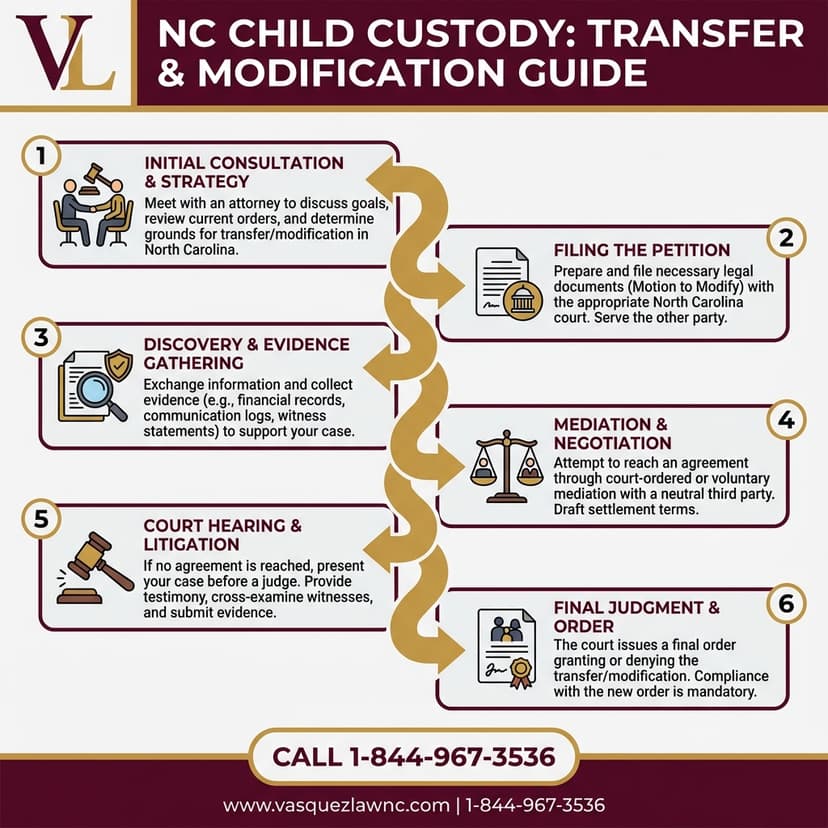
If mediation is unsuccessful, the case will proceed to court for a hearing. During the hearing, both parents will present evidence, call witnesses, and argue their positions before a judge. The judge will then make a decision based on the evidence presented, issuing a new custody order that outlines the child custody transfer. This entire process can be lengthy and complex, underscoring the importance of legal representation.
Common Mistakes in a Child Custody Transfer Case
One of the biggest mistakes a parent can make during a child custody transfer is to disregard the existing court order. For example, if a parent decides to move out of state with the child without seeking court approval, they could face severe penalties, including losing custody. Always adhere to the current order until a new one is legally in place.
- Acting without a court order: Never unilaterally change custody arrangements. Always seek a court order first.
- Failing to prove substantial change: Without concrete evidence of a significant change, your motion to modify will likely be denied.
- Focusing on parental desires instead of child's best interests: Courts prioritize the child's welfare, not what a parent wants for themselves.
- Lack of documentation: Failing to gather evidence like school records, medical reports, or employment changes can weaken your case.
- Poor communication with co-parent: Antagonistic behavior can negatively impact your standing with the court and hinder potential settlements.
- Not understanding mediation: Skipping or dismissing mediation as a waste of time can lead to more costly and prolonged litigation.
- Underestimating legal complexity: Child custody transfer cases involve intricate legal rules; attempting to navigate them without legal counsel can be detrimental.
- Delaying action: Waiting too long to address a substantial change could be seen as an acceptance of the status quo or make it harder to prove the necessity of a transfer.
If you only remember one thing: Always prioritize the child's best interests and ensure every action is legally sound and supported by documentation. Consulting with a family law attorney in Raleigh early in the process is crucial to avoid these pitfalls and ensure a smooth child custody transfer.
NC Child Custody Laws and Relocation
North Carolina does not have a specific statute solely dedicated to parental relocation in child custody cases. Instead, relocation is treated as a substantial change in circumstances that may warrant a modification of an existing custody order. For instance, if a custodial parent living in Raleigh wishes to move with the child to another state, they must file a motion to modify custody and prove that the move is in the child's best interests, as well as demonstrating a substantial change.
How far can a parent move with joint custody in NC?
When parents share joint custody in North Carolina, any move that significantly impacts the existing custody schedule or the other parent's access to the child will likely be considered a substantial change in circumstances. There isn't a specific mileage limit defined by statute. Instead, the court assesses the practical implications of the move on the child's relationship with both parents, their schooling, and overall stability. If the move is far enough to disrupt the current arrangement, court approval for a child custody transfer will be necessary.
When to Call a Lawyer for Child Custody Transfer in 2026
If your co-parent announces plans to move out of state with your child, or if you are considering such a move yourself, it's time to speak with a family law attorney immediately. A delay can impact your rights and the child custody transfer process. Waiting too long might be interpreted as acquiescence to the change.
- Your co-parent plans to relocate significantly, affecting the current custody schedule.
- You believe your child's current living environment is unsafe or detrimental to their well-being.
- There has been a significant change in either parent's circumstances (e.g., job loss, health issues, new marriage).
- Your child, being of sufficient age and maturity, expresses a strong desire to live with the other parent.
- You are facing accusations of violating a current custody order.
- You need to enforce an existing custody order because the other parent is not complying.
- You are considering filing for an emergency custody order due to immediate concerns for your child's safety.
- You want to understand how to win sole custody in NC or how to file for child custody in NC without a lawyer, but need guidance on the complexities.
These situations are complex and require careful legal consideration. Contacting an attorney can help you understand your options and protect your family's future, especially regarding a child custody transfer.
Don't face your legal challenges alone. Our team is here to help you every step of the way.
Call today: 1-844-967-3536 | Se Habla Español
About Vasquez Law Firm
At Vasquez Law Firm, we combine compassion with aggressive representation. Our motto "Yo Peleo" (I Fight) reflects our commitment to standing up for your rights. We understand the emotional toll that family law matters, especially a child custody transfer, can take on families in Raleigh and across North Carolina.
- Bilingual Support: Se Habla Español - our team is fully bilingual, ensuring clear communication.
- Service Areas: We primarily serve clients in North Carolina for family law, personal injury, workers' compensation, criminal defense, and traffic cases. We also handle immigration cases nationwide.
- Experience: With over 15 years helping clients navigate complex legal matters, Attorney Vasquez brings extensive knowledge and a proven track record.
- Results: We are dedicated to achieving favorable outcomes, guiding clients through thousands of successful cases across multiple practice areas.
Attorney Trust and Experience
Attorney Vasquez holds a Juris Doctor degree and is admitted to practice in both the North Carolina State Bar and Florida Bar. With over 15 years of dedicated legal experience, he has built a reputation for providing personalized attention and achieving favorable outcomes for his clients. His commitment to justice and his clients' well-being makes him a trusted advocate in complex cases, including those involving a child custody transfer.
Frequently Asked Questions
What is the biggest mistake in a custody battle?
The biggest mistake in a custody battle is often prioritizing your own emotions or desires over the child's best interests. Courts focus on the child's welfare, stability, and safety. Engaging in negative behavior, disparaging the other parent, or failing to follow existing orders can severely harm your case. Always maintain a child-centered approach and seek legal guidance to navigate the complexities effectively.
How far can a parent move with joint custody in NC?
In North Carolina, there is no specific mileage limit for parental relocation with joint custody. Any move that significantly impacts the existing custody schedule or the other parent's ability to see the child is considered a substantial change in circumstances. This requires court approval through a motion to modify custody. The court will assess the impact on the child's best interests.
Does a father have 50/50 rights in NC child custody?
Yes, North Carolina law does not favor mothers or fathers in custody disputes. Both parents have equal rights to seek custody, and courts make decisions based on the child's best interests. A father can absolutely be awarded 50/50 joint physical and legal custody if it is deemed to be in the child's best interest, considering factors like parental fitness and home environment.
Who is most likely to win custody of a child in NC?
There is no automatic winner in North Carolina child custody cases. The parent who can best demonstrate that they can provide a stable, safe, and nurturing environment that prioritizes the child's physical and emotional needs is most likely to win. This often involves proving parental fitness, consistent care, and a strong bond with the child.
What Are My Options in Family Court?
Answer 3 questions to understand your rights
Question 1 / 3
What family legal issue are you facing?
Keep Reading
Can I move my child custody case to another county in NC?
Yes, you can request to move your child custody case to another county in North Carolina if there's a valid reason, such as a change in residence for both parties or the child. This is typically done through a motion for change of venue. The court will consider if the new venue is more convenient and serves the interests of justice and the child.
What is an emergency custody order NC form?
An Emergency Custody Order (ECO) in NC is a temporary order granted by the court in urgent situations where a child is at risk of immediate harm. You file a specific petition, often using an AOC-CV-605 form. The court can issue an ECO without notice to the other parent if there's compelling evidence of abuse, neglect, or abandonment. A hearing follows quickly to determine if it should remain in effect.
How do I file for child custody in NC without a lawyer?
You can file for child custody in NC without a lawyer by obtaining the necessary forms from the courthouse or online, completing them accurately, and filing them with the clerk of court. You will need to serve the other parent and attend mediation or court hearings. However, navigating the legal complexities, understanding court procedures, and presenting your case effectively can be challenging without legal representation, especially for a child custody transfer.
What factors influence child custody paperwork in NC?
Child custody paperwork in NC is influenced by factors such as the child's best interests, parental fitness, stability of each home, history of domestic violence, and the child's wishes (if mature enough). The specific forms you use will depend on whether you are initiating a new custody case, seeking to modify an existing order, or requesting an emergency order. Accuracy and completeness are vital.
Can unmarried parents get child custody in NC?
Yes, unmarried parents can absolutely get child custody in North Carolina. When parents are unmarried, neither parent automatically has more rights than the other. Either parent can file a complaint for custody to establish a legal custody order. The court will then determine custody based on the child's best interests, just as it would for married parents.
What is a motion to modify child custody NC form?
A Motion to Modify Child Custody NC form is a legal document filed with the court to request changes to an existing child custody order. This form is used when there has been a substantial change in circumstances since the last order was entered, and the proposed modification is in the child's best interests. It initiates the court process for a child custody transfer or adjustment.
Sources and References
- North Carolina General Statutes, Chapter 50: Divorce and Alimony
- North Carolina Courts: Child Custody Help Topic
Ready to take the next step? Contact Vasquez Law Firm today for a free, confidential consultation. We're committed to fighting for your rights and achieving the best possible outcome for your case.
Start Your Free Consultation Now
Call us: 1-844-967-3536
Se Habla Español - Estamos aquí para ayudarle.
Vasquez Law Firm
Legal Team
Our experienced attorneys at Vasquez Law Firm have been serving clients in North Carolina and Florida since 2011, with 70+ years of combined attorney experience. We specialize in immigration, personal injury, criminal defense, workers compensation, and family law.