What U.S. Customs and Border Protection Does in 2026
Discover what U.S. Customs and Border Protection does in 2026. Learn your rights and next steps. Contact Vasquez Law Firm for a free consultation.
Published on March 16, 2026
Talk to an immigration attorney
Free call. A clear plan for your case.
Free & confidential · Se habla espanol · 24/7
Have questions? Talk to an attorney - free evaluation.
Call 1-844-967-3536Worried how the latest immigration news affects you?
Schedule a confidential case review with an immigration attorney - know exactly where you stand.
USCIS Case Status
Check your USCIS case status
Enter your receipt number and get the official status. Free, no registration.
What U.S. Customs and Border Protection Does in 2026
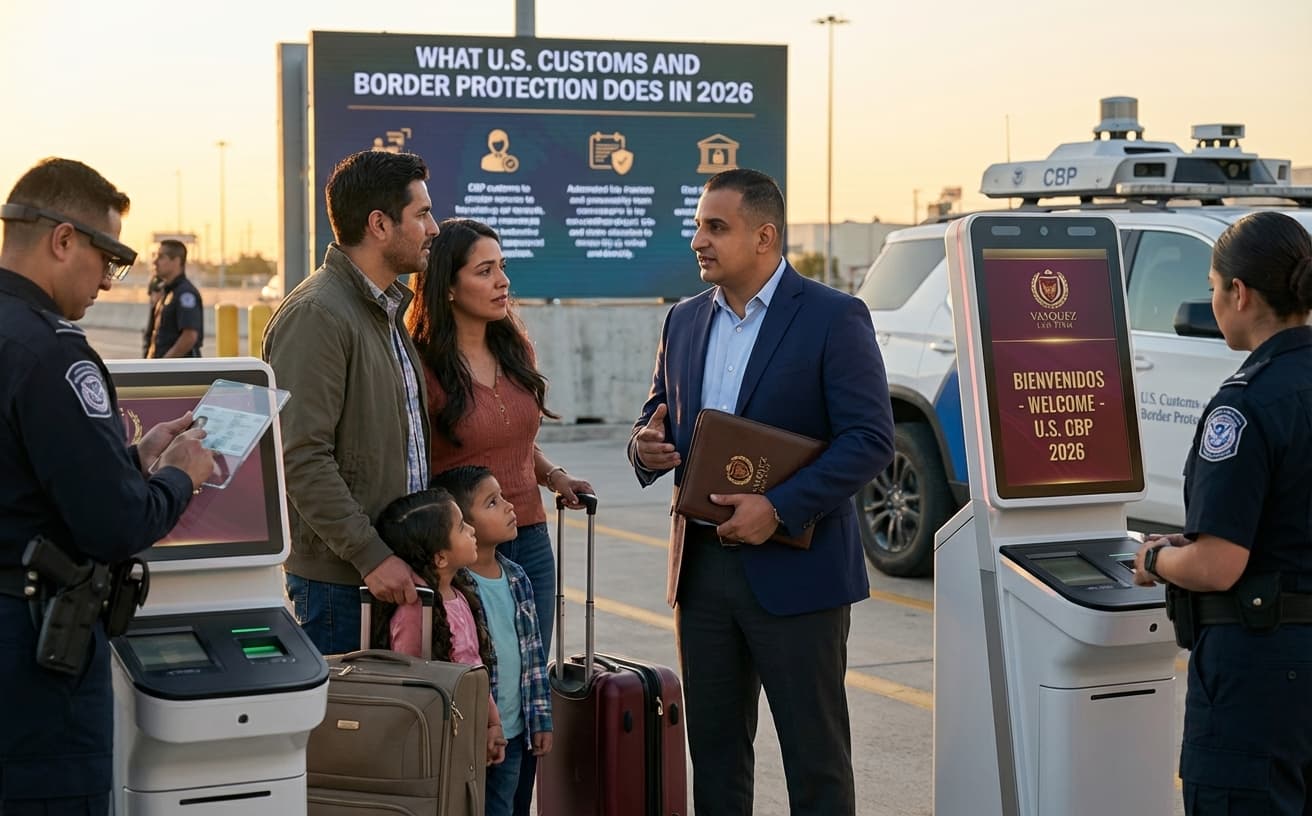
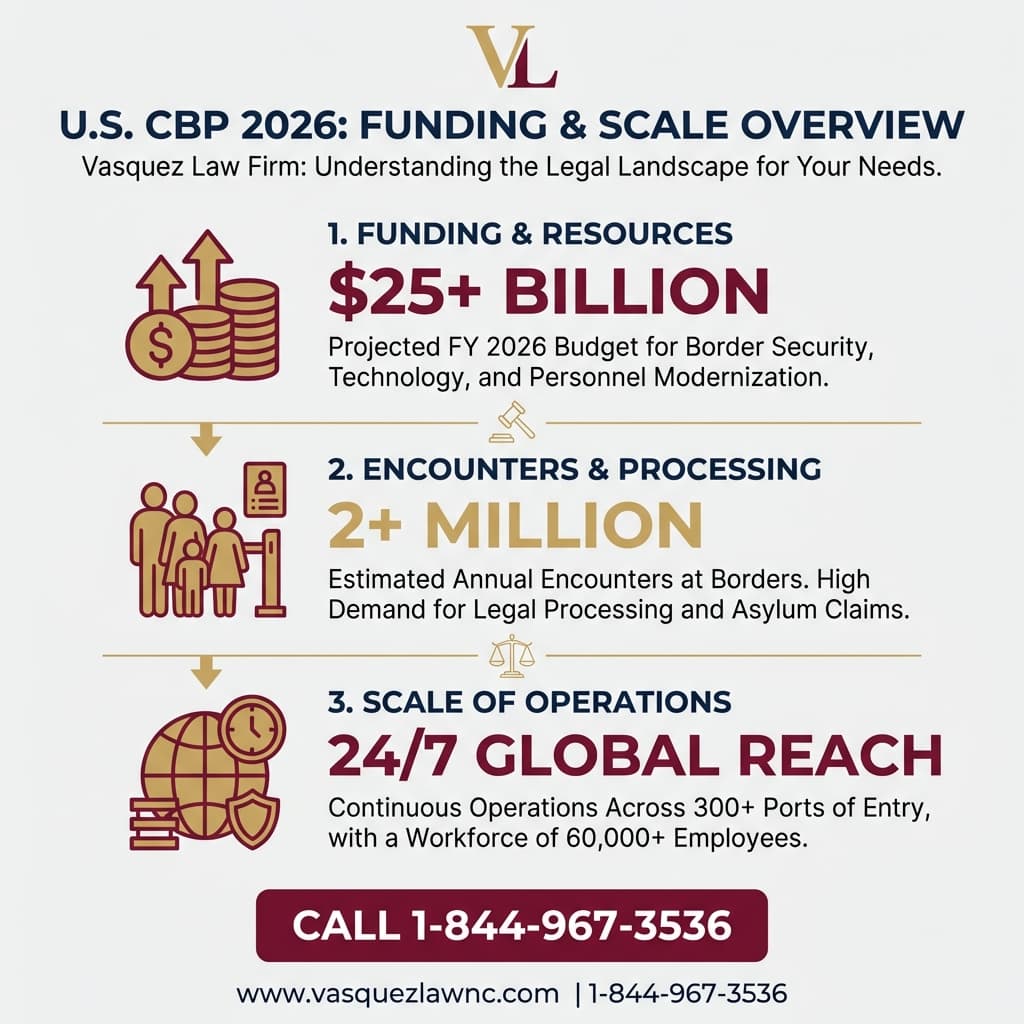
U.S. Customs and Border Protection (CBP) is the largest federal law enforcement agency in the United States, responsible for securing the nation’s borders and facilitating lawful international travel and trade. In 2026, understanding how CBP operates is essential, especially for immigrants, travelers, and residents in states like North Carolina and Florida. Whether you are a Dreamer or planning international travel, this guide explains key functions, necessary documents, and your rights when interacting with CBP officers. If you are in Smithfield or nearby areas, this information will help you navigate the process with greater confidence.
Need help with your case? Our experienced attorneys are ready to fight for you. Se Habla Español.
Schedule Your Free Case Evaluation
Or call us now: 1-844-967-3536
Quick Answer
U.S. Customs and Border Protection in 2026 enforces laws related to immigration, trade, and border security. They inspect travelers and goods entering the U.S., ensure prohibited items don’t cross borders, and uphold immigration rules.
- Largest federal border agency in the U.S.
- Manages customs, immigration inspections, and enforcement
- Operates at all U.S. ports of entry and along borders
- Handles Form I-94 for nonimmigrant arrivals
- Protects trade while stopping illegal imports
Why U.S. Customs and Border Protection Matters for You
Imagine arriving at an airport or border crossing in Smithfield, North Carolina. CBP officers will check your documents and may question you about your travel purpose. Their role is crucial to national security but also affects your ability to enter or remain in the United States legally. Missing or incorrect paperwork, not knowing prohibited items, or misunderstanding your rights can delay or deny entry. In addition, new enforcement rules may impact Dreamers or immigrants differently in 2026. Being prepared helps reduce stress and avoid mistakes during interactions.
CBP also protects American jobs and prevents dangerous goods, counterfeit products, or drugs from entering the country. This balance between facilitation and enforcement affects everyone crossing the border or returning from international travel in North Carolina, Florida, or nationwide.
Step-by-step: What to Do When Interacting with CBP
- Prepare your documents: Ensure you have your passport, visa (if needed), and any required forms like the I-94 Arrival/Departure Record ready before arrival.
- Answer questions clearly: CBP officers will ask about your trip purpose and itinerary. Provide simple, honest answers.
- Declare goods properly: Always declare items you are bringing or returning with. Failure to declare can lead to penalties.
- Know your rights: While CBP has authority to inspect and question, you have the right to remain silent or request an attorney in some cases.
- Follow instructions: Comply with reasonable requests for inspection of luggage or electronic devices.
- Stay calm and polite: Your behavior can influence the experience and outcome of the inspection.
Documents or Evidence Checklist for CBP Interactions
- Valid passport or travel document
- U.S. visa or ESTA travel authorization as applicable
- CBP Form I-94 Arrival/Departure Record (print confirmation if available)
- Evidence of lawful status (e.g., work or study authorization)
- Proof of residence if returning to the U.S. (e.g., driver’s license, utility bills)
- Receipts or invoices for goods you are bringing
- Return ticket or itinerary to prove your travel plans
- Contact information for your attorney or sponsor
Timeline: What to Expect with CBP in 2026
- Upon Arrival: Present documents at the port of entry; initial questions and document verification.
- Inspection Process: Detailed baggage and electronic device screening; declaration of goods.
- Secondary Inspection (if required): Further questioning or verification, may take additional time.
- Admission or Refusal: CBP grants entry or issues a Notice to Appear in immigration court if entry is denied.
- Follow-up: For immigrants, CBP may coordinate with ICE or Executive Office for Immigration Review as needed.
Costs and Fees: What Affects the Price of CBP Processing
- No fees for inspection: CBP services at ports of entry do not have direct fees.
- Visa application fees: Separate from CBP, visa processing through U.S. Department of State has costs.
- Legal assistance: Hiring an immigration attorney for complicated cases adds costs but can provide valuable support.
- Penalties for violations: Failure to declare goods or false statements can result in fines or seizures.
Common Mistakes and How to Avoid Them
- Failing to bring required documents: Always check passport validity and visa status before travel.
- Not declaring items: Declare everything brought from abroad to avoid fines or confiscations.
- Inconsistent answers: Prepare truthful and consistent information about travel plans.
- Ignoring electronic device inspection: CBP may ask to search devices; refusal can lead to complications.
- Becoming argumentative: Stay respectful to officers despite stressful situations.
- Misunderstanding CBP vs ICE: CBP manages border entry; ICE handles interior enforcement.
- Not knowing rights: Understand your right to speak or remain silent and ask for counsel when needed.
- Delaying legal help: Consult an immigration lawyer promptly if facing difficulties or refusals at the border.
If you only remember one thing: Be prepared with documents, declare honestly, and remain calm during all CBP interactions.
NC, FL, and Nationwide Notes for CBP Encounters
North Carolina Notes
CBP operates major ports of entry in North Carolina, including Charlotte Douglas International Airport and border checkpoints. Dreamers and immigrants in Smithfield should stay updated on any local CBP policies that affect travel and border encounters. North Carolina state laws also complement federal immigration enforcement.
Florida Notes
Florida’s busy international airports, like Miami International, have high CBP activity. Many immigrants and visitors pass through Florida ports yearly, so knowing CBP requirements is critical. Vasquez Law Firm offers bilingual support in Florida to assist with CBP-related immigration matters.
Nationwide Concepts
CBP enforces federal laws nationwide at all ports of entry, including airports, seaports, and land borders. The agency’s mission to protect borders is governed by federal statutes such as 8 U.S.C. § 1357 (immigration inspection authority). CBP handles Form I-94 for nonimmigrant admissions across the country and works with agencies like USCIS and ICE for immigration enforcement.
When to Call a Lawyer Now
- If you are denied entry or detained by CBP
- If you face secondary inspection for extended periods
- After a CBP search of your electronic devices
- If questioned about your immigration status or history
- If CBP issues a Notice to Appear for removal proceedings
- When you receive penalties for improper declarations
- If you are a Dreamer facing travel restrictions
- If unsure about forms like I-94 or visa issues
About Vasquez Law Firm
At Vasquez Law Firm, we combine compassion with aggressive representation. Our motto "Yo Peleo" (I Fight) reflects our commitment to standing up for your rights.
- Bilingual Support: Se Habla Español - our team is fully bilingual
- Service Areas: North Carolina, Florida, and nationwide immigration services
- Experience: Over 15 years helping clients navigate complex legal matters
- Results: Thousands of successful cases across multiple practice areas
Attorney Trust and Experience
Attorney Vasquez holds a Juris Doctor degree and is admitted to practice in both the North Carolina State Bar and Florida Bar. With over 15 years of dedicated legal experience, he has built a reputation for providing personalized attention and achieving favorable outcomes for his clients.
Don't wait to get the help you deserve. Call us now for immediate assistance.
Or schedule a free case evaluation Se Habla Español
Frequently Asked Questions
What does U.S. Customs and Border Protection do?
U.S. Customs and Border Protection enforces laws that regulate international trade and travel. It inspects goods and people entering the country to protect borders from illegal activities, such as drug smuggling and unauthorized immigration. CBP also processes Forms I-94 for visitors and immigrants arriving in the United States.
Is U.S. Customs and Border Protection the same as ICE?
No. CBP primarily operates at U.S. ports of entry to inspect travelers and goods. Immigration and Customs Enforcement (ICE) works mainly within the interior of the United States investigating violations and deporting undocumented immigrants. Both agencies are under the Department of Homeland Security but have different roles.
What is U.S. Customs and Border Protection Form I-94?
Form I-94 is the Arrival/Departure Record issued by CBP to nonimmigrant visitors when entering the United States. It records the date of entry, authorized length of stay, and traveler details. It is critical for maintaining lawful status and is required for various immigration benefits applications.
What items are not allowed to bring into the USA?
CBP prohibits items such as illegal drugs, unauthorized firearms, certain plant and animal products, counterfeit goods, and items that violate U.S. laws. Travelers must declare all items and may face penalties for undeclared or prohibited materials.
How can I find the U.S. Customs and Border Protection phone number?
The general phone number for CBP inquiries is 1-877-227-5511. Specific ports or offices may have different contact information. You can also find contact details on the official CBP website for Smithfield and other locations.
What should I do if denied entry by CBP?
If denied entry, remain calm and request to speak to a supervisor. You may be issued a Notice to Appear for removal proceedings. Contact an immigration attorney immediately to understand your rights and possible options.
How much do U.S. Customs officers get paid?
CBP officer salaries vary by location and experience, ranging approximately from $50,000 to over $80,000 annually, including benefits. This does not affect traveler or legal processes but is often a common question.
Can CBP inspect my phone and electronic devices?
Yes, CBP officers have the authority to inspect electronic devices at border crossings to enforce laws. Travelers should be aware of their rights and may consult an attorney before consenting or refusing such searches.
Sources and References
- U.S. Citizenship and Immigration Services (USCIS)
- U.S. Department of State Visa Information
- Executive Office for Immigration Review
- North Carolina Courts
Need immigration help? Our immigration attorneys can review your case.
Take the first step toward justice today. Our team is standing by to help.
Start Your Free Case Evaluation Now
Call us: 1-844-967-3536
Se Habla Español - Estamos aquí para ayudarle.

William Vasquez
Founder & CEO, Vasquez Law Firm, PLLC
William Vasquez is the founder and CEO of Vasquez Law Firm, PLLC, a results-driven firm specializing in immigration, criminal defense, personal injury, and workers' compensation. A U.S. Air Force veteran and recipient of the Joint Service Achievement Medal, William is dedicated to fiercely fighting for his clients' rights.
Related Legal Services
Need legal help? Learn more about speak with an immigration lawyer, or contact us for a free evaluation.
You can also visit immigration lawyers serving all of North Carolina for more information.