What Happens During a Traffic Stop in Smithfield in 2026?
Wondering what happens during a traffic stop in Smithfield? Learn your rights, procedures, and what to expect in 2026. Call for a free consultation.
Published on May 14, 2026
Protect your record and your freedom
Free, confidential review. 24/7.
Free & confidential · Se habla espanol · 24/7
Have questions? Talk to an attorney - free evaluation.
Call 1-844-967-3536Protect Your Record and Your Freedom
A confidential case review - available 24/7 for emergencies.
What Happens During a Traffic Stop in Smithfield in 2026?
Every day in Smithfield, North Carolina, police officers conduct numerous traffic stops. Understanding the traffic stop procedure and knowing your rights can protect you during these encounters. This article explains what to expect during a traffic stop, common mistakes to avoid, and how Vasquez Law Firm’s criminal defense attorneys can assist if you face citations or charges.
Need help with your case? Our experienced attorneys are ready to fight for you. Se Habla Español.
Or call us now: 1-844-967-3536
Quick Answer
A traffic stop in Smithfield involves police signaling you to pull over for suspected violations. The officer will approach, ask questions, request documents, and may issue a citation or make an arrest based on the situation.
- Police must have reasonable suspicion to stop your vehicle
- Always comply but know your legal rights
- Officers can ask for license, registration, and proof of insurance
- Refusing a search can protect your rights
- Contact a criminal defense lawyer if charged
Understanding a Traffic Stop in Smithfield
Imagine driving home in Smithfield and seeing flashing lights behind you. A traffic stop occurs when a police officer signals you to pull your vehicle to the side. In North Carolina, officers must have reasonable suspicion you violated a traffic law under N.C. Gen. Stat. § 20-16 to perform a stop.
Common reasons include speeding, running a red light, or suspected impaired driving. During a stop, the officer aims to confirm your identity, assess the situation, and decide if enforcement actions are necessary.
Because traffic stops in Smithfield often lead to citations or arrests, understanding the procedure is crucial. A well-informed response helps protect your rights and may prevent escalation.
Our criminal defense attorneys in Smithfield have extensive experience helping clients facing traffic stop consequences.
It is also important to recognize that not all traffic stops are initiated for criminal purposes. Some may be routine checks for vehicle registration or sobriety checkpoints conducted periodically throughout Smithfield. Knowing the legal basis for a stop can help you understand when an officer's actions may be lawful or if they are potentially infringing on your rights.
For instance, if you are stopped for a broken taillight but the officer uses this as a pretext to investigate unrelated matters without reasonable suspicion, this could raise legal challenges later. Being aware of these nuances can assist you in responding appropriately and seeking legal advice if necessary.
Additionally, traffic stops can vary in tone and approach depending on the officer and the situation. Some stops may be brief and courteous, while others might feel more intense or confrontational. Regardless, maintaining composure and understanding your rights remains paramount to avoid misunderstandings or escalation.
Traffic Stop Procedure: What to Expect
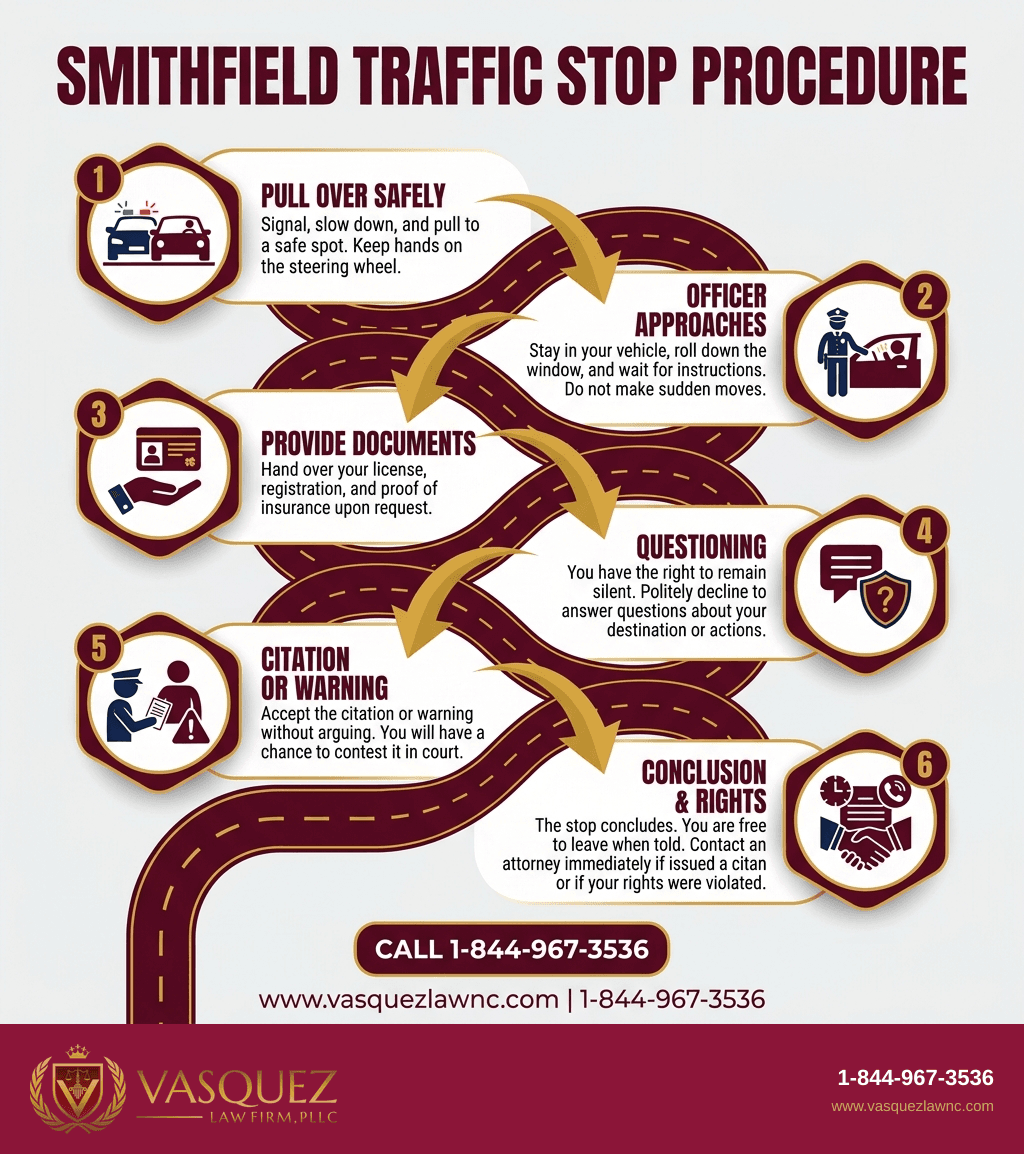
When you see a police vehicle signaling you to stop, it is important to comply promptly but calmly. Pull over safely, turn off your engine, and keep your hands visible on the steering wheel. Officers prefer clear visibility to assess the situation.
The officer will approach your window and ask for your driver's license, vehicle registration, and proof of insurance. These requests are standard as part of the traffic stop procedure. You are legally required to present such documents when asked.
Officers might ask where you are going or question you about recent behavior. In Smithfield, you have the right to politely decline answering non-essential questions.
What If Asked to Roll Down Your Window?
Rolling down your window is usually expected during a stop, as it allows the officer to communicate clearly. Refusing without a valid reason can raise suspicion or lead to additional issues.
For example, if you keep your window rolled up and the officer cannot hear you properly, they may interpret this as non-compliance or evasiveness, which could prolong the stop or escalate the officer’s suspicion. However, if there is a legitimate safety concern, such as a risk of injury or window malfunction, you should calmly explain this to the officer.
In colder months or situations where weather conditions make rolling down the window uncomfortable, it is still advisable to comply unless you have a valid reason. Officers are trained to understand various circumstances but expect cooperation to facilitate a smooth interaction.
Police Search and Your Rights
The officer may request to search your vehicle. Unless they have a search warrant, probable cause, or your consent, you can lawfully refuse a search. Saying "I do not consent to a search" protects your rights in Smithfield and North Carolina courts.
Practical scenarios include an officer smelling alcohol or detecting something suspicious in plain view, which may constitute probable cause. In such cases, the officer may legally search without your consent. However, if no such indication exists, your refusal to consent is a critical protection against unlawful searches.
It is best to remain polite and calm when denying consent. For example, you can say, "Officer, I do not consent to any searches." Avoid physical obstruction or aggressive behavior, which could lead to additional charges.
Issuance of Citation or Release
If the officer determines a violation occurred, they may issue a ticket. Alternatively, you might be released with a warning. Criminal charges may follow if there is evidence of impaired or reckless driving.
Receiving a citation does not always mean you admit guilt. You have the option to contest the ticket in court. For instance, if you believe the speed measurement was inaccurate or you had a valid reason for the alleged violation, you can present your case before a judge.
In more serious situations, such as suspected DUI, the officer may arrest you on the spot. This initiates a more complex legal process involving bail, arraignment, and possibly trial. Early consultation with a criminal defense attorney can be crucial in navigating these proceedings.
Common Mistakes to Avoid During a Traffic Stop
- Arguing with the officer: Stay calm and avoid confrontation. Arguing can escalate the situation.
- Failing to provide documents: Always have your license, registration, and insurance ready to show.
- Consenting to unwarranted searches: Know your rights. Don’t consent without understanding the consequences.
- Admitting guilt verbally: Avoid making statements that could be used against you later.
- Not recording the stop when possible: If legally allowed, recording may protect your rights.
- Panic or sudden movements: Keep your hands visible and move slowly when asked.
- Driving away: Never try to evade a traffic stop. This could lead to serious criminal charges.
If you only remember one thing: Always remain polite, keep your hands visible, and exercise your right to remain silent.
Additional common mistakes include providing inconsistent information that contradicts your initial statements. For example, if you tell an officer you were at one location but later admit to being somewhere else, this can raise suspicion and complicate your case. Consistency and brevity in your responses help avoid misunderstandings.
Another mistake is failing to comply with lawful commands, such as stepping out of the vehicle when requested. Even if you feel the request is unnecessary, complying and then addressing concerns later with your attorney is safer than resisting on the spot.
Finally, many drivers neglect to familiarize themselves with the specific local traffic laws in Smithfield or North Carolina, which can lead to unintentional violations. For instance, not knowing the exact speed limits or rules regarding cell phone use while driving can result in avoidable stops. Staying informed about traffic regulations is a proactive way to minimize encounters with law enforcement.
Timeline and Legal Process After a Traffic Stop
After a Smithfield traffic stop, if you receive a citation, you typically have 30 days to respond by paying the fine, contesting the ticket, or seeking a hearing. Failure to act can result in additional penalties.
For criminal charges following impaired driving or other offenses, initial court appearances occur within 10-30 days. You may be required to enter a plea or schedule pretrial motions.
If you are arrested, the process involves arraignment, possible bond hearings, and trial preparation. Vasquez Law Firm will explain each step and provide vigorous defense tailored to North Carolina law.
In many cases, the timeline can extend considerably depending on court schedules, the complexity of the case, and whether you pursue plea negotiations or trial. For example, DUI cases often require additional testing, expert testimony, and pretrial motions, which may delay resolution.
It is also important to note that ignoring legal deadlines, such as failing to appear in court or respond to citations, can lead to warrants for your arrest or license suspensions. Prompt action and legal guidance can prevent these complications.
Throughout the process, maintaining communication with your attorney and attending all court dates is essential. Your lawyer can assist with negotiating plea deals, filing motions to suppress evidence obtained during the traffic stop, or preparing a strong defense for trial if necessary.
Frequently Asked Questions About Traffic Stops
What should I say when a cop asks where I am going?
You are not obligated to answer where you are going. A simple polite response like "I prefer not to answer" is acceptable. Avoid giving unnecessary information that could be misinterpreted. Being brief helps prevent unintentional admissions or inconsistencies that might be used against you.
For example, if you were going to a location that might raise suspicion, volunteering this information is not required. Staying courteous but firm in protecting your privacy is your right during a traffic stop.
Do I have to roll down my window during a traffic stop?
Yes, in most cases, you must roll down your window to communicate with the officer. Refusing may increase suspicion and cause complications, so comply unless there is a safety concern. Rolling down the window allows clear communication and reduces misunderstandings.
If you have a legitimate reason for hesitation, such as a medical condition or safety issue, inform the officer calmly. However, outright refusal without explanation can escalate the encounter and potentially lead to additional enforcement actions.
Can police search my car during a traffic stop?
Police need probable cause, a warrant, or your consent to search your car. You can legally refuse consent. Saying "I do not consent to a search" protects your rights but always remain calm. Refusal does not guarantee the officer will not search, but it strengthens your legal position if the search is challenged in court.
For instance, if an officer smells marijuana or sees contraband in plain view, they may have probable cause to search without consent. Understanding these limits helps you respond appropriately while safeguarding your rights during the stop.
What happens if I’m cited during a traffic stop?
You will receive a citation with instructions on how to pay or contest it. Ignoring the ticket can lead to license suspension or additional penalties. Consider consulting a lawyer before deciding. Contesting a citation may involve attending court hearings and presenting evidence or arguments to dispute the charge.
Paying the ticket is an admission of guilt and may impact insurance rates or driving records. A legal review can help you understand the best course of action based on your specific circumstances.
What is a "trick question" police ask during stops?
Police may ask questions like "Where are you going?" aiming to detect inconsistent or suspicious answers. You have the right to stay silent or give brief responses to avoid self-incrimination. These questions test your reaction and may be used to infer guilt or nervousness.
For example, an officer might ask if you have been drinking, even if you have not. Answering cautiously or politely declining to answer can prevent unintended admissions.
How many people does a cop pull over a day in Smithfield?
It varies based on patrol shifts and area traffic. Generally, local officers might conduct several stops per shift, but exact numbers depend on specific policing practices. Factors include crime rates, traffic volume, and department priorities.
For example, during special enforcement campaigns targeting impaired driving, the number of stops may increase. Conversely, routine patrols in low-traffic areas may result in fewer stops. Understanding this variability helps set realistic expectations.
What if I face multiple charges after a traffic stop?
Multiple charges can complicate your case greatly. It is critical to consult an experienced criminal defense attorney to protect your rights and seek the best possible outcome. Charges such as DUI combined with reckless driving or resisting arrest require a coordinated defense strategy.
Your attorney can evaluate the evidence, negotiate with prosecutors, and explore options like plea bargains or alternative sentencing programs tailored to your situation.
What are unconstitutional traffic stops?
Stops without reasonable suspicion or made based on discrimination violate constitutional rights. Such stops may be challenged in court to exclude illegally obtained evidence. For example, stopping a vehicle solely based on race or ethnicity is unconstitutional and can result in dismissal of charges.
If you believe your stop was unlawful, document the details and consult an attorney promptly to explore legal remedies that protect your rights and address improper police conduct.
About Vasquez Law Firm
At Vasquez Law Firm, we combine compassion with aggressive representation. Our motto "Yo Peleo®" (I Fight) reflects our commitment to standing up for your rights during traffic stops and criminal charges in Smithfield and the wider North Carolina area.
- Bilingual Support: Se Habla Español — Spanish-speaking attorneys and staff available
- Service Areas: Criminal defense in Johnston and Harnett counties, NC; immigration nationwide, including Florida
- Experience: Over 15 years helping clients navigate complex criminal defense issues
- Results: Thousands of successful cases across multiple practice areas
Our firm understands the stress and uncertainty that traffic stops and related charges can cause. We provide personalized attention to each client, ensuring that you fully understand your options and the potential consequences of your case.
Whether you face minor infractions or serious criminal charges, we tailor our defense strategies to meet your unique circumstances. Our attorneys stay current with evolving laws and court rulings in North Carolina to offer effective representation.
Moreover, Vasquez Law Firm is dedicated to community education, regularly offering resources and seminars to inform Smithfield residents about their rights and responsibilities on the road. Empowering our clients with knowledge is a cornerstone of our practice.
Attorney Trust and Experience
Attorney Vasquez is admitted to the North Carolina State Bar with 15 years of experience. He has successfully represented clients facing traffic violations and criminal charges throughout Smithfield, Johnston County, and surrounding areas.
His extensive courtroom experience includes negotiating with prosecutors, filing motions to suppress unlawfully obtained evidence, and securing favorable plea agreements or verdicts. Clients trust his ability to navigate complex legal challenges and advocate vigorously on their behalf.
Attorney Vasquez's bilingual skills enable him to connect with a diverse client base, providing culturally sensitive representation. His dedication to justice and client service has earned him a reputation as a reliable and effective criminal defense lawyer in the region.
Don't wait to get the help you deserve. Call us now for immediate assistance.
Se Habla Español
Sources and References
Take the first step toward justice today. Our team is standing by to help.
Start Your Free Evaluation Now
Call us: 1-844-967-3536
Se Habla Español - Estamos aquí para ayudarle.


William Vasquez
Founder & CEO, Vasquez Law Firm, PLLC
William Vasquez is the founder and CEO of Vasquez Law Firm, PLLC, a results-driven firm specializing in immigration, criminal defense, personal injury, and workers' compensation. A U.S. Air Force veteran and recipient of the Joint Service Achievement Medal, William is dedicated to fiercely fighting for his clients' rights.
Related Legal Services
Need legal help? Learn more about speak with a criminal defense lawyer, or contact us for a free evaluation.
You can also visit our North Carolina defense practice for more information.