What You Need to Know About Racketeering and RICO Charges in 2026
Facing racketeering charges or RICO allegations in 2026? Understand your defense options. Contact Vasquez Law Firm for a free consultation today.
Published on February 14, 2026
Protect your record and your freedom
Free, confidential review. 24/7.
Free & confidential · Se habla espanol · 24/7

Have questions? Talk to an attorney - free evaluation.
Call 1-844-967-3536Protect Your Record and Your Freedom
A confidential case review - available 24/7 for emergencies.
What You Need to Know About Racketeering and RICO Charges in 2026
Facing racketeering charges or allegations under the RICO Act can be one of the most serious legal challenges an individual or business might encounter. These complex federal and state statutes target organized criminal activity, often involving a pattern of illegal acts. Understanding what constitutes racketeering, the potential penalties, and the critical importance of a robust legal defense is essential in 2026. At Vasquez Law Firm, we are dedicated to providing aggressive and compassionate representation for those accused of these serious offenses, ensuring your rights are protected every step of the way.
Need help with your case? Our experienced attorneys are ready to fight for you. Se Habla Español.
Schedule Your Free Case Evaluation
Or call us now: 1-844-967-3536
Quick Answer
Racketeering charges, often associated with the RICO Act, involve engaging in a pattern of criminal activity connected to an enterprise. These can include offenses like extortion, fraud, drug trafficking, and money laundering. Convictions carry severe penalties, including lengthy prison sentences and substantial fines, making immediate legal defense crucial.
- Racketeering requires a "pattern of criminal activity."
- The RICO Act (federal law) targets organized crime.
- Penalties are severe, often involving decades in prison.
- Both federal and state laws address racketeering.
- An experienced criminal defense attorney is essential for these complex cases.
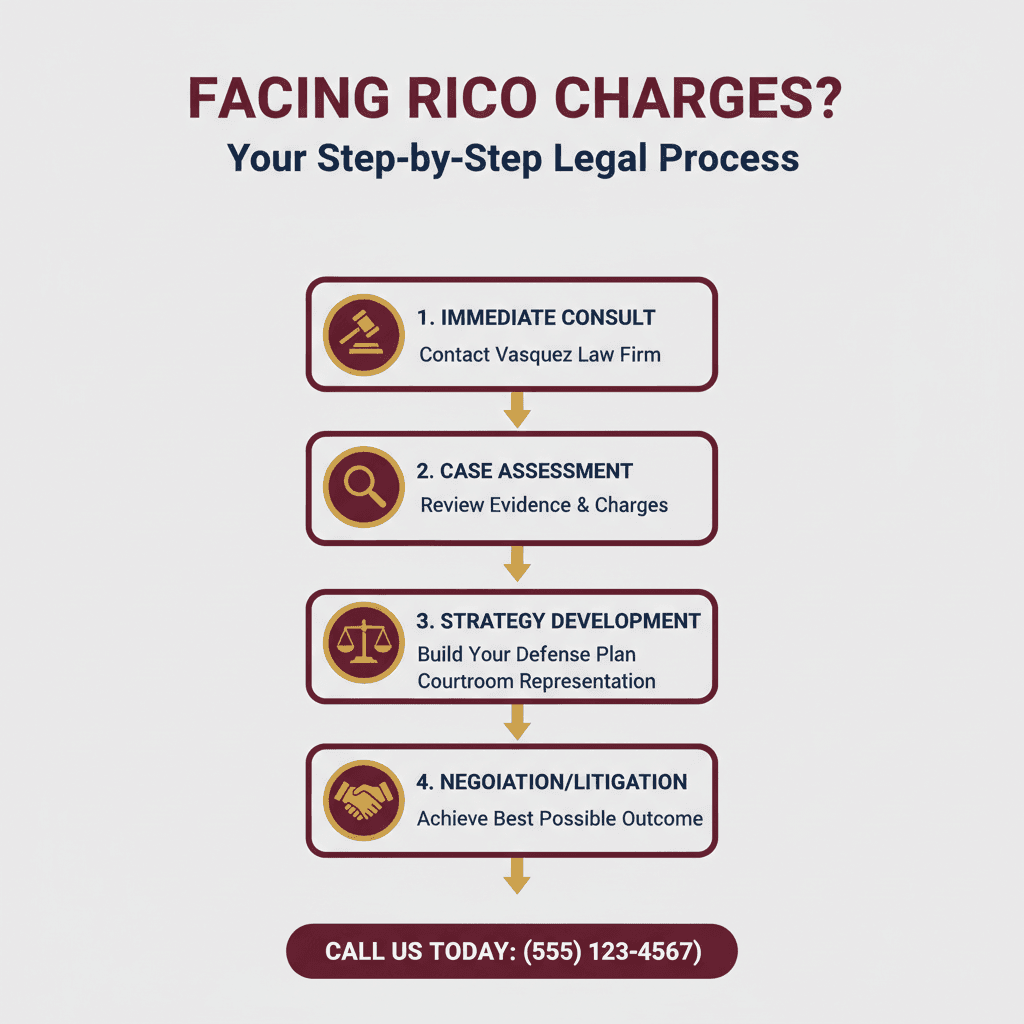
Infographic: Key Elements of a RICO Charge
Understanding the core components of a RICO charge is vital for anyone facing these complex allegations. This infographic breaks down the essential elements that prosecutors must prove for a conviction.
For a detailed explanation of these elements and how they apply to your case, contact Vasquez Law Firm today.
Understanding Racketeering Charges and RICO
Racketeering broadly refers to operating an illegal business or engaging in a pattern of criminal activity. The most well-known statute addressing this is the federal Racketeer Influenced and Corrupt Organizations (RICO) Act, codified at 18 U.S. Code §§ 1961-1968. This powerful law allows prosecutors to target individuals who are part of an ongoing criminal enterprise, not just those who commit individual crimes. A key component of racketeering charges is the requirement for a "pattern of racketeering activity," which typically means at least two predicate acts committed within a ten-year period.
Predicate acts are specific state or federal crimes that can be considered part of a racketeering pattern. These can range from violent crimes like murder and kidnapping to financial crimes such as bribery, fraud, and money laundering. The broad scope of RICO means that many different types of criminal organizations, not just traditional mafia groups, can be targeted, including drug trafficking rings, street gangs, and even corrupt businesses. Understanding the specific predicate acts alleged in a case is crucial for building an effective defense against racketeering charges.
Both federal and state laws address racketeering. While the federal RICO Act is the most prominent, many states, including North Carolina and Florida, have their own versions of racketeering statutes, sometimes called "Little RICO" laws. These state laws often mirror the federal statute but apply to criminal activities within state borders. Navigating the complexities of these laws requires an attorney with deep experience in both federal and state criminal defense. The legal team at Vasquez Law Firm has extensive experience defending clients against these serious allegations in both North Carolina and Florida.
Common Predicate Acts and Racketeering Examples
The RICO Act lists 35 specific federal and state crimes that can serve as predicate acts for a racketeering charge. These offenses cover a wide spectrum of illegal activities, reflecting the law's intent to dismantle diverse criminal enterprises. Some of the most common predicate acts include, but are not limited to, the following categories:
- Violent Crimes: Murder, kidnapping, extortion, arson, robbery, and threats.
- Financial Crimes: Bribery, counterfeiting, embezzlement, mail fraud, wire fraud, securities fraud, and money laundering.
- Drug Offenses: Drug trafficking, manufacturing, and distribution of controlled substances. For more on related federal charges, see our guide on federal drug trafficking charges.
- Gambling and Prostitution: Illegal gambling operations and promoting prostitution.
- Labor Racketeering: Union corruption, such as illegal payments or threats related to labor organizations.
- Other Offenses: Counterfeiting, slavery, and dealing in obscene matter.
An example of racketeering might involve a group systematically extorting protection money from businesses over several years. Each act of extortion, when part of a larger scheme run by an identifiable enterprise, could constitute a predicate act. Another common racketeering example could be a drug cartel using legitimate businesses to launder money derived from illegal drug sales, with each instance of money laundering or drug distribution counting as a predicate act. Understanding these examples helps illustrate the broad reach of racketeering laws.
Penalties for Racketeering Convictions
The consequences of a racketeering conviction are extremely severe, reflecting the serious nature of these charges. Under federal law, a person convicted of racketeering or a RICO charge can face up to 20 years in prison for each count, or even life imprisonment if the predicate act carries a life sentence. Additionally, substantial fines of up to $25,000 per count, or twice the gross profits or proceeds from the racketeering activity, can be imposed. This financial penalty can be devastating, often leading to forfeiture of assets and property acquired through or used in the criminal enterprise.
Asset forfeiture is a particularly harsh aspect of racketeering penalties. The government can seize any property, including real estate, vehicles, and financial accounts, that was involved in or derived from the racketeering activity. This means that even if you are not directly involved in every predicate act, but benefit from the enterprise, your assets could be at risk. State racketeering laws in North Carolina and Florida also carry significant penalties, often including lengthy prison terms and substantial fines, though the specifics can vary.
The long-term impact of a racketeering conviction extends beyond immediate prison time and fines. A felony record can severely limit future employment opportunities, housing options, and even eligibility for certain professional licenses. For immigrants, a conviction for racketeering can lead to deportation or inadmissibility. Given these severe consequences, securing experienced legal representation immediately upon being accused of racketeering charges is not just advisable, it is absolutely critical for your future.
Don't face your legal challenges alone. Our team is here to help you every step of the way.
Call today: 1-844-967-3536 | Se Habla Español
Building a Strong Defense Against RICO Charges
Defending against racketeering charges requires a sophisticated and aggressive legal strategy. These cases are often complex, involving extensive investigations, mountains of evidence, and numerous witnesses. An effective defense begins with a thorough understanding of the prosecution's case, meticulously examining every piece of evidence, from financial records to wiretap transcripts. Our approach at Vasquez Law Firm focuses on identifying weaknesses in the prosecution's arguments and challenging the core elements they must prove.
Several defense strategies can be employed, depending on the specifics of the racketeering charges. One common defense is to challenge the existence of a criminal "enterprise" or the "pattern of racketeering activity." Prosecutors must prove these elements beyond a reasonable doubt, and if they fail, the entire case can collapse. We may argue that the alleged acts are isolated incidents, not part of a continuous pattern, or that the association does not meet the legal definition of an enterprise under 18 U.S. Code § 1961(4). This requires careful analysis of the evidence and expert legal arguments.
Other defenses might include demonstrating a lack of intent, challenging the reliability of witnesses or evidence, or arguing that the defendant was not directly involved in the alleged criminal enterprise. In some cases, constitutional challenges, such as violations of Fourth Amendment rights regarding search and seizure, or Fifth Amendment rights against self-incrimination, can be powerful tools. For more information on your rights during an arrest, please review our guide on criminal defense rights during arrest in NC and FL. Early intervention by an experienced attorney can significantly impact the outcome, potentially leading to reduced charges or even dismissal. Attorney Vasquez has over 15 years of experience in criminal defense, including complex federal cases.
NC, FL, and Nationwide Considerations for Racketeering
While the federal RICO Act applies nationwide, both North Carolina and Florida have their own state-specific racketeering statutes, which can lead to charges at either the state or federal level. In North Carolina, racketeering offenses are typically prosecuted under the North Carolina Racketeer Influenced and Corrupt Organizations Act (NC RICO Act), which largely mirrors the federal statute. These charges are often brought in cases involving organized drug rings, financial fraud schemes, or other extensive criminal enterprises within the state. The penalties under NC law are severe, including lengthy prison sentences and significant fines, similar to federal penalties but applied through the state court system.
Similarly, Florida has its own Florida RICO Act, which provides state prosecutors with tools to combat organized crime within its borders. Florida's law is also broad, covering a wide array of predicate offenses and allowing for asset forfeiture. Cases in Florida can involve anything from large-scale insurance fraud to human trafficking operations. Given the presence of major ports and international connections, Florida's racketeering cases often have complex interstate or even international dimensions, making legal representation from a firm familiar with both state and federal jurisdictions, like Vasquez Law Firm, crucial for clients in Smithfield and across the state.
Nationwide, federal racketeering charges are typically handled by the U.S. Department of Justice through federal district courts. These cases often involve multi-state operations or crimes that cross international borders, bringing in federal agencies like the FBI, DEA, and IRS. The penalties for federal racketeering charges are uniformly severe across the country. Regardless of whether you are facing state or federal racketeering charges in North Carolina, Florida, or elsewhere, the fundamental principles of defense remain the same: challenge the enterprise, challenge the pattern of activity, and protect your constitutional rights. Our firm's ability to operate in both NC and FL provides a distinct advantage for clients facing these multi-jurisdictional challenges.
When to Call a Lawyer Now About Racketeering Charges
The moment you suspect you are under investigation for racketeering or a RICO charge, it is imperative to contact an experienced criminal defense attorney immediately. Early legal intervention can significantly alter the trajectory of your case. Do not wait for an arrest or formal charges to be filed. Here are critical triggers that signal it's time to call a lawyer:
- You've been contacted by federal agents (FBI, DEA, IRS) or state law enforcement: Any questioning related to organized crime, financial activities, or a group's operations warrants immediate legal counsel.
- You receive a grand jury subpoena: This indicates you are a subject or target of a serious investigation.
- Your property or assets are being investigated or frozen: This is a strong sign of a potential asset forfeiture action linked to racketeering.
- You are asked to provide financial documents or business records: Law enforcement or prosecutors may be building a financial crimes case.
- Associates or business partners are being questioned or arrested: This suggests a broader investigation that could involve you.
- You learn of an informant or witness cooperating with the government against you: This indicates direct evidence may be building.
- You are formally arrested or charged with racketeering: This is the most urgent trigger, demanding immediate and aggressive defense.
Delaying legal counsel can jeopardize your rights and weaken your defense. Attorney Vasquez and the Vasquez Law Firm team are ready to provide the urgent, aggressive defense you need. We understand the complexities of racketeering charges and are prepared to fight tirelessly on your behalf. Se Habla Español.
About Vasquez Law Firm
At Vasquez Law Firm, we combine compassion with aggressive representation. Our motto "Yo Peleo" (I Fight) reflects our commitment to standing up for your rights. We understand the immense stress and uncertainty that come with criminal charges, especially serious allegations like racketeering charges, and we are here to provide unwavering support and a powerful defense strategy.
- Bilingual Support: Se Habla Español - our team is fully bilingual, ensuring clear communication and understanding for all our clients.
- Service Areas: Criminal defense in Johnston and Harnett counties, NC; immigration nationwide, including Florida
- Experience: With over 15 years of dedicated legal experience, Attorney Vasquez has a proven track record in complex criminal defense cases.
- Results: Our firm is committed to achieving the best possible outcomes, fighting for dismissals, reduced charges, and favorable plea agreements for our clients.
Attorney Trust and Experience
Attorney Vasquez holds a Juris Doctor degree and is admitted to practice in the North Carolina State Bar. With over 15 years of dedicated legal experience, he has built a reputation for providing personalized attention and achieving favorable outcomes for his clients. His deep understanding of federal and state criminal law, particularly regarding complex statutes like RICO, makes him a formidable advocate for those facing serious charges. Trust Vasquez Law Firm to bring experience and dedication to your defense.
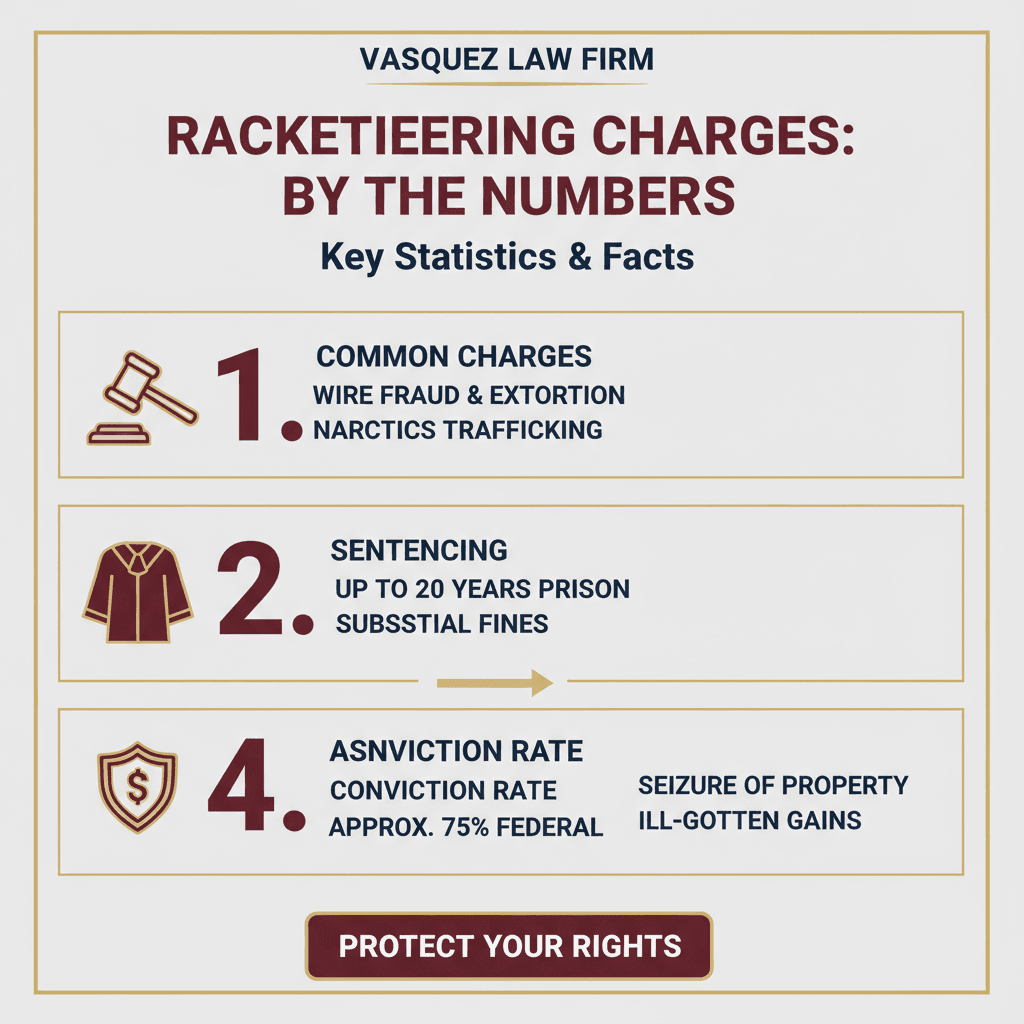
Infographic: Severe Penalties for RICO Convictions
A conviction for racketeering or a RICO violation carries life-altering consequences. This infographic summarizes the severe penalties you could face.
Learn how to protect your future by scheduling a free case evaluation with our firm.
Frequently Asked Questions
What exactly is a RICO charge?
A RICO charge, under the Racketeer Influenced and Corrupt Organizations Act (18 U.S. Code §§ 1961-1968), targets individuals involved in an ongoing criminal enterprise. It requires proof of a "pattern of racketeering activity," meaning at least two specific predicate criminal acts committed within a ten-year period. This law allows prosecutors to pursue leaders of criminal organizations beyond individual crimes.
What are common examples of racketeering activity?
Common examples of racketeering activity include a wide range of state and federal offenses. These can involve extortion, bribery, fraud (mail, wire, or securities), drug trafficking, money laundering, illegal gambling, and even violent crimes like murder or kidnapping, when committed as part of an organized criminal enterprise. The key is the pattern and connection to an enterprise.
Is racketeering a federal or state crime?
Racketeering can be both a federal and a state crime. The federal RICO Act is a widely known statute, but many states, including North Carolina and Florida, have their own "Little RICO" laws. These state laws allow for prosecution of similar organized criminal activities within their respective jurisdictions, often carrying comparable severe penalties.
What are the penalties for a RICO conviction?
Penalties for a RICO conviction are severe, including up to 20 years in federal prison for each count, or even life imprisonment if a predicate offense carries that penalty. Additionally, substantial fines of up to $25,000 per count or twice the illicit gains, and mandatory asset forfeiture of property connected to the crime, are common.
What does "pattern of racketeering activity" mean?
A "pattern of racketeering activity" generally means committing at least two specific predicate acts within a ten-year period. These acts must be related to each other and pose a threat of continued criminal activity. This pattern element distinguishes racketeering from isolated criminal offenses, focusing on ongoing organized crime.
Can a legitimate business be accused of racketeering?
Yes, a legitimate business can absolutely be accused of racketeering if it is used as a front or vehicle for organized criminal activity. RICO laws define "enterprise" broadly to include any individual, partnership, corporation, association, or other legal entity, as well as any union or group of individuals associated in fact although not a legal entity.
How does asset forfeiture relate to racketeering charges?
Asset forfeiture is a significant consequence of racketeering charges. If convicted, the government can seize any property, assets, or proceeds derived from or used to facilitate the racketeering activity. This can include real estate, bank accounts, vehicles, and other valuable possessions, even if they are not directly owned by the convicted individual.
What should I do if I am being investigated for racketeering?
If you are being investigated for racketeering, the most critical step is to immediately contact an experienced criminal defense attorney. Do not speak with law enforcement without legal counsel present. An attorney can protect your rights, advise you on how to proceed, and begin building a robust defense strategy to mitigate potential consequences.
Are there different types of racketeering?
While the core definition of racketeering remains consistent, different types often refer to the nature of the underlying criminal enterprise or predicate acts. These can include labor racketeering (union corruption), financial racketeering (fraud schemes), drug racketeering (trafficking operations), or traditional organized crime. The specific predicate acts define the type.
Can racketeering charges be brought against individuals or only groups?
Racketeering charges can be brought against both individuals and groups. While the RICO Act targets criminal enterprises, individuals who participate in or benefit from such an enterprise, even if they are not the primary leaders, can still face severe racketeering charges. The focus is on the individual's role within the broader criminal organization.
Sources and References
- U.S. Department of Justice - Criminal Resource Manual on RICO
- 18 U.S. Code Chapter 96 - Racketeer Influenced and Corrupt Organizations (RICO)
- North Carolina Courts
Facing charges? Our criminal defense attorneys can review your case.
Ready to take the next step? Contact Vasquez Law Firm today for a free, confidential consultation. We're committed to fighting for your rights and achieving the best possible outcome for your case.
Start Your Free Case Evaluation Now
Call us: 1-844-967-3536
Se Habla Español - Estamos aquí para ayudarle.


William Vasquez
Founder & CEO, Vasquez Law Firm, PLLC
William Vasquez is the founder and CEO of Vasquez Law Firm, PLLC, a results-driven firm specializing in immigration, criminal defense, personal injury, and workers' compensation. A U.S. Air Force veteran and recipient of the Joint Service Achievement Medal, William is dedicated to fiercely fighting for his clients' rights.
Related Legal Services
Need legal help? Learn more about NC criminal defense legal team, or contact us for a free evaluation.
You can also visit Smithfield criminal defense attorneys for more information.