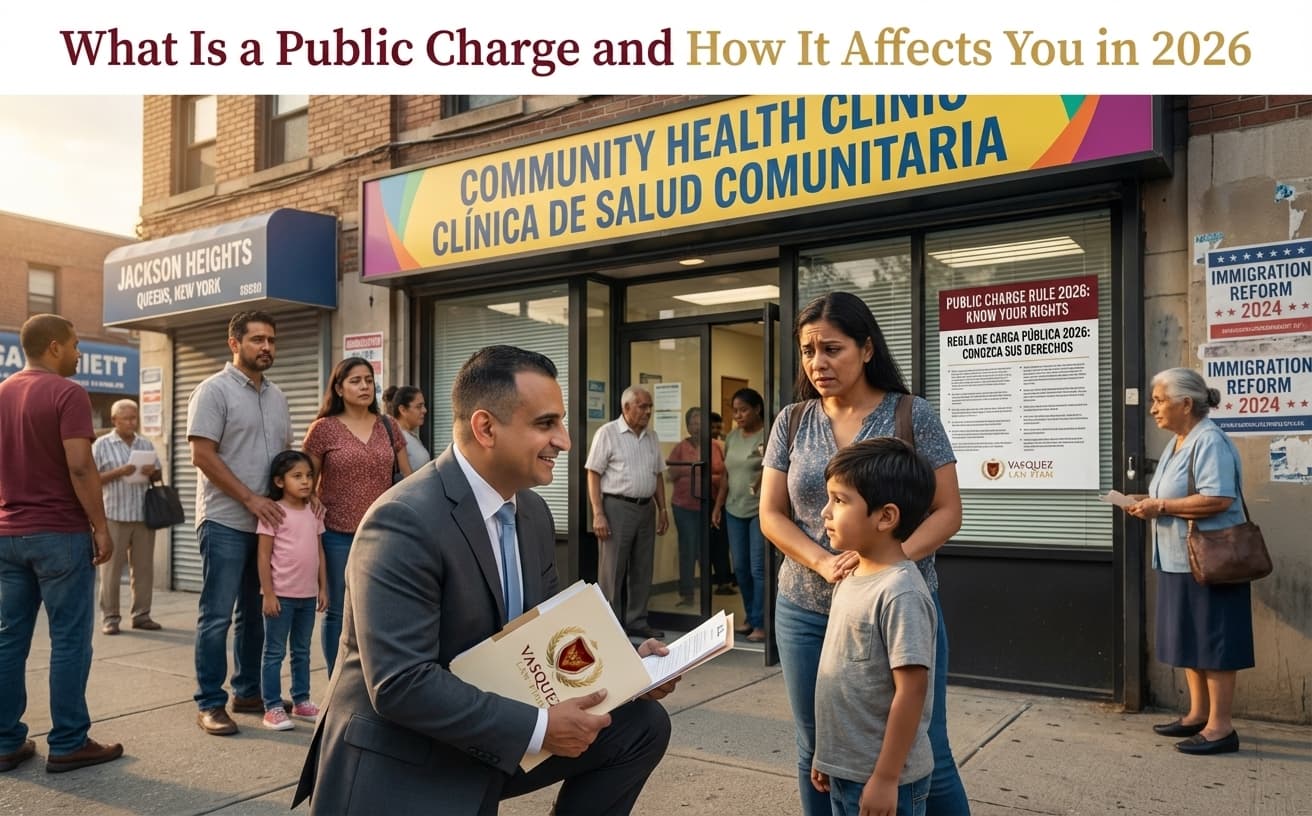
What Is a Public Charge and How It Affects You in 2026
Learn what a public charge means in immigration and protect your case in 2026. Contact Vasquez Law for a free consultation today.
Published on March 17, 2026
Talk to an immigration attorney
Free call. A clear plan for your case.
Free & confidential · Se habla espanol · 24/7
Have questions? Talk to an attorney - free evaluation.
Call 1-844-967-3536Worried how the latest immigration news affects you?
Schedule a confidential case review with an immigration attorney - know exactly where you stand.
USCIS Case Status
Check your USCIS case status
Enter your receipt number and get the official status. Free, no registration.
What Is a Public Charge and How It Affects You in 2026
Understanding the public charge rule is crucial for immigrants in Smithfield, NC, and Florida in 2026. A public charge refers to someone likely to depend on government benefits. This affects visa and green card eligibility. Knowing how USCIS evaluates public charge status helps you protect your immigration status. This article explains what benefits count, recent rule changes, and key actions for Dreamers and all immigrants.
Need help with your case? Our experienced attorneys are ready to fight for you. Se Habla Español.
Schedule Your Free Case Evaluation
Or call us now: 1-844-967-3536
Quick Answer
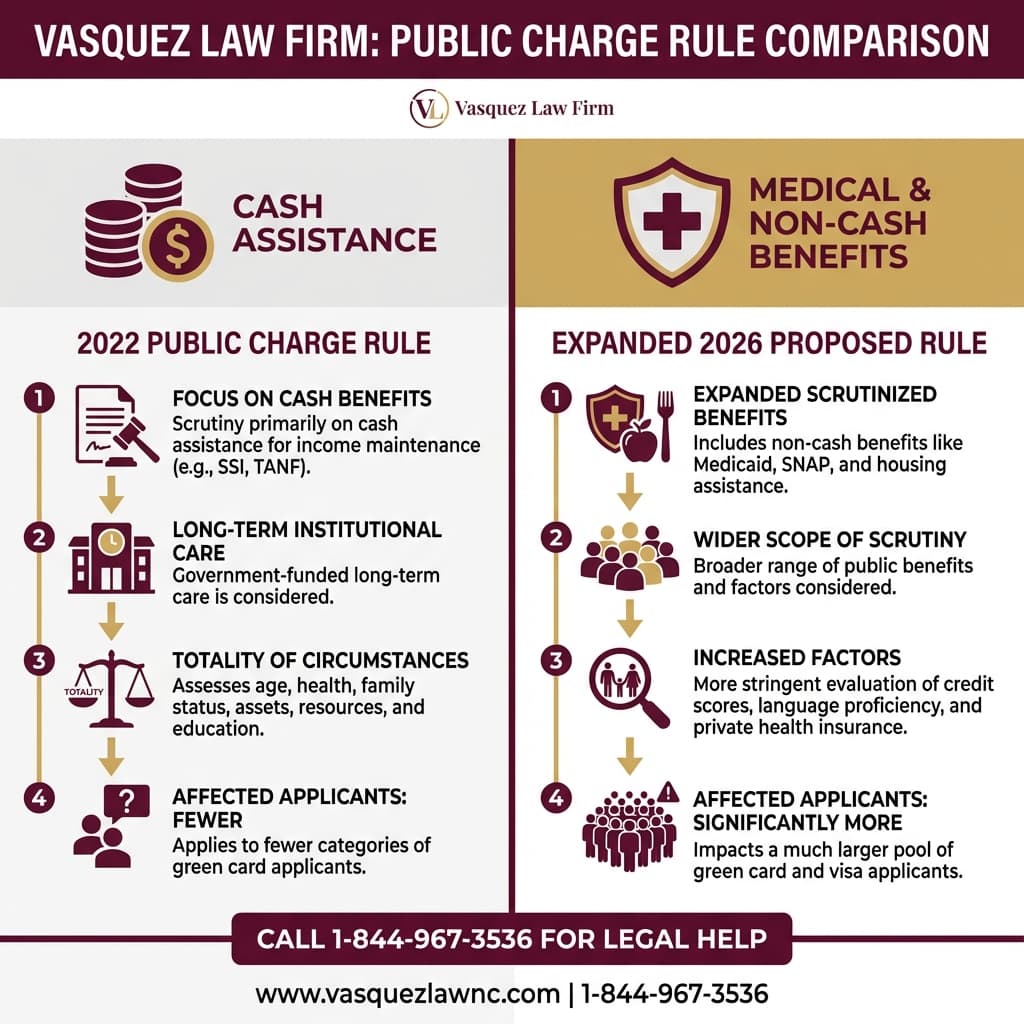
A public charge is an immigrant who is likely to rely on certain government benefits, such as cash assistance or long-term care. In 2026, the rules focus on specific benefits like Supplemental Security Income, Temporary Assistance, and Medicaid for long-term care. Understanding public charge is essential for visa and green card applicants to avoid denial.
- Only certain benefits count towards public charge
- Many non-cash benefits are exempt
- Applicants can prove financial stability to avoid a public charge finding
- Recent changes have narrowed public charge rules
- Dreamers have specific exceptions under current laws
Understanding Public Charge in Immigration
Imagine applying for a green card or a visa in Smithfield or Florida and facing a question about whether you will be a "public charge". This term is part of immigration law used to assess if you might become dependent on government aid. The public charge ground of inadmissibility is based on federal law 8 U.S.C. § 1182(a)(4), which denies entry or adjustment of status to those likely to become a public charge.
In 2026, USCIS reviews specific benefits to decide this. Cash benefits like Supplemental Security Income (SSI), Temporary Assistance for Needy Families (TANF), and certain Medicaid coverage count. Non-cash benefits, including emergency Medicaid and most nutrition programs, usually do not count. This distinction affects millions of immigrants and their families applying for legal status.
USCIS Public Charge Rule
The rule evaluates your age, health, family status, assets, education, and financial resources. USCIS officers weigh these factors to predict if immigrants might need public support. For example, a young, employed person with steady income is less likely to be found a public charge than someone with serious medical needs relying on cash benefits.
Public Charge Ground of Inadmissibility
This ground is a legal reason USCIS refuses entry or green cards. It protects public resources but can affect lawful immigrants if not carefully addressed. Knowing which benefits count and how your case will be reviewed is vital, especially in Smithfield or Florida, where local community support can also influence preparation.
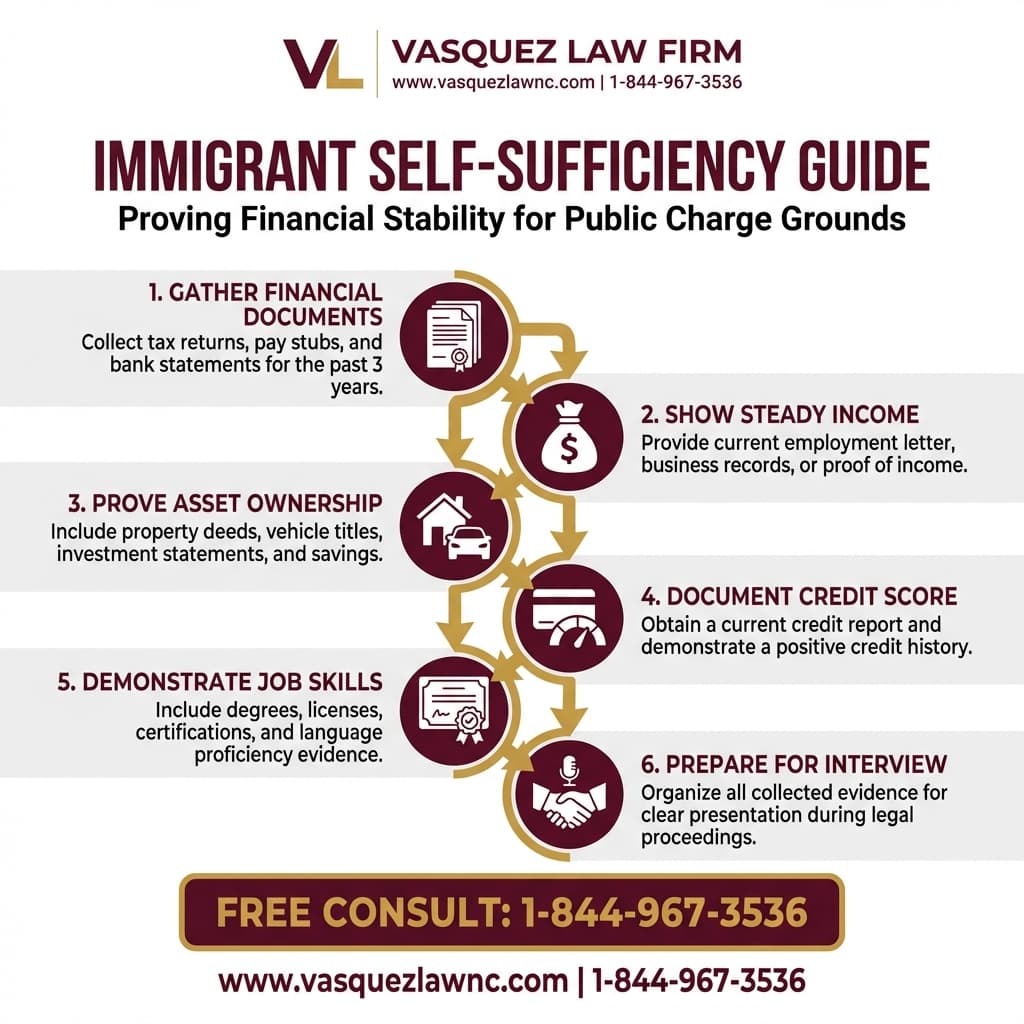
Step-by-Step: How to Prove You're Not a Public Charge
Proving you are not a public charge involves submitting documents that show you will support yourself and not rely on government aid. Here is a typical process:
- Gather Financial Documents: Collect pay stubs, tax returns, bank statements, and affidavits of support from sponsors.
- Show Employment and Income: Provide proof of steady employment or job offers that ensure self-support.
- Submit Health Insurance Proof: Demonstrate you have coverage to avoid becoming a public charge through medical dependency.
- Avoid Benefits That Count: Avoid using benefits that could be considered under public charge unless legally exempt.
- Consult an Immigration Lawyer: Present your evidence organized and receive legal guidance to strengthen your case.
Step 1: Collect Income and Asset Evidence
Provide pay stubs, bank statements, and proof of assets like property or savings to prove you can support yourself financially.
Step 2: Obtain Affidavit of Support
If you have a sponsor, their affidavit guarantees financial responsibility. The form I-864 is crucial in this step.
Step 3: Prepare Health Insurance Proof
Show that you have private or employer-provided health insurance, decreasing the chance of future reliance on public aid.
Don't wait to get the help you deserve. Call us now for immediate assistance. Se Habla Español.
Documents Checklist for Public Charge Evaluations
- Recent pay stubs showing earning stability
- Tax returns for the past 2 years
- Bank statements verifying savings and assets
- Affidavit of Support form I-864 from a sponsor
- Proof of health insurance coverage
- Property deeds or ownership documentation
- Employment offer letters or contracts
- Evidence of educational qualifications or skills
- Medical records if health is a key concern
Timeline and What to Expect During Your Case
- Week 1 to 4: Collect and prepare all documents, attend medical exams if required.
- Week 5 to 8: Submit your immigration application with all evidence related to public charge.
- Week 9 to 12: USCIS reviews your case. You may receive a Request for Evidence (RFE) if more proof is needed.
- Week 13 to 16: Respond promptly to RFE. Legal assistance can improve response quality.
- Week 17 to 24: Final decision issued. If denied, explore appeals or waivers with a lawyer.
Costs and Fees: What Impacts the Price
- USCIS filing fees vary by application type
- Legal fees depend on case complexity and documentation needed
- Medical examination and translation costs add to expenses
- Expedited processing requests increase fees
- Additional fees may apply for appeals or motions to reopen
Common Mistakes to Avoid Regarding Public Charge
- Failing to understand which benefits count: Use legal guidance to avoid unintentional public charge triggers.
- Not submitting enough evidence: Always provide thorough proof of financial stability.
- Ignoring health insurance documentation: Lack of insurance can increase risk of a public charge finding.
- Delaying response to USCIS requests: Timely replies avoid delays or denials.
- Using barred public benefits: Avoid receiving benefits that could count against you.
- Not consulting a lawyer early: Early legal advice prevents mistakes.
- Relying on outdated rule interpretations: Stay informed on 2026 updates.
If you only remember one thing: always get legal advice before applying or accepting benefits that might affect your immigration status.
NC and FL Notes on Public Charge Enforcement
North Carolina Notes
Federal public charge laws apply in NC, but local agencies may have specific benefit programs. In Smithfield and across the state, free community legal services can assist with public charge concerns. NC Medicaid policies follow federal guidelines and may affect public charge evaluations if used for long-term care.
Florida Notes
Florida immigrants face the same federal public charge rules. Use of public assistance can vary by county. Local legal help is available for Dreamers and immigrants to understand their options. Florida Medicaid use for certain long-term care services exchanges with USCIS's assessment in your immigration cases.
Nationwide Concepts
The public charge ground is federal but enforcement evolves. States may provide non-cash benefits that do not count toward public charge. Legal interpretation can differ by jurisdiction, so advice tailored to your location and facts is crucial.
When to Call an Immigration Lawyer Now
- If USCIS sends a Request for Evidence related to public charge
- If you have used government benefits and want to apply for a visa or green card
- If you are a Dreamer planning to adjust status or apply for citizenship
- If you received a public charge denial
- If you have health or financial issues affecting your immigration
- If you do not understand the recent 2026 public charge rule changes
- If you want to avoid public charge issues before applying
- If you have questions about Medicaid or public benefits use
- If your sponsor has financial difficulties
- If you need help preparing affidavits or complex evidence
About Vasquez Law Firm
At Vasquez Law Firm, we combine compassion with aggressive representation. Our motto "Yo Peleo" (I Fight) reflects our commitment to standing up for your rights.
- Bilingual Support: Se Habla Español - our team is fully bilingual
- Service Areas: North Carolina, Florida, and nationwide immigration services
- Experience: Over 15 years helping clients navigate complex legal matters
- Results: Thousands of successful cases across multiple practice areas
Attorney Trust and Experience
Attorney Vasquez holds a Juris Doctor degree and is admitted to practice in both the North Carolina State Bar and Florida Bar. With over 15 years of dedicated legal experience, he has built a reputation for providing personalized attention and achieving favorable outcomes for his clients.
Don't wait to get the help you deserve. Call us now for immediate assistance. Se Habla Español.
Frequently Asked Questions
What is considered a public charge under immigration law?
A public charge is someone likely to depend mainly on government cash assistance or long-term institutional care. USCIS evaluates if an immigrant might need public benefits like SSI, TANF, or Medicaid. Understanding this helps determine admissibility for visas or green cards under immigration law.
Is Medicaid considered a public charge in 2026?
As of 2026, Medicaid received for long-term institutional care may count as a public charge, but short-term emergency Medicaid or benefits for children usually do not. Policies have changed recently, so legal advice is important to understand specific cases and exceptions.
How do I prove I’m not a public charge during my immigration case?
You can show proof of income, job offers, assets, health insurance, and lack of public benefits use. Submit documents such as pay stubs, bank statements, affidavits of support, and health coverage details. This evidence helps USCIS decide you won't rely on government aid.
What are the potential consequences if I’m found a public charge?
Being labeled a public charge can result in visa denial, green card refusal, or removal from the U.S. It may also affect future immigration benefits or entry attempts. Early legal guidance helps avoid this outcome and protect your rights.
What benefits does USCIS consider when determining public charge?
USCIS reviews if you’ve used cash assistance programs like SSI or TANF, and certain long-term Medicaid benefits. Non-cash benefits such as food stamps or emergency Medicaid generally do not count. Recent 2026 rules clarify these distinctions.
How does the public charge rule affect Dreamers in Smithfield?
Dreamers with DACA are generally exempt from public charge evaluations, as DACA is a temporary protection. However, if applying for other immigration benefits, the public charge rule might apply. Local advice ensures Dreamers in Smithfield understand their risks.
Has the public charge rule changed recently in 2026?
Yes, in 2026, the public charge rule reverted to a narrower interpretation focusing mainly on cash benefits and long-term care. This adjustment impacts many immigrants by reducing barriers and clarifying what benefits count in applications.
Where can I get trusted help for my public charge concerns?
Reliable legal help is available from experienced immigration attorneys like those at Vasquez Law Firm. They provide bilingual support, guide you through evaluating public charge risks, and help prepare strong immigration applications in Smithfield, NC, and Florida.
Sources and References
- USCIS official guidelines on public charge
- Executive Office for Immigration Review
- U.S. Department of State visa information
- North Carolina Courts
Need immigration help? Our immigration attorneys can review your case.
Take the first step toward justice today. Our team is standing by to help. Se Habla Español.
Start Your Free Case Evaluation Now
Call us: 1-844-967-3536
Se Habla Español - Estamos aquí para ayudarle.

William Vasquez
Founder & CEO, Vasquez Law Firm, PLLC
William Vasquez is the founder and CEO of Vasquez Law Firm, PLLC, a results-driven firm specializing in immigration, criminal defense, personal injury, and workers' compensation. A U.S. Air Force veteran and recipient of the Joint Service Achievement Medal, William is dedicated to fiercely fighting for his clients' rights.
Related Legal Services
Need legal help? Learn more about our immigration law practice, or contact us for a free evaluation.
You can also visit immigration lawyers serving all of North Carolina for more information.
![Bill Requiring Immigration Checks in Tennessee Schools [2026]](/_next/image?url=https%3A%2F%2Fvuuyorlsmhunqektprqy.supabase.co%2Fstorage%2Fv1%2Fobject%2Fpublic%2Fblogs%2Fimmigration-header-1782501200499.png&w=1920&q=75)