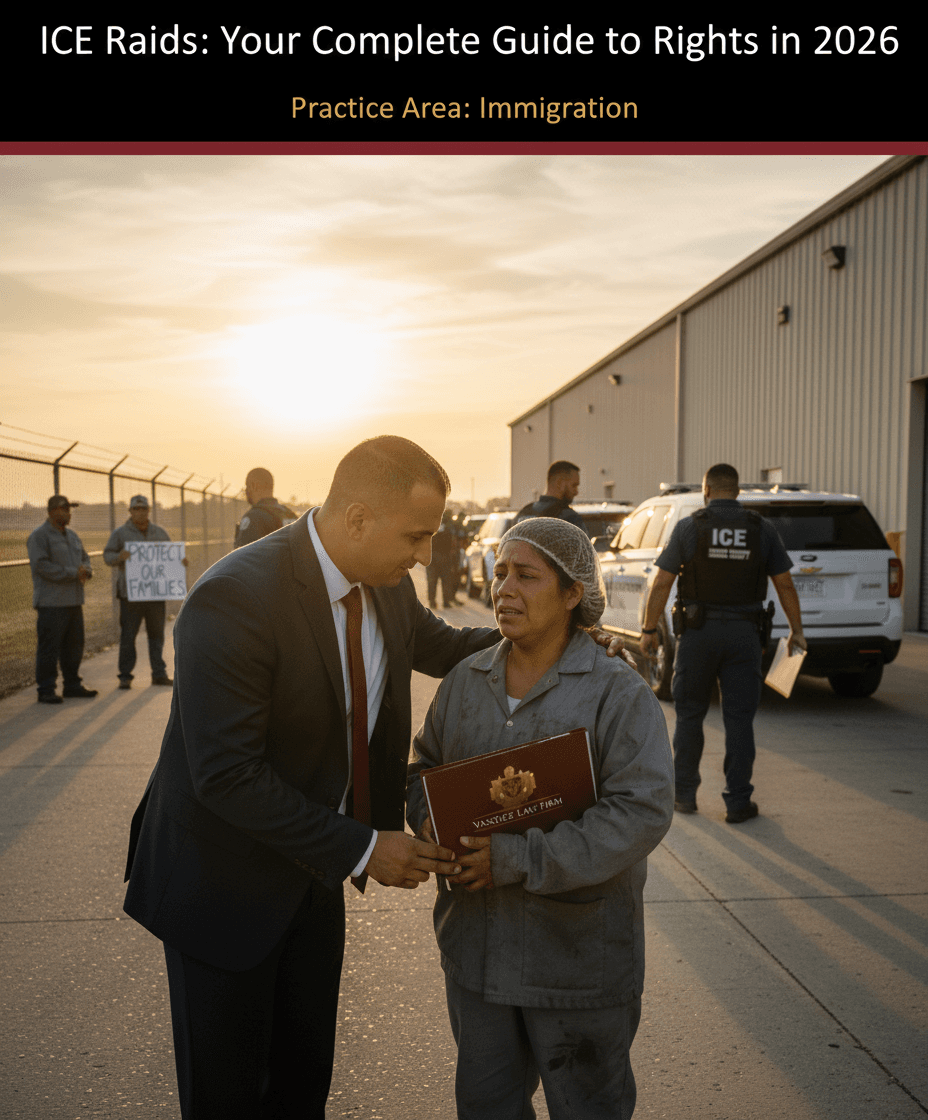
Know Your Rights During an ICE Raid in 2026
Understand your rights during ICE raids in 2026. Get critical information and learn how to protect yourself and your family. Contact Vasquez Law for help.
Published on February 14, 2026
Talk to an immigration attorney
Free call. A clear plan for your case.
Free & confidential · Se habla espanol · 24/7
Have questions? Talk to an attorney - free evaluation.
Call 1-844-967-3536Worried how the latest immigration news affects you?
Schedule a confidential case review with an immigration attorney - know exactly where you stand.
USCIS Case Status
Check your USCIS case status
Enter your receipt number and get the official status. Free, no registration.
Know Your Rights During an ICE Raid in 2026
Understanding your rights during an ICE raid is crucial for individuals and families in North Carolina, Florida, and across the nation. As of 2026, immigration enforcement actions by U.S. Immigration and Customs Enforcement (ICE) continue to be a significant concern for undocumented immigrants and even some legal permanent residents. Knowing what to do, what to say, and when to seek legal counsel can make a profound difference in the outcome of an encounter. This comprehensive guide will equip you with essential knowledge to navigate these challenging situations, helping you protect your rights and those of your loved ones.
Need help with your case? Our experienced attorneys are ready to fight for you. Se Habla Español.
Schedule Your Free Case Evaluation
Or call us now: 1-844-967-3536
Quick Answer: What You Need to Know About ICE Raids
ICE raids are enforcement actions by U.S. Immigration and Customs Enforcement to locate and arrest individuals violating immigration laws. These operations can occur in homes, workplaces, or public spaces. While ICE has the authority to enforce federal immigration law, individuals have constitutional rights, including the right to remain silent and the right to an attorney. It is vital to understand these rights to prevent unlawful detention or deportation.
- Do not open your door if ICE agents do not have a warrant signed by a judge.
- Remain silent and do not answer questions about your immigration status.
- Do not sign any documents without consulting an attorney.
- You have the right to speak with a lawyer. Ask for one immediately.
- Document everything if possible, including agent names and badge numbers.
- Know the difference between an administrative warrant and a judicial warrant.
Understanding ICE Raids and Enforcement Actions in 2026
ICE raids, sometimes referred to as immigration raids or enforcement actions, are operations conducted by U.S. Immigration and Customs Enforcement. Their primary goal is to identify, apprehend, and detain individuals who are in the country without legal authorization or who have violated immigration laws. These operations can take various forms, from targeted arrests of specific individuals to broader sweeps in communities, workplaces, or even at transportation hubs.
In 2026, ICE's enforcement priorities often focus on individuals with criminal records, those who pose a threat to public safety, and those who have recently crossed the border illegally. However, anyone without documented immigration status could potentially be subject to an ICE encounter. It's important to remember that while ICE operates under federal authority, individuals still possess fundamental constitutional rights. Understanding these rights is your first line of defense.
The legal framework for ICE operations is complex, stemming from federal statutes like the Immigration and Nationality Act (INA) and regulations found in the Code of Federal Regulations (CFR). ICE agents typically require a warrant to enter a private residence, but not always for arrests made in public places or workplaces. The type of warrant is critical: a warrant signed by a judge (judicial warrant) is different from an administrative warrant issued by an immigration officer. This distinction is paramount when deciding whether to open your door. For more information on federal immigration processes, you can consult resources from U.S. Citizenship and Immigration Services (USCIS).
Your Constitutional Rights During an ICE Raid
Even if you are not a U.S. citizen, you still have important constitutional rights that protect you during an encounter with ICE agents. Knowing and asserting these rights can significantly impact the outcome of an interaction. These rights are guaranteed under the U.S. Constitution and apply to everyone on U.S. soil, regardless of immigration status.
The Fourth Amendment protects against unreasonable searches and seizures. This means ICE agents generally cannot enter your home without a judicial warrant or your consent. The Fifth Amendment grants you the right to remain silent, meaning you do not have to answer questions about your immigration status, nationality, or where you were born. You also have the right to due process and to consult with an attorney before answering questions or signing any documents. It is crucial to assert these rights clearly and politely.
Understanding these protections is not just about avoiding immediate detention; it's about preserving your ability to pursue legal remedies. For instance, signing documents you don't understand or waiving your rights unknowingly can have long-term negative consequences for your immigration case. Always remember, you have the right to legal representation, and you should always exercise that right before making any decisions that could affect your future. For details on legal counsel in immigration proceedings, refer to the Executive Office for Immigration Review.
What to Do if ICE Agents Are at Your Door: A Step-by-Step Guide
An encounter with ICE agents at your home can be frightening, but knowing these steps can empower you to protect yourself and your family. Your actions in the first few minutes are often the most critical.
- Do Not Open the Door: If ICE agents are at your door, do not open it unless they present a warrant signed by a judge. Ask them to slide the warrant under the door or hold it up to a window so you can inspect it.
- Examine the Warrant Carefully: Look for key details: Does it have your name and address? Is it signed by a judge (not just an immigration officer)? A warrant for arrest (Form I-200) or a warrant for a search (Form I-205) must be signed by a judge. An administrative warrant (Form I-200 or I-205) signed only by an ICE officer is not sufficient for them to enter your home without your consent.
- Assert Your Rights: If they do not have a judicial warrant, state clearly, "I do not consent to your entry or to any search." You do not need to explain further.
- Remain Silent: You have the right to remain silent. Do not answer questions about your immigration status, birthplace, or how you entered the country. You can say, "I wish to remain silent and I want to speak with my lawyer."
- Do Not Sign Anything: Never sign any document presented by an ICE agent without first consulting with an attorney. Signing documents you don't understand can waive critical rights.
- Document the Encounter: If safe to do so, write down or record (if legal in your state) the agents' badge numbers, names, vehicle descriptions, and what happened. Note the time and date.
- Contact an Attorney Immediately: As soon as possible, contact an immigration attorney. They can advise you on your specific situation and intervene on your behalf.
These steps are designed to protect your Fourth Amendment rights against unlawful searches and seizures. Remember, even if agents claim they have a warrant, you have the right to inspect it and verify its validity before granting entry. For further reading on state-specific immigration considerations, visit our blog on state immigration laws.
Workplace and Public Space Raids: Knowing Your Protections
ICE raids aren't confined to homes; they can also occur in workplaces, public areas, or during traffic stops. The legal protections in these scenarios differ slightly from those inside your private residence, but your core constitutional rights remain.
In a workplace raid, ICE agents often have an administrative warrant or simply a notice of inspection. Employers also have rights and responsibilities. If agents enter your workplace, you should still remain silent and request to speak with an attorney. Do not flee, as this can be used against you. Employers must also understand their rights and obligations to their employees during such inspections. Our firm, Vasquez Law Firm, can provide guidance to both individuals and businesses facing these situations, whether in Charlotte, North Carolina, or across Florida.
When stopped in a public place or during a traffic stop, ICE agents generally need reasonable suspicion to detain you and probable cause to arrest you. They cannot stop you solely based on your appearance or ethnicity. Again, the right to remain silent is paramount. Do not consent to searches of your person, vehicle, or belongings. If you are arrested, ask why you are being arrested and immediately state that you want to speak with a lawyer. These principles are consistent with federal law and aim to prevent arbitrary enforcement actions. Understanding these nuances is critical for anyone living in NC or FL.
Common Mistakes to Avoid During an ICE Encounter
Navigating an ICE encounter can be stressful, and it's easy to make mistakes that could jeopardize your case. Being prepared means knowing what not to do.
- Opening the Door Without a Judicial Warrant: This is one of the most common errors. Opening your door grants ICE agents implied consent to enter, even if they lack a judge's signature. Always insist on seeing a judicial warrant first.
- Answering Questions About Immigration Status: You are not required to disclose your immigration status to ICE agents without a court order. Remaining silent is your right and often your best defense.
- Signing Documents Without Legal Review: ICE agents may present documents for you to sign. These could include voluntary departure forms or waivers of rights. Never sign anything without a lawyer's review.
- Providing False Information: Lying to a federal agent, including an ICE officer, can lead to serious criminal charges, regardless of your immigration status. Always be truthful if you choose to speak, but remember your right to remain silent.
- Fleeing or Resisting Arrest: Attempting to escape or physically resisting arrest can result in additional criminal charges and may lead to a more aggressive response from agents.
- Failing to Document the Encounter: If safe, gathering details about the agents (names, badge numbers), vehicles, and the sequence of events can be invaluable evidence for your attorney.
- Not Contacting an Attorney Promptly: Delaying legal counsel can limit your options. An experienced immigration attorney can intervene quickly, assess your situation, and advise on the best course of action.
If you only remember one thing: Always assert your right to remain silent and your right to speak with an attorney. Do not open your door to ICE without a judicial warrant.
What Happens After an ICE Raid and Detention?
If you or a loved one is detained following an ICE raid, the situation becomes even more urgent. Understanding the immediate aftermath and potential next steps is vital for mounting an effective defense. Detention often occurs at facilities operated by ICE or contract facilities, and access to legal counsel can be challenging but is absolutely essential.
Once detained, individuals typically undergo processing, which includes fingerprinting and interviews. They may be issued a Notice to Appear (NTA), which is the formal document initiating removal (deportation) proceedings before an immigration judge. At this point, the individual has the right to a bond hearing to request release from detention, provided they are not subject to mandatory detention. The ability to secure release on bond often depends on factors such as ties to the community, criminal history, and flight risk.
Immigration court proceedings are complex and move quickly. Having a knowledgeable immigration attorney is critical to navigate these hearings, present evidence, and argue for relief from removal, such as asylum, cancellation of removal, or adjustment of status. Attorney Vasquez and the team at Vasquez Law Firm are adept at handling these post-detention challenges, fighting aggressively for clients in Charlotte, Florida, and across the nation. We understand the urgency and provide compassionate yet fierce advocacy. For more on this, consider reading our guide on how to terminate a deportation case.
Don't face your legal challenges alone. Our team is here to help you every step of the way.
Call today: 1-844-967-3536 | Se Habla Español
Preparing Your Family and Community for ICE Encounters
Preparation is the best defense against the fear and uncertainty surrounding ICE raids. Developing a family emergency plan and educating your community can make a significant difference in protecting your loved ones and asserting your rights effectively. This proactive approach can reduce panic and ensure that critical information and resources are accessible when needed most.
Creating a Family Emergency Plan
A comprehensive family plan should include several key components. First, designate a trusted person who is a U.S. citizen or legal permanent resident to care for your children if you are detained. This person should have legal documents granting them temporary guardianship. Second, create a "raid card" or "know your rights" card for every adult in your family, clearly stating their right to remain silent and their right to an attorney. Third, compile a binder with important documents, such as birth certificates, marriage licenses, immigration documents, and contact information for your attorney and emergency contacts. Keep this binder in a safe, accessible place, and ensure your designated caregiver knows its location.
Community Education and Resources
Community education is vital. Share information about rights during ICE encounters through workshops, flyers, and local organizations. Encourage everyone to memorize an attorney's phone number. Organizations like the ACLU often provide resources and training on these topics. By fostering a well-informed community, we can collectively strengthen our defenses against aggressive enforcement tactics. Vasquez Law Firm is committed to supporting our communities in Charlotte, Florida, and beyond by providing accurate legal information and robust representation.
About Vasquez Law Firm
At Vasquez Law Firm, we combine compassion with aggressive representation. Our motto "Yo Peleo" (I Fight) reflects our commitment to standing up for your rights. We understand the profound impact that immigration issues, including ICE raids, can have on individuals and families. That's why we bring a relentless dedication to every case, ensuring our clients receive the fierce advocacy they deserve while also providing the empathetic support they need.
- Bilingual Support: Se Habla Español - our team is fully bilingual and ready to communicate effectively in both English and Spanish, ensuring no detail is lost due to language barriers.
- Service Areas: We proudly serve clients facing immigration challenges in North Carolina, Florida, and across the entire nation. Our deep understanding of federal immigration law allows us to represent clients effectively, regardless of their location.
- Experience: With over 15 years of dedicated legal experience, our firm has successfully navigated countless complex immigration matters, personal injury claims, and workers' compensation cases.
- Results: Our track record speaks for itself. We have secured thousands of successful outcomes for clients in diverse legal areas, always striving for the best possible resolution.
Attorney Trust and Experience
Attorney Vasquez holds a Juris Doctor degree and is admitted to practice in the North Carolina State Bar. With over 15 years of dedicated legal experience, he has built a reputation for providing personalized attention and achieving favorable outcomes for his clients. He is a veteran-founded leader who brings discipline, strategic thinking, and an unwavering commitment to justice to every case. His comprehensive knowledge of immigration law, including the intricacies of ICE policies and procedures, makes him a formidable advocate for those facing the most challenging situations.
Frequently Asked Questions About ICE Raids
What exactly is an ICE raid?
An ICE raid is an enforcement operation conducted by U.S. Immigration and Customs Enforcement (ICE) to locate, apprehend, and detain individuals who are suspected of violating federal immigration laws. These operations can take place in various locations, including private homes, workplaces, or public spaces, and are part of ICE's broader mission to enforce immigration statutes across the United States in 2026.
Do ICE agents need a warrant to enter my home?
Generally, yes. ICE agents need a warrant signed by a judge to legally enter your home without your consent. An administrative warrant, which is issued by an immigration officer and not a judge, is typically not sufficient for forced entry into a private residence. Always ask to see a judicial warrant before opening your door.
What are my rights if ICE stops me in public or at work?
If stopped in public or at work, you have the right to remain silent and do not have to answer questions about your immigration status. You also have the right to an attorney. Do not sign any documents without legal counsel. You are generally not required to produce identification unless you are driving a vehicle.
What is the difference between an administrative warrant and a judicial warrant?
A judicial warrant is signed by a federal judge and permits law enforcement to enter a specific property or arrest a specific individual. An administrative warrant, such as Form I-200 or I-205, is issued by an ICE officer and only authorizes ICE to apprehend an individual. It does not grant permission to enter a private home without consent.
Can I refuse to answer questions about my immigration status?
Yes, you have the right to remain silent under the Fifth Amendment of the U.S. Constitution. You are not required to answer questions about your immigration status, nationality, or how you entered the country. Politely state that you wish to remain silent and want to speak with your lawyer.
Should I carry identification documents with me at all times?
While not legally required to carry immigration documents at all times if you are over 18, it is generally advisable to have them accessible, especially if you have valid status. However, if you are undocumented, providing documents could confirm your status to ICE. Consult an attorney about what is best for your specific situation.
What should I do if a family member is detained by ICE?
If a family member is detained, immediately contact an immigration attorney. Try to gather as much information as possible, including their full name, date of birth, country of origin, and the location of detention. An attorney can help locate them, advise on bond, and initiate deportation defense.
Are ICE raids common in North Carolina and Florida?
ICE conducts enforcement actions across the entire United States, including in North Carolina and Florida. These states, with significant immigrant populations, are frequently areas of ICE operations. While the specific frequency and focus can vary, it is crucial for residents in Charlotte, FL, and other areas to be prepared and informed about their rights.
Can ICE deport U.S. citizens or legal permanent residents?
U.S. citizens cannot be deported. Legal Permanent Residents (LPRs) can be deported if they commit certain crimes or violate other immigration laws. However, LPRs have significant due process rights, including the right to a hearing before an immigration judge. If you are an LPR facing deportation, immediate legal counsel is essential.
How can Vasquez Law Firm help me with an ICE encounter?
Vasquez Law Firm provides comprehensive legal assistance for individuals facing ICE encounters. We can advise you on your rights, help you prepare a family emergency plan, intervene if you or a loved one is detained, and represent you in immigration court. Our bilingual team is dedicated to fighting for your rights and navigating complex immigration challenges in NC, FL, and nationwide.
Sources and References
- U.S. Citizenship and Immigration Services (USCIS)
- U.S. Department of State
- Executive Office for Immigration Review (EOIR)
- 8 U.S.C. § 1229a - Removal proceedings
Need immigration help? Our immigration attorneys can review your case.
Ready to take the next step? Contact Vasquez Law Firm today for a free, confidential consultation. We're committed to fighting for your rights and achieving the best possible outcome for your case.
Start Your Free Case Evaluation Now
Call us: 1-844-967-3536
Se Habla Español - Estamos aquí para ayudarle.



William Vasquez
Founder & CEO, Vasquez Law Firm, PLLC
William Vasquez is the founder and CEO of Vasquez Law Firm, PLLC, a results-driven firm specializing in immigration, criminal defense, personal injury, and workers' compensation. A U.S. Air Force veteran and recipient of the Joint Service Achievement Medal, William is dedicated to fiercely fighting for his clients' rights.
Related Legal Services
Need legal help? Learn more about our immigration legal services, or contact us for a free evaluation.
You can also visit our NC immigration team for more information.