Dalilah's Law: What Truck Drivers Need to Know in 2026
Curious about Dalilah's Law and its impact on truck drivers? Learn what the new 2026 Dalilah Law means. Contact Vasquez Law Firm for a free consultation.
Published on May 1, 2026
Injured? Get what your case is worth
Free review.
Free & confidential · Se habla espanol · 24/7
Have questions? Talk to an attorney - free evaluation.
Call 1-844-967-3536Get What Your Injury Is Worth
Schedule your consultation.
Dalilah's Law: What Truck Drivers Need to Know in 2026
Dalilah's Law is a critical new law passed in 2026 that changes trucking safety and dispatch requirements, affecting drivers across the country including Orlando. Named after Dalilah Coleman, the law aims to reduce accidents caused by driver fatigue and improve overall safety. If you or someone you know was injured in a commercial truck accident, understanding Dalilah's Law and how it impacts personal injury claims is vital. At Vasquez Law Firm, we provide experienced representation for truck accident victims navigating these changes and ensuring their rights are protected.
Need help with your case? Our experienced attorneys are ready to fight for you. Se Habla Español.
Or call us now: 1-844-967-3536
Quick Answer
Dalilah's Law, enacted in 2026, changes trucking dispatch and driver fatigue rules nationwide. It aims to reduce truck accidents by setting stricter driving limits and improving dispatch oversight. Truck accident victims affected by these changes should preserve all records and seek legal help promptly.
- New limits on driving hours
- Mandatory rest breaks
- More dispatch accountability
- Stronger evidence rules for claims
- Applies to all states including Florida and North Carolina
Understanding Dalilah's Law and Its Origins
Dalilah's Law is named in honor of Dalilah Coleman, a truck driver whose tragic accident highlighted dangerous issues with trucking dispatch and driver fatigue. Passed by Congress in early 2026, this law federally mandates new truck driving limits and dispatch procedures designed to reduce accidents nationwide. It reflects growing federal concerns about truck safety, as commercial vehicle crashes have caused thousands of injuries and fatalities annually in the United States.
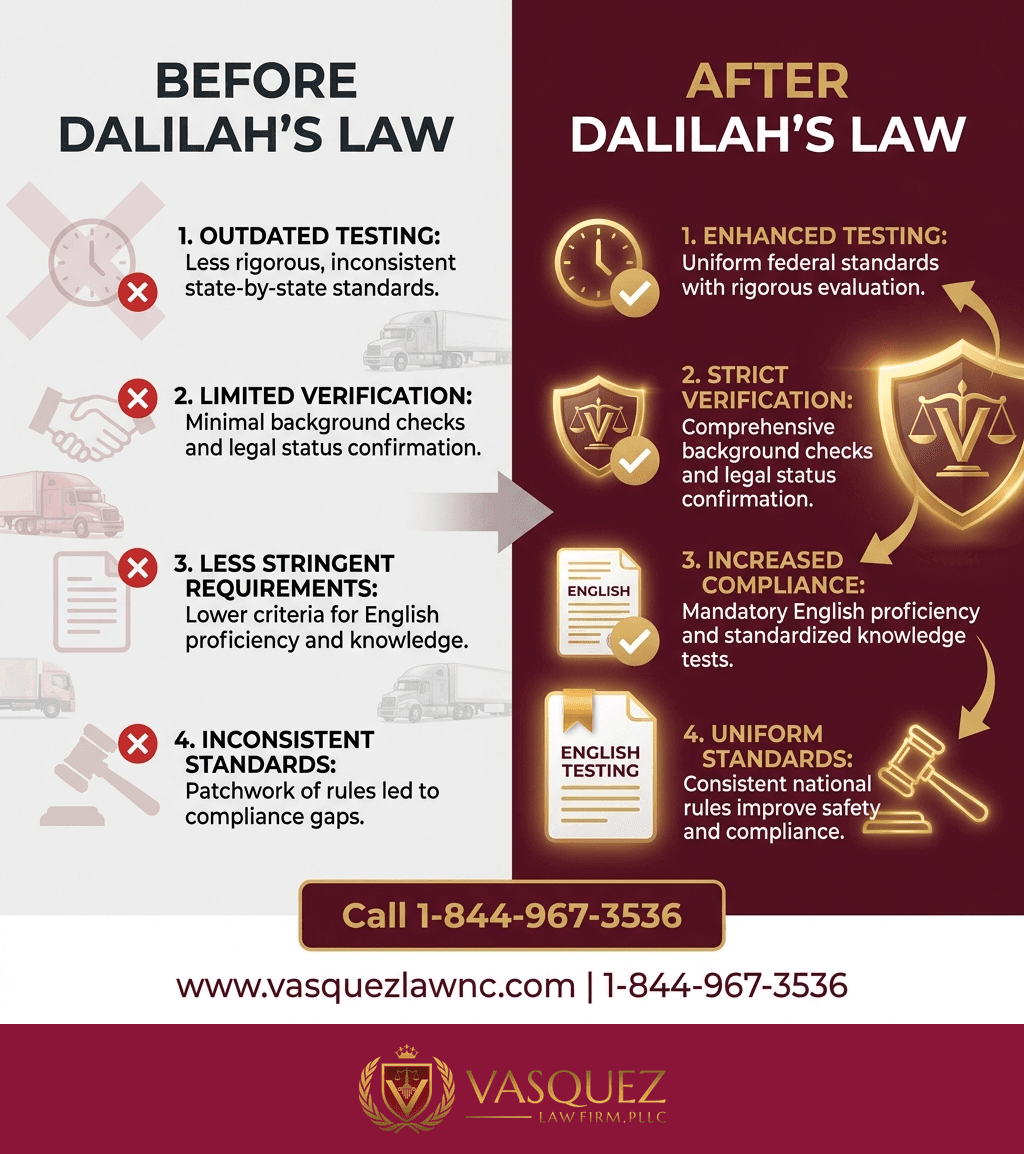
This law requires tighter control over how dispatchers schedule drivers, adds monitoring technology, and imposes stricter hours-of-service regulations. Dalilah's Law also sets clearer standards for record-keeping and reporting, which helps injured victims prove liability more effectively. Understanding the law is essential for truck drivers, trucking companies, and individuals injured in truck accidents.
For current and future cases in Orlando, Florida, and North Carolina, Dalilah's Law establishes a federal baseline over state safety rules. While states may have additional or varying regulations, this law’s provisions apply across all jurisdictions. Our personal injury legal team frequently handles cases where Dalilah's Law evidence plays a crucial role.
Step-by-step: How Dalilah's Law Affects Truck Drivers
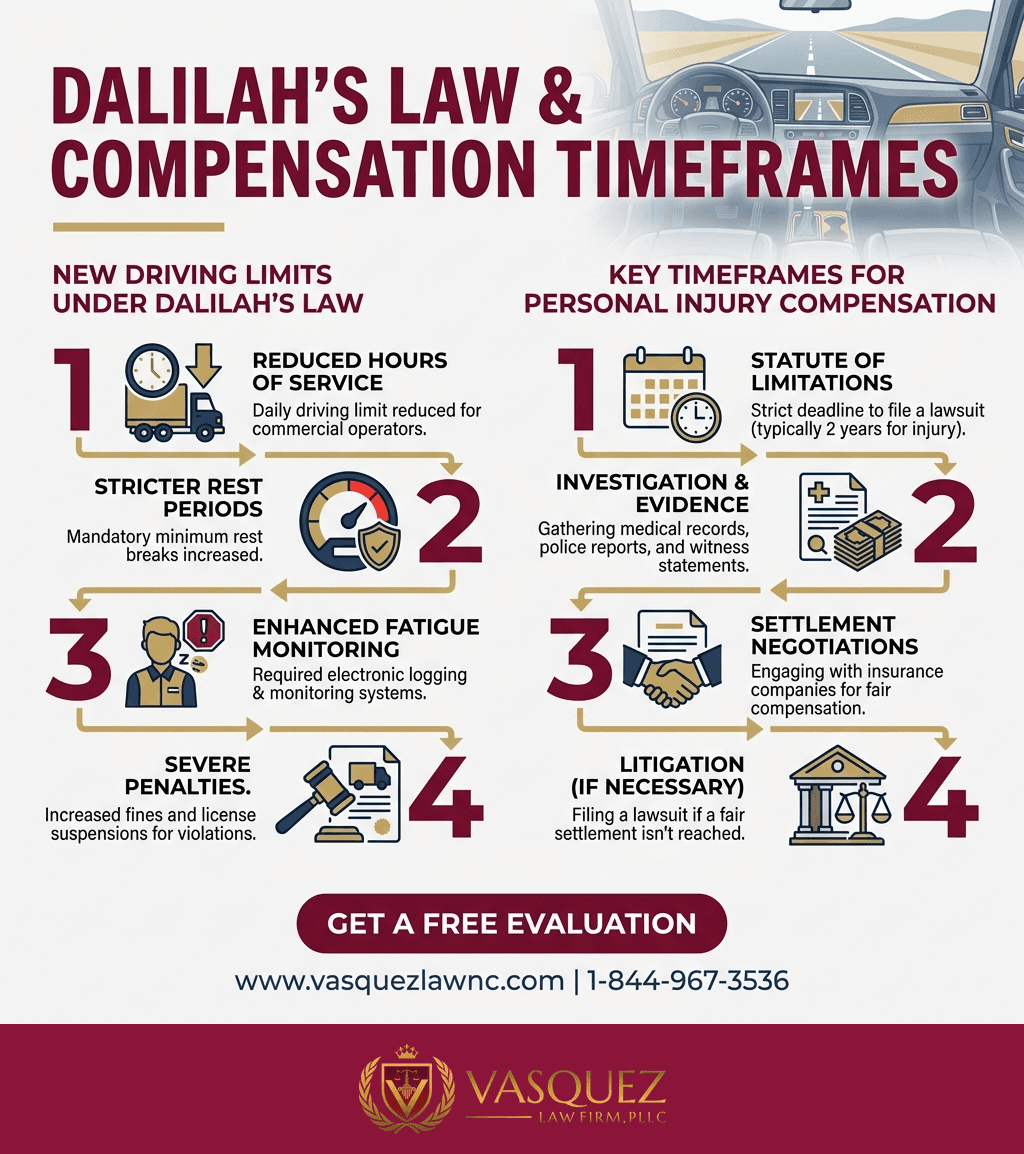
- New Hours-of-Service Limits: Drivers may not exceed 8 driving hours per shift and must take a 30-minute rest break every 4 hours. A minimum of 10 hours off between shifts is now mandatory.
- Dispatch Oversight Requirements: Dispatchers must use updated technology systems to monitor driver scheduling and avoid unsafe driving hours, minimizing fatigue-related risks.
- Monitoring and Reporting: Trucking companies are required to maintain detailed logs and use fatigue detection tools, allowing real-time monitoring of driver alertness.
- Enforcement and Penalties: Failure to comply with these rules can lead to federal penalties and can be used as evidence in personal injury claims.
- Driver Training Updates: Truck drivers receive training on Dalilah Law requirements to ensure understanding and compliance with new safety standards.
Truck drivers in Orlando and across the country have had to adjust how they plan shifts and manage breaks. This shift affects dispatch centers and trucking companies, who must now verify compliance with the new mandates. These changes also impact insurance companies and legal claims, as violations of Dalilah's Law can serve as proof of negligence.
Dispatch Changes After Dalilah's Law
Dispatchers can no longer assign drivers to schedules that violate hours-of-service rules. Technology now assists in preventing over-scheduling, reducing human error and pressure to push drivers beyond safe limits. Companies are regularly audited to ensure compliance. In personal injury claims, dispatcher negligence under this law can increase liability for trucking companies.
Fatigue Monitoring Technology
The law requires real-time fatigue detection systems incorporated in many commercial trucks. This helps alert drivers and dispatchers when rest is needed, aiming to prevent fatigue-induced crashes. In cases of injury, data from these systems often becomes critical evidence.
Attorney Vasquez and our team can help you understand how these new rules affect your potential case and gather necessary evidence.
Documents and Evidence Checklist for Truck Accident Claims
- Dispatch logs and driver schedules compliant with Dalilah's Law
- Electronic Logging Device (ELD) data showing hours driven and rest breaks
- Fatigue monitoring reports and alerts recorded by truck systems
- Accident reports from law enforcement and the trucking company
- Medical records documenting injuries sustained in the accident
- Witness statements and contact information
- Photos and videos from the accident scene
- Inspection reports for vehicle maintenance and safety checks
This evidence is essential to build a strong personal injury claim. Dalilah's Law specifically makes police and company dispatch logs more legally significant because they prove whether the trucking company followed the new safety mandates. Our lawyers in Orlando and North Carolina know what to look for to strengthen your claim.
Timeline: What to Expect After a Truck Accident in 2026
- Immediately (0-48 hours): Seek medical attention. Report the accident to police and notify your insurance company.
- First week: Collect evidence, including truck dispatch logs and ELD records compliant with Dalilah's Law.
- 2-4 weeks: Consult with a personal injury attorney to protect your rights and begin case evaluation.
- 1-3 months: Your attorney may negotiate with insurers or prepare to file a formal claim or lawsuit.
- 6 months to 1 year: Many claims are settled during this period; however, complex cases may take longer if injuries or liability issues require extended litigation.
Knowing this timeline helps injured victims manage expectations and avoid costly delays. Contact Vasquez Law Firm early to ensure timely evidence preservation and legal strategy.
Costs and Fees: Legal Expenses After Truck Crashes
- Most personal injury attorneys, including Vasquez Law Firm, work on a contingency fee basis for truck accident cases—meaning you do not pay unless we recover compensation.
- Costs may include fees for expert witnesses, accident reconstruction, medical records, and filing court documents.
- Insurance companies may offer low initial settlements; an attorney helps evaluate fair value under Dalilah's Law impact.
- Legal fees typically range from 25% to 40% of recovered compensation but vary by case complexity.
- Victims should avoid upfront costs and seek a free case evaluation to understand potential expenses and outcomes.
Common Mistakes Truck Accident Victims Should Avoid
- Not Seeking Immediate Medical Care: Delays can worsen injuries and raise doubts about claim legitimacy. Always get prompt medical attention.
- Failing to Preserve Evidence: Losing dispatch logs or accident scene photos harms your case. Collect and safeguard all documents.
- Giving Recorded Statements to Insurers Without Lawyer: Insurance adjusters may use your words against you. Talk to an attorney first.
- Not Understanding Dalilah’s Law Implications: New regulations affect liability; ignoring them risks weaker claims.
- Delaying Contact with a Lawyer: Evidence fades and witnesses become unavailable. Early consultation is crucial.
- Accepting Low Settlement Offers Too Quickly: Initial offers often undervalue injuries and damages. Get professional advice.
- Ignoring State-Specific Rules: North Carolina and Florida may have unique procedures for truck accident claims.
If you only remember one thing: Contact a qualified attorney with expertise in truck accidents and Dalilah's Law immediately after an injury.
North Carolina and Nationwide Notes
North Carolina Notes
North Carolina follows state laws alongside the federal Dalilah Law for commercial truck accidents. The North Carolina Department of Transportation enforces trucking safety in combination with federal rules. Personal injury claims in NC require understanding of both systems. Our personal injury lawyers in North Carolina are experienced in navigating this dual framework.
Nationwide Concepts (General Only, Rules Vary)
Dalilah's Law is a federal baseline, so commercial truck drivers and companies across the country must comply regardless of state. However, injury claim procedures, insurance policies, and damage caps vary by state. Injured parties should seek legal advice tailored to their location and facts.
When to Call a Lawyer Immediately After a Truck Accident
- If you suffered serious physical injuries or disability
- If the trucking company or driver disputes fault
- If dispatch logs or hours-of-service records are missing or suspicious
- If insurance companies pressure you to settle quickly
- If you were not at fault but face liability claims from others
- If you need help navigating complex Dalilah Law regulations
- If deadlines to file claims or lawsuits are approaching
- If insurance refuses to pay medical bills or lost wages
About Vasquez Law Firm
At Vasquez Law Firm, we combine compassion with aggressive representation. Our motto "Yo Peleo®" (I Fight) reflects our commitment to standing up for your rights.
- Bilingual Support: Se Habla Español - our team is fully bilingual
- Service Areas: Personal injury in North Carolina; immigration nationwide, including Florida
- Experience: Over 30 years helping clients navigate complex legal matters including truck accidents
- Results: Thousands of successful cases protecting injured victims and their families
Attorney Trust and Experience
Attorney Vasquez holds a Juris Doctor degree and is admitted to practice in both the North Carolina State Bar and Florida Bar. With over 15 years of dedicated legal experience, he has built a reputation for providing personalized attention and achieving favorable outcomes for his clients.
Don't wait to get the help you deserve. Call us now for immediate assistance.
Se Habla Español
Frequently Asked Questions
What is Dalilah's Law?
Dalilah's Law is a 2026 federal law focused on trucking safety, named for Dalilah Coleman. It sets new limits on driving hours and enhances dispatch oversight to reduce fatigue-related accidents.
Has Dalilah's Law been passed?
Yes. It was enacted in early 2026 and now governs truck driver scheduling and dispatch operations nationwide to improve safety.
What changes does Dalilah's Law bring for truck drivers?
The law restricts daily driving hours, mandates rest breaks, and requires dispatchers to use technology to monitor driver fatigue to reduce crash risks.
How does Dalilah's Law impact personal injury cases?
It creates new evidence requirements and standards that help injured victims prove negligence related to dispatch violations and driver fatigue.
What to do if injured in a truck accident after Dalilah's Law?
Preserve medical records, dispatch logs, and accident evidence. Contact an attorney experienced with Dalilah's Law for advice promptly.
Does Dalilah's Law apply nationwide?
Yes. It is federal and applies across all states, including North Carolina and Florida, though state laws may vary.
How can I check my trucking company's compliance with Dalilah Law?
Request dispatch records, hours-of-service logs, and fatigue reports. A lawyer can audit these for violations.
How will Dalilah's Law affect truck dispatch operations?
Dispatch centers must use stricter scheduling practices and fatigue monitoring technology to ensure safer driving hours.
Sources and References
- National Highway Traffic Safety Administration
- North Carolina Department of Transportation
- North Carolina Courts
Take the first step toward justice today. Our team is standing by to help.
Start Your Free Evaluation Now
Call us: 1-844-967-3536
Se Habla Español - Estamos aquí para ayudarle.

William Vasquez
Founder & CEO, Vasquez Law Firm, PLLC
William Vasquez is the founder and CEO of Vasquez Law Firm, PLLC, a results-driven firm specializing in immigration, criminal defense, personal injury, and workers' compensation. A U.S. Air Force veteran and recipient of the Joint Service Achievement Medal, William is dedicated to fiercely fighting for his clients' rights.
Related Legal Services
Need legal help? Learn more about personal injury lawyers in North Carolina, or contact us for a free evaluation.
You can also visit statewide personal injury legal services for more information.