Co-Employment Explained: What It Means for You in 2026
Understand co-employment risks and laws in 2026. Learn how co-employment affects your workers compensation claim. Contact Vasquez Law for a free evaluation.
Published on May 1, 2026
Hurt on the job?
Free review of your workers' comp claim.
Free & confidential · Se habla espanol · 24/7
Have questions? Talk to an attorney - free evaluation.
Call 1-844-967-3536Hurt on the Job? Claim What You Are Owed
A review of your workers' comp claim - we handle the fight.
Co-Employment Explained: What It Means for You in 2026
Co-employment occurs when two or more employers share control over an employee’s work, often leading to legal and workers' compensation complications. In Charlotte and beyond, understanding co-employment in 2026 is crucial for employees and employers alike. This article explains co-employment laws, risks, examples, and what to do if you face co-employment issues. Vasquez Law Firm provides trusted guidance and support in workers' compensation claims involving co-employment situations.
Need help with your case? Our experienced attorneys are ready to fight for you. Se Habla Español.
Or call us now: 1-844-967-3536
Quick Answer
Co-employment is when two or more employers share control over an employee, affecting legal responsibilities and workers compensation claims. Understanding co-employment risks, laws, and examples is vital to protect your rights.
- Shared employer control creates unique legal risks
- Workers compensation claims can be complex under co-employment
- Proper documentation and legal advice are essential
- Co-employment training can reduce violations and misunderstandings
Understanding Co-Employment and Its Meaning
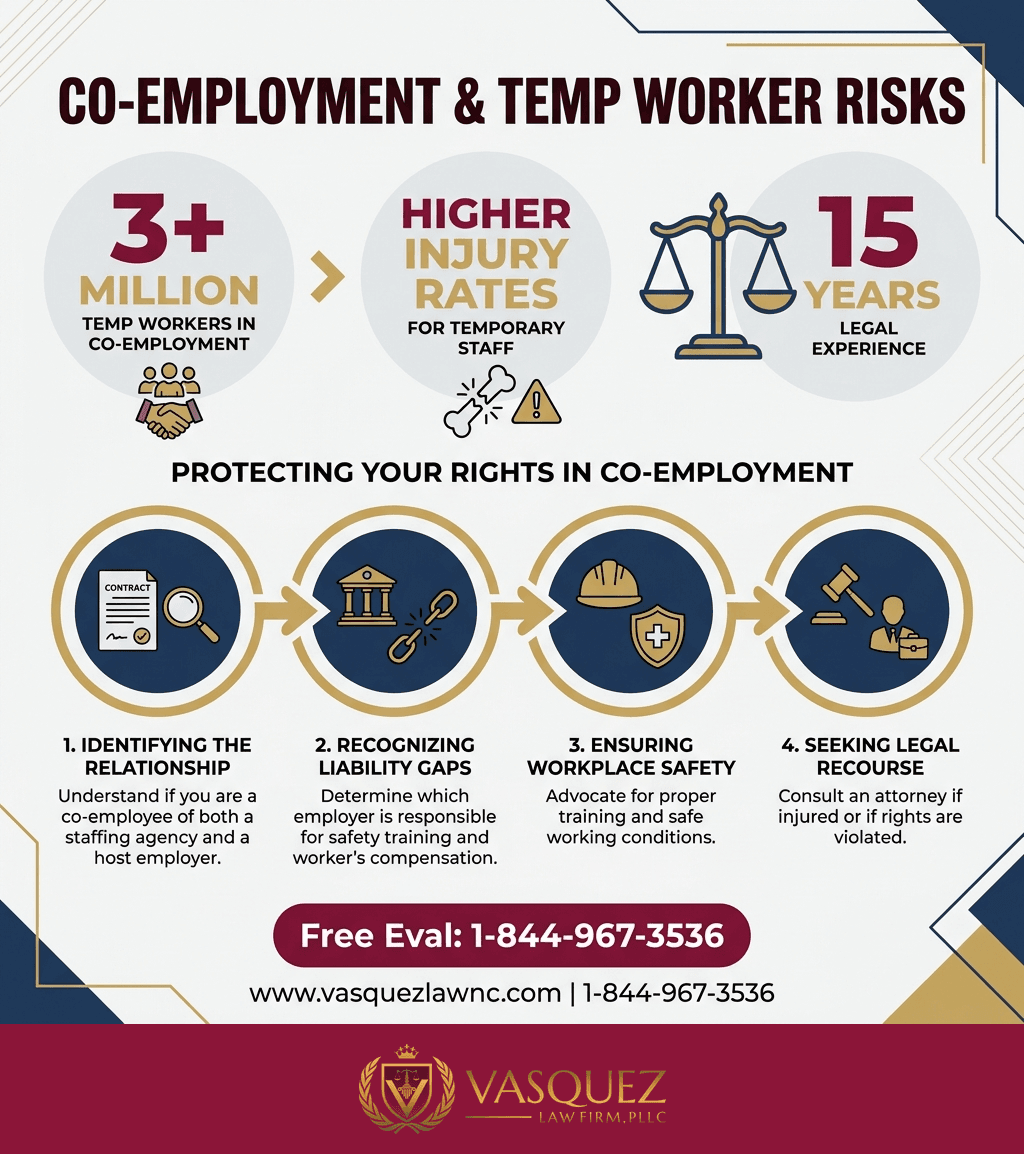
Imagine working for a staffing agency that provides workers to multiple companies in Charlotte. Legally, both the agency and the company you work at may share responsibilities for your employment conditions. This is co-employment: two or more employers having control over the same employee's work.
Co-employment often occurs in temporary staffing, franchises, or joint ventures. The "co-job" concept refers to situations where workers may effectively have overlapping employment roles, but true legal co-employment means shared control and liability.
In North Carolina, co-employment is recognized under labor laws and affects how workplace injuries and workers compensation claims are handled. Employers may share liability for claims, complicating the process and requiring clear agreements.
Understanding co-employment laws helps employees know their rights and enables employers to properly handle training, safety, and claim management.
Co-employment is not only a legal concept but also a practical reality in many industries. For example, in a manufacturing plant using a third-party contractor for specialized labor, both the contractor and the plant management may have overlapping responsibilities regarding employee supervision and safety. This shared responsibility means that both entities must coordinate to ensure compliance with workplace regulations and that employees receive appropriate protections.
Additionally, co-employment can arise in situations involving independent contractors who are misclassified as such. When an employer exercises too much control over a contractor's work, courts may find co-employment, triggering obligations for workers compensation and other benefits. This highlights the importance of clearly defining roles and responsibilities in contracts and real work practices.
Practically, employees caught in co-employment arrangements should be vigilant about who they report to, who pays their wages, and who provides safety equipment. These factors often influence which employer is liable in the event of a workplace injury, making it crucial to understand the nuances of co-employment.
What is Co-Employment? Legal Definition
Legally, co-employment means multiple employers have "control and direction" over the same employee. This can apply to hiring, firing, assignment, and supervision. If documented well, it explains which employer is responsible for what.
The legal standard for co-employment generally hinges on the degree of control each employer exercises. Courts and regulatory bodies examine factors such as who sets the employee’s schedule, who supervises the work, who provides tools or equipment, and who handles payroll and benefits. The more control an employer has over these elements, the more likely they are considered a co-employer.
For instance, if a staffing agency hires an employee but the client company controls daily tasks and discipline, both may be deemed co-employers. This means both have legal responsibilities for the employee’s rights and workplace safety. Proper contracts can clarify roles, but actual practices often determine legal outcomes.
Understanding the legal definition is critical for employers to allocate responsibilities properly and for employees to know who is accountable for workplace matters like injuries or wage disputes. Misunderstanding this can lead to costly litigation or denied benefits.
Common Co-Employment Examples
- Staffing agency workers assigned to client companies
- Franchisees and franchisors sharing employee supervision
- Joint ventures where partners share staff
Beyond the listed examples, co-employment can frequently occur in industries such as construction, where subcontractors and general contractors share control over workers on a job site. For example, a subcontractor may hire workers but the general contractor sets safety protocols and supervises daily activities, creating co-employment relationships.
Another example includes healthcare, where temporary nursing agencies place nurses in hospitals. Both the agency and hospital often have responsibilities for scheduling, training, and workplace safety, making co-employment a common scenario.
These examples underscore the importance of clear contracts and communication between employers to avoid confusion and ensure compliance with labor laws. Employees benefit when employers clarify roles and responsibilities upfront, especially regarding workers compensation and injury claims.
Why Co-Employment Matters in Workers Compensation
Because more than one employer may be liable for workplace injuries, workers compensation claims can be harder to process. Employees need to identify who carries insurance and responsibilities correctly to receive benefits.
When co-employment exists, workers compensation insurers may dispute which employer’s policy applies, delaying benefits or causing denials. Employees may struggle to get timely medical care or wage replacement without clarity on responsible parties. This uncertainty can increase stress and financial hardship for injured workers.
Employers must coordinate their insurance coverage and clarify liabilities to avoid gaps or overlaps that complicate claims. For instance, a staffing agency might carry workers compensation insurance for its employees, but if the client company exerts significant control, it may also bear liability. Proper documentation and communication are essential to prevent disputes.
For injured employees, understanding co-employment's impact on workers compensation means knowing which parties to notify immediately after an injury and seeking legal help if claims are delayed or denied. Legal guidance can help untangle liability issues and secure rightful benefits.
Key Steps to Take If Facing Co-Employment Issues
When co-employment is suspected, workers and employers must take strategic steps to protect their interests. For workers compensation claims, timely action matters.
Step 1: Document Your Work Relationships
Keep records of your work assignments, who supervises you, pay sources, and any contracts or agreements. This evidence clarifies who shares control and liability.
Examples of useful documentation include emails assigning tasks, copies of pay stubs showing who pays you, workplace safety manuals from each employer, and notes on who provides training or equipment. This creates a clear picture of the employment relationship, which is crucial if disputes arise.
For instance, if you are injured while working and both a staffing agency and client company claim they are not responsible, having documented evidence of who directed your work and provided supervision can help establish liability and expedite your workers compensation claim.
Step 2: Educate Yourself on Co-Employment Risks and Laws
Learn about co-employment risks such as liability exposure and claim complications. Understanding your rights and the legal definitions in North Carolina helps you navigate claims.
Knowing the responsibilities of each employer under co-employment can empower you to ask the right questions and make informed decisions. For example, you can inquire who holds the workers compensation insurance or who is responsible for workplace safety training.
Employers should also invest in training for managers and supervisors to recognize co-employment situations and comply with applicable laws. This reduces the risk of violations and promotes a safer workplace.
Step 3: Consult with a Workers Compensation Attorney
Attorney Vasquez and the team at Vasquez Law Firm have experience with co-employment cases. They can review your work situation, explain your rights, and guide you through filing or appealing claims.
An experienced attorney can help identify all responsible parties, gather necessary evidence, and communicate effectively with insurers and employers. They can also represent you in hearings or negotiations to ensure your legal rights are protected.
Early legal consultation is especially important in co-employment cases because of their complexity. Waiting too long may jeopardize your ability to collect benefits or resolve disputes efficiently.
Common Mistakes to Avoid with Co-Employment
- Ignoring proper documentation: Without clear records, proving liability becomes difficult. Keep all contracts and communication.
- Assuming co-employment is illegal: It’s legal but requires compliance. Misunderstanding this can affect claim outcomes.
- Not seeking legal advice: Failing to consult an attorney delays protecting your rights.
- Overlooking workers compensation training: Employers often neglect training on co-employment duties, increasing risks.
- Waiting too long to report injuries: Timely reporting to all possible employers is critical for claims.
- Failing to check employer insurance coverage: Confirm which employer provides workers compensation insurance.
If you only remember one thing: Document, educate, and get legal help promptly to protect your rights under co-employment.
Another common mistake is assuming that the employer who pays your wages is automatically responsible for your workers compensation claim. In co-employment scenarios, liability can be shared or disputed between employers, so knowing all employers involved and their roles is essential.
Similarly, employers sometimes fail to update contracts or clarify roles when co-employment relationships change. This can result in gaps in insurance coverage or miscommunication about responsibilities, putting both employees and employers at risk.
For employees, not reporting an injury to all potential employers involved can lead to claim denials or delays. It is best practice to notify every employer who exercises control over your work, ensuring your claim is properly processed.
Timeline and What to Expect for Co-Employment Cases
- Week 1-2: Gather work records and report injury to all employers involved.
- Week 3-4: Consult an attorney to review your work arrangement and start claim filings.
- Month 2-3: Workers compensation insurer investigates shared liability.
- Month 4-6: Possible disputes or hearings if co-employment responsibilities are unclear.
- Month 6+: Resolution or appeals depending on claim outcome.
Following a clear timeline helps avoid delays and denials in claims involving co-employment.
It is important to understand that co-employment cases may take longer than standard claims due to the involvement of multiple employers and insurers. Therefore, patience and persistence are necessary. Keeping open communication with your legal counsel and employers can facilitate smoother progress.
During the investigation phase, expect insurers to request detailed documentation from all parties. Your attorney can help you prepare and submit these materials promptly. If disputes arise regarding liability, hearings before the North Carolina Industrial Commission or equivalent bodies may be required to resolve them.
After resolution, if you disagree with the outcome, appeals processes are available but also follow strict deadlines. Timely legal action ensures your rights remain protected throughout.
Costs and Fees: What Impacts the Price of Representation
- Complexity of co-employment relationships can increase legal fees.
- Multiple parties involved may require more negotiation or litigation.
- Insurance disputes often call for expert consultations.
- Vasquez Law Firm offers free case evaluations and works to minimize your upfront costs.
The cost of legal representation in co-employment cases depends largely on the complexity of the situation, such as the number of employers involved, the clarity of contracts, and the extent of disputes. Cases involving multiple insurers or contested liability often require additional time and resources.
Expert witnesses or consultants may be necessary to clarify employment control or insurance coverage, which can increase costs. However, these expenses are often vital to achieving a favorable outcome.
At Vasquez Law Firm, we strive to provide transparent pricing and free initial consultations, ensuring clients understand potential costs upfront. We also work on contingency fee arrangements in many cases, meaning you pay only if we recover benefits for you.
NC and Nationwide Notes
North Carolina Notes
The North Carolina Industrial Commission regulates workers compensation claims. Co-employment cases require clear evidence of employer control and proper insurance coverage according to N.C. Gen. Stat. § 97-2.
North Carolina law recognizes co-employment in cases where multiple employers share control over the injured worker. The Industrial Commission carefully examines the degree of supervision, payment, and assignment control to determine liability.
Employers in North Carolina must ensure they carry appropriate workers compensation insurance if they exercise control over employees, even in co-employment setups. Failure to provide coverage can lead to penalties and increased liability.
Nationwide Concepts (General Only, Rules Vary)
Federal OSHA guidelines influence workplace safety obligations under co-employment. Workers compensation laws vary widely by state, so knowing local rules matters. The U.S. Department of Labor offers resources for understanding co-employment and related protections.
Across the United States, co-employment laws differ in scope and application. Some states have detailed regulations addressing co-employment in staffing and joint venture contexts, while others rely on case law and administrative rulings.
Employers and employees engaged in multi-state work arrangements should seek legal advice tailored to each jurisdiction. Federal OSHA regulations provide a baseline for workplace safety but do not govern workers compensation, which is state-regulated.
When to Call a Lawyer Now
- If your workers compensation claim was denied due to co-employment confusion
- If you’re unsure who is responsible for your workers compensation insurance
- If you suffer a workplace injury while working under a co-employment arrangement
- If you face retaliation or termination after reporting injury
- If employers fail to provide proper worker safety training
- If you receive conflicting information from multiple employers
- If you have questions about your rights under co-employment
- If you need help negotiating settlements involving multiple employers
Contacting an attorney early can prevent costly mistakes and protect your rights. Co-employment cases often involve complicated legal questions best addressed by professionals experienced in workers compensation law.
Delays in seeking legal help may result in missed deadlines or lost evidence, weakening your claim. A skilled lawyer can help gather necessary documentation, communicate with insurers, and advocate on your behalf throughout the claims process and any appeals.
If you feel overwhelmed by conflicting information from employers or insurers, an attorney can clarify your situation and ensure you are treated fairly under the law.
About Vasquez Law Firm
At Vasquez Law Firm, we combine compassion with aggressive representation. Our motto "Yo Peleo®" reflects our commitment to standing up for your rights and fighting for what’s fair.
- Bilingual Support: Se Habla Español - our team is fully bilingual
- Service Areas: Workers compensation in North Carolina; immigration nationwide, including Florida
- Experience: Over 30 years helping clients navigate complex legal matters in workers compensation and co-employment
- Results: Thousands of successful cases across multiple practice areas
Attorney Trust and Experience
Attorney Vasquez holds a Juris Doctor degree and is admitted to practice in both the North Carolina State Bar and Florida Bar. With over 15 years of dedicated legal experience, he has built a reputation for providing personalized attention and skilled guidance in co-employment and workers compensation cases.
His approach emphasizes thorough case analysis, clear communication, and aggressive advocacy to secure the best possible outcomes for clients. Whether navigating complex multi-employer liability or negotiating settlements, Attorney Vasquez prioritizes client interests and legal compliance.
Clients appreciate his bilingual services and commitment to making the legal process accessible and understandable, particularly in co-employment scenarios that can be confusing and stressful.
Don't wait to get the help you deserve. Call us now for immediate assistance.
Se Habla Español
Frequently Asked Questions
What is co-employment?
Co-employment refers to a situation where two or more employers both exert control over an employee’s work conditions. This shared control can influence responsibility for wages, workplace safety, and liability in workers compensation claims. It often arises in staffing agency assignments, franchises, or joint ventures where multiple entities supervise or manage the same employee.
Is co-employment illegal?
No. Co-employment itself is legal, but it requires that employers abide by applicable labor and safety laws. Failure to comply with co-employment regulations can lead to violations, penalties, or lawsuits. Proper documentation and clear agreements help employers manage their shared responsibilities lawfully.
Can co-employment cause disputes in workers compensation claims?
Yes, co-employment situations often complicate who is liable for workplace injuries. This can delay claims or create conflicts between insurers and employers, making legal guidance essential to resolve responsibilities promptly and ensure injured employees receive benefits without undue delay.
What are common co-employment violations?
Violations include employers not providing proper workers compensation coverage, inadequate safety training, and failure to properly document the employment relationship and responsibilities. These lapses can expose employers to fines and workers to risks of denied benefits.
How can workers protect themselves in co-employment situations?
Employees should keep detailed records of their work, understand their rights, report injuries promptly, and consult experienced attorneys familiar with co-employment laws and workers compensation. Being proactive helps ensure claims are handled correctly and benefits received.
What is co-employment training?
Co-employment training educates employers and supervisors about their shared legal responsibilities, helping reduce risks and improve compliance with workplace safety and compensation laws. It promotes awareness of the complexities of co-employment and fosters proper management practices.
Are there examples of co-employment lawsuits?
Lawsuits often arise when it is unclear which employer is responsible for injury benefits or when benefits are denied. These cases stress the importance of clear agreements and legal compliance to prevent disputes and protect workers’ rights.
Does having two full-time jobs count as co-employment?
Not necessarily. Having two jobs may be a 'co-job' arrangement but does not mean employers share control as in co-employment unless they exert joint control over work conditions. Co-employment requires shared control and liability, not just multiple employment relationships.
Sources and References
- Occupational Safety and Health Administration
- U.S. Department of Labor
- North Carolina Industrial Commission
Take the first step toward justice today. Our team is standing by to help.
Start Your Free Evaluation Now
Call us: 1-844-967-3536
Se Habla Español - Estamos aquí para ayudarle.
If you need legal assistance, learn more about workers comp lawyers in North Carolina, or call us at 1-844-967-3536 for a free evaluation.

William Vasquez
Founder & CEO, Vasquez Law Firm, PLLC
William Vasquez is the founder and CEO of Vasquez Law Firm, PLLC, a results-driven firm specializing in immigration, criminal defense, personal injury, and workers' compensation. A U.S. Air Force veteran and recipient of the Joint Service Achievement Medal, William is dedicated to fiercely fighting for his clients' rights.
Related Legal Services
Need legal help? Learn more about workers comp lawyers in North Carolina, or contact us for a free evaluation.
You can also visit statewide workers comp services for more information.