What Is OPT and How Does It Work in Smithfield NC in 2026?
Learn what OPT means, how OPT works for F1 students in NC and FL, and OPT requirements in 2026. Call Vasquez Law for expert immigration help.
Published on March 23, 2026
Talk to an immigration attorney
Free call. A clear plan for your case.
Free & confidential · Se habla espanol · 24/7
Have questions? Talk to an attorney - free evaluation.
Call 1-844-967-3536Worried how the latest immigration news affects you?
Schedule a confidential case review with an immigration attorney - know exactly where you stand.
USCIS Case Status
Check your USCIS case status
Enter your receipt number and get the official status. Free, no registration.
What Is OPT and How Does It Work in Smithfield NC in 2026?
Optional Practical Training (OPT) allows F-1 international students in Smithfield, NC to gain practical work experience in the U.S. after completing their degrees. As of 2026, OPT remains a critical pathway for students on F1 visas to work legally while gaining professional skills related to their studies. This article breaks down OPT meaning, requirements, STEM OPT options, and timelines to help you understand this valuable immigration program.
Need help with your case? Our experienced attorneys are ready to fight for you. Se Habla Español.
Schedule Your Free Case Evaluation
Or call us now: 1-844-967-3536
Quick Answer
Optional Practical Training (OPT) grants F-1 students temporary work authorization to gain experience related to their studies. It usually lasts 12 months, with an optional 24-month STEM extension. Students must apply to USCIS and maintain status during employment.
- OPT applies to F-1 visa holders completing academic programs
- Employment must be related to field of study
- Standard OPT period is 12 months
- STEM OPT extends work authorization by 24 months
- USCIS issues an Employment Authorization Document (EAD)
Understanding OPT and Its Meaning
Imagine you have just completed your degree at a university near Smithfield, NC, and want to gain hands-on experience that complements your education without leaving the U.S. This opportunity is called Optional Practical Training, or OPT.
OPT is a type of work authorization for students on an F-1 visa. It lets you work in your field of study for a certain period after or during your academic program. The idea is to allow international students to apply what they learned in real-world jobs, enhancing career prospects.
The United States Citizenship and Immigration Services (USCIS) recognizes OPT as a key program that supports international students’ temporary employment. The OPT visa is not actually a visa itself but a benefit granted to those holding an F-1 visa.
OPT Full Form and Meaning
OPT stands for Optional Practical Training. This means the training (or work) is optional for students but practical as it relates directly to their course of study. OPT helps bridge the gap between academic theory and workplace practice, allowing students to legally work in the U.S. for professional development.
OPT USCIS Role
USCIS manages the OPT program by reviewing and approving applications submitted on Form I-765, Application for Employment Authorization. Only after USCIS approval and receiving the Employment Authorization Document (EAD) can a student legally begin OPT employment.
OPT Immigration Context
OPT is part of the larger F-1 student visa category regulated under federal immigration law. This program balances the educational goals of students with U.S. immigration control policies. For students in Smithfield or anywhere in NC and FL, understanding OPT’s role in immigration is essential for compliance.
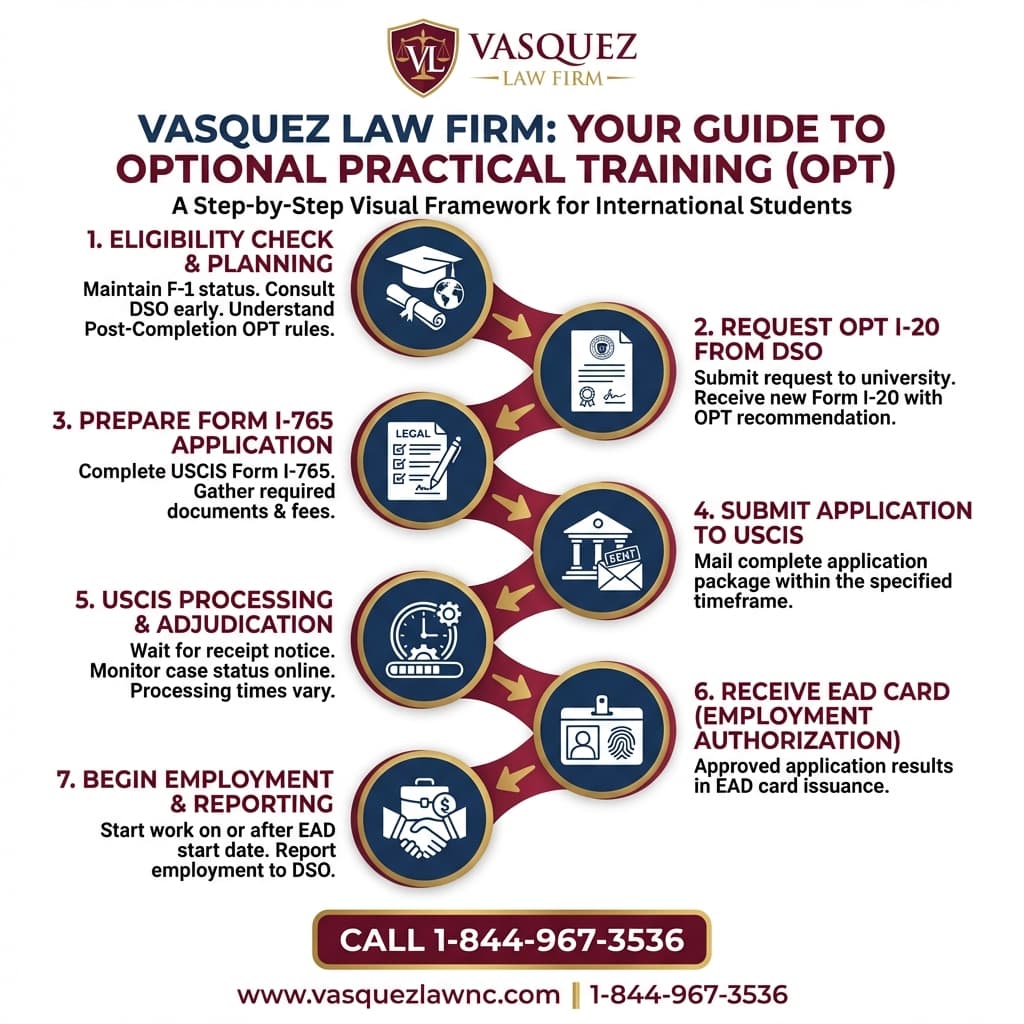
Step-by-Step Process for OPT Application
Applying for OPT involves several steps that must be completed carefully to avoid denial or delays. Consider Sarah, a recent Smithfield graduate planning to work under OPT.
- Meet Eligibility Requirements: You must be an F-1 student enrolled in full-time studies for at least one academic year.
- Speak with Designated School Official (DSO): Your school’s DSO will recommend OPT in SEVIS and provide a new Form I-20 indicating OPT authorization.
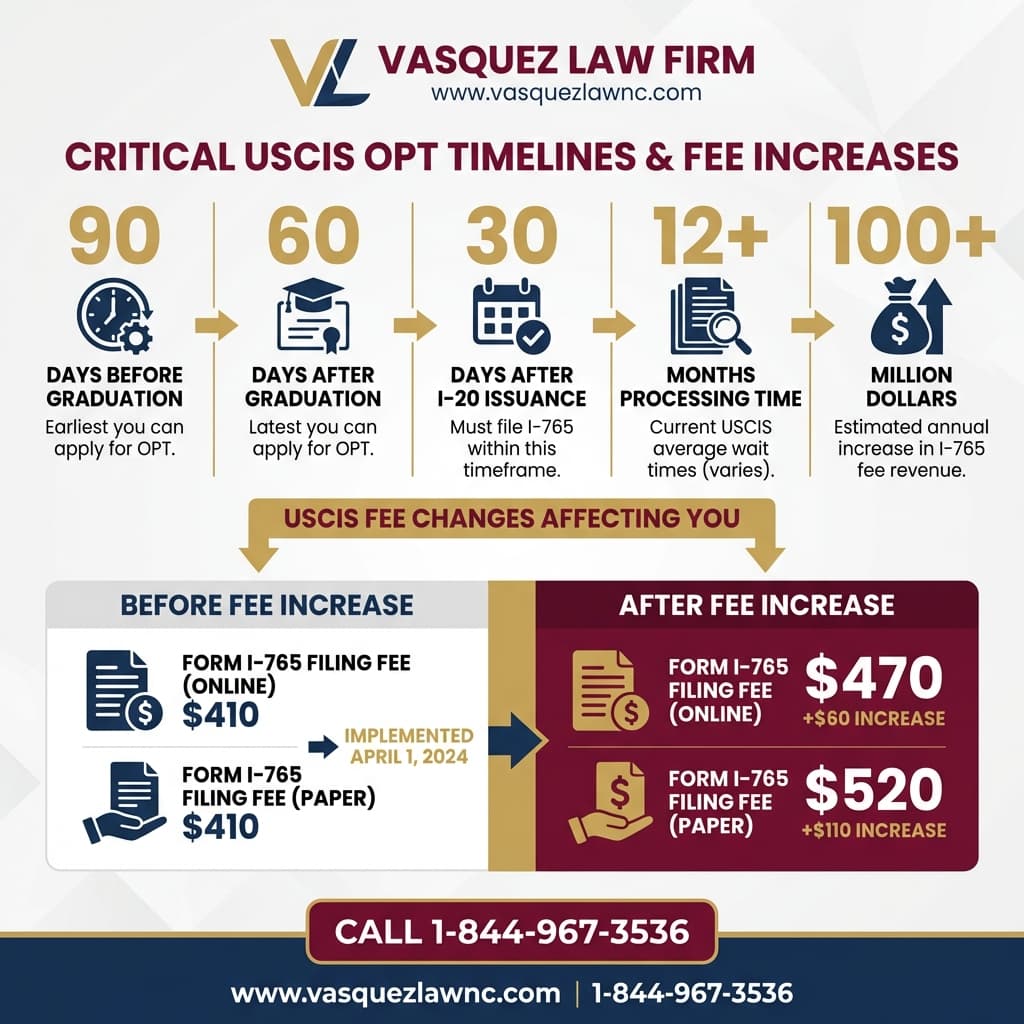
- File Form I-765 with USCIS: Submit your application up to 90 days before completing your degree but no later than 60 days after graduation.
- Receive Employment Authorization Document (EAD): Wait for USCIS to process your application. Processing times vary but generally last 3-5 months.
- Begin OPT Employment: Once you have your EAD, you can start working within the authorized OPT period.
- Report Employment Details: Keep your DSO informed of your employer, job type, and address changes as required.
Required Documents
- Completed Form I-765
- Copies of your current and previous Form I-20s with OPT recommendation
- Passport photo
- Copy of your passport and F-1 visa
- Copy of I-94 Arrival/Departure record
- Filing fee payment receipt
Common OPT Mistakes to Avoid
Several common mistakes could jeopardize your OPT chance. Here are key errors and how to prevent them:
- Missing Deadlines: Applying after the allowable OPT filing window can result in denial. Track your dates carefully.
- Incorrect Form Filing: Filing the wrong version of Form I-765 or incomplete documents can cause delays.
- Working Without Authorization: Starting a job before receiving your EAD violates your status and could cause serious problems.
- Unrelated Employment: Working in positions unrelated to your major may lead to USCIS revoking your OPT.
- Failing to Report Changes: Not keeping your DSO updated with employment or residential changes breaches OPT rules.
- Exceeding Unemployment Limits: OPT has a maximum of 90 unemployment days; exceeding this can terminate your status.
- Neglecting STEM OPT Requirements: For STEM extensions, employers must be enrolled in E-Verify, if not, applications may be rejected.
If you only remember one thing: Always follow USCIS procedures carefully and consult a legal professional if uncertain.
OPT Timeline and What to Expect
Timeline management is vital. John from Smithfield applied for OPT after graduation — here’s what he experienced:
- 90 Days Before Graduation: John coordinated with his DSO to request OPT recommendation.
- Up to 60 Days After Graduation: He filed Form I-765 within this window to keep eligibility.
- 3-5 Months Wait: USCIS processed his application during this period; he monitored case status online.
- OPT Start Date: John’s employment authorization began as soon as he received his EAD, matching his planned job start.
- End of OPT Period: After 12 months, he prepared to apply for STEM extension or change of status.
USCIS processing times fluctuate, so applying early is advised to avoid gaps in authorization.
Costs and Fees Associated with OPT
Filing OPT requires paying fees that can impact your budget. In 2026, the USCIS Form I-765 application fee is $410. Additional costs include:
- Biometrics Fee: Some applicants may be required to pay this optional $85 fee.
- Legal Fees: Attorney assistance for filing or appeals adds cost but can improve success chances.
- Other Expenses: Mailing, document preparation, and travel for biometrics appointments may add up.
Vasquez Law Firm offers experienced support to navigate these costs and guide you through filing your OPT application properly.
OPT Rules in North Carolina and Florida
OPT is a federal program under USCIS authority; however, practical details vary by location.
North Carolina Notes
Students in Smithfield and wider North Carolina communicate via their university DSO for OPT endorsements. Local employers may have experience hiring OPT workers, especially in research and STEM fields. It’s important to maintain active communication with your school and legal advisor.
Florida Notes
In Florida, OPT is administered the same federally but regional USCIS offices may have different processing times. STEM OPT extensions are popular given Florida’s technology sectors. Again, DSO coordination and employment reporting are critical.
Nationwide Concepts (General Only)
OPT rules are federal under 8 CFR 214.2(f) and subject to USCIS guidelines. All applications follow the same regulations, with no state-level OPT issuance. Check USCIS and Department of State for official updates.
When to Call a Lawyer About Your OPT
- If USCIS issues a Request for Evidence (RFE) on your OPT application
- If your OPT application is denied or delayed unusually
- If you are uncertain about employer eligibility or job relationship to studies
- If you face issues reporting employment or changes to your DSO
- If you want help applying for STEM OPT extension correctly
- If you plan to change status after OPT expires
- If you suffer immigration legal challenges during OPT period
- If you need assistance understanding USCIS notices or legal terms
About Vasquez Law Firm
At Vasquez Law Firm, we combine compassion with aggressive representation. Our motto "Yo Peleo" (I Fight) reflects our commitment to standing up for your rights.
- Bilingual Support: Se Habla Español - our team is fully bilingual
- Service Areas: North Carolina, Florida, and nationwide immigration services
- Experience: Over 15 years helping clients navigate complex legal matters
- Results: Thousands of successful cases across multiple practice areas
Attorney Trust and Experience
Attorney Vasquez holds a Juris Doctor degree and is admitted to practice in the North Carolina State Bar. With over 15 years of dedicated legal experience, he has built a reputation for providing personalized attention and helping clients achieve the best possible outcome.
Don't wait to get the help you deserve. Call us now for immediate assistance.
Se Habla Español
Frequently Asked Questions
What does OPT mean?
OPT means Optional Practical Training. It is a program that allows F-1 international students to legally work in the U.S. for up to 12 months to gain experience related to their academic field. This practical application helps students build career skills while maintaining immigration status.
Who is eligible for OPT?
F-1 students who have been enrolled full-time for one academic year and are in good standing can apply. Both pre-completion and post-completion OPT are available depending on your study status and career plans. You must maintain lawful F-1 status during application and employment.
How long is the OPT period?
The basic OPT period is 12 months of employment authorization. Students in STEM fields may apply for an additional 24-month extension, allowing up to 36 months total work authorization under OPT programs.
What are the OPT requirements?
Applicants must submit Form I-765, receive an Employment Authorization Document, have employment related to their degree, and keep their school's Designated School Official updated with employment details. Timely filing is essential to avoid losing eligibility.
Can OPT be used after graduation?
Yes. Post-completion OPT is commonly used after graduating. Students can apply up to 90 days in advance and must begin work within 60 days after graduation. This time allows students to gain practical experience while staying in status.
What is STEM OPT?
STEM OPT is an additional 24 months of work authorization for students who earn degrees in science, technology, engineering, or math. Employers must participate in the E-Verify system and comply with reporting to maintain eligibility.
What happens if my OPT application is denied?
If USCIS denies your application, you lose the right to work under OPT. You must stop working and possibly leave the country unless you have another valid immigration status. Legal advice should be sought immediately to explore other options.
How do I maintain my status during OPT?
Maintain status by working only in jobs related to your field, reporting employment and address changes to your DSO, and not exceeding the allowed unemployment period of 90 days. Staying compliant avoids termination of your immigration status.
Sources and References
- USCIS official OPT guidelines
- U.S. Department of State student visa information
- Executive Office for Immigration Review
Dealing with this near Smithfield? Our Smithfield immigration lawyers can review your situation.
Take the first step toward justice today. Our team is standing by to help.
Start Your Free Case Evaluation Now
Call us: 1-844-967-3536
Se Habla Español - Estamos aquí para ayudarle.

William Vasquez
Founder & CEO, Vasquez Law Firm, PLLC
William Vasquez is the founder and CEO of Vasquez Law Firm, PLLC, a results-driven firm specializing in immigration, criminal defense, personal injury, and workers' compensation. A U.S. Air Force veteran and recipient of the Joint Service Achievement Medal, William is dedicated to fiercely fighting for his clients' rights.
Related Legal Services
Need legal help? Learn more about immigration case consultation, or contact us for a free evaluation.
You can also visit immigration attorneys across North Carolina for more information.